
Question 293 marksEasy
State three differences between the heat capacity and specific heat capacity.
Confirming your payment
Sign up now and get 250 free tokens.
Calorimetry · Question 29 of 108
State three differences between the heat capacity and specific heat capacity.
Solution:
Concept: Heat capacity belongs to a whole body; specific heat capacity belongs to unit mass of a substance. They are linked by C′ = m × c.
Step 1 — Compare them point by point.
The table sets the two side by side; any three rows answer the question.
| Heat capacity | Specific heat capacity |
|---|---|
| It is the heat needed to raise the temperature of the whole body by 1 K. | It is the heat needed to raise the temperature of unit mass of the substance by 1 K. |
| It depends on the mass of the body (and on its material). | It does not depend on the mass; it depends only on the material. |
| Its S.I. unit is J K⁻¹. | Its S.I. unit is J kg⁻¹ K⁻¹. |
| It is a property of a particular body. | It is a characteristic property of a substance. |
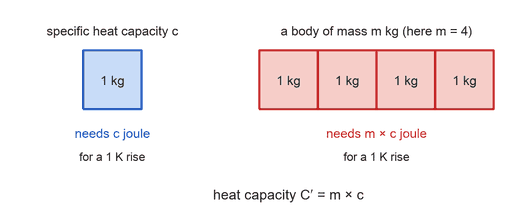
Step 2 — See the difference in an example.
2 kg of water has twice the heat capacity of 1 kg of water (8400 J K⁻¹ against 4200 J K⁻¹), but both have the same specific heat capacity, 4200 J kg⁻¹ K⁻¹.
Therefore, heat capacity is for the whole body, depends on its mass and is in J K⁻¹; specific heat capacity is for unit mass, depends only on the material and is in J kg⁻¹ K⁻¹.