
Opening your dashboard
Class 10 Physics Chapter 11 Calorimetry: Competency-Based Questions (CBQ)
40 questions on Chapter 11, each worked through on its own page with the AI tutor. Class 10 Physics, ICSE 2026-27.
40 questions
1–5 marks · Mixed difficulty
- 11 mark
Question 1
Competency: Evaluation
Data: mass = 10 g, quantity of heat supplied = 120 J, rise in temperature = 10 °C
STATEMENT A: The heat capacity of the substance is 12 J/g.
STATEMENT B: The specific heat capacity of the substance is 1.2 J/gK.
- 21 mark
Question 2
Competency: Evaluation & Application
Three metals, A, B and C, are supplied with the same quantity of heat. Their masses are in the ratio 2:3:4. If they show the same rise in the temperature, then the ratio of their thermal capacities will be:
- 31 mark
Question 3
Competency: Recall & Application
Two substances, A and B, have the same mass. Substance A has a higher specific heat capacity than substance B. What consequences would you expect when these substances are subjected to the same amount of heat energy?
- 41 mark
Question 4
Competency: Understanding
Rivers which originate from the glaciers at high altitudes have a supply of water throughout the year. This is because ice in high mountains does not melt all at once. This is due to:
- 51 mark
Question 5
Competency: Analysis
During the change of state of a substance from solid to liquid, heat is absorbed by a body, but its temperature does not rise. Which of the following statements explains the phenomenon?
- 62 marks
Question 6
Competency: Understanding
The two metals A and B have their specific heat capacities in the ratio 2:3. If they are supplied the same amount of heat, then
(a) which metal piece will show a greater rise in temperature if their masses are the same?
(b) calculate the ratio in which their temperatures rise, if the mass ratio of metal A and metal B is 3:5.
- 72 marks
Question 7
Competency: Evaluation & Understanding
(a) Convert to SI unit: 1 J/g °F
(b) Why does 1 g of water at 0 °C have 336 J more heat energy than 1 g of ice at 0 °C?
- 82 marks
Question 8
Competency: Application
On a hot summer day, we often put ice cubes to cool the water. Why?
- 92 marks
Question 9
Competency: Application
The difference between the temperature of water at the bottom and the top of a waterfall is 0.2 °C. Calculate the height of the waterfall. [ = 10 N kg, Specific heat capacity of water = 4200 J kg °C]
- 103 marks
Question 10
Competency: Analysis & Application
In the physics laboratory, various blocks of materials labelled A and B, each with masses ranging from 10 grams to 50 grams, are utilised to determine their respective heat capacities. Subsequently, a graph is plotted to depict the relationship between the heat capacity and the mass of the materials, as shown.
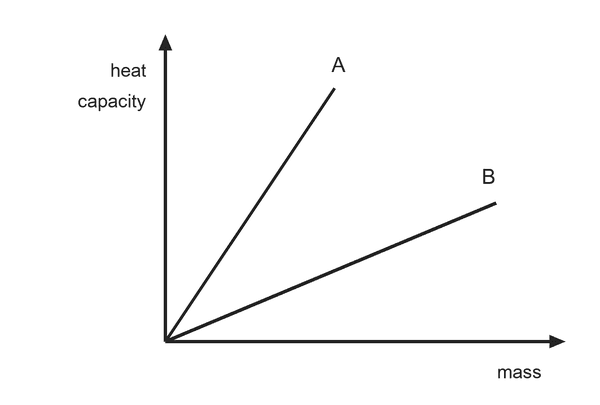
(a) Plot a graph illustrating the relationship between the mass and specific heat capacity of materials A and B.
(b) Which material is a relatively better conductor?
- 114 marks
Question 11
Competency: Understanding & Analysis
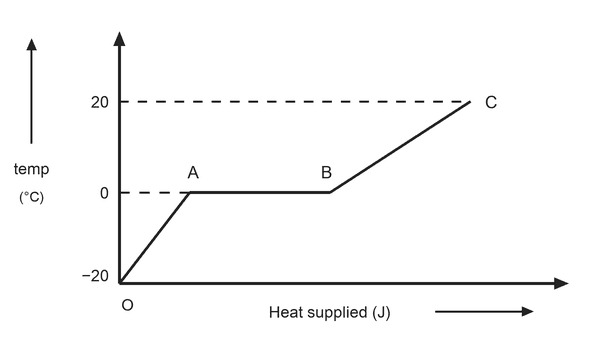
In the graph, a given quantity of ice is converted to water.
(a) What does the portion AB represent?
(b) Why is the portion AB parallel to the time axis?
(c) Why is the slope OA steeper than the slope BC?
- 121 mark
Question 12
Competency: Understanding & Application
Assertion (A): A rubber bag filled with water at 60 °C stays warm enough for fomentation for a much longer time than a cloth bag filled with an equal mass of sand at 60 °C.
Reason (R): For the same fall in temperature, water gives out less heat energy than an equal mass of sand.
- 131 mark
Question 13
Competency: Application & Analysis
Assertion (A): In an open vessel, potatoes kept in boiling water get cooked in less time at a hill station than at a place at sea level.
Reason (R): The boiling point of water falls when the pressure on its surface decreases.
- 144 marks
Question 14
Competency: Analysis & Evaluation
Case study: Nikhil wants to find the specific heat capacity of the metal of a paperweight. He keeps the paperweight in boiling water for some minutes, lifts it out by a thread and lowers it into a copper calorimeter containing water. He stirs the water and notes the highest temperature reached. His readings are given below.
Quantity Reading Mass of the copper calorimeter with stirrer 50 g Mass of water in the calorimeter 100 g Initial temperature of the calorimeter and water 20 °C Mass of the paperweight 220 g Temperature of the boiling water 100 °C Final temperature of the mixture 36 °C Specific heat capacity of copper = 0.4 J g K, specific heat capacity of water = 4.2 J g K.
(a) Calculate the heat energy gained by the calorimeter and the water together.
(b) Assuming that no heat is lost to the surroundings, calculate the specific heat capacity of the metal.
(c) Nikhil's teacher points out that the paperweight took about half a minute to reach the calorimeter, and that the calorimeter stood on the table without any insulating jacket or lid. Nikhil says, "Then the true specific heat capacity of the metal must be smaller than my value." Judge his statement, giving reasons.
- 154 marks
Question 15
Competency: Analysis & Evaluation
Case study: In a candle-making unit, 60 g of molten wax at 80 °C is poured into a mould and left to cool. A temperature sensor placed in the wax gives the graph PQRS shown below. Assume that the wax gives out heat to the surroundings at a constant rate throughout. Specific heat capacity of liquid wax = 2.5 J g K.
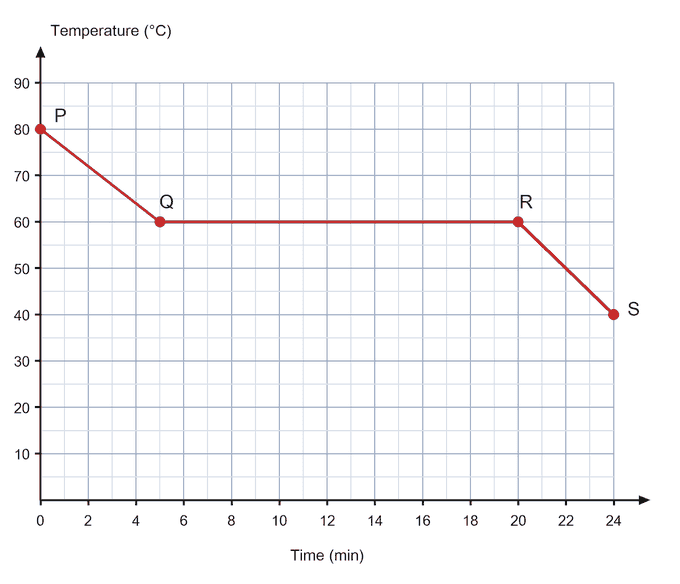
(a) State the freezing point of the wax, and the state in which the wax exists 12 minutes after it was poured.
(b) Use the part PQ to find the rate at which the wax gives out heat, in joule per minute. Then find the specific latent heat of fusion of the wax.
(c) A worker says, "RS is steeper than PQ, so solid wax has a higher specific heat capacity than liquid wax." Find the specific heat capacity of solid wax from the graph and judge his statement.
- 164 marks
Question 16
Competency: Application & Evaluation
Case study: At a tea stall, water for tea is heated by bubbling steam through it instead of keeping it over a flame. Steam at 100 °C from a boiler is passed into 280 g of water at 20 °C in an insulated cup until the temperature of the water becomes 80 °C. Neglect the heat taken by the cup and the heat lost to the surroundings.
Specific heat capacity of water = 4.2 J g K, specific latent heat of vaporisation of steam = 2268 J g.
(a) Calculate the heat energy gained by the 280 g of water.
(b) Calculate the mass of steam that condenses in the cup.
(c) The helper at the stall says, "Pouring the same mass of boiling water at 100 °C into the cup would have heated the water just as well." Find the final temperature that this would give and judge his statement.
- 174 marks
Question 17
Competency: Application & Creation
A blacksmith heats a small iron ball in his furnace. Meena wants to estimate the temperature of the furnace, but her laboratory thermometer reads only up to 110 °C. She has the hot iron ball (which can be held with tongs), a copper calorimeter with a stirrer and a lid, an insulating jacket, a balance, water and the thermometer. She knows the specific heat capacities of iron, copper and water.
(a) On which principle can her measurement be based? Explain why the thermometer can be used even though the furnace is far hotter than 110 °C.
(b) Plan the measurement: write the steps in order and list the readings to be taken.
(c) Obtain an expression for the temperature of the furnace in terms of her readings, and give two precautions, each with its reason.
- 181 mark
Question 18
Competency: Analysis
A science club records the temperatures of two metal blocks: block X is at 305 K and block Y is at 30 °C. The two blocks are now pressed together and kept insulated from their surroundings. What happens?
- 191 mark
Question 19
Competency: Understanding
A cup of hot tea is left on a table in a room at 30 °C. Which statement describes correctly what happens?
- 201 mark
Question 20
Competency: Analysis
Two solid spheres of equal mass, 200 g each, one of aluminium (specific heat capacity 0.9 J g K) and one of lead (0.13 J g K), are kept in boiling water at 100 °C for some time. Each sphere is then placed on its own block of paraffin wax that is already at its melting point, 55 °C. Each sphere cools down to 55 °C, and all the heat it gives out melts the wax. The masses of wax melted by the aluminium sphere and by the lead sphere are in the ratio:
- 211 mark
Question 21
Competency: Understanding
Assertion (A): Early in the morning after a clear summer night, a thermometer shows that the water of a village pond is warmer than the air just above it.
Reason (R): Water has a low specific heat capacity, so it loses its heat slowly.
- 221 mark
Question 22
Competency: Application
Assertion (A): Steam at 100 °C causes a more severe burn than the same mass of boiling water at 100 °C.
Reason (R): When steam condenses on the skin it gives out its latent heat of vaporisation as well as the heat given out by the water formed as it cools.
(Take the skin temperature as 35 °C; specific heat capacity of water = 4.2 J g K; specific latent heat of vaporisation of water = 2268 J g.)
- 231 mark
Question 23
Competency: Application
Ice cubes taken out of a freezer at −20 °C are put in a lunch box, where they first warm up to 0 °C and then melt. Specific heat capacity of ice = 2.1 J g K; specific latent heat of fusion of ice = 336 J g. For each gram of ice, the heat needed to melt it at 0 °C is how many times the heat needed to warm it from −20 °C to 0 °C?
- 241 mark
Question 24
Competency: Understanding
Meera fills two identical steel tumblers, P and Q, with equal amounts of chilled water at 5 °C. Tumbler P is kept in humid air, and drops of water soon form on its outside. Tumbler Q is kept in dry air at the same temperature, with no breeze on either, and no drops form on it. After 20 minutes the water in P is found to be warmer than the water in Q. (Hypothetical data.) Which explanation is correct?
- 251 mark
Question 25
Competency: Analysis
The table gives approximate melting and boiling points of four substances.
Substance Melting point (°C) Boiling point (°C) Mercury −39 357 Ethyl alcohol −114 78 Gallium 30 2400 Naphthalene 80 218 Each substance is heated steadily from 20 °C to 100 °C. When its temperature is recorded against time, a flat part (a stretch at constant temperature) will appear for:
- 261 mark
Question 26
Competency: Analysis
The graph shows the rise in temperature of 100 g samples of three liquids P, Q and R when each is given heat, with no heat lost. (Hypothetical data.)
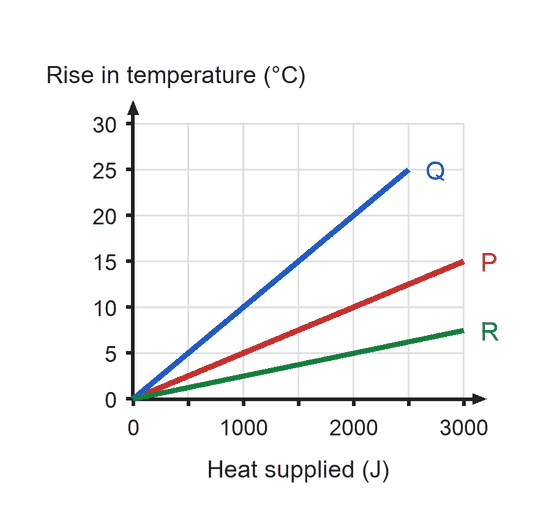
Which statement is correct?
- 272 marks
Question 27
Competency: Application
A steel tava and an aluminium tava, each of mass 800 g, are heated on two identical burners from 25 °C to 225 °C. Each burner gives 18000 J of heat per minute and all of it goes into the tava. Specific heat capacity of steel = 0.45 J g K; of aluminium = 0.9 J g K.
(a) Calculate the heat that each tava absorbs.
(b) Find how long each takes to reach 225 °C.
- 282 marks
Question 28
Competency: Application
Priya's bucket holds 12 kg of tap water at 20 °C. She adds hot water at 80 °C until the bath water is at 35 °C. Neglect the heat taken by the bucket and the heat lost to the surroundings.
(a) Find the mass of hot water she adds.
(b) Why is the specific heat capacity of water not needed in the calculation?
- 292 marks
Question 29
Competency: Evaluation
Aman makes two claims. Say whether each is true or false, and give a reason.
(a) "Two bodies at the same temperature always contain the same amount of heat energy."
(b) "A big iron nail and a small iron nail have the same specific heat capacity but different heat capacities."
- 302 marks
Question 30
Competency: Creativity & Application
A poultry farmer in a hill village wants to keep his small shed from getting too cold at night without using electricity. He places black-painted drums holding 400 kg of water in a sunny spot inside the shed, behind a glass window. By evening the sunlight has warmed the water to 40 °C, and by morning it has cooled to 15 °C. (Hypothetical data.) Specific heat capacity of water = 4200 J kg K.
(a) Calculate the heat that the water gives to the shed during the night, in MJ.
(b) Suggest two changes to his plan that would let the drums give more heat to the shed at night, and explain each with the formula .
- 312 marks
Question 31
Competency: Analysis
A 250 g metal block is heated and its temperature is noted after each supply of heat.
Heat supplied (J) 0 600 1200 1800 Temperature (°C) 25 31 37 43 (Hypothetical data.) Assume that no heat is lost.
(a) Find the heat capacity of the block.
(b) Find the specific heat capacity of the metal, and say which of these it most probably is: aluminium (0.90 J g K), copper (0.39 J g K) or lead (0.13 J g K).
- 322 marks
Question 32
Competency: Analysis
A cold laboratory thermometer at 20 °C, with heat capacity 2 J K, is dipped into 5 g of hot water at 80 °C kept in a tiny insulated cup. (Hypothetical data.) Neglect the cup and any heat loss to the air. Specific heat capacity of water = 4.2 J g K.
(a) Find the temperature that the thermometer shows when it settles, and by how much it differs from the true temperature of the water.
(b) How could the error be made smaller?
- 333 marks
Question 33
Competency: Analysis
A hot metal block of mass 300 g is dropped into 100 g of water in an insulated container. The graph shows how the temperature of the block and of the water change with time. (Hypothetical data.) Specific heat capacity of water = 4.2 J g K.

(a) Read from the graph the starting temperature of the block, the starting temperature of the water and the final common temperature.
(b) Find the ratio of the heat capacity of the block to that of the water.
(c) Find the specific heat capacity of the metal.
- 343 marks
Question 34
Competency: Application
On a frosty spring night in an apple orchard, the air is at −3 °C. Apple buds are damaged if their temperature falls below about −2 °C. The farmer sprays a fine shower of water on one young tree all night, and the water freezes on its buds and twigs. The buds and twigs of the tree lose heat to the cold air at a steady rate of 70 W (70 J every second). Take the water to reach the tree at 0 °C. Specific latent heat of fusion of ice = 336 J g. (Hypothetical data.)
(a) Explain why the buds stay at 0 °C, and are not damaged, while water is freezing on them.
(b) Find the least mass of water that must freeze on the tree every hour to keep the buds at 0 °C.
(c) Explain why the buds may be damaged if the farmer stops spraying while the air is still at −3 °C, even though the buds are covered with ice.
- 353 marks
Question 35
Competency: Application & Evaluation
An electric steam humidifier in a hospital ward boils water to add water vapour to the dry winter air. Its heater gives 420 W, and all of this heat goes into the water. The water tank sits on the warm body of the machine, so the water enters the boiling chamber at 40 °C. (Hypothetical data.) Specific heat capacity of water = 4.2 J g K; specific latent heat of vaporisation of water = 2268 J g.
(a) Calculate the heat needed to change 1 g of water at 40 °C into steam at 100 °C.
(b) Find the mass of water that the humidifier turns into steam in one hour.
(c) In another model, waste heat from the machine warms the tank more, so the water enters the boiling chamber at 70 °C instead of 40 °C. Its heater is the same 420 W. A salesman claims that this model gives "nearly twice as much steam". Check his claim with a calculation.
- 363 marks
Question 36
Competency: Evaluation
In a school laboratory, a student burns a groundnut under a metal can holding 200 g of water. The water warms from 25 °C to 35 °C, and 0.8 g of the groundnut burns. (Hypothetical data.) Assume that all the heat from the burning goes into the water. Specific heat capacity of water = 4.2 J g K.
(a) Calculate the heat gained by the water.
(b) Calculate the heat given out per gram of groundnut, in kJ.
(c) The packet says that 1 g of groundnut gives about 24 kJ. Why is the student's value smaller?
- 373 marks
Question 37
Competency: Application
In a demonstration, 10 g of steam at 100 °C is blown on to a lump of ice kept at 0 °C. The steam turns into water at 100 °C, and this water then cools down to 0 °C on the ice. Every bit of heat it gives out melts ice. Use: = 2268 J g for steam, = 4.2 J g K for water and = 336 J g for ice.
(a) Calculate the heat given out when the steam condenses.
(b) Calculate the heat given out when the water formed cools from 100 °C to 0 °C.
(c) Find the mass of ice that is melted.
- 385 marks
Question 38
Competency: Evaluation
Case study: A health camp in a remote village needs a vaccine carrier that keeps the vaccines cold during a 15-hour trip. The carrier is packed with ice at 0 °C, and heat leaks in from the warm air at a steady rate. Assume that all the heat that leaks in goes into melting the ice. Three designs are available. (Hypothetical data.)
Design Mass of ice (g) Rate of heat leaking in (W) A 900 6 B 600 4 C 500 3 Specific latent heat of fusion of ice = 336 J g.
(a) Calculate the heat needed to melt all the ice of design B.
(b) For how many hours does the ice of design B last?
(c) Which design or designs can keep the vaccines cold for the 15-hour trip? Show your working.
- 394 marks
Question 39
Competency: Analysis & Evaluation
Case study: Tanvi, a Class 10 student, puts 100 g of water at 20 °C in a well-insulated beaker for a project on mixing hot and cold water. She adds hot water at 80 °C a little at a time, stirs the mixture well, and notes the temperature of the mixture. The graph shows the temperature of the mixture against the total mass of hot water added. Neglect the heat taken by the beaker and the heat lost to the air. (Hypothetical data.)
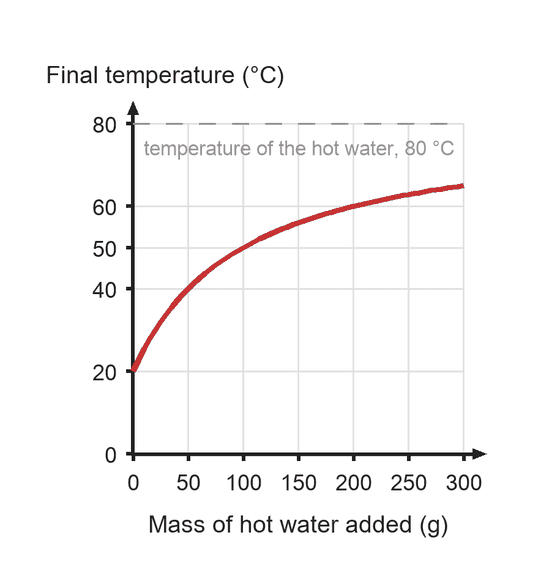
(a) Read from the graph the temperature of the mixture when 100 g of hot water has been added, and show by a calculation that it is correct.
(b) Tanvi expected that adding 200 g of hot water would raise the temperature of the mixture twice as much as adding 100 g. Use the graph to test her idea, and explain the result.
(c) Show from the heat balance that the temperature of the mixture can never reach 80 °C, however much hot water is added.
- 404 marks
Question 40
Competency: Evaluation & Analysis
Case study: Rhea uses a 50 W immersion heater to find the specific heat capacity of glycerine for her school project. She puts 200 g of glycerine in an insulated plastic container, switches the heater on, stirs gently and notes the temperature on a thermometer every minute for five minutes. (Hypothetical data.) A data book gives the accepted value for glycerine as 2.4 J g K.
Time (min) 0 1 2 3 4 5 Temperature (°C) 25 31 37 43 49 55 (a) Calculate the heat supplied by the heater in 5 minutes.
(b) Calculate Rhea's value of the specific heat capacity of glycerine.
(c) Her value is higher than the accepted value. Assuming this is only because some heat did not reach the glycerine, calculate what percentage of the heat supplied was wasted, and suggest how to waste less.