
Opening your dashboard
Class 10 Physics Chapter 11 Calorimetry: Practice Questions
43 questions on Chapter 11, each worked through on its own page with the AI tutor. Class 10 Physics, ICSE 2026-27.
43 questions
1–5 marks · Mixed difficulty
- 11 mark
Question 1
Bloom's level: Remember
The temperature of a body is a measure of the :
- 21 mark
Question 2
Bloom's level: Remember
A kettle keeps boiling after the water reaches 100°C. Roughly how much heat does it supply to turn each gram of that boiling water into steam at 100°C ?
- 31 mark
Question 3
Bloom's level: Understand
A hot iron block of mass 500 g at 60°C is dropped into a bucket containing 2 kg of water at 40°C. Which statement is correct ?
- 41 mark
Question 4
Bloom's level: Apply
An aluminium pan has a mass of 600 g. The specific heat capacity of aluminium is 900 J kg K. Its heat capacity, and the heat needed to warm it from 25°C to 75°C, are :
- 51 mark
Question 5
Bloom's level: Apply
While lying on a hot stove, a 200 g metal spatula takes in 3600 J and warms up by 20°C. What is the specific heat capacity of its metal ?
- 61 mark
Question 6
Bloom's level: Understand
In cold countries, rooms are heated by pumping hot water from a boiler through pipes and radiators. Water is used for this mainly because :
- 71 mark
Question 7
Bloom's level: Analyse
A molten substance is allowed to cool and its temperature is noted every minute :
Time (in minute) 0 1 2 3 4 5 6 7 8 Temperature (in °C) 95 86 79 72 72 72 72 65 58 Which conclusion is correct ?
- 81 mark
Question 8
Bloom's level: Analyse
Water boils at 88°C in pan P, at 120°C in pan Q and at 101°C in pan R. Which set of conditions explains these boiling points ?
- 91 mark
Question 9
Bloom's level: Evaluate
Anu mixes 100 g of water at 80°C with 100 g of water at 20°C in a copper calorimeter. She expects 50°C but finds 48°C, and says, "The principle of method of mixtures is wrong." Which is the best judgement ?
- 101 mark
Question 10
Bloom's level: Understand
Read the Assertion (A) and the Reason (R) and choose the correct option.
Assertion (A): Food cooks faster in a pressure cooker than in an open pan.
Reason (R): Dissolving salt in water raises its boiling point.
- 111 mark
Question 11
Bloom's level: Understand
Read the Assertion (A) and the Reason (R) and choose the correct option.
Assertion (A): A bucket of 10 kg of water at 40°C can melt more ice than a cup of 200 g of water at 80°C.
Reason (R): The heat a body gives out on cooling depends on its mass as well as on its fall in temperature.
- 121 mark
Question 12
Bloom's level: Understand
Read the Assertion (A) and the Reason (R) and choose the correct option.
Assertion (A): Water pipes in very cold places sometimes burst in winter.
Reason (R): Water contracts when it freezes into ice.
- 132 marks
Question 13
Bloom's level: Remember
Heat supplied to a substance is used in one of two ways.
(a) Name these two ways.
(b) For each, name the property of the substance that tells how much heat is needed per unit mass, and give its S.I. unit.
- 142 marks
Question 14
Bloom's level: Remember
Name the following :
(a) the change of a solid into a liquid at a constant temperature,
(b) the constant temperature at which a liquid changes into vapour at a given pressure,
(c) the heat absorbed or given out during a change of phase without a change in temperature,
(d) the change of a vapour into a liquid.
- 152 marks
Question 15
Bloom's level: Apply
An immersion heater of power 1000 W is used to warm 2.5 kg of water from 15°C to 40°C. Assuming all the heat goes into the water, find the time taken. Specific heat capacity of water = 4200 J kg K.
- 162 marks
Question 16
Bloom's level: Understand
Two blocks A and B have the same mass. The heat capacity of A is 400 J K and that of B is 800 J K.
(a) Which block is made of the material with the higher specific heat capacity ? How many times higher ?
(b) If both are placed on identical heaters, which will warm up faster ? Explain.
- 172 marks
Question 17
Bloom's level: Apply
A hot-water bag holds 2 kg of water at 70°C. It is used to warm someone's back until it cools to 40°C.
(a) How much heat does it give out ? (Specific heat capacity of water = 4200 J kg K)
(b) How much heat would 2 kg of dry sand (specific heat capacity 800 J kg K) give out over the same fall in temperature ? Which is the better filling ?
- 182 marks
Question 18
Bloom's level: Understand
A thin wire with heavy weights hanging from its ends is placed over a block of ice. The wire slowly cuts its way down through the ice, yet the block remains one piece. Explain this.
- 192 marks
Question 19
Bloom's level: Apply
During cooking, 50 g of water that started at 30°C boils away entirely as steam. Calculate the heat used for this. (Use J g K for water and J g for steam.)
- 202 marks
Question 20
Bloom's level: Analyse
300 g of water at 25°C is mixed with 100 g of water at 85°C in a thin plastic cup.
(a) Find the final temperature expected if no heat is lost.
(b) The measured final temperature is 38°C. Find how much heat was lost to the cup and the surroundings. Take the specific heat capacity of water as 4.2 J g K.
- 212 marks
Question 21
Bloom's level: Apply
(a) The normal temperature of the human body is 37°C. Express it in kelvin.
(b) Liquid nitrogen boils at 77 K. Express this in °C.
(c) A metal rod is heated from 20°C to 60°C. What is its rise in temperature in kelvin ?
- 222 marks
Question 22
Bloom's level: Evaluate
Kunal says, "When ice melts at 0°C its temperature does not change, so melting 1 kg of ice needs very little heat compared with heating 1 kg of water from 0°C to 100°C." Evaluate his statement with a calculation. Specific latent heat of ice = 336 J g; specific heat capacity of water = 4.2 J g K.
- 234 marks
Question 23
Bloom's level: Apply
A 200 g piece of an unknown metal is taken out of hot water at 95°C and dropped into 300 g of water at 20°C in a copper calorimeter of mass 150 g. The final steady temperature is 29°C. Specific heat capacity of water = 4.2 J g K; of copper = 0.4 J g K.
(a) Find the heat gained by the water and by the calorimeter.
(b) Find the specific heat capacity of the metal.
(c) Using the table, identify the metal.
Metal aluminium iron copper lead (in J g K) 0.9 0.45 0.4 0.13 (d) State one precaution to make the result accurate.
- 244 marks
Question 24
Bloom's level: Apply
Case study: At a school fair, Ravi wants to cool 4 bottles of lemonade, each containing 250 g, from 30°C to 8°C. He has ice at 0°C. Take the specific heat capacity of lemonade and of water as 4.2 J g K and the specific latent heat of ice as 336 J g. Ignore the heat taken by the bottles.
(a) How much heat must the lemonade give out ?
(b) What mass of ice is needed, if the melted ice also ends at 8°C ?
(c) If he used 250 g of ice-cold water at 0°C instead of ice (mixed with the lemonade), what would the final temperature be ? What does this show ?
- 254 marks
Question 25
Bloom's level: Analyse
Case study: The table gives typical summer temperatures of two cities: Mumbai, on the sea coast, and Nagpur, far inland.
City Day maximum Night minimum Mumbai (coastal) 33°C 26°C Nagpur (inland) 43°C 27°C (a) Find the day-night range of temperature for each city.
(b) Which property of water explains the difference ? Explain how it keeps the coastal climate moderate by day and by night.
(c) Explain why a cool breeze blows from the sea towards the land in the afternoon at Mumbai.
- 264 marks
Question 26
Bloom's level: Analyse
100 g of a solid is heated by a 50 W heater, and all the heat goes into the substance. The graph shows its temperature against time.
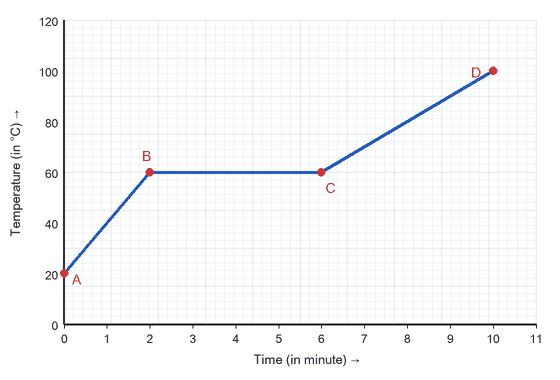
(a) What is the melting point of the substance ? In which state is it along AB, BC and CD ?
(b) Find the specific latent heat of fusion of the substance.
(c) Find the specific heat capacity of the substance in the solid state and in the liquid state.
(d) Why is the slope of CD less than the slope of AB ?
- 275 marks
Question 27
Bloom's level: Create
Design an experiment to find the specific heat capacity of a cooking oil using an electric immersion heater of known power. Include :
(a) the apparatus and its arrangement,
(b) the measurements you will take,
(c) the formula you will use, with a sample calculation for readings you would expect (for example, a 100 W heater, 500 g of oil and a 30°C rise in 5 minutes),
(d) two precautions to reduce errors.
- 284 marks
Question 28
Bloom's level: Evaluate
A group of trekkers camps at a height where water boils at 86°C. Their rice does not get cooked properly. Four suggestions are made :
- "Turn the flame up as high as possible."
- "Use a pressure cooker."
- "Keep the rice boiling for a longer time."
- "Add salt to the water."
Evaluate each suggestion, stating whether it will help and why. Which is the best one ?
- 294 marks
Question 29
Bloom's level: Create
Plan a simple experiment, using two identical heaters, two identical beakers, a thermometer and a stop-watch, to show that heat and temperature are different quantities. State what you will do, what you expect to observe, and how the result shows the difference.
- 305 marks
Question 30
Bloom's level: Apply
Case study: In a café, milk is heated by blowing steam at 100°C into it through a thin pipe. The steam condenses in the milk. A cup holds 400 g of milk at 12°C, which is to be heated to 50°C. Specific heat capacity of milk = 3.9 J g K; of water = 4.2 J g K; specific latent heat of vaporisation of water = 2260 J g.
(a) How much heat must the milk gain ?
(b) Find the mass of steam needed.
(c) If boiling water at 100°C were poured in instead of steam, what mass would be needed ? Use your answers to explain why steam is used.
- 311 mark
Question 31
A copper vessel of heat capacity 84 J K contains 100 g of water. The specific heat capacity of water is 4.2 J g K. The heat energy needed to raise the temperature of the vessel and the water together by 10°C is :
- 321 mark
Question 32
Which pair of changes will both lower the melting point of ice ?
- 331 mark
Question 33
Assertion (A): When water is boiling in an open vessel, its temperature does not rise even though heat is supplied to it continuously.
Reason (R): During boiling, the heat supplied increases the average kinetic energy of the molecules of water.
- 342 marks
Question 34
A spirit lamp supplies 21 kJ of heat energy to 500 g of water. Assume that all of this heat is taken up by the water. (Take 1 cal = 4.2 J.)
(i) Express this heat energy in calorie.
(ii) Using the definition of the calorie, find the rise in temperature of the water.
- 352 marks
Question 35
Two liquids A and B of equal mass, both at 20°C, are heated by identical heaters, so that each liquid receives heat energy at the same rate. The graph shows how their temperatures change with time.
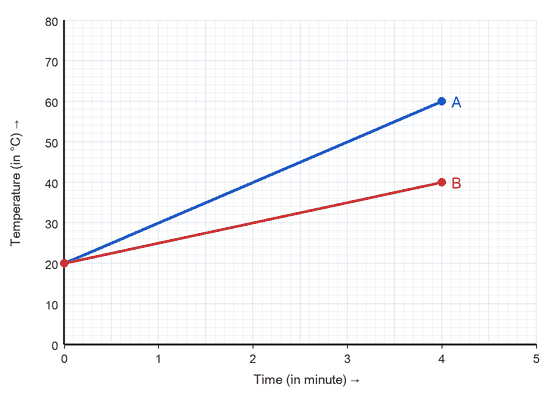
(i) Which liquid has the higher specific heat capacity ? Give a reason for your answer.
(ii) Find the ratio of the specific heat capacity of A to that of B.
- 362 marks
Question 36
The specific heat capacity of water is about five times that of sand.
(i) Equal masses of dry sand and water receive equal amounts of heat energy from the Sun. If the temperature of the water rises by 3°C, by how much does the temperature of the sand rise ?
(ii) Use your answer to explain why a cool breeze blows from the sea towards the land on a hot afternoon.
- 372 marks
Question 37
A kulfi seller packs a mixture of crushed ice and common salt around the kulfi moulds.
(i) State the effect of adding salt on the melting point of ice.
(ii) Explain why this mixture is used, instead of ice alone, to freeze the kulfi.
- 384 marks
Question 38
A copper calorimeter of mass 105 g contains 110 g of water at 20°C. 60 g of hot water at 80°C is poured into it and the mixture is stirred well.
Specific heat capacity of copper = 0.4 J g K, specific heat capacity of water = 4.2 J g K.
(i) Calculate the heat capacity of the calorimeter.
(ii) Calculate the final temperature of the mixture, assuming that no heat is lost to the surroundings.
(iii) In the actual experiment the final temperature is found to be slightly lower than the calculated value. Give one reason.
- 394 marks
Question 39
100 g of ice at 0°C is added to 300 g of water at 40°C kept in an insulated vessel of negligible heat capacity.
Specific latent heat of fusion of ice = 336 J g, specific heat capacity of water = 4.2 J g K.
(i) Calculate the heat energy needed to melt all the ice at 0°C.
(ii) Show by calculation that all the ice melts.
(iii) Calculate the final temperature of the water.
- 403 marks
Question 40
200 g of ice at 0°C is heated by an electric heater which supplies heat energy at a constant rate. The graph shows how the temperature changes with time. Assume that all the heat supplied is taken up by the ice and the water formed from it.
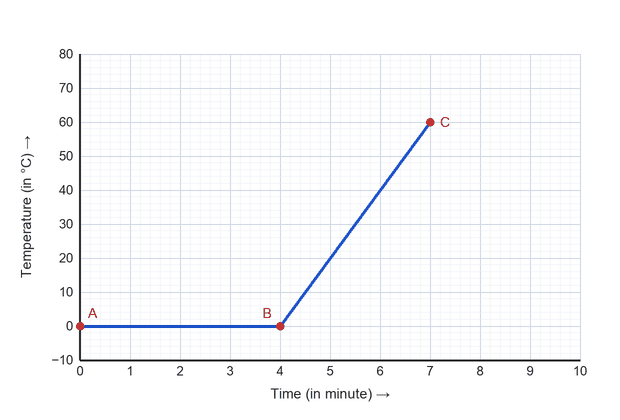
Specific latent heat of fusion of ice = 336 J g.
(i) Name the change of phase taking place in the part AB, and state what the heat supplied is used for in this part.
(ii) Calculate the power of the heater.
(iii) Use the part BC of the graph to calculate the specific heat capacity of water.
- 414 marks
Question 41
A piece of ice of mass 15 g at 0°C is added to 100 g of water contained in a copper calorimeter of mass 50 g. The temperature of the water is 15°C at first, but it falls to 3°C after the ice has melted. Calculate the specific latent heat of fusion of ice.
(Take specific heat capacity of copper = 0.42 J g °C and specific heat capacity of water = 4.2 J g °C.)
- 422 marks
Question 42
What is the reason that land cools at a faster rate than water ?
- 431 mark
Question 43
Why do we feel cool under a fan ?