
Opening your dashboard
Class 10 Physics Chapter 1: Force Solutions
99 textbook questions with step-by-step answers, free to read, for ICSE 2026-27.
Get talked through Ch 1, not just shown the answer
Reading a finished solution is not the same as being able to do it. The AI tutor takes one question at a time and works it with you, in your own words, until you can.
- Ask it out loud, in your own words
- It gives you the next step, not the answer
- Stuck on part (ii)? Start there
99 questions with solutions
1–5 marks · Mixed difficulty
- 11 mark
Question 1
The motion of a stationary rigid body in a straight path when a force is applied in the direction of force is called :
Solve with AIAnswer
(A) rotational motion
- Correct
(B) linear motion
(C) angular motion
(D) zigzag motion
Answer: (B) linear motion
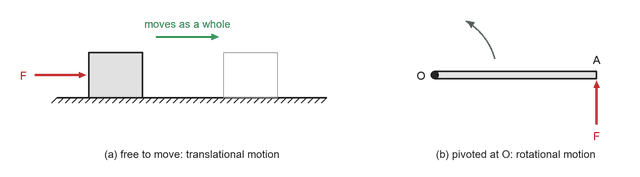
Concept: When a rigid body is free to move (not fixed at any point), a force applied on it moves the whole body in the direction of the force. This is linear (translational) motion.
Step 1 — Look at the body.
The body is stationary and not fixed anywhere, and the force acts in the direction in which the body is to move.
Step 2 — See how its particles move.
Every particle of the body moves through the same distance in the same direction, so the whole body moves along a straight line, in the direction of the force.
Step 3 — Name the motion.
Motion of a whole body along a straight path is called linear (or translational) motion, as when a ball is pushed along the floor.
Watch out: Rotation needs a pivot; a free body pushed in the direction of motion simply moves along a straight line.
Why the other options are wrong:
- (A) rotational motion: rotational motion happens only when the body is pivoted (fixed) at a point, so that it turns about an axis.
- (C) angular motion: angular motion means turning through an angle about an axis; this free body does not turn.
- (D) zigzag motion: zigzag motion keeps changing direction, but here the body moves along one straight line, the direction of the force.
Therefore, the motion is linear motion, option (B).
- 21 mark
Question 2
The motion of a door when a force is applied on its handle is :
Solve with AIAnswer
- Correct
(A) rotational motion
(B) linear motion
(C) angular motion
(D) zig-zag motion
Answer: (A) rotational motion
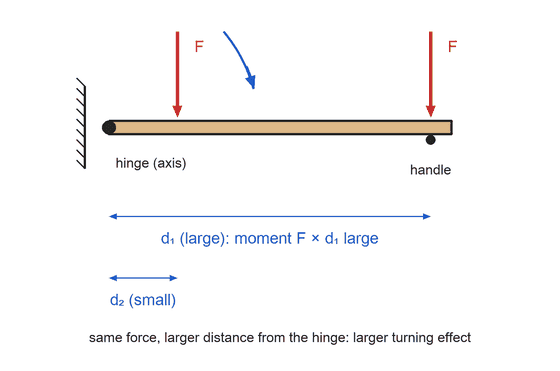
Concept: A body that is pivoted (fixed at a point or along a line) cannot move as a whole. A force on it, acting away from the pivot, turns it about the axis through the pivot: this is rotational motion.
Step 1 — Find the pivot.
A door is fixed to the frame at its hinges, which form a vertical axis.
Step 2 — See what the force does.
A force on the handle acts far from this axis, so it has a turning effect about the hinges. The door turns about the hinge axis instead of moving as a whole.
Step 3 — Name the motion.
Turning of a body about a fixed axis is rotational motion.
Watch out: The door does move, but every point of it moves along an arc about the hinges, not along a straight line.
Why the other options are wrong:
- (B) linear motion: linear motion needs the body to be free to move as a whole; the hinges stop the door from doing that.
- (C) angular motion: angular motion is not the term the book uses here; turning of a pivoted body about a fixed axis is called rotational motion.
- (D) zig-zag motion: zig-zag motion is a path that keeps changing direction; the door simply swings about its hinges.
Therefore, the door has rotational motion, option (A).
- 31 mark
Question 3
The moment of a force about a given axis depends on :
Solve with AIAnswer
(A) only the magnitude of force
(B) only the perpendicular distance of force from the axis
(C) neither the force nor the perpendicular distance of force from the axis
- Correct
(D) both the force and its perpendicular distance from the axis.
Answer: (D) both the force and its perpendicular distance from the axis.
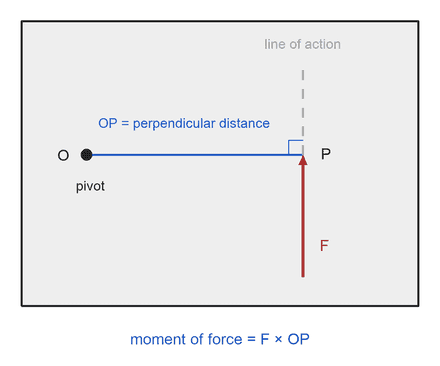
Concept: The turning effect of a force is called its moment (or torque): moment of force = force × perpendicular distance of its line of action from the axis of rotation, τ = F × d. Its S.I. unit is the newton metre (N m).
Step 1 — Write the formula.
The moment of a force about an axis is the product of two quantities.
Here F is the force and d is the perpendicular distance of its line of action from the axis.
Step 2 — Change each factor in turn.
If F is doubled with d unchanged, the moment doubles. If d is doubled with F unchanged, the moment also doubles. So the moment depends on both the force and its perpendicular distance.
Watch out: Use the perpendicular distance of the line of action from the axis, not just any distance to the force.
Why the other options are wrong:
- (A) only the magnitude of force: it leaves out the distance: the same force acting through the axis (d = 0) gives no turning at all.
- (B) only the perpendicular distance of force from the axis: it leaves out the force: with no force there is no turning, however large the distance.
- (C) neither the force nor the perpendicular distance of force from the axis: it is the opposite of the truth; the moment changes when either the force or the distance changes.
Therefore, the moment depends on both the force and its perpendicular distance from the axis, option (D).
- 41 mark
Question 4
For producing the maximum turning effect on a body by a given force, the perpendicular distance of the line of action of force from the axis of rotation should be :
Solve with AIAnswer
(A) minimum
(B) it does not matter
- Correct
(C) maximum
(D) zero
Answer: (C) maximum
Concept: The turning effect of a force is called its moment (or torque): moment of force = force × perpendicular distance of its line of action from the axis of rotation, τ = F × d. Its S.I. unit is the newton metre (N m). For a given force F, the moment is directly proportional to d.
Step 1 — Compare different distances.
With F fixed, the moment F × d grows as d grows, so the turning effect is greatest when d is greatest.
Step 2 — Connect it to daily life.
That is why a door handle is fixed at the free edge, the point farthest from the hinges.
Watch out: A zero distance does not give a large moment; it gives no moment at all.
Why the other options are wrong:
- (A) minimum: a small perpendicular distance gives a small moment, the least turning effect, not the greatest.
- (B) it does not matter: it does matter, because the moment is directly proportional to the perpendicular distance.
- (D) zero: if d = 0 the line of action passes through the axis, and the force produces no turning at all.
Therefore, the perpendicular distance should be maximum, option (C).
- 51 mark
Question 5
The moment of force for anticlockwise moment is taken as .................. and for clockwise moment is taken as .............. :
Solve with AIAnswer
- Correct
(A) positive, negative
(B) negative, positive
(C) positive, positive
(D) negative, negative
Answer: (A) positive, negative
Concept: Moments in opposite senses are given opposite signs, so that they can be added algebraically. By convention an anticlockwise moment is taken as positive and a clockwise moment as negative.
Step 1 — Recall the convention.
A moment that turns a body anticlockwise is taken as positive.

Step 2 — Apply it to the other sense.
A moment that turns a body clockwise is therefore taken as negative. In equilibrium the algebraic sum of all the moments is then zero.
Watch out: The signs are a convention, but it must be used consistently in the whole solution; the book's convention is anticlockwise positive.
Why the other options are wrong:
- (B) negative, positive: it reverses the book's convention (anticlockwise positive, clockwise negative).
- (C) positive, positive: giving both senses the same sign means a clockwise moment could never cancel an anticlockwise one.
- (D) negative, negative: giving both senses the same sign means a clockwise moment could never cancel an anticlockwise one.
Therefore, the anticlockwise moment is positive and the clockwise moment negative, option (A).
- 61 mark
Question 6
The direction of rotation of a pivoted body can be changed by changing :
Solve with AIAnswer
(A) the direction of force
(B) the point of application of force
- Correct
(C) both the direction of force and the point of application of force
(D) the magnitude of force.
Answer: (C) both the direction of force and the point of application of force
Concept: Which way a pivoted body turns depends on which way the force points and on which side of the pivot it acts.
Step 1 — Reverse the direction of the force.
Keep the point of application and reverse the force: the sense of rotation reverses, as when a door is pulled instead of pushed.
Step 2 — Shift the point of application.
Keep the direction and move the point of application to the other side of the pivot: the sense of rotation again reverses, as when the other end of a see-saw is pressed.

Step 3 — Combine the two results.
Both changes work, so the complete answer includes both.
Watch out: Changing only the size of the force never reverses the turning; it only makes it stronger or weaker.
Why the other options are wrong:
- (A) the direction of force: it gives only one of the two ways; option (C) includes both.
- (B) the point of application of force: it gives only one of the two ways; option (C) includes both.
- (D) the magnitude of force: changing only the magnitude makes the body turn more or less strongly, but in the same direction.
Therefore, the direction of rotation can be changed by changing both the direction of the force and its point of application, option (C).
- 71 mark
Question 7
A couple is formed when ........ are not acting along the same line.
Solve with AIAnswer
(A) two unequal and parallel forces
(B) two equal and parallel forces
- Correct
(C) two equal and opposite parallel forces
(D) two unequal and opposite parallel forces
Answer: (C) two equal and opposite parallel forces
Concept: A couple is a pair of equal and opposite parallel forces not acting along the same line. Its resultant is zero, so it produces rotation only, and moment of couple = either force × couple arm (the perpendicular distance between the two lines of action).
Step 1 — Check the resultant.
Two forces that are equal and opposite add up to zero, so the body does not move as a whole.
Step 2 — Check the turning effect.
Acting along different lines, the two forces turn the body in the same sense, so the body rotates.
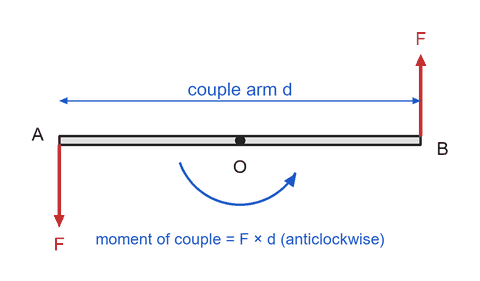
Watch out: A couple needs all three: equal size, opposite directions and different (parallel) lines of action.
Why the other options are wrong:
- (A) two unequal and parallel forces: unequal forces do not cancel, so the body would also move as a whole.
- (B) two equal and parallel forces: equal parallel forces in the same direction add up to a resultant of 2F, so the body would move as a whole.
- (D) two unequal and opposite parallel forces: unequal opposite forces leave a resultant equal to their difference, so the body would both move and turn.
Therefore, a couple is formed by two equal and opposite parallel forces, option (C).
- 81 mark
Question 8
As per the principle of moments in equilibrium :
Solve with AIAnswer
(A) Sum of anticlockwise moments is greater than sum of clockwise moments
- Correct
(B) Sum of anticlockwise moments is equal to sum of clockwise moments
(C) Sum of anticlockwise moments is less than sum of clockwise moments
(D) none of the above
Answer: (B) Sum of anticlockwise moments is equal to sum of clockwise moments
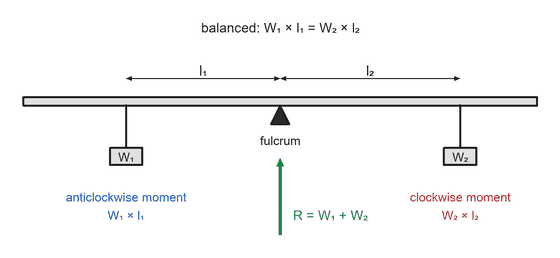
Concept: Principle of moments: when a body is in equilibrium under several forces, the sum of the anticlockwise moments about the pivot equals the sum of the clockwise moments (their algebraic sum is zero). By convention an anticlockwise moment is taken as positive and a clockwise moment as negative.
Step 1 — Write the condition.
For no rotation, the algebraic sum of the moments about the pivot is zero.
Step 2 — Split it by sense.
Anticlockwise moments are positive and clockwise moments negative, so a zero sum means the two totals are equal.
Why the other options are wrong:
- (A) Sum of anticlockwise moments is greater than sum of clockwise moments: a larger anticlockwise moment would turn the body anticlockwise, so it would not be in equilibrium.
- (C) Sum of anticlockwise moments is less than sum of clockwise moments: a larger clockwise moment would turn the body clockwise, so it would not be in equilibrium.
- (D) none of the above: it is wrong because option (B) is correct.
Therefore, in equilibrium the sum of anticlockwise moments equals the sum of clockwise moments, option (B).
- 91 mark
Question 9
A body is acted upon by two unequal forces in opposite direction, but not along the same line. The effect is that :
Solve with AIAnswer
(A) the body will only have rotational motion
(B) the body will only have translational motion
(C) the body will have neither rotational nor translational motion
- Correct
(D) the body will have both rotational as well as translational motion
Answer: (D) the body will have both rotational as well as translational motion
Concept: The resultant force decides whether a body moves as a whole (translation); the moment of the forces decides whether it turns (rotation).
Step 1 — Check the resultant.
The forces are unequal, so their resultant (the difference of the two) is not zero. The body moves in the direction of the larger force: translation.
Step 2 — Check the turning effect.
The forces do not act along the same line, so they have a turning effect on the body: rotation.

Watch out: Only equal and opposite forces (a couple) give pure rotation; here the forces are unequal.
Why the other options are wrong:
- (A) the body will only have rotational motion: rotation only needs equal and opposite forces (a couple), so that the resultant is zero.
- (B) the body will only have translational motion: translation only needs the forces to act along the same line, so that there is no turning effect.
- (C) the body will have neither rotational nor translational motion: neither motion needs equal and opposite forces acting along the same line.
Therefore, the body will have both rotational and translational motion, option (D).
- 101 mark
Question 10
Out of the following, which one is an example of dynamic equilibrium ?
(1) Moon revolving around the earth.
(2) A pebble fixed at the end of a string whirling in a circular path.
(3) An aeroplane moving at a constant height.
(4) A beam balance balanced in a horizontal position.
Solve with AIAnswer
(A) (3) and (4)
- Correct
(B) (1), (2) and (3)
(C) (1) and (2)
(D) (1) and (3)
Answer: (B) (1), (2) and (3)
Concept: A body is in static equilibrium when it stays at rest under the forces acting on it, and in dynamic equilibrium when it keeps the same state of motion (uniform motion, rotation or revolution).
Step 1 — Check statement 1.
The moon keeps revolving round the earth in the same way, so it is in dynamic equilibrium.
Step 2 — Check statement 2.
The pebble keeps whirling round its circle in the same way, so it is in dynamic equilibrium.
Step 3 — Check statement 3.
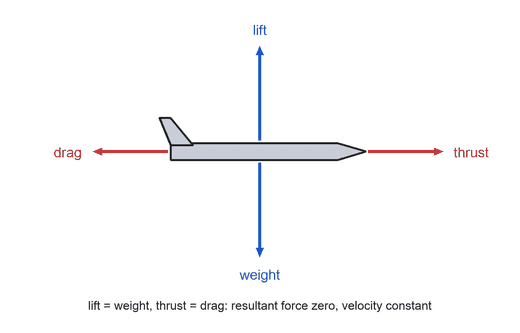
The aeroplane keeps flying at a constant height: the lift balances its weight while it moves, so it is in dynamic equilibrium.
Step 4 — Check statement 4.
A balanced beam balance is at rest, so it is in static equilibrium, not dynamic.
Watch out: A body at rest is in static equilibrium even though several forces act on it.
Note: Selina calls a body that keeps moving in the same way, even round a circle at constant speed, a body in dynamic equilibrium, and that is the answer expected here. Strictly, a body moving in a circle has a centripetal acceleration and an unbalanced (centripetal) force, so a physicist would not call it equilibrium in the strict sense.
Why the other options are wrong:
- (A) (3) and (4): it includes statement 4, which is static, and leaves out statements 1 and 2.
- (C) (1) and (2): it leaves out statement 3, the aeroplane.
- (D) (1) and (3): it leaves out statement 2, the whirling pebble.
Therefore, statements 1, 2 and 3 are examples of dynamic equilibrium, option (B).
- 112 marks
Question 11
State the condition when on applying a force, a body has :
(a) translational motion, (b) rotational motion.
Solve with AIWritten solution
Solution:
Concept: What a force does to a rigid body depends on whether the body is free or pivoted (fixed at a point).
Step 1 — (a) Translational motion.
When the body is free to move (not fixed at any point), the force moves the whole body in a straight line in the direction of the force. Every particle moves through the same distance, as when a ball is pushed along the floor.
Step 2 — (b) Rotational motion.
When the body is pivoted (fixed) at a point and the line of action of the force does not pass through the pivot, the force turns the body about an axis through the pivot, as when a door turns about its hinges.
Watch out: A pivoted body does not rotate if the line of action of the force passes through the pivot (zero moment).
Therefore, a force gives (a) translational motion to a free body and (b) rotational motion to a pivoted body when its line of action does not pass through the pivot.
- 121 mark
Question 12
State whether the moment of force is a scalar or vector quantity ?
Solve with AIWritten solution
Solution:
Concept: A scalar has only magnitude; a vector has both magnitude and direction.
Step 1 — Look at what describes a moment.
A moment of force has a size, F × d, and it also has a sense: it turns the body either clockwise or anticlockwise about the axis.
Step 2 — Decide the type.
Since a direction is needed to describe it fully, the moment of force is a vector quantity. Its direction is along the axis of rotation, and in this class we describe it by its sense, clockwise or anticlockwise.
Therefore, moment of force is a vector quantity.
- 131 mark
Question 13
Write the expression for the moment of force about a given axis.
Solve with AIWritten solution
Solution:
Concept: The turning effect of a force is called its moment (or torque): moment of force = force × perpendicular distance of its line of action from the axis of rotation, τ = F × d. Its S.I. unit is the newton metre (N m).
Step 1 — State the rule in words.
The moment about an axis is the force multiplied by the perpendicular distance of its line of action from the axis.
Step 2 — Write it in symbols.
With F the force and d the perpendicular distance of its line of action from the axis of rotation:
Watch out: Use the perpendicular distance of the line of action from the axis, not just any distance to the force.
Therefore, moment of force τ = F × d, measured in newton metre (N m).
- 141 mark
Question 14
State one way to reduce the moment of a given force about a given axis of rotation.
Solve with AIWritten solution
Solution:
Concept: The turning effect of a force is called its moment (or torque): moment of force = force × perpendicular distance of its line of action from the axis of rotation, τ = F × d. Its S.I. unit is the newton metre (N m). For a given force the moment is proportional to d.
Step 1 — Pick the factor to change.
The force is given, so only the perpendicular distance d can be changed.
Step 2 — Decrease the distance.
Apply the force closer to the axis of rotation, so that d is smaller and the moment F × d is smaller. Pushing a door near its hinges gives a much smaller turning effect than pushing at the handle.
Therefore, the moment of a given force is reduced by decreasing the perpendicular distance of its line of action from the axis of rotation.
- 151 mark
Question 15
State one way to obtain a greater moment of a force about a given axis of rotation.
Solve with AIWritten solution
Solution:
Concept: The turning effect of a force is called its moment (or torque): moment of force = force × perpendicular distance of its line of action from the axis of rotation, τ = F × d. Its S.I. unit is the newton metre (N m). For a given force the moment is proportional to d.
Step 1 — Pick the factor to change.
The force is given, so only the perpendicular distance d can be changed.
Step 2 — Increase the distance.
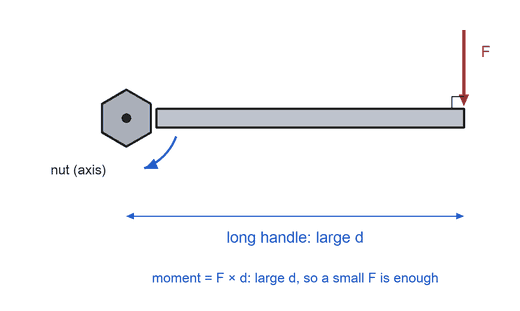
Apply the force farther from the axis of rotation, so that d is larger and the moment F × d is larger. A spanner with a longer handle turns a tight nut more easily.
Therefore, a greater moment is obtained by increasing the perpendicular distance of the line of action of the force from the axis of rotation.
- 162 marks
Question 16
Complete the following sentences :
(i) The S.I. unit of moment of force is .............. .
(ii) In equilibrium, algebraic sum of moments of all forces about the point of rotation is .............. .
(iii) In a beam balance when the beam is balanced in a horizontal position, it is in .............. equilibrium.
(iv) The moon revolving around the earth is in .............. equilibrium.
Solve with AIWritten solution
Solution:
Concept: The turning effect of a force is called its moment (or torque): moment of force = force × perpendicular distance of its line of action from the axis of rotation, τ = F × d. Its S.I. unit is the newton metre (N m). Principle of moments: when a body is in equilibrium under several forces, the sum of the anticlockwise moments about the pivot equals the sum of the clockwise moments (their algebraic sum is zero).
Step 1 — (i) S.I. unit of moment of force.
Moment = force (N) × perpendicular distance (m), so its unit is the newton metre (N m).
Step 2 — (ii) Sum of moments in equilibrium.
In equilibrium the anticlockwise moments exactly cancel the clockwise moments, so the algebraic sum of the moments about the point of rotation is zero.
Step 3 — (iii) Beam balance balanced horizontally.
The beam stays at rest, so it is in static equilibrium.
Step 4 — (iv) Moon revolving around the earth.
The moon keeps moving round the earth in the same way, so it is in dynamic equilibrium.
Note: Selina calls a body that keeps moving in the same way, even round a circle at constant speed, a body in dynamic equilibrium, and that is the answer expected here. Strictly, a body moving in a circle has a centripetal acceleration and an unbalanced (centripetal) force, so a physicist would not call it equilibrium in the strict sense.
Therefore, the blanks are (i) newton metre (N m), (ii) zero, (iii) static, (iv) dynamic.
- 172 marks
Question 17
Define moment of force and state its S.I. unit.
Solve with AIWritten solution
Solution:
Concept: The turning effect of a force depends on both the force and its distance from the axis of rotation.
Step 1 — Define the moment of force.
The moment of force (torque) is the turning effect produced by a force on a body about an axis. It is measured by the product of the force and the perpendicular distance of its line of action from the axis of rotation.
Step 2 — State the S.I. unit.
Force is in newton and distance in metre, so the S.I. unit is the newton metre (N m).
Step 3 — Relate it to the C.G.S. unit.
The C.G.S. unit is the dyne cm. Since 1 N = 10⁵ dyne and 1 m = 10² cm:
Watch out: Use the perpendicular distance of the line of action from the axis, not just any distance to the force.
Therefore, moment of force = force × perpendicular distance of its line of action from the axis, and its S.I. unit is the newton metre (N m).
- 182 marks
Question 18
State two factors affecting the turning effect of a force.
Solve with AIWritten solution
Solution:
Concept: The turning effect of a force is called its moment (or torque): moment of force = force × perpendicular distance of its line of action from the axis of rotation, τ = F × d. Its S.I. unit is the newton metre (N m).
Step 1 — First factor: the magnitude of the force.
For the same distance, a bigger force gives a bigger turning effect.
Step 2 — Second factor: the perpendicular distance.
For the same force, the farther its line of action is from the axis of rotation, the bigger the turning effect.
Step 3 — Connect to daily life.
That is why a door is pushed at the handle (large distance) and not near the hinges.
Watch out: Use the perpendicular distance of the line of action from the axis, not just any distance to the force.
Therefore, the turning effect depends on (1) the magnitude of the force and (2) the perpendicular distance of its line of action from the axis of rotation.
- 193 marks
Question 19
When does a body rotate ? State one way to change the direction of rotation of the body. Give a suitable example to explain your answer.
Solve with AIWritten solution
Solution:
Concept: A pivoted body turns when a force has a moment about the pivot. The sense of turning depends on the direction of the force and on which side of the pivot it acts.
Step 1 — When a body rotates.
A body rotates when it is pivoted (fixed) at a point and a force acts at some other point so that its line of action does not pass through the pivot. The force then has a moment about the pivot and turns the body.
Step 2 — One way to change the direction of rotation.
Reverse the direction of the force, keeping its point of application the same. (Shifting the point of application to the other side of the pivot also works.)
Step 3 — Example.
A door is pivoted at its hinges. Pushing the handle turns the door one way and it closes. Pulling the same handle reverses the force, so the door turns the other way and opens.
Watch out: A force whose line of action passes through the pivot cannot rotate the body, however large it is.
Therefore, a pivoted body rotates when the force does not act through the pivot, and reversing the direction of the force (as in pushing or pulling a door) reverses its rotation.
- 203 marks
Question 20
What do you understand by the clockwise and anticlockwise moment of force ? When is it taken positive ?
Solve with AIWritten solution
Solution:
Concept: The sense of a moment is named after the way the hands of a clock move.
Step 1 — Anticlockwise moment.
If a force turns a body in the direction opposite to the motion of the hands of a clock, its moment is called an anticlockwise moment.
Step 2 — Clockwise moment.
If a force turns a body in the same direction as the hands of a clock, its moment is called a clockwise moment.
Step 3 — Sign convention.
By convention the anticlockwise moment is taken as positive and the clockwise moment as negative.
Therefore, a moment is clockwise or anticlockwise according to the way it turns the body, and the anticlockwise moment is taken as positive.
- 212 marks
Question 21
Why is it easier to open a door by applying the force at the free end of it ?
Solve with AIWritten solution
Solution:
Concept: The turning effect of a force is called its moment (or torque): moment of force = force × perpendicular distance of its line of action from the axis of rotation, τ = F × d. Its S.I. unit is the newton metre (N m).
Step 1 — Find the axis.
A door turns about its hinges, so the hinge line is the axis of rotation.
Step 2 — Compare distances.
The free end is the point farthest from the hinges, so a force applied there has the largest perpendicular distance from the axis.
Step 3 — Find the force needed.
The door needs a certain moment to open. With a large d, the force F = moment ÷ d is small, so the door opens easily. Pushing near the hinges needs a much bigger force for the same moment.
Therefore, a force at the free end has the greatest perpendicular distance from the hinges, so a smaller force gives the moment needed; that is why door handles are fixed at the free end.
- 222 marks
Question 22
The stone of a hand flour grinder is provided with a handle near its rim. Give reason.
Solve with AIWritten solution
Solution:
Concept: The turning effect of a force is called its moment (or torque): moment of force = force × perpendicular distance of its line of action from the axis of rotation, τ = F × d. Its S.I. unit is the newton metre (N m).
Step 1 — Find the axis.
The grinder stone turns about its central axle.
Step 2 — Compare distances.
A handle near the rim is at the largest distance r from this axle.

Step 3 — Find the force needed.
A large r gives the moment needed with a small force, so the heavy stone is turned easily. A handle near the centre would need a much larger force for the same moment.
Therefore, the handle is fixed near the rim so that the perpendicular distance from the axle is largest and a small force turns the stone.
- 232 marks
Question 23
It is easier to turn the steering wheel of a large diameter than that of a small diameter. Give reason.
Solve with AIWritten solution
Solution:
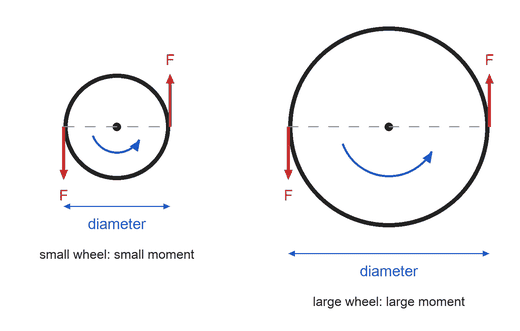
Concept: The two hands on a steering wheel apply equal and opposite forces at the rim and form a couple; moment of couple = force × couple arm, and here the couple arm is the diameter of the wheel.
Step 1 — Locate the forces.
The driver's hands push and pull at opposite ends of a diameter, at the rim, and the wheel turns about its centre.
Step 2 — Compare the two wheels.
For a wheel of larger diameter, the couple arm is larger, so the same turning moment is obtained with a smaller force.
Step 3 — Connect to daily life.
This is why heavy vehicles such as buses and trucks have large steering wheels.
Therefore, a large steering wheel gives a larger couple arm, so a smaller force produces the same moment and the wheel is easier to turn.
- 242 marks
Question 24
A spanner (or wrench) has a long handle. Why ?
Solve with AIWritten solution
Solution:
Concept: The turning effect of a force is called its moment (or torque): moment of force = force × perpendicular distance of its line of action from the axis of rotation, τ = F × d. Its S.I. unit is the newton metre (N m).
Step 1 — Find the axis.
A nut turns about its own axis, the axis of the bolt.
Step 2 — See what the long handle does.
A long handle lets the force be applied at a large perpendicular distance from this axis.
Step 3 — Find the force needed.
A large distance gives the large moment needed to open or tighten a tight nut with a small force.
Therefore, a spanner has a long handle so that a small force, applied far from the nut's axis, gives the large moment needed to turn the nut.
- 252 marks
Question 25
A jack screw is provided with a long arm. Explain why ?
Solve with AIWritten solution
Solution:
Concept: The turning effect of a force is called its moment (or torque): moment of force = force × perpendicular distance of its line of action from the axis of rotation, τ = F × d. Its S.I. unit is the newton metre (N m).
Step 1 — See how a jack works.
A jack screw lifts a heavy load, such as a car, when its screw is turned by rotating an arm about the axis of the screw.
Step 2 — See what the long arm does.
The long arm means the effort is applied at a large perpendicular distance from the axis of the screw.
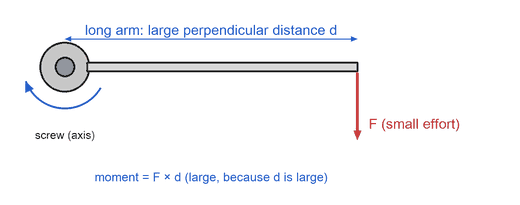
Step 3 — Find the effort needed.
A large distance gives the large moment needed to turn the screw, and so raise the heavy load, with a small effort.
Therefore, a jack screw has a long arm so that a small effort produces the large moment needed to turn the screw and lift the load.
- 263 marks
Question 26
The adjacent diagram (Fig. 1.26) shows a heavy roller, with its axle at O, which is to be raised on a pavement XY. If there is friction between the roller and pavement, show by an arrow on the diagram the point of application and the direction of force to be applied. If pivoted at 0, now will it go up?
 Solve with AI
Written solution
Solution:
Concept: As the roller is lifted onto the pavement it does not turn about its axle O. Friction stops it slipping at the edge, so it turns about the edge X of the pavement, where it touches the step. To raise it with the least force, the applied force must have the largest possible moment about X.
Step 1 — Choose the point of application.
Apply the force at the point P of the roller that is diametrically opposite to X, at the other end of the diameter through X. This is the point of the roller farthest from X: its distance from X is the full diameter.
Step 2 — Choose the direction.
Apply the force perpendicular to the diameter XP, in the sense that turns the roller about X up onto the pavement. Then the whole diameter XP is the perpendicular distance, so the moment about X is the largest and the force needed is the least.
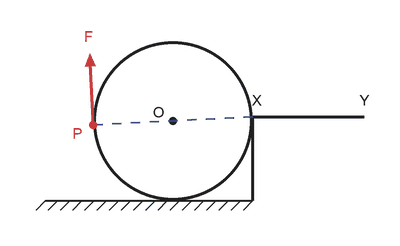
Step 3 — Decide whether it goes up.
The roller turns about the edge X as a pivot. Its weight W acts at O and tries to turn it back down about X. When the moment of the applied force about X becomes greater than the moment of W about X, the roller turns about X and rolls up onto the pavement XY.
Watch out: The pivot is the edge X, not the axle O; a force that only has a moment about O would just spin the roller in place.
Therefore, the force is applied at P, the end of the diameter through X, perpendicular to XP; the roller turns about X as the pivot, and yes, it goes up onto the pavement.
- 272 marks
Question 27
Define moment of couple. Write its S.I. unit.
Solve with AIWritten solution
Solution:
Concept: A couple is a pair of equal and opposite parallel forces not acting along the same line. Its resultant is zero, so it produces rotation only, and moment of couple = either force × couple arm (the perpendicular distance between the two lines of action).
Step 1 — Define the moment of a couple.
The moment of a couple is its turning effect, measured by the product of either force and the perpendicular distance between the lines of action of the two forces (the couple arm d).
Step 2 — State the S.I. unit.
Force is in newton and the couple arm in metre, so the unit is the newton metre (N m).
Watch out: Use only ONE of the two forces, not their sum, and the distance BETWEEN their lines of action.
Therefore, moment of couple = either force × couple arm, and its S.I. unit is the newton metre (N m).
- 282 marks
Question 28
What do you mean by equilibrium of a body ?
Solve with AIWritten solution
Solution:
Concept: Equilibrium means the forces on a body balance, so its state of rest or of motion does not change.
Step 1 — Define equilibrium.
A body is in equilibrium when the forces acting on it produce no change in its state of rest or of uniform motion (translational or rotational).
Step 2 — State what this needs.
The resultant of all the forces on it is zero (no change in linear motion), and the algebraic sum of their moments about the point of rotation is zero (no change in rotation).
Step 3 — Give an example.
A metre rule balanced horizontally on a fulcrum is in equilibrium.
Therefore, a body is in equilibrium when the forces on it cause no change in its state of rest or motion.
- 293 marks
Question 29
State the condition when a body is in (i) static, (ii) dynamic equilibrium. Give one example each of static and dynamic equilibrium.
Solve with AIWritten solution
Solution:
Concept: In both kinds of equilibrium the forces balance; the difference is whether the body is at rest or moving.
Step 1 — (i) Static equilibrium.
When a body remains in the state of rest under the action of several forces, it is in static equilibrium. Example: a beam balance with its beam balanced horizontally, or a book lying on a table (its weight is balanced by the reaction of the table).
Step 2 — (ii) Dynamic equilibrium.
When a body remains in the same state of motion (uniform translational or rotational motion) under the action of several forces, it is in dynamic equilibrium. Example: an aeroplane flying at a constant height and speed (lift balances its weight and thrust balances air drag), or a raindrop falling with its constant terminal velocity.
Therefore, a body at rest under balanced forces is in static equilibrium (a balanced beam balance), and a body moving uniformly under balanced forces is in dynamic equilibrium (an aeroplane at constant height and speed).
- 302 marks
Question 30
State two conditions for a body, acted upon by several forces, to be in equilibrium.
Solve with AIWritten solution
Solution:
Concept: A body can change its state in two ways, by moving as a whole or by turning, so there are two conditions.
Step 1 — Condition 1: no translation.
The resultant of all the forces acting on the body must be zero: the forces in one direction balance the forces in the opposite direction.
Step 2 — Condition 2: no rotation.
The algebraic sum of the moments of all the forces about the point of rotation must be zero: the sum of the anticlockwise moments equals the sum of the clockwise moments.
Step 3 — See both in the balanced rule.
In the balanced metre rule, the upward push R of the fulcrum equals W₁ + W₂ (condition 1), and W₁ × l₁ = W₂ × l₂ (condition 2).
Therefore, for equilibrium the resultant force on the body must be zero and the algebraic sum of the moments about the point of rotation must be zero.
- 312 marks
Question 31
State the principle of moments. Name one device based on it.
Solve with AIWritten solution
Solution:
Concept: In equilibrium the turning effects in the two senses cancel.
Step 1 — State the principle.
If the algebraic sum of the moments of all the forces acting on a body about the axis of rotation is zero, the body is in equilibrium (it does not rotate). In other words, in equilibrium:
Step 2 — Name a device.
The beam balance (physical balance) works on this principle. A see-saw and a lever also work on it.
Therefore, by the principle of moments the sum of anticlockwise moments equals the sum of clockwise moments in equilibrium, and the beam balance is based on it.
- 324 marks
Question 32
A, B and C are three forces each of magnitude 4 N acting in the plane of paper as shown in Fig. 1.27. Point O lies in the same plane.

(i) Which force has the least moment about O ? Give reason.
(ii) Which force has the greatest moment about O ? Give reason.
(iii) Name the forces producing (a) clockwise, (b) anticlockwise moments.
(iv) What is the resultant torque about the point O ?
Solve with AIWritten solution
Solution:
Concept: All three forces have the same size (4 N), so their moments about O, 4 N × d, differ only through the perpendicular distance d of each line of action from O. By convention an anticlockwise moment is taken as positive and a clockwise moment as negative.
Step 1 — Find the moment of each force.
Multiply 4 N by each perpendicular distance.
Step 2 — (i) Least moment.
Force C has the least moment, 2.4 N m, because its line of action is nearest to O (0.6 m).
Step 3 — (ii) Greatest moment.
Force A has the greatest moment, 3.6 N m, because its line of action is farthest from O (0.9 m).
Step 4 — (iii) Sense of each moment.
Imagine each force acting alone on a body pivoted at O. (a) A and B turn it clockwise: A acts upward on the left of O, and B acts towards the right above O. (b) C turns it anticlockwise: it acts upward and to the right along a line passing below and to the right of O.
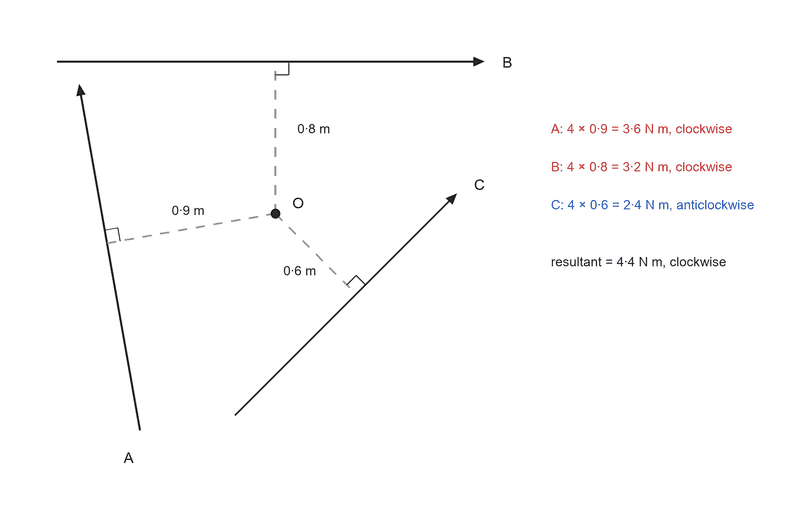
Step 5 — (iv) Resultant torque.
Add the moments with their signs (anticlockwise +, clockwise −).
The negative sign means the resultant torque is clockwise.
Watch out: Compare the PERPENDICULAR distances (the dashed lines meet the forces at right angles), not the distances to the tails of the arrows.
Therefore, (i) C has the least moment, (ii) A has the greatest, (iii) A and B give clockwise and C anticlockwise moments, and (iv) the resultant torque about O is 4.4 N m, clockwise.
- 334 marks
Question 33
A body is acted upon by two forces each of magnitude F, but in opposite directions. State the effect of the forces if
(a) both forces act at the same point of the body.
(b) the two forces act at two different points of the body at a separation r.
Solve with AIWritten solution
Solution:
Concept: The resultant force decides whether the body moves as a whole; the moment of the forces decides whether it turns.
Step 1 — (a) Both forces at the same point.
The resultant force is F − F = 0, so there is no translational motion. Both forces act through the same point along the same line, so their moments about any point cancel and there is no turning. The body stays in equilibrium: it neither moves nor turns.
Step 2 — (b) Forces at two points a distance r apart.
With their lines of action r apart, the two equal and opposite forces form a couple. The resultant force is still zero, so the body does not move as a whole, but the moment of the couple is F × r, which is not zero, so the body rotates.

Watch out: Equal and opposite forces do not always cancel completely: they cancel as forces, but not as moments unless they act along the same line.
Therefore, (a) the body stays in equilibrium (no motion, no turning), and (b) the forces form a couple that rotates the body with a moment F × r but does not move it as a whole.
- 344 marks
Question 34
Draw a neat labelled diagram to show the direction of two forces acting on a body to produce rotation in it. Also mark the point O about which the rotation takes place.
Solve with AIWritten solution
Solution:
Concept: Rotation without any linear motion is produced by a couple: two equal and opposite parallel forces acting at two different points of the body, not along the same line.
Step 1 — Plan the diagram.
Take a wheel pivoted at its centre O. At the end A of a diameter a force F acts downward, and at the other end B an equal force F acts upward.
Step 2 — Draw it.
The diagram shows the two forces and the point O about which the wheel turns.
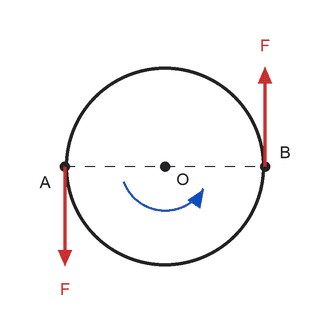
Step 3 — Check the effect.
The forces are equal and opposite, so their resultant is zero and the wheel does not shift. Their lines of action are a distance AB apart, so both turn the wheel the same way, anticlockwise about O, with a moment of the couple = F × AB.
Therefore, two equal and opposite parallel forces at the ends A and B of a diameter (down at A, up at B) rotate the body anticlockwise about its centre O.
- 354 marks
Question 35
What do you understand by the term couple ? State its effect on a body. Give two examples in our daily life where couple is applied to turn a body.
Solve with AIWritten solution
Solution:
Concept: A couple is a pair of forces that turns a body without moving it from its place.
Step 1 — Define a couple.
Two equal and opposite parallel forces, not acting along the same line, form a couple.
Step 2 — State its effect.
The two forces are equal and opposite, so their resultant is zero and the body has no translational motion. But their lines of action are separated, so both turn the body in the same sense. A couple therefore produces only rotation, and its moment = either force × couple arm.
Step 3 — Give two daily-life examples.
1. Turning a steering wheel with both hands: one hand pushes up while the other pulls down. 2. Turning a water tap, or the cap of a bottle or pen, between the thumb and fingers. (Other examples: winding a clock key and turning a key in a lock.)
Therefore, a couple is two equal and opposite parallel forces not along the same line; it produces only rotation, as in turning a steering wheel or a water tap.
- 364 marks
Question 36
Prove that
Moment of couple = Force × couple arm.
Solve with AIWritten solution
Solution:
Concept: Find the moment of each force of the couple about the mid-point O of the couple arm, then add them; both turn the body the same way.
Step 1 — Set up the couple.
Two equal and opposite parallel forces, each of magnitude F, act at the points A and B of a body. The perpendicular distance between their lines of action, the couple arm, is AB = d. The body turns about O, the mid-point of AB, so OA and OB are each d/2.

Step 2 — Moment of the force at A about O.
The force at A is a perpendicular distance OA from O.
Step 3 — Moment of the force at B about O.
The force at B is a perpendicular distance OB from O.
Step 4 — Add the two moments.
The forces are opposite and act on opposite sides of O, so both turn the body in the same sense (anticlockwise in the figure) and their moments add.
Step 5 — Note the result holds about any point.
The same total, F × d, is obtained about any point in the plane: the moment of a couple does not depend on the point about which it is taken.
Watch out: The two moments ADD (same sense); they do not cancel, even though the forces themselves cancel.
Therefore, moment of couple = F × d, that is, force × couple arm.
- 375 marks
Question 37
Describe a simple experiment to verify the principle of moments, if you are supplied with a metre rule, a fulcrum and two springs with slotted weights.
Solve with AIWritten solution
Solution:
Concept: Balance a metre rule with weights on both sides of the fulcrum and compare the anticlockwise and clockwise moments about the fulcrum. Principle of moments: when a body is in equilibrium under several forces, the sum of the anticlockwise moments about the pivot equals the sum of the clockwise moments (their algebraic sum is zero).
Step 1 — Aim and apparatus.
Aim: to verify that, in equilibrium, the sum of the anticlockwise moments equals the sum of the clockwise moments. Apparatus: a uniform metre rule, a sharp fulcrum (knife edge), and two spring hooks to hang slotted weights.
Step 2 — Balance the rule alone.
Place the metre rule on the fulcrum and adjust it until it balances horizontally. A uniform rule balances at its middle, the 50 cm mark, so its weight then acts through the fulcrum and has no moment.
Step 3 — Hang the weights.
Hang a weight W₁ from a spring on one side of the fulcrum, say the left, at a distance l₁ from it. Hang a second weight W₂ on the other side and slide it along the rule until the rule is again horizontal. Note its distance l₂ from the fulcrum.
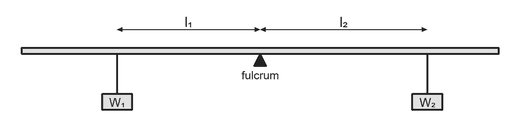
Step 4 — Calculate and repeat.
Calculate the anticlockwise moment W₁ × l₁ and the clockwise moment W₂ × l₂. Repeat with different weights and positions, and record the results in a table with columns W₁, l₁, W₁ × l₁, W₂, l₂ and W₂ × l₂.
Step 5 — Observation and conclusion.
In every case the two products are equal:
So, when the rule is in equilibrium, the sum of the anticlockwise moments about the fulcrum equals the sum of the clockwise moments. This verifies the principle of moments.
Step 6 — Precautions.
The rule must be horizontal before readings are taken, and each distance is measured from the fulcrum to the point where the weight hangs.
Therefore, the equal products W₁ × l₁ = W₂ × l₂ in every reading verify the principle of moments.
- 383 marks
Question 38
The moment of a force of 20 N about a fixed point O is 10 N m. Calculate the distance of the point O from the line of action of the force.
Solve with AIWritten solution
Solution:
Concept: The turning effect of a force is called its moment (or torque): moment of force = force × perpendicular distance of its line of action from the axis of rotation, τ = F × d. Its S.I. unit is the newton metre (N m). So the distance is the moment divided by the force.
Given: Force F = 20 N; moment about O, τ = 10 N m.
Step 1 — Rearrange the formula.
From τ = F × d, divide both sides by F.
Step 2 — Substitute the values.
Put τ = 10 N m and F = 20 N.
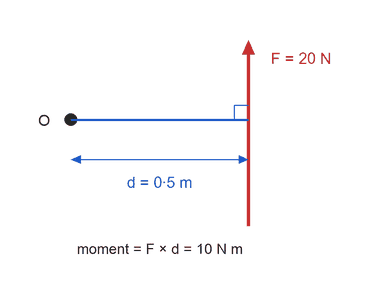
Therefore, the point O is 0.5 m from the line of action of the force.
- 393 marks
Question 39
A nut is opened by a wrench of length 25 cm. If the least force required is 10 N, find the moment of force needed to turn the nut.
Solve with AIWritten solution
Solution:
Concept: The turning effect of a force is called its moment (or torque): moment of force = force × perpendicular distance of its line of action from the axis of rotation, τ = F × d. Its S.I. unit is the newton metre (N m).
Given: Length of wrench = 25 cm; least force F = 10 N.
Step 1 — Decide where the least force acts.
The force is least when it acts at the end of the wrench, perpendicular to it, so the perpendicular distance is the full length of the wrench.
Step 2 — Find the moment.
Multiply the force by this distance.
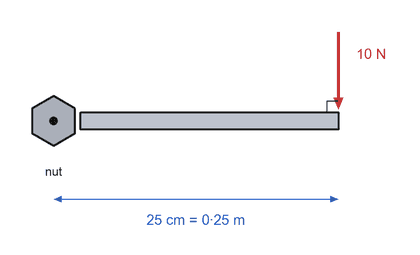
Watch out: Change 25 cm into metres (0.25 m) before multiplying, to get the answer in N m.
Therefore, the moment of force needed to turn the nut is 2.5 N m.
- 403 marks
Question 40
A 50 kg mass is being lifted by using a 1 metre long lever. If the length of the lever is reduced by 20%, how much more or less force is to be applied to achieve the same torque ?
Solve with AIWritten solution
Solution:
Concept: The turning effect of a force is called its moment (or torque): moment of force = force × perpendicular distance of its line of action from the axis of rotation, τ = F × d. Its S.I. unit is the newton metre (N m). The torque needed stays the same, so if the lever (the distance d) becomes shorter, the force must increase: F = τ ÷ d.
Given: Mass = 50 kg; lever length = 1 m, then reduced by 20%; g = 9.8 m s⁻².
Step 1 — State the reading used.
The question gives only the mass and the lever length, so (as the book intends) the torque needed is taken as the weight of the mass acting at the full 1 m length of the lever. With g = 9.8 m s⁻²:
Step 2 — Find the torque needed.
Multiply this force by the lever length of 1 m.
Step 3 — Find the new length.
The lever is reduced by 20%, so 80% of it is left.
Step 4 — Find the new force.
The same torque must now come from the shorter lever.

Step 5 — Find the change.
Subtract the old force from the new one.
Watch out: A shorter lever needs MORE force, not less, for the same torque.
Note: if g = 10 m s⁻² is used, the forces are 500 N and 625 N, and the answer is 125 N more.
Therefore, 122.5 N more force has to be applied.
- 413 marks
Question 41
A mechanic applies a force of 100 N at the end of a spanner to tighten a bolt. The length of the spanner is 0.5 metres. How much torque is exerted on the bolt ? If the mechanic increases the force applied by 20% but holds the spanner closer at 0.4 metres, would it result in an increase or decrease of torque ?
Solve with AIWritten solution
Solution:
Concept: The turning effect of a force is called its moment (or torque): moment of force = force × perpendicular distance of its line of action from the axis of rotation, τ = F × d. Its S.I. unit is the newton metre (N m). A larger force at a smaller distance may give more or less torque, so work out both and compare.
Given: F₁ = 100 N, applied at d₁ = 0.5 m; then the force is increased by 20%, applied at d₂ = 0.4 m.
Step 1 — Find the first torque.
The force acts at the end of the 0.5 m spanner.
Step 2 — Find the new force.
The force is increased by 20% of 100 N.
Step 3 — Find the new torque.
The mechanic now holds the spanner at 0.4 m.
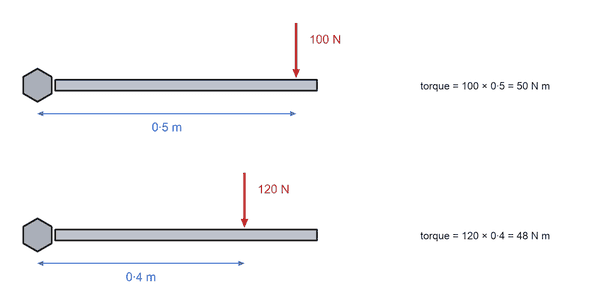
Step 4 — Compare.
The new torque is smaller than the first one.
The force is multiplied by 1.2 but the distance by 0.8, and 1.2 × 0.8 = 0.96, so the torque falls by 4%.
Watch out: A 20% rise in force does not make up for a 20% fall in distance, because the torque depends on the product.
Therefore, the torque at first is 50 N m, and the change gives a decrease of 2 N m (to 48 N m).
- 423 marks
Question 42
A wheel of diameter 2 m is shown in Fig. 1.28 with axle at O. A force N is applied at B in the direction shown in figure. Calculate the moment of force about (i) the centre O, and (ii) the point A.
 Solve with AI
Written solution
Solution:
Concept: The turning effect of a force is called its moment (or torque): moment of force = force × perpendicular distance of its line of action from the axis of rotation, τ = F × d. Its S.I. unit is the newton metre (N m). The force at B is horizontal (along the tangent at the top), so its perpendicular distance from any point on the vertical diameter is the vertical distance of that point from B.
Given: Diameter = 2 m; F = 2 N acting horizontally at the top point B.
Step 1 — Read the figure.
The diameter is 2 m, so the radius OB is 1 m. The force of 2 N acts horizontally to the right at the top point B, and A is the lowest point, so AB is 2 m.
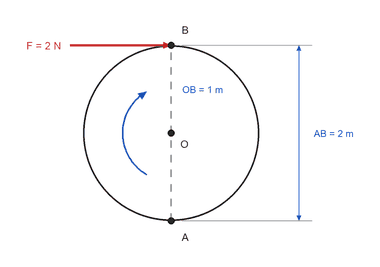
Step 2 — (i) Moment about O.
The perpendicular distance of the force from O is OB = 1 m.
The force pushes the top of the wheel to the right, so it turns the wheel clockwise about O.
Step 3 — (ii) Moment about A.
The perpendicular distance of the force from A is AB = 2 m.
About A the force also turns the wheel clockwise. The same force has twice the moment about A, because A is twice as far from its line of action.
Watch out: Use the perpendicular distance of the line of action from the axis, not just any distance to the force.
Therefore, the moment of the force is (i) 2 N m clockwise about O and (ii) 4 N m clockwise about A.
- 433 marks
Question 43
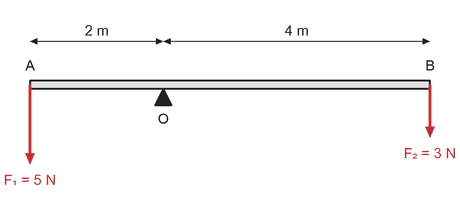
The diagram in Fig. 1.29 shows two forces N and N acting at points A and B respectively of a rod pivoted at a point O, such that OA = 2 m and OB = 4 m.
Calculate :
(i) the moment of force about O.
(ii) the moment of force about O.
(iii) total moment of the two forces about O.
Solve with AIWritten solution
Solution:
Concept: The turning effect of a force is called its moment (or torque): moment of force = force × perpendicular distance of its line of action from the axis of rotation, τ = F × d. Its S.I. unit is the newton metre (N m). A downward force on the left of the pivot turns the rod anticlockwise; one on the right turns it clockwise. By convention an anticlockwise moment is taken as positive and a clockwise moment as negative.
Given: F₁ = 5 N at A, OA = 2 m; F₂ = 3 N at B, OB = 4 m; both downward, on opposite sides of O.
Step 1 — (i) Moment of F₁ about O.
F₁ = 5 N acts downward at A, 2 m to the left of O.
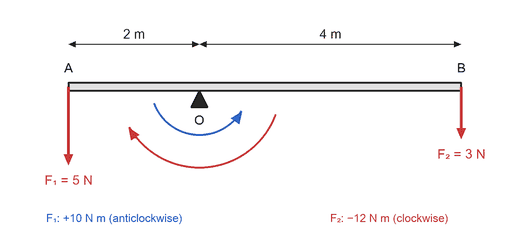
It turns the rod anticlockwise, so it is +10 N m.
Step 2 — (ii) Moment of F₂ about O.
F₂ = 3 N acts downward at B, 4 m to the right of O.
It turns the rod clockwise, so it is −12 N m.
Step 3 — (iii) Total moment about O.
Add the two moments with their signs.
The negative sign means the total moment is clockwise, so the rod turns clockwise.
Watch out: The smaller force (3 N) has the larger moment here, because it acts twice as far from O.
Therefore, (i) the moment of F₁ is 10 N m anticlockwise, (ii) the moment of F₂ is 12 N m clockwise, and (iii) the total moment is 2 N m clockwise.
- 443 marks
Question 44
Two forces each of magnitude 10 N act vertically upwards and downwards respectively at the two ends A and B of a uniform rod of length 4 m which is pivoted at its mid point O as shown in Fig. 1.30. Determine the magnitude of the resultant moment of forces about the pivot O.
 Solve with AI
Written solution
Solution:
Concept: An upward force on the left of the pivot and a downward force on the right both turn the rod clockwise, so their moments add. A couple is a pair of equal and opposite parallel forces not acting along the same line. Its resultant is zero, so it produces rotation only, and moment of couple = either force × couple arm (the perpendicular distance between the two lines of action).
Given: Rod AB = 4 m, pivoted at its mid-point O; 10 N upward at A and 10 N downward at B.
Step 1 — Find the distances.
The rod is 4 m long and pivoted at its mid-point O, so OA and OB are each 2 m.
Step 2 — Moment of the upward force at A.
10 N acts upward at A, 2 m to the left of O; it turns the rod clockwise.
Step 3 — Moment of the downward force at B.
10 N acts downward at B, 2 m to the right of O; it also turns the rod clockwise.

Step 4 — Add the moments.
Both are clockwise, so they add.
Check: The two forces form a couple of arm AB = 4 m, so the moment is force × couple arm.
Watch out: Do not subtract the moments just because one force is up and the other down; check the sense of each.
Therefore, the resultant moment about O is 40 N m, clockwise.
- 454 marks
Question 45
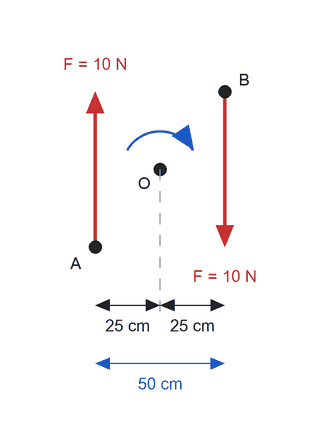
Fig. 1.31 shows two forces each of magnitude 10 N acting at points A and B at a separation of 50 cm, in opposite directions. Calculate the resultant moment of the two forces about the point (i) A, (ii) B and (iii) O situated exactly at the middle of the two forces.
 Solve with AI
Written solution
Solution:
Concept: The two forces are equal, opposite and parallel, so they form a couple with arm 50 cm = 0.5 m. A force has no moment about a point on its own line of action. The force at A acts up and the force at B acts down, so the couple turns clockwise.
Given: Two forces of 10 N in opposite directions at A and B; AB = 50 cm; O midway between them.
Step 1 — (i) About A.
The force at A passes through A, so its moment is zero. The force at B is 0.5 m from A.
Step 2 — (ii) About B.
The force at B has no moment about B. The force at A is 0.5 m from B.
Step 3 — (iii) About O.
O is midway, so each force is 0.25 m from O, and both turn the body clockwise.
Step 4 — Compare the three answers.
The moment is the same about every point, as it must be for a couple.
Watch out: Convert 50 cm to 0.5 m before multiplying, to get N m.
Therefore, the resultant moment is 5 N m clockwise about each of A, B and O.
- 463 marks
Question 46
A steering wheel of diameter 0·5 m is rotated anticlockwise by applying two forces each of magnitude 6 N. Draw a diagram to show the application of forces and calculate the moment of the forces applied.
Solve with AIWritten solution
Solution:
Concept: The two hands apply equal and opposite forces at the two ends of a diameter, along the rim. They form a couple, and its arm is the diameter of the wheel. Moment of couple = F × d.
Given: Diameter of the wheel = 0.5 m; each force = 6 N; the wheel turns anticlockwise.
Step 1 — Draw the forces.
Forces of 6 N act at the ends A and B of a diameter, tangential to the rim: downward at A and upward at B, so that both turn the wheel anticlockwise.
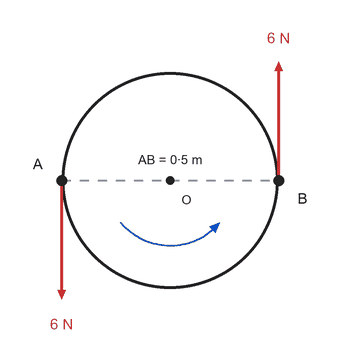
Step 2 — Find the moment of the couple.
Multiply either force by the couple arm, the diameter 0.5 m.
Watch out: The couple arm is the diameter (0.5 m), not the radius, because the two forces act at opposite ends of a diameter.
Therefore, the moment of the forces is 3 N m, anticlockwise.
- 473 marks
Question 47
A uniform metre rule is pivoted at its mid-point. A weight of 50 gf is suspended at one end of it.

Where should a weight of 100 gf be suspended to keep the rule horizontal ?
Solve with AIWritten solution
Solution:
Concept: A uniform rule (or bar) has its weight acting at its mid-point, its centre of gravity. If the pivot is at that mid-point, the rule's own weight has no moment about the pivot. Principle of moments: when a body is in equilibrium under several forces, the sum of the anticlockwise moments about the pivot equals the sum of the clockwise moments (their algebraic sum is zero).
Given: Metre rule pivoted at its mid-point (50 cm); 50 gf at one end; 100 gf to be placed.
Step 1 — Place the 50 gf.
Let the 50 gf hang at one end, say the 0 cm mark. It is 50 cm from the pivot, so it turns the rule anticlockwise. The 100 gf must hang on the other side at a distance d.
Step 2 — Apply the principle of moments.
Equate the anticlockwise and clockwise moments.
Step 3 — Solve for d.
Divide both sides by 100 gf.
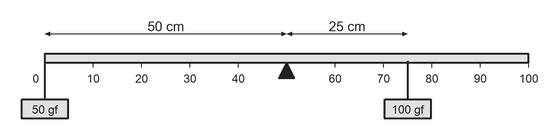
Step 4 — Locate the mark.
25 cm from the pivot on the other side is the 50 + 25 = 75 cm mark, which is 25 cm from the other end of the rule.
Watch out: The heavier weight balances when it is at HALF the distance, on the opposite side of the pivot.
Therefore, the 100 gf weight should be hung at the 75 cm mark, 25 cm from the pivot on the other side.
- 484 marks
Question 48
A uniform metre rule balances horizontally on a knife edge placed at the 58 cm mark when a weight of 20 gf is suspended from one end.
(i) Draw a diagram of the arrangement.
(ii) What is the weight of the rule ?
Solve with AIWritten solution
Solution:
Concept: A uniform rule (or bar) has its weight acting at its mid-point, its centre of gravity. If the pivot is at that mid-point, the rule's own weight has no moment about the pivot. The knife edge is at 58 cm, so the 20 gf must hang from the end on the same side as the knife edge (the 100 cm end); only then can it balance the rule's weight, which lies on the other side.
Given: Knife edge at 58 cm; 20 gf hung from one end; uniform rule, so its weight W acts at 50 cm.
Step 1 — (i) Draw the arrangement.
The rule rests on a knife edge at the 58 cm mark, its weight W acts at the 50 cm mark, and 20 gf hangs at the 100 cm end.
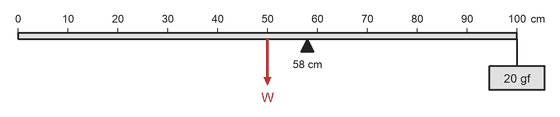
Step 2 — Find the distances from the knife edge.
The weight W acts to the left of the knife edge (anticlockwise), and the 20 gf acts to the right of it (clockwise).
Step 3 — (ii) Apply the principle of moments.
Equate the anticlockwise and clockwise moments.
Watch out: The rule's own weight acts at 50 cm, which is NOT at the knife edge here, so it has a moment and must be included.
Therefore, the weight of the rule is 105 gf.
- 493 marks
Question 49
The diagram below (Fig. 1.32) shows a uniform bar supported at the middle point O. A weight of 40 gf is placed at a distance 40 cm to the left of point O. How can you balance the bar with a weight of 80 gf ?
 Solve with AI
Written solution
Solution:
Concept: The bar is uniform and supported at its middle O, so its own weight has no moment about O. Principle of moments: when a body is in equilibrium under several forces, the sum of the anticlockwise moments about the pivot equals the sum of the clockwise moments (their algebraic sum is zero).
Given: Uniform bar supported at its middle O; 40 gf at 40 cm to the left of O; 80 gf to be placed.
Step 1 — Choose the side.
The 40 gf on the left of O turns the bar anticlockwise, so the 80 gf must be on the right of O, at a distance d, to give a clockwise moment.
Step 2 — Apply the principle of moments.
Equate the two moments.
Step 3 — Solve for d.
Divide both sides by 80 gf.

Watch out: A weight on the left of the pivot turns the rule anticlockwise and one on the right turns it clockwise; put the balancing weight on the side that needs the extra moment.
Therefore, the bar is balanced by placing the 80 gf weight 20 cm to the right of O.
- 504 marks
Question 50
Fig. 1.33 shows a uniform metre rule placed on a fulcrum at its mid-point O and having a weight 40 gf at the 10 cm mark and a weight of 20 gf at the 90 cm mark. (i) Is the metre rule in equilibrium ? If not, how will the rule turn ? (ii) How can the rule be brought in equilibrium by using an additional weight of 40 gf ?
 Solve with AI
Written solution
Solution:
Concept: The fulcrum is at the 50 cm mark, so the rule's own weight has no moment. Compare the moments on the two sides; the extra weight must make up the difference on the weaker side. Principle of moments: when a body is in equilibrium under several forces, the sum of the anticlockwise moments about the pivot equals the sum of the clockwise moments (their algebraic sum is zero).
Given: Fulcrum at the mid-point O (50 cm); 40 gf at 10 cm; 20 gf at 90 cm; an extra 40 gf available.
Step 1 — Find the anticlockwise moment.
40 gf at the 10 cm mark is 50 − 10 = 40 cm to the left of O.
Step 2 — Find the clockwise moment.
20 gf at the 90 cm mark is 90 − 50 = 40 cm to the right of O.
Step 3 — (i) Decide whether it balances.
The moments are not equal, so the rule is not in equilibrium. The anticlockwise moment is larger, so the rule turns anticlockwise: the 10 cm end goes down.
Step 4 — (ii) Place the extra 40 gf.
It must add a clockwise moment of 1600 − 800 = 800 gf cm, so it goes on the right of O at a distance d.

Check: With the extra weight at 70 cm, the clockwise moments add up to the anticlockwise moment.
Watch out: A weight on the left of the pivot turns the rule anticlockwise and one on the right turns it clockwise; put the balancing weight on the side that needs the extra moment.
Therefore, (i) the rule is not in equilibrium and turns anticlockwise, and (ii) it is balanced by placing the 40 gf at the 70 cm mark, 20 cm to the right of O.
- 513 marks
Question 51
When a boy weighing 20 kgf sits at one end of a 4 m long see-saw, it gets depressed at this end.
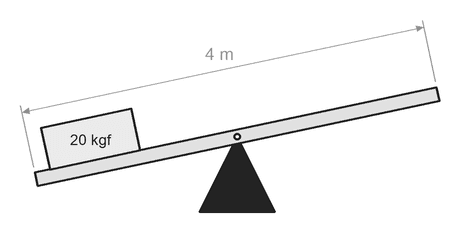
How can it be brought to the horizontal position by a man weighing 40 kgf.
Solve with AIWritten solution
Solution:
Concept: A see-saw is pivoted at its middle. The man must sit on the opposite side to the boy, at a distance where his moment equals the boy's moment. Principle of moments: when a body is in equilibrium under several forces, the sum of the anticlockwise moments about the pivot equals the sum of the clockwise moments (their algebraic sum is zero).
Given: See-saw 4 m long, pivoted at its middle; boy 20 kgf at one end; man 40 kgf.
Step 1 — Find the boy's distance.
The see-saw is 4 m long, so the boy at one end is 4 ÷ 2 = 2 m from the pivot.
Step 2 — Apply the principle of moments.
Let the man sit at a distance d on the other side.
Step 3 — Solve for d.
Divide both sides by 40 kgf.
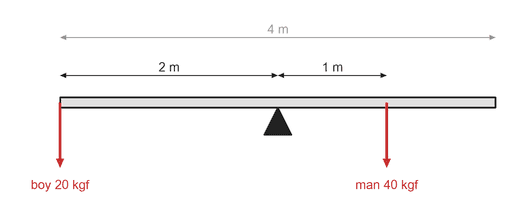
Watch out: The man must sit on the OTHER side of the pivot; on the boy's side he would push that end down further.
Therefore, the man should sit 1 m from the centre, on the side opposite to the boy.
- 523 marks
Question 52
A physical balance has its arms of length 60 cm and 40 cm.
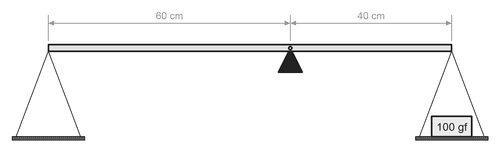
What weight kept on the pan of the longer arm will balance an object of weight 100 gf kept on the other pan ?
Solve with AIWritten solution
Solution:
Concept: A physical balance is a lever pivoted at its central knife edge. With unequal arms, the weights in the two pans balance when their moments about the knife edge are equal. Principle of moments: when a body is in equilibrium under several forces, the sum of the anticlockwise moments about the pivot equals the sum of the clockwise moments (their algebraic sum is zero).
Given: Arms 60 cm and 40 cm; object of weight 100 gf on the pan of the shorter arm.
Step 1 — Set up the balance.
The weight W is on the pan of the longer arm (60 cm), and the 100 gf object is on the pan of the shorter arm (40 cm).
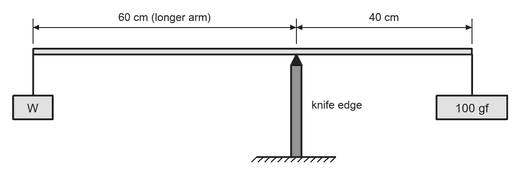
Step 2 — Apply the principle of moments.
Equate the moments about the knife edge.
Step 3 — Solve for W.
Divide both sides by 60 cm.
Watch out: A SMALLER weight is enough on the longer arm, because it acts at a larger distance from the knife edge.
Therefore, a weight of 66.67 gf on the pan of the longer arm balances the 100 gf object.
- 534 marks
Question 53
The diagram in Fig. 1.34 shows a uniform metre rule weighing 100 gf, pivoted at its centre O. Two weights 150 gf and 250 gf hang from the points A and B respectively of the metre rule such that OA = 40 cm and OB = 20 cm. Calculate : (i) the total anticlockwise moment about O, (ii) the total clockwise moment about O, (iii) the difference of anticlockwise and clockwise moments, and (iv) the distance from O where a 100 gf weight should be placed to balance the metre rule.
 Solve with AI
Written solution
Solution:
Concept: The rule is pivoted at its centre, so its own weight (100 gf) has no moment about O. A weight on the left of O gives an anticlockwise moment; one on the right gives a clockwise moment.
Given: Uniform metre rule of weight 100 gf pivoted at its centre O; 150 gf at A, OA = 40 cm; 250 gf at B, OB = 20 cm.
Step 1 — (i) Total anticlockwise moment.
150 gf hangs at A, 40 cm to the left of O.
Step 2 — (ii) Total clockwise moment.
250 gf hangs at B, 20 cm to the right of O.
Step 3 — (iii) Difference.
Subtract the clockwise moment from the anticlockwise moment.
Step 4 — (iv) Place the 100 gf.
It must supply the missing clockwise moment of 1000 gf cm, so it goes to the right of O at a distance d.

Check: The clockwise moments now add up to the anticlockwise moment.
Watch out: The rule's own 100 gf weight acts at O and has no moment; do not include it in the moments.
Therefore, (i) 6000 gf cm, (ii) 5000 gf cm, (iii) 1000 gf cm, and (iv) the 100 gf weight goes 10 cm to the right of O, on the side of B.
- 543 marks
Question 54
A uniform metre rule of weight 10 gf is pivoted at its 0 mark.

(i) What moment of force depresses the rule ?
(ii) How can it be made horizontal by applying a least force ?
Solve with AIWritten solution
Solution:
Concept: A uniform rule (or bar) has its weight acting at its mid-point, its centre of gravity. If the pivot is at that mid-point, the rule's own weight has no moment about the pivot. The least balancing force is the one with the largest possible perpendicular distance from the pivot.
Given: Uniform metre rule of weight 10 gf, pivoted at its 0 mark.
Step 1 — (i) Moment that depresses the rule.
The rule's weight of 10 gf acts at its 50 cm mark, 50 cm from the pivot at the 0 mark.
With the pivot on the left, this moment is clockwise.
Step 2 — (ii) Choose where the least force acts.
The least force is needed when it acts at the greatest distance from the pivot, the 100 cm mark, and vertically upward, against the weight.
Step 3 — Apply the principle of moments.
Its moment must equal the moment of the weight.
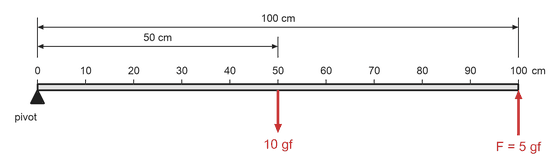
Watch out: The weight of a uniform rule acts at its MIDDLE (50 cm), not at the end.
Therefore, (i) a moment of 500 gf cm depresses the rule, and (ii) a least force of 5 gf applied vertically upward at the 100 cm mark makes it horizontal.
- 554 marks
Question 55
A uniform half metre rule can be balanced at the 29·0 cm mark when a mass 20 g is hung from its one end.
(a) Draw a diagram of the arrangement.
(b) Find the mass of the half metre rule.
(c) In which direction would the balancing point shift if 20 g mass is shifted inside from its one end ?
Solve with AIWritten solution
Solution:
Concept: A half metre rule is 50 cm long, so its weight acts at its mid-point, the 25 cm mark. The balance point (29 cm) is on the side of the 50 cm end, so the 20 g mass hangs from the 50 cm end. Principle of moments: when a body is in equilibrium under several forces, the sum of the anticlockwise moments about the pivot equals the sum of the clockwise moments (their algebraic sum is zero).
Given: Uniform half metre rule balanced at the 29 cm mark with 20 g hung from one end.
Step 1 — (a) Draw the arrangement.
The rule rests on a knife edge at the 29 cm mark, its weight Mg acts at 25 cm, and 20 g hangs at the 50 cm end.
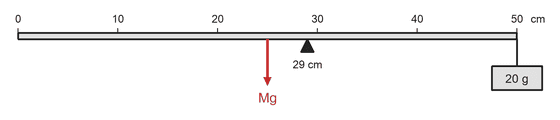
Step 2 — Find the distances from the knife edge.
The rule's weight acts 29 − 25 = 4 cm to the left; the 20 g acts 50 − 29 = 21 cm to the right.
Step 3 — (b) Apply the principle of moments.
Equate the moments (g cancels on both sides, so masses can be used).
Step 4 — (c) Shift of the balancing point.
If the 20 g mass is moved inward from the end, its distance from the balance point falls, so its moment falls. The rule's own weight now has the larger moment and the rule tips towards the 25 cm side. To balance again, the support must move towards the rule's own centre of gravity, that is, towards the 25 cm mark. For example, with the 20 g at the 40 cm mark the new balance point is at 27.4 cm.
Watch out: The rule's mass acts at its OWN middle (25 cm for a half metre rule), not at 50 cm.
Therefore, (b) the mass of the half metre rule is 105 g, and (c) the balancing point shifts towards the 25 cm mark (the centre of the rule).
- 564 marks
Question 56
A uniform metre rule of mass 100 g is balanced on a fulcrum at mark 40 cm by suspending an unknown mass m at the mark 20 cm.

(i) Find the value of m.
(ii) To which side the rule will tilt if the mass m is moved to the mark 10 cm ?
(iii) What is the resultant moment now ?
(iv) How can it be balanced by another mass of 50 g ?
Solve with AIWritten solution
Solution:
Concept: The weight of the uniform rule (100 gf) acts at its 50 cm mark, 10 cm to the right of the fulcrum at 40 cm, so it gives a clockwise moment. The mass m on the left gives an anticlockwise moment. Principle of moments: when a body is in equilibrium under several forces, the sum of the anticlockwise moments about the pivot equals the sum of the clockwise moments (their algebraic sum is zero).
Given: Uniform metre rule of mass 100 g; fulcrum at 40 cm; mass m at 20 cm.
Step 1 — (i) Find m.
m is at the 20 cm mark, 40 − 20 = 20 cm to the left of the fulcrum.
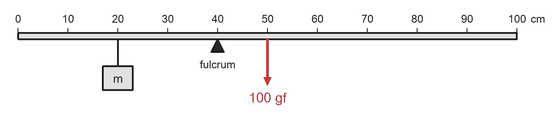
Step 2 — (ii) Moments with m at the 10 cm mark.
m is now 40 − 10 = 30 cm from the fulcrum.
The anticlockwise moment is larger, so the rule tilts towards the side of the mass m (the 0 cm end).
Step 3 — (iii) Resultant moment.
Subtract the clockwise moment from the anticlockwise moment.
It is anticlockwise.
Step 4 — (iv) Balance with another 50 g.
The 50 g must add a clockwise moment of 500 gf cm on the right of the fulcrum.
10 cm to the right of the 40 cm mark is the 50 cm mark.
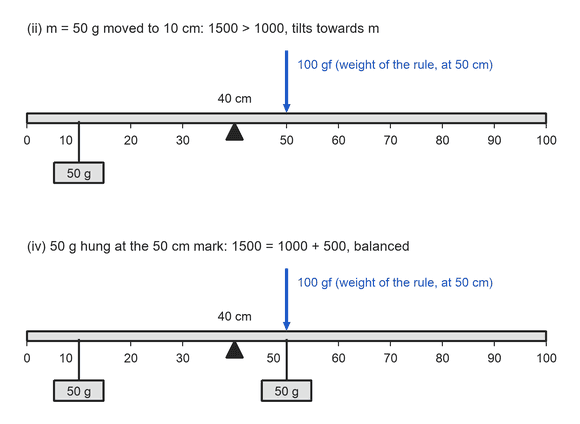
Watch out: The rule's weight acts at 50 cm, 10 cm from the fulcrum, so it DOES have a moment here.
Therefore, (i) m = 50 g, (ii) the rule tilts towards m, (iii) the resultant moment is 500 gf cm anticlockwise, and (iv) the extra 50 g is hung at the 50 cm mark.
- 573 marks
Question 57
In Fig. 1.35, a uniform bar of length l m is supported at its ends and loaded by a weight W kgf at its middle. In equilibrium, find the reactions and at the ends.
[Hint : In equilibrium and ]
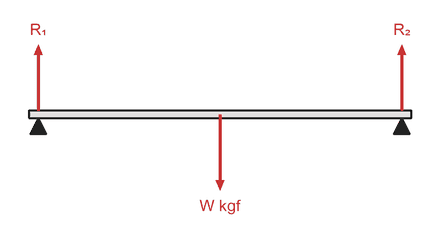 Solve with AI
Written solution
Solution:
Concept: The bar is in equilibrium, so both conditions hold: the upward forces balance the downward force, and the moments about any point cancel.
Given: Uniform bar of length l m supported at its ends; load W kgf at its middle.
Step 1 — Use the force condition.
The two reactions R₁ and R₂ act upward at the ends and the load W acts downward at the middle (as in the hint, only the load W is considered).
Step 2 — Use the moment condition about the middle.
R₁ and R₂ are each l/2 from the middle, on opposite sides, so they turn the bar in opposite senses and their moments must be equal.
Step 3 — Solve the two equations.
Put R₁ = R₂ into the force condition.
Since R₂ is equal to R₁:
Watch out: Take moments about the point where the unknown you do NOT want acts (here W at the middle), so that it drops out.
Note: the bar's own weight also acts at the middle and would be shared in the same way.
Therefore, each reaction is W/2 kgf (R₁ and R₂ are equal): the load at the middle is shared equally by the two supports.
- 581 mark
Question 58
With respect to centre of gravity, which of the following statements are correct ?
Solve with AIAnswer
(A) The position of centre of gravity of a body depends on its shape.
(B) It is not necessary that the centre of gravity of a body should always be within the material of the body.
(C) A body of weight W can be considered as a point particle of weight W at its centre of gravity.
- Correct
(D) All of the above
Answer: (D) All of the above
Concept: The centre of gravity (C.G.) of a body is the point through which the whole weight of the body acts, however the body is placed. It is the point about which the algebraic sum of the moments of the weights of all the particles of the body is zero. Its position depends on how the mass of the body is spread out.
Step 1 — Check statement (A).
It is true. The C.G. depends on the shape, that is, on the distribution of mass. A straight wire has its C.G. at its middle; bend the same wire into a ring and the C.G. moves to the centre of the ring.
Step 2 — Check statement (B).
It is true. The C.G. need not lie in the material: for a ring it is at the centre, where there is no material.
Step 3 — Check statement (C).
It is true. The whole weight W acts at the C.G., so the body can be treated as a point particle of weight W placed at its C.G.
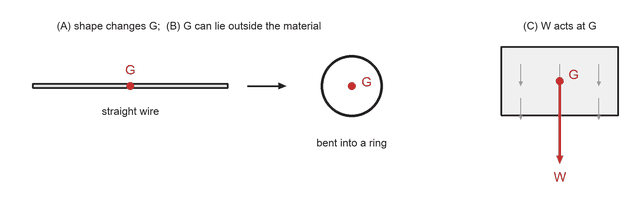
Step 4 — Choose the option.
All three statements are correct, so the answer is the option that includes all of them.
Watch out: When every listed statement is true, a single statement is an incomplete answer.
Why the other options are wrong:
- (A) The position of centre of gravity of a body depends on its shape: it is true but incomplete: (B) and (C) are also correct.
- (B) It is not necessary that the centre of gravity of a body should always be within the material of the body: it is true but incomplete: (A) and (C) are also correct.
- (C) A body of weight W can be considered as a point particle of weight W at its centre of gravity: it is true but incomplete: (A) and (B) are also correct.
Therefore, all three statements are correct, option (D).
- 591 mark
Question 59
The centre of gravity of a body is the point about which the algebraic sum of moments of weights of all the particles constituting the body is :
Solve with AIAnswer
(A) 1
(B) > 1
(C) < 1
- Correct
(D) 0
Answer: (D) 0
Concept: The centre of gravity (C.G.) of a body is the point through which the whole weight of the body acts, however the body is placed. It is the point about which the algebraic sum of the moments of the weights of all the particles of the body is zero.
Step 1 — Look at the moments of the particles.
Every particle of the body has a weight acting vertically down. About the C.G., the particles on one side turn the body anticlockwise and those on the other side turn it clockwise.
Step 2 — Add them.
At the C.G. these moments exactly cancel, so their algebraic sum is 0. That is why a body supported at its C.G. stays balanced, like a metre rule on a knife edge at its 50 cm mark.

Watch out: A moment of 1 (or any non-zero value) would turn the body, so only zero fits the definition.
Why the other options are wrong:
- (A) 1: a non-zero sum of moments would turn the body about that point, so it could not balance there.
- (B) > 1: any sum greater than zero would also turn the body, so the point would not be the C.G.
- (C) < 1: it includes non-zero values such as 0.5, which would still turn the body; only exactly zero works.
Therefore, the algebraic sum of the moments about the C.G. is 0, option (D).
- 601 mark
Question 60
The centre of gravity of a hollow cone of heigth h is at distance x from its vertex where the value of x is :
Solve with AIAnswer
(A)
(B)
- Correct
(C)
(D)
Answer: (C)
Concept: For a hollow cone of height h, the C.G. lies on its axis at a height h/3 from the base (Selina's table). The question asks for the distance from the vertex.
Step 1 — Start from the base.
The C.G. is at a distance h/3 from the base, measured along the axis.
Step 2 — Measure from the vertex.
The vertex is a distance h from the base, so subtract.

Step 3 — Check that it makes sense.
Most of the material of a hollow cone's wall is near the wide base, so the C.G. should be nearer the base than the vertex, and 2h/3 from the vertex is indeed nearer the base.
Watch out: Read whether the distance is asked from the BASE or from the VERTEX.
Why the other options are wrong:
- (A) : h/3 is the distance from the base, not from the vertex.
- (B) : h/4 is the distance of a solid cone's C.G. from its base; it would put a hollow cone's C.G. near the narrow tip, where there is the least material.
- (D) : 3h/4 is the distance of a solid cone's C.G. from its vertex (h/4 from the base), not of a hollow cone.
Therefore, x = 2h/3, option (C).
- 611 mark
Question 61
Where should the centre of gravity of a body be located for stable equilibrium ?
Solve with AIAnswer
(A) above the base
(B) near the geometric centre
(C) can be anywhere
- Correct
(D) both (A) and (B)
Answer: (D) both (A) and (B)
Concept: Selina's rule: for stable equilibrium the centre of gravity of a body must be as low as possible, the vertical line through it must fall within the base, and it should be near the geometric centre of the body.
Step 1 — Why above the base.
If the body is tipped slightly, the vertical line through its C.G. still falls within the base. The weight then has a moment that turns the body back to its original position.
Step 2 — Why near the geometric centre (and low).
A C.G. near the centre of the body and low down needs a large tilt before the vertical through it leaves the base, so the body does not topple easily.
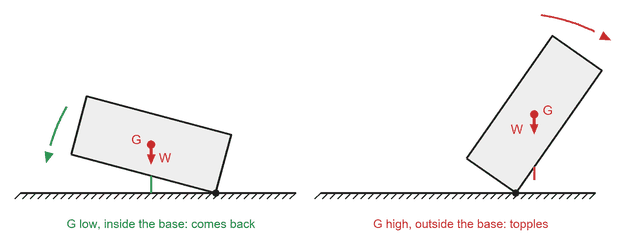
Step 3 — Choose the option.
Both conditions (A) and (B) are needed, so the answer is (D).
Watch out: A C.G. above the base but high up still topples easily; the C.G. must be low as well.
Why the other options are wrong:
- (A) above the base: it misses the second condition the book gives (near the geometric centre).
- (B) near the geometric centre: it misses the main condition: if the vertical through the C.G. falls outside the base, the body topples.
- (C) can be anywhere: if the vertical through the C.G. falls outside the base, the weight turns the body over, so it cannot be anywhere.
Therefore, the C.G. should be above the base and near the geometric centre, option (D).
- 621 mark
Question 62
Two objects have the same mass but different shapes. Which object would have a higher centre of gravity?
Solve with AIAnswer
(A) the one with a larger base
- Correct
(B) the one with a smaller base
(C) both would have the same centre of gravity
(D) it depends on the material of the obejct
Answer: (B) the one with a smaller base
Concept: The C.G. lies where the mass of a body is concentrated. For the same mass, a body with a smaller base must be taller, so more of its mass is higher up.
Step 1 — Look at the body with the larger base.
It is short and spread out, with most of its mass near the ground, so its C.G. is low.
Step 2 — Look at the body with the smaller base.
The same mass is stacked upward, so its C.G. is high. That is also why it topples more easily.
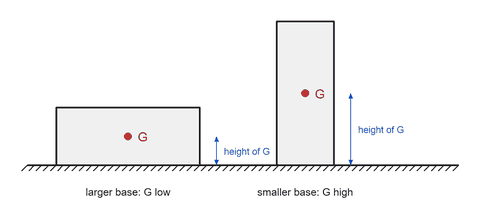
Why the other options are wrong:
- (A) the one with a larger base: a larger base keeps the mass low, so its C.G. is lower, not higher.
- (C) both would have the same centre of gravity: the C.G. depends on the shape of the body, so two different shapes need not have it at the same height.
- (D) it depends on the material of the obejct: for the same mass, it is the shape (the way the mass is spread), not the material, that decides the height of the C.G.
Therefore, the object with the smaller base has the higher centre of gravity, option (B).
- 631 mark
Question 63
Can the centre of gravity of a body be situated outside its material ? Give an example.
Solve with AIWritten solution
Solution:
Concept: The centre of gravity (C.G.) of a body is the point through which the whole weight of the body acts, however the body is placed. It is the point about which the algebraic sum of the moments of the weights of all the particles of the body is zero. It depends on how the mass is spread, so it can be at a point with no material.
Step 1 — Answer the question.
Yes, the centre of gravity of a body can lie outside its material.
Step 2 — Give an example.
The C.G. of a ring is at its centre, where there is no material. Other examples are a hollow sphere (C.G. at its centre) and an L-shaped rod (C.G. in the empty corner between its two arms).

Therefore, yes: the C.G. of a ring lies at its centre, outside its material.
- 642 marks
Question 64
What is the position of the centre of gravity of a :
(a) rectangular lamina (b) cylinder ?
Solve with AIWritten solution
Solution:
Concept: For a uniform regular body, the C.G. is at its geometric centre, where its lines of symmetry meet.
Step 1 — (a) Rectangular lamina.
The C.G. is at the point of intersection of its diagonals. The two diagonals cut each other in half, and this point is the centre of the rectangle.
Step 2 — (b) Cylinder.
The C.G. is at the mid-point of its axis, on the axis at a distance L/2 from each end (L = length of the cylinder).

Therefore, the C.G. is (a) at the intersection of the diagonals of a rectangular lamina and (b) at the mid-point of the axis of a cylinder.
- 652 marks
Question 65
At which point is the centre of gravity situated in :
(a) a triangular lamina and (b) a circular lamina ?
Solve with AIWritten solution
Solution:
Concept: For a uniform lamina, the C.G. is the point where the lines that divide its mass equally meet.
Step 1 — (a) Triangular lamina.
The C.G. is at the point of intersection of its medians (the centroid). A median joins a vertex to the mid-point of the opposite side; the three medians meet at one point.
Step 2 — (b) Circular lamina.
The C.G. is at its centre, where its diameters meet.
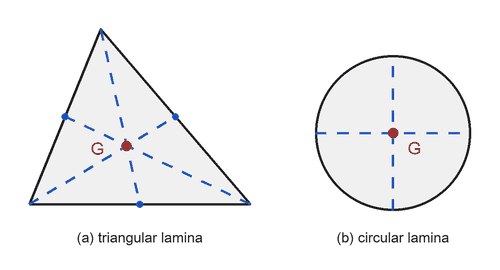
Therefore, the C.G. of (a) a triangular lamina is at the intersection of its medians and (b) a circular lamina is at its centre.
- 661 mark
Question 66
Where is the centre of gravity of a uniform ring situated ?
Solve with AIWritten solution
Solution:
Concept: The mass of a uniform ring is spread evenly round its circle, so its C.G. is at the geometric centre.
Step 1 — Locate the centre of gravity.
The C.G. of a uniform ring is at the centre of the ring.
Step 2 — Notice where it is.
There is no material at that point: the C.G. of a ring lies outside its material.
Therefore, the centre of gravity of a uniform ring is at its centre.
- 672 marks
Question 67
State whether the following statements are true or false.
(i) 'The position of the centre of gravity of a body remains unchanged even when the body is deformed.'
(ii) 'The centre of gravity of a freely suspended body always lies vertically below the point of suspension'.
Solve with AIWritten solution
Solution:
Concept: The C.G. depends on how the mass of a body is distributed, and a freely suspended body rests only when its weight has no moment about the point of suspension.
Step 1 — (i) Statement about deforming.
False. When a body is deformed, its mass is redistributed, so its C.G. shifts. For example, the C.G. of a straight wire is at its middle; when the wire is bent into a U, the C.G. moves off the wire, between its arms.
Step 2 — (ii) Statement about suspension.
True. The weight of a freely suspended body acts at its C.G. If the C.G. were to one side, the weight would have a moment about the point of suspension and the body would swing. It comes to rest only when the C.G. is vertically below the point of suspension, so that the weight passes through that point and its moment is zero.
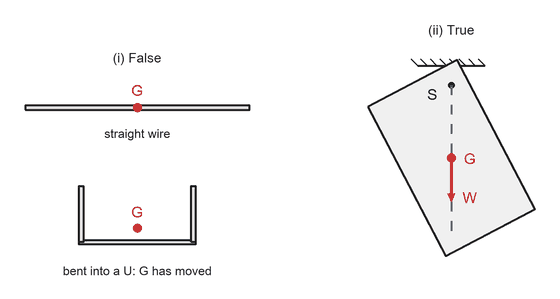
Therefore, (i) is false and (ii) is true.
- 682 marks
Question 68
Define the term 'centre of gravity of a body'.
Solve with AIWritten solution
Solution:
Concept: A body is made of many particles, each with its own weight. All these weights can be replaced by a single weight W acting at one point, the centre of gravity.
Step 1 — Define it.
The centre of gravity (C.G.) of a body is the point about which the algebraic sum of the moments of the weights of all the particles constituting the body is zero.
Step 2 — Explain its meaning.
The entire weight of the body can be considered to act at this point, however the body is placed. For example, a uniform metre rule has its C.G. at the 50 cm mark, and it balances on a knife edge placed there.

Therefore, the centre of gravity is the point about which the algebraic sum of the moments of the weights of all the particles of the body is zero, so the whole weight acts there.
- 693 marks
Question 69
State a factor on which the position of the centre of gravity of a body depends. Explain your answer with an example.
Solve with AIWritten solution
Solution:
Concept: The C.G. is the point where the whole weight of the body acts, so it depends on where the mass of the body is.
Step 1 — Name the factor.
For a body of given mass, the position of the C.G. depends on its shape, that is, on the distribution of mass (of particles) in it. If the body is deformed, its C.G. changes.
Step 2 — Give an example.
For a uniform straight rod, the C.G. is at its mid-point, on the rod itself. If the same rod is bent into a circular ring, its mass is spread round the circle and the C.G. moves to the centre of the ring, outside the material.
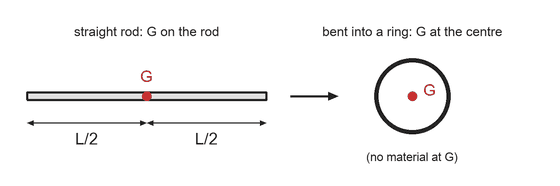
Step 3 — Draw the conclusion.
The mass of the rod is unchanged; only its shape has changed, and this has shifted the C.G.
Therefore, the position of the C.G. depends on the shape (distribution of mass) of the body, as a straight rod bent into a ring shows.
- 702 marks
Question 70
A square card board is suspended by passing a pin through a narrow hole at its one corner. Draw a diagram to show its rest position. In the diagram, mark the point of suspension by the letter S and the centre of gravity by the letter G.
Solve with AIWritten solution
Solution:
Concept: A freely suspended body comes to rest with its centre of gravity vertically below the point of suspension. Only then does its weight pass through the point of suspension, so it has no moment to turn the body.
Step 1 — Find G.
The C.G. of a uniform square card is at the point where its diagonals intersect, its centre.
Step 2 — Find the rest position.
The card is held at the corner S, so it swings until G is directly below S. The line from S to G is the diagonal through S, so the card hangs with that diagonal vertical and the square looks like a diamond.

Step 3 — See why it settles there.
If the card is turned aside, G moves to one side of the vertical through S. The weight W acting at G then has a moment about S that swings the card back, until G is again vertically below S and the moment is zero.

Therefore, the card rests with the diagonal through S vertical and G (the centre) vertically below S.
- 712 marks
Question 71
Humans bend forward when they carry a heavy load on their back. Give reason.
Solve with AIWritten solution
Solution:
Concept: A person stays balanced only while the vertical line through the combined centre of gravity (body + load) falls within the base formed by the feet.
Step 1 — Effect of the load.
A heavy load on the back adds weight behind the body, so the combined C.G. of the body and the load shifts backward.
Step 2 — If the person stood upright.
The vertical line through this C.G. would fall behind the heels, outside the base. The weight would then have a moment that turns the person backward, and the person would fall.
Step 3 — Bending forward.
By bending forward, the person moves the upper body and the load forward, bringing the combined C.G. back over the feet. The vertical line through it falls within the base again, and the person stays in stable equilibrium.
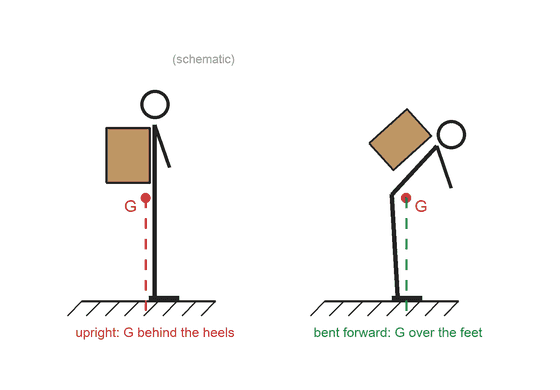
Therefore, a person bends forward with a load on the back to keep the combined centre of gravity above the feet, so as not to fall backward.
- 723 marks
Question 72
You are assigned to look after a loading of a cargo ship with containers marked A and B. The A type containers are 50% more heavier than B type containers. What precaution would you take and why so that the ship sails smoothly even in rougher seas ?
Solve with AIWritten solution
Solution:
Concept: A body is more stable when its centre of gravity is low. A ship with a low C.G. rights itself when it rolls; a ship with a high C.G. can capsize.
Step 1 — State the precaution.
Load the heavier A-type containers at the bottom (in the lowest holds or decks), and place the lighter B-type containers above them.
Step 2 — Why: it lowers the centre of gravity.
The A-type containers are one and a half times as heavy as the B-type ones. Keeping this heavier load low brings the centre of gravity of the loaded ship down. (For two layers of containers, the C.G. of the cargo is at 0.9 container heights with A below, but at 1.1 with A on top.)
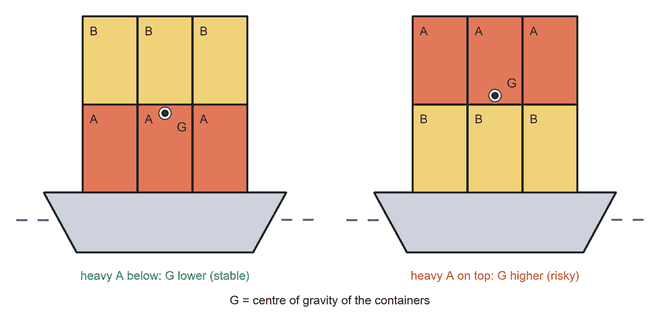
Step 3 — Why: a low C.G. restores the ship.
When the ship rolls in rough seas, its weight acting at a low C.G. produces a restoring moment that brings the ship back upright, so it does not capsize.
Step 4 — Why not the other way.
If the heavy containers were on top, the C.G. would be high. Then even a small tilt could carry the line of action of the weight far to one side, and the ship could overturn.
Therefore, the heavier A-type containers are loaded at the bottom and the lighter B-type on top, to keep the ship's centre of gravity low so that it sails steadily.
- 732 marks
Question 73
A uniform flat circular rim is balanced on a sharp vertical nail by supporting it at a point A, as shown in Fig. 1.41. Mark the position of the centre of gravity of the rim in the diagram by the letter G.
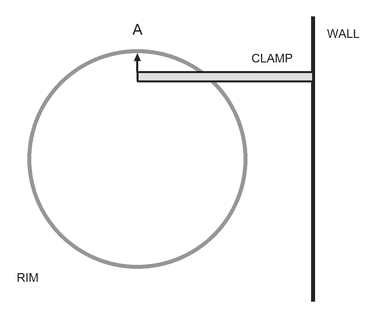 Solve with AI
Written solution
Solution:
Concept: The C.G. of a uniform circular rim is at its centre, and a body balanced at a single point rests with its C.G. on the vertical line through that point.
Step 1 — Find where the C.G. is.
For a uniform circular rim (a ring), the C.G. is at its geometric centre. It lies outside the material of the rim.
Step 2 — See why it is below A.
The rim is balanced on the nail at A. If its C.G. were not on the vertical line through A, its weight would have a moment about A and the rim would turn. So the C.G. lies vertically below A.
Step 3 — Mark G.
The centre of the rim is vertically below A, so G is marked at the centre of the rim.
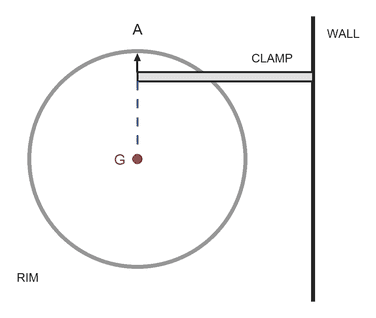
Therefore, G is at the centre of the rim, vertically below the point of support A.
- 743 marks
Question 74
Fig. 1.42 shows three pieces of card board of uniform thickness cut into three different shapes. On each diagram draw two lines to indicate the position of the centre of gravity G.
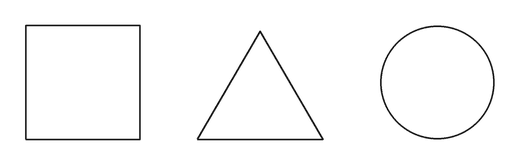 Solve with AI
Written solution
Solution:
Concept: For a uniform lamina, the C.G. lies on every line that divides it symmetrically. So it is the point where any two such lines cross; drawing two lines is enough to fix G.
Step 1 — Square.
Draw the two diagonals. G is the point where they intersect, the centre of the square.
Step 2 — Triangle.
Draw two medians (each from a vertex to the mid-point of the opposite side). G is the point where they intersect, the centroid.
Step 3 — Circle.
Draw two diameters. G is the point where they intersect, the centre of the circle.
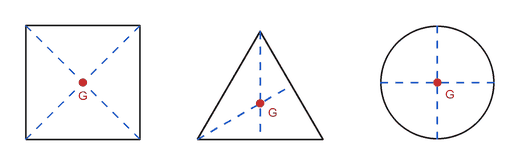
Therefore, G is where the two diagonals of the square, two medians of the triangle and two diameters of the circle intersect.
- 755 marks
Question 75
Explain how will you determine experimentally the position of the centre of gravity for a triangular lamina (or a triangular piece of card board).
Solve with AIWritten solution
Solution:
Concept: A freely suspended body comes to rest with its centre of gravity vertically below the point of suspension. So the vertical line through the point of suspension, shown by a plumb line, always passes through the C.G.
Step 1 — Apparatus.
A triangular cardboard lamina with three small holes near its corners A, B and C; a retort stand with a pin clamped horizontally; a plumb line (a thread with a small bob); a pencil.
Step 2 — First suspension.
Suspend the lamina from the pin through the hole near corner C, so that it can swing freely, and let it come to rest. Hang the plumb line from the same pin. When it comes to rest, mark two points on the lamina along the thread. Take the lamina down and join the points; this line passes through the C.G.
Step 3 — Second suspension.
Suspend the lamina from the hole near corner A and draw the plumb line in the same way.

Step 4 — Locate G.
The point G where the two lines intersect is the centre of gravity.
Step 5 — Check.
Suspend the lamina from the third hole, near B. The plumb line through it also passes through G. G lies at the point of intersection of the medians of the triangle (its centroid): each plumb line runs along a median because the lamina is uniform. As a further check, the lamina balances horizontally on a pin-point placed under G.
Step 6 — Precautions.
The lamina must swing freely on the pin; mark the plumb line only after both the lamina and the bob have come to rest; make the holes small and close to the corners.
Watch out: One suspension gives only a LINE through G; two suspensions are needed to fix the point G.
Therefore, the C.G. of the triangular lamina is the point where the plumb lines from two suspensions intersect, which is the point of intersection of its medians.
- 761 mark
Question 76
Which of the following quantities remains constant in a uniform circular motion ?
Solve with AIAnswer
(A) Velocity
- Correct
(B) Speed
(C) Acceleration
(D) Both velocity and speed
Answer: (B) Speed
Concept: In uniform circular motion a body moves along a circle with constant speed. Its direction of motion at any instant is along the tangent to the circle, so the direction keeps changing, and with it the velocity (velocity has size and direction).
Step 1 — Check the speed.
The body covers equal distances along the circle in equal intervals of time, so its speed is constant.
Step 2 — Check the velocity.
At every point the body moves along the tangent to the circle there, and the tangent changes from point to point. So the direction of motion, and hence the velocity, keeps changing.
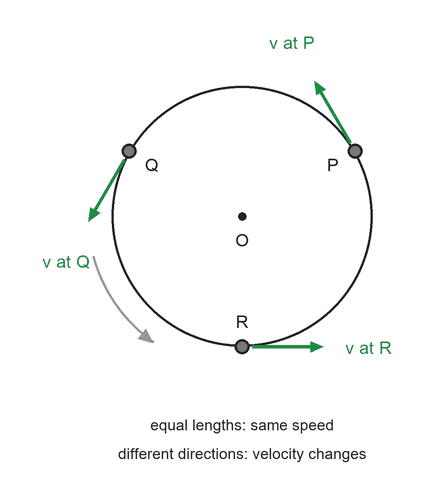
Watch out: Speed and velocity are not the same: speed has only size, velocity has size AND direction.
Why the other options are wrong:
- (A) Velocity: the size of the velocity stays the same, but its direction changes at every point, so it is not constant.
- (C) Acceleration: the acceleration always points towards the centre, so its direction keeps changing as the body goes round; it is not constant.
- (D) Both velocity and speed: it is wrong because the velocity changes.
Therefore, only the speed remains constant, option (B).
- 771 mark
Question 77
The direction of motion in circular motion :
Solve with AIAnswer
(A) is linear
- Correct
(B) is along the tangent at that point of the circular path
(C) towards the centre
(D) none of these
Answer: (B) is along the tangent at that point of the circular path
Concept: At any instant, a body moving in a circle is moving in the direction of the tangent to the circle at its position. The tangent is at right angles to the radius at that point.
Step 1 — Use a simple test.
If the string of a whirled stone is let go, the stone does not fly outward along the radius; it flies off along the tangent at the point of release.
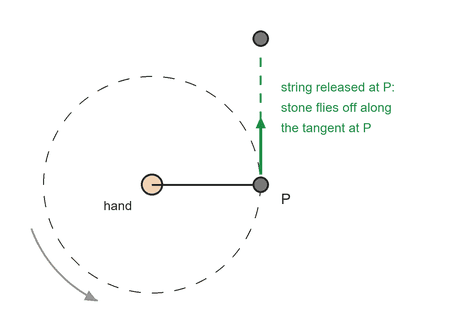
Step 2 — Draw the conclusion.
So the direction of motion at each instant is along the tangent. As the body moves on, the tangent turns, so the direction of motion keeps changing.
Why the other options are wrong:
- (A) is linear: the path is a circle, not a straight line; the direction does not stay fixed.
- (C) towards the centre: towards the centre is the direction of the centripetal force (and of the acceleration), not of the motion.
- (D) none of these: it is wrong because option (B) is correct.
Therefore, the direction of motion is along the tangent at that point of the circular path, option (B).
- 781 mark
Question 78
The direction of centripetal force is always :
Solve with AIAnswer
(A) along the tangent at that point of the circular path
- Correct
(B) towards the centre
(C) outwards from the centre
(D) none of the above
Answer: (B) towards the centre
Concept: 'Centripetal' means centre-seeking. The centripetal force is the force needed to keep a body moving in a circle.
Step 1 — See what happens without it.
Left to itself, the body would move straight on along the tangent. To keep it turning round the circle, a force must keep pulling it inward.
Step 2 — State the direction.
So the centripetal force acts along the radius, towards the centre of the circle, at right angles to the velocity at every point.
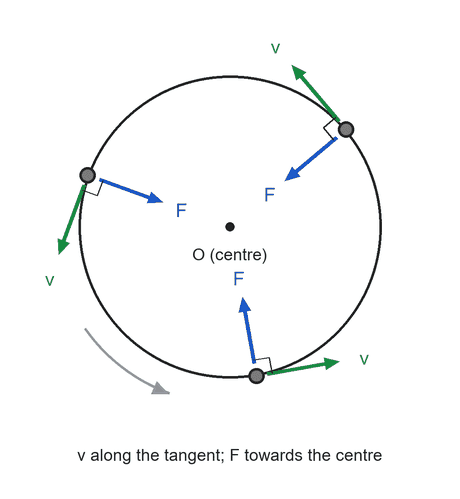
Why the other options are wrong:
- (A) along the tangent at that point of the circular path: along the tangent is the direction of the velocity, not of the centripetal force.
- (C) outwards from the centre: outwards from the centre is the direction of the fictitious centrifugal force.
- (D) none of the above: it is wrong because option (B) is correct.
Therefore, the centripetal force always acts towards the centre, option (B).
- 791 mark
Question 79
Centrifugal force is :
Solve with AIAnswer
(A) a real force
(B) the force of reaction of centripetal force
- Correct
(C) a fictitious force
(D) directed towards the centre of the circular path :
Answer: (C) a fictitious force
Concept: A fictitious (imaginary) force is one that no real body exerts. It is only assumed by an observer who is himself moving in a circle (in a rotating frame), to explain what he sees.
Step 1 — Take the rotating observer's view.
An observer moving with the rotating body sees the body at rest, even though the centripetal force pulls it inward.
Step 2 — See what he imagines.
To explain this balance, he imagines an equal force on the body acting away from the centre. This imagined outward force is the centrifugal force.
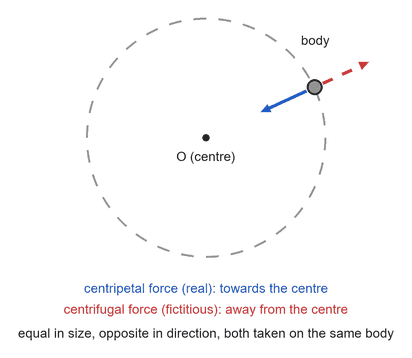
Watch out: The centrifugal force is not the reaction of the centripetal force: both are taken on the SAME body.
Why the other options are wrong:
- (A) a real force: no real body exerts it, so it is not a real force.
- (B) the force of reaction of centripetal force: a reaction always acts on a different body, but the centrifugal force is imagined to act on the same body as the centripetal force.
- (D) directed towards the centre of the circular path :: it is directed away from the centre, not towards it.
Therefore, centrifugal force is a fictitious force, option (C).
- 801 mark
Question 80
The difference between centripetal and centrifugal force is :
Solve with AIAnswer
(A) they both act in the same direction
- Correct
(B) they both act in opposite directions
(C) they both have different magnitudes
(D) none of the above
Answer: (B) they both act in opposite directions
Concept: A body moves in a circle only if a force pulls it towards the centre all the time: the centripetal force. The centrifugal force is a fictitious force, imagined only by an observer who moves round with the body; it is equal in size to the centripetal force and acts away from the centre.
Step 1 — Compare the directions.
Both act along the same radius, but one points in and the other points out, so they act in opposite directions.
Step 2 — Compare the sizes.
Their sizes are equal. That is why, for an observer moving with the body, they balance and the body appears to be at rest.
Why the other options are wrong:
- (A) they both act in the same direction: one acts towards the centre and the other away from it, so they are not in the same direction.
- (C) they both have different magnitudes: their magnitudes are equal (ratio 1 : 1).
- (D) none of the above: it is wrong because option (B) is correct.
Therefore, centripetal and centrifugal forces act in opposite directions, option (B).
- 811 mark
Question 81
Which of the following is an example of uniform circular motion ?
Solve with AIAnswer
(A) a car accelerating on a straight road
(B) a pendulum swinging back and forth
- Correct
(C) a satellite orbiting the earth at a constant altitude
(D) a ball rolling down a hill
Answer: (C) a satellite orbiting the earth at a constant altitude
Concept: Uniform circular motion needs two things: the path is a circle, and the speed is constant.
Step 1 — Check the path.
At a constant altitude the satellite stays at the same distance from the centre of the earth, so its path is a circle.
Step 2 — Check the speed.
It moves round this circle with a constant speed. The earth's gravitational pull, directed towards the earth's centre, provides the centripetal force.
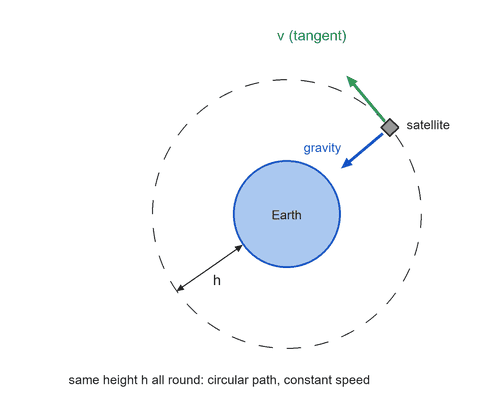
Why the other options are wrong:
- (A) a car accelerating on a straight road: a car accelerating on a straight road moves in a straight line, and its speed changes.
- (B) a pendulum swinging back and forth: a pendulum moves back and forth along an arc, and its speed changes (largest at the lowest point, zero at the ends), so its motion is not uniform circular motion.
- (D) a ball rolling down a hill: a ball rolling down a hill speeds up and does not move in a circle.
Therefore, a satellite orbiting the earth at a constant altitude is in uniform circular motion, option (C).
- 821 mark
Question 82
Assertion (A) : When a beam is in static equilibrium, the sum of clockwise moments is equal to the sum of anticlockwise moments.
Reason (R) : According to the principle of moments for a body in equilibrium, the sum of moments acting in one direction must be equal to the sum of moments in opposite direction.
Solve with AIAnswer
- Correct
(A) both A and R are true and R is the correct explanation of A
(B) both A and R are True and R is not the correct explanation of A
(C) assertion is false but reason is true
(D) assertion is true but reason is false
Answer: (A) both A and R are true and R is the correct explanation of A
Concept: Principle of moments: when a body is in equilibrium under several forces, the sum of the anticlockwise moments about the pivot equals the sum of the clockwise moments (their algebraic sum is zero).
Step 1 — Judge the assertion.
It is true. A beam in static equilibrium does not turn, so the moments turning it one way must exactly balance those turning it the other way.
Step 2 — Judge the reason.
It is true: it is the statement of the principle of moments.
Step 3 — Does R explain A?.
Yes. The assertion is just the principle of moments applied to a beam. For example, on a metre rule pivoted at its middle:

Why the other options are wrong:
- (B) both A and R are True and R is not the correct explanation of A: R is not a separate fact; it is the very rule that makes A true, so it does explain A.
- (C) assertion is false but reason is true: the assertion is true, not false.
- (D) assertion is true but reason is false: the reason is true, not false.
Therefore, both A and R are true and R is the correct explanation of A, option (A).
- 831 mark
Question 83
Assertion (A) : A heavier object placed at a far distance from the pivot point will have the same moment as a lighter object placed close to the pivot point.
Reason (R) : The moment of force is determined by the magnitude of the force along with its distance from the pivot point.
Solve with AIAnswer
(A) both A and R are true and R is the correct explanation of A
(B) both A and R are True and R is not the correct explanation of A
- Correct
(C) assertion is false but reason is true
(D) assertion is true but reason is false
Answer: (C) assertion is false but reason is true
Concept: The turning effect of a force is called its moment (or torque): moment of force = force × perpendicular distance of its line of action from the axis of rotation, τ = F × d. Its S.I. unit is the newton metre (N m). Both factors matter.
Step 1 — Judge the assertion.
It is false. A heavier object at a greater distance has both factors larger, so its moment is greater, not the same. For example, 40 gf at 40 cm gives 1600 gf cm, but 10 gf at 10 cm gives only 100 gf cm. Equal moments need the heavier object closer to the pivot:
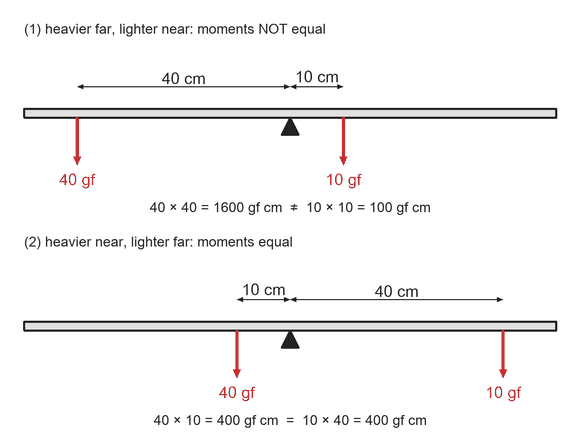
Step 2 — Judge the reason.
It is true: the moment depends on the size of the force and on its distance from the pivot.
Why the other options are wrong:
- (A) both A and R are true and R is the correct explanation of A: it is wrong because the assertion is false.
- (B) both A and R are True and R is not the correct explanation of A: it is wrong because the assertion is false.
- (D) assertion is true but reason is false: it has it the wrong way round: the assertion is false and the reason is true.
Therefore, the assertion is false but the reason is true, option (C).
- 841 mark
Question 84
Assertion (A) : The centre of gravity of an irregularly- shaped object always lies at its geometric centre.
Reason (R) : The centre of gravity depends on the distribution of mass within an object.
Solve with AIAnswer
(A) both A and R are true and R is the correct explanation of A
(B) both A and R are True and R is not the correct explanation of A
- Correct
(C) assertion is false but reason is true
(D) assertion is true but reason is false
Answer: (C) assertion is false but reason is true
Concept: The centre of gravity (C.G.) of a body is the point through which the whole weight of the body acts, however the body is placed. It is the point about which the algebraic sum of the moments of the weights of all the particles of the body is zero. Its position depends on the shape of the body and on how its mass is distributed.
Step 1 — Judge the assertion.
It is false. Only for a uniform, symmetrical body (a uniform rod, square plate or sphere) does the C.G. lie at the geometric centre. In an irregular body the mass is unevenly spread, so the C.G. shifts towards the heavier part. A hammer has its C.G. near its heavy iron head, not at the middle of its length.

Step 2 — Judge the reason.
It is true: the C.G. depends on the distribution of mass, and that is exactly why the assertion fails.
Why the other options are wrong:
- (A) both A and R are true and R is the correct explanation of A: it is wrong because the assertion is false.
- (B) both A and R are True and R is not the correct explanation of A: it is wrong because the assertion is false.
- (D) assertion is true but reason is false: it has it the wrong way round: the assertion is false and the reason is true.
Therefore, the assertion is false but the reason is true, option (C).
- 851 mark
Question 85
Is it possible to have an accelerated motion with a constant speed ? Name such type of motion.
Solve with AIWritten solution
Solution:
Concept: Acceleration is the rate of change of velocity, and velocity has both size and direction.
Step 1 — Answer the question.
Yes. If only the direction of motion changes, the velocity changes even though the speed stays the same, so the body is accelerated.
Step 2 — Name the motion.
This is uniform circular motion. For example, the tip of the second hand of a clock moves at constant speed, but its direction of motion changes at every point.
Therefore, yes: uniform circular motion is accelerated motion with constant speed.
- 861 mark
Question 86
Give an example of motion in which speed remains uniform, but the velocity changes.
Solve with AIWritten solution
Solution:
Concept: Speed has only size; velocity has size and direction. If the direction changes, the velocity changes even at constant speed.
Step 1 — Give the example.
Uniform circular motion: for example, the motion of the tip of the second hand of a clock, or of a stone whirled in a circle at constant speed.
Step 2 — Explain it.
The speed is constant, but the direction of motion (along the tangent) changes at every point, so the velocity changes.
Therefore, uniform circular motion, such as the tip of a clock's second hand, has uniform speed but changing velocity.
- 871 mark
Question 87
Name the force required for circular motion. State its direction.
Solve with AIWritten solution
Solution:
Concept: A body moves in a straight line unless a force changes its direction. To keep it going round a circle, a force must keep pulling it inward.
Step 1 — Name the force.
The force required for circular motion is the centripetal force.
Step 2 — State its direction.
It acts along the radius, towards the centre of the circular path, at right angles to the velocity at every point.
Therefore, circular motion needs a centripetal force, directed towards the centre of the circle.
- 881 mark
Question 88
Is centrifugal force a real force ?
Solve with AIWritten solution
Solution:
Concept: A body moves in a circle only if a force pulls it towards the centre all the time: the centripetal force. The centrifugal force is a fictitious force, imagined only by an observer who moves round with the body; it is equal in size to the centripetal force and acts away from the centre.
Step 1 — Answer the question.
No. Centrifugal force is a fictitious (imaginary) force.
Step 2 — Explain why.
No real body exerts it. Only an observer moving along with the rotating body imagines it, acting away from the centre, to explain why the body appears to be at rest in his rotating frame.
Therefore, centrifugal force is not a real force; it is fictitious.
- 892 marks
Question 89
State whether the following statements are true or false by writing T/F against them.
(a) Earth moves around Sun with a uniform velocity.
(b) The motion of Moon around Earth in a circular path is an accelerated motion.
(c) A uniform linear motion is unaccelerated, while a uniform circular motion is an accelerated motion.
(d) In a uniform circular motion, the speed continuously changes because the direction of motion changes.
(e) A boy experiences a centrifugal force on his hand when he rotates a piece of stone tied at one end of a string, holding the other end in the hand.
Solve with AIWritten solution
Solution:
Concept: Velocity has size and direction. A change in either one is a change of velocity, that is, an acceleration. In circular motion the direction keeps changing.
Step 1 — (a) Earth round the sun.
F. The direction of the earth's motion keeps changing as it goes round the sun, so its velocity is not uniform. At most its speed is nearly uniform.
Step 2 — (b) Moon round the earth.
T. The direction of the moon's velocity changes continuously, so its motion is accelerated, with the acceleration towards the earth.
Step 3 — (c) Linear versus circular.
T. In uniform linear motion neither the speed nor the direction changes, so there is no acceleration. In uniform circular motion the direction changes, so there is an acceleration.
Step 4 — (d) Speed in uniform circular motion.
F. The speed stays constant; only the velocity changes, because its direction changes.
Step 5 — (e) Force on the boy's hand.
F. The hand feels the real reaction of the tension in the string, pulling it towards the stone. The centrifugal force is fictitious and is imagined on the stone, not on the hand.
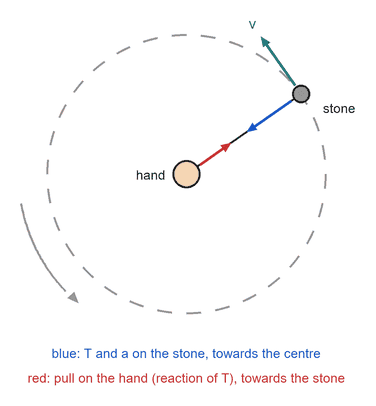
Therefore, (a) F, (b) T, (c) T, (d) F, (e) F.
- 903 marks
Question 90
Differentiate between uniform linear motion and uniform circular motion.
Solve with AIWritten solution
Solution:
Concept: In both motions the speed is constant. They differ in whether the direction of motion changes, and so in whether the velocity changes.
Step 1 — Compare the two motions.
The table compares them point by point.
Uniform linear motion Uniform circular motion The body moves along a straight line with constant speed. The body moves along a circle with constant speed. The direction of motion does not change. The direction of motion changes at every point (it is along the tangent). The velocity is constant. The velocity is variable, since its direction changes. It is an unaccelerated motion: no net force acts. It is an accelerated motion: a centripetal force acts towards the centre. Step 2 — See it in a figure.
The figure shows constant velocity along a line and changing velocity round a circle.
Therefore, uniform linear motion has constant velocity and no acceleration, while uniform circular motion has changing velocity and is accelerated.
- 912 marks
Question 91
What is a centripetal force ?
Solve with AIWritten solution
Solution:
Concept: A body moving in a circle keeps changing direction, so a force must keep pulling it towards the centre.
Step 1 — Define it.
When a body moves in a circular path, a force acts on it along the radius towards the centre of the circle. This centre-seeking force is called the centripetal force.
Step 2 — State what it does.
It keeps changing the direction of the body's velocity, and so keeps the body on the circular path. Without it, the body would fly off along the tangent.
Step 3 — Name its sources.
It is not a new kind of force; some real force provides it:
- the tension in the string, for a stone whirled on a string;
- the gravitational pull of the earth, for the moon;
- friction between the tyres and the road, for a car turning a corner.
Therefore, the centripetal force is the force acting on a body in circular motion along the radius towards the centre.
- 923 marks
Question 92
Explain the motion of a planet around the sun in an elliptical path.
Solve with AIWritten solution
Solution:
Concept: Any body moving along a curved path needs a force towards the centre of the curve, a centripetal force. For a planet, the sun's gravity supplies it.
Step 1 — The path.
A planet moves round the sun along an elliptical path, which is nearly circular.
Step 2 — The force.
The centripetal force is provided by the gravitational force of attraction between the sun and the planet. It acts along the line joining the planet to the sun and is directed towards the sun.
Step 3 — The motion.
At every instant the planet tends to move straight on along the tangent to its path. The sun's pull continuously changes the direction of its velocity, so the planet keeps going round the sun instead of flying off in a straight line.
Therefore, the sun's gravitational pull on the planet acts as the centripetal force that keeps it moving round the sun in its elliptical path.
- 933 marks
Question 93
(a) How does a centripetal force differ from a centrifugal force with reference to the direction in which they act ?
(b) Is centrifugal force the force of reaction of the centripetal force ?
(c) Compare the magnitudes of centripetal and centrifugal force.
Solve with AIWritten solution
Solution:
Concept: A body moves in a circle only if a force pulls it towards the centre all the time: the centripetal force. The centrifugal force is a fictitious force, imagined only by an observer who moves round with the body; it is equal in size to the centripetal force and acts away from the centre.
Step 1 — (a) Direction.
They act in opposite directions. The centripetal force acts towards the centre of the circular path, while the centrifugal force is imagined to act away from the centre.
Step 2 — (b) Is it the reaction?.
No. Action and reaction always act on two different bodies. The centrifugal force is taken to act on the same body that moves in the circle, so it cannot be the reaction of the centripetal force. (It is not a real force at all.)
Step 3 — (c) Magnitudes.
They are equal in magnitude: centripetal force : centrifugal force = 1 : 1.
Therefore, (a) they act in opposite directions, (b) the centrifugal force is not the reaction of the centripetal force, and (c) their magnitudes are equal (1 : 1).
- 942 marks
Question 94
State two differences between centripetal and centrifugal force.
Solve with AIWritten solution
Solution:
Concept: The two forces differ in whether they are real, and in their direction.
Step 1 — First difference: real or fictitious.
The centripetal force is a real force, provided by tension, gravity, friction and so on. The centrifugal force is a fictitious (imaginary) force, assumed only by an observer moving with the rotating body.
Step 2 — Second difference: direction.
The centripetal force acts towards the centre of the circular path; the centrifugal force acts away from the centre.
Step 3 — Note what they share.
Both have the same size, so for an observer moving with the body they balance each other.
Therefore, the centripetal force is real and acts towards the centre, while the centrifugal force is fictitious and acts away from the centre.
- 954 marks
Question 95
Explain the meaning of uniform circular motion. Why is such motion said to be accelerated ?
Solve with AIWritten solution
Solution:
Concept: Acceleration is the rate of change of velocity. Velocity has size and direction, so a change in direction alone is enough to make a motion accelerated.
Step 1 — Meaning of uniform circular motion.
When a particle moves along a circular path with a constant speed, covering equal distances along the circle in equal intervals of time, its motion is called uniform circular motion.
Step 2 — The direction keeps changing.
At every point the particle moves along the tangent to the circle at that point. As it moves round, the tangent, and hence the direction of motion, keeps changing. In the figure, the velocities v₁ at A and v₂ at B have the same size but different directions.
Step 3 — So the velocity changes.
Even though the speed is constant, the velocity changes continuously. A change of velocity with time is an acceleration, so uniform circular motion is an accelerated motion.
Step 4 — Direction of the acceleration.
The change in velocity, v₂ − v₁, points towards the centre, so the acceleration is directed towards the centre of the circle.
Therefore, uniform circular motion is motion along a circle at constant speed, and it is accelerated because the direction, and so the velocity, changes at every instant.
- 963 marks
Question 96
Draw a neat labelled diagram for a particle moving in a circular path with a constant speed. In your diagram show the direction of velocity at any instant.
Solve with AIWritten solution
Solution:
Concept: At any instant a body moving in a circle moves along the tangent to the circle at its position. At constant speed the velocity arrows have the same length everywhere but point in different directions.
Step 1 — Draw the diagram.
The particle moves anticlockwise round the circle with centre O at constant speed. At each position A, B, C and D the velocity v is drawn along the tangent to the circle at that point.
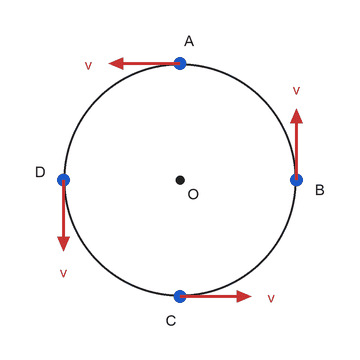
Step 2 — Read the diagram.
The arrows are of equal length, because the speed is constant, but they point in different directions.
Step 3 — State the direction of velocity.
At any instant the velocity is along the tangent to the circle at the particle's position, perpendicular to the radius there. Since this direction changes from point to point, the velocity keeps changing even though the speed does not.
Therefore, the velocity at any instant is along the tangent to the circular path at the particle's position.
- 975 marks
Question 97
A uniform circular motion is an accelerated motion. Explain it. State whether the acceleration is uniform or variable ? Name the force responsible to cause this acceleration. What is the direction of force at any instant ? Draw a diagram in support of your answer.
Solve with AIWritten solution
Solution:
Concept: Acceleration is the rate of change of velocity. In uniform circular motion the speed is constant but the direction of motion changes all the time, so the velocity changes.
Step 1 — Why it is accelerated.
The speed is constant, but the direction of motion, along the tangent, changes at every point. So the velocity changes continuously, and a body whose velocity changes is accelerated.
Step 2 — Uniform or variable.
The acceleration is variable. Its magnitude stays the same, but its direction, always towards the centre, keeps changing as the body moves round. An acceleration is uniform only if both its size and its direction stay the same.
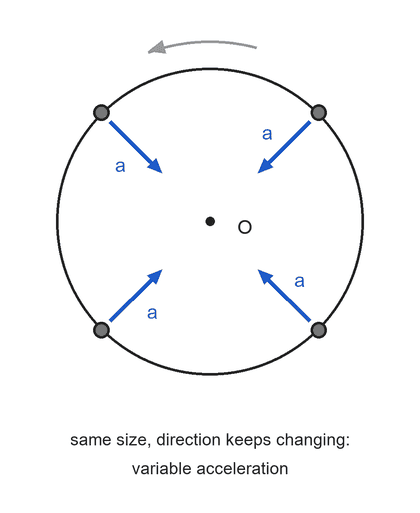
Step 3 — Force responsible.
The centripetal force causes this acceleration.
Step 4 — Direction of the force.
At every instant it acts along the radius towards the centre of the circle, perpendicular to the velocity. In the diagram, at P the velocity v is along the tangent and the centripetal force F is along PO, towards the centre O.
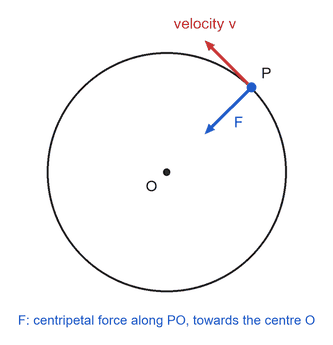
Watch out: Constant SIZE of acceleration is not enough for uniform acceleration; its direction must also stay fixed.
Therefore, uniform circular motion is accelerated, its acceleration is variable (constant in size, changing in direction), and it is caused by the centripetal force acting towards the centre at every instant.
- 984 marks
Question 98
A small pebble tied at one end of a string is placed near the periphery of a circular disc, at the centre of which the other end of the string is tied to a peg. The disc is rotating about an axis passing through its centre.
(a) What will be your observation when you are standing outside the disc ? Explain.
(b) What will be your observation when you are standing at the centre of the disc ? Explain.
Solve with AIWritten solution
Solution:
Concept: An observer at rest (outside the disc) explains the motion with the real centripetal force alone. An observer rotating with the disc sees the pebble at rest, and has to imagine an outward centrifugal force to balance the tension.
Step 1 — (a) Observation from outside.
Standing outside the disc, at rest, I see the pebble moving in a circular path along with the disc.
Step 2 — (a) Explanation.
The pebble tends to move along the tangent, but the tension in the string, directed towards the peg at the centre, provides the centripetal force. This keeps pulling it towards the centre, so it keeps going round in a circle.
Step 3 — (b) Observation from the centre.
Standing at the centre and rotating with the disc, I see the pebble stationary, always at the same place on the disc in front of me.
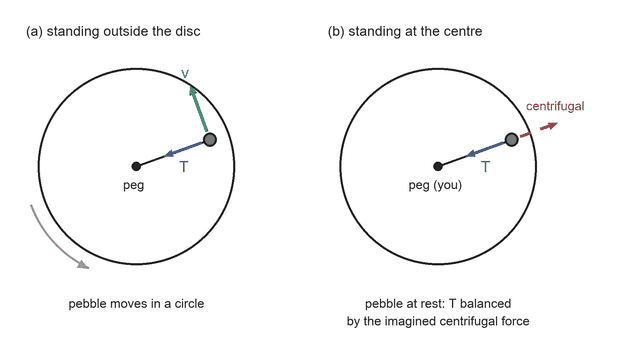
Step 4 — (b) Explanation.
In my rotating frame, I see the string pulling the pebble inward with a tension, yet the pebble does not move towards me. To explain this I imagine an outward centrifugal force on the pebble, equal and opposite to the tension, which balances it. This centrifugal force is fictitious; it appears only because I am rotating with the disc.
Therefore, (a) from outside the pebble is seen moving in a circle under the centripetal force (the tension), and (b) from the centre it is seen at rest, the tension being balanced by an imagined centrifugal force.
- 995 marks
Question 99
A piece of stone tied at the end of a thread is whirled in a horizontal circle with uniform speed by hand. Answer the following questions :
(a) Is the velocity of stone uniform or variable ?
(b) Is the acceleration of stone uniform or variable?
(c) What is the direction of acceleration of stone at any instant ?
(d) Which force provides the centripetal force required for circular motion ?
(e) Name the force and its direction which acts on the hand.
Solve with AIWritten solution
Solution:
Concept: The stone moves at constant speed, but its direction of motion changes at every point. The tension in the thread pulls it towards the centre and keeps it on the circle.
Step 1 — (a) Velocity.
Variable. The speed is constant, but the direction of motion (along the tangent) changes at every point, so the velocity changes.
Step 2 — (b) Acceleration.
Variable. Its magnitude is constant, but its direction, towards the centre, changes continuously as the stone goes round.
Step 3 — (c) Direction of acceleration.
Towards the centre of the circular path, along the radius (along the thread, towards the hand).
Step 4 — (d) Source of the centripetal force.
The tension in the thread provides it.
Step 5 — (e) Force on the hand.
The reaction of the tension acts on the hand. The stone pulls the thread, and the thread pulls the hand outward, away from the centre of the circular path, towards the stone.
Watch out: This outward pull on the hand is a REAL force (the reaction of the tension); the centrifugal force is a different, fictitious force imagined on the stone by an observer moving with it.
Therefore, (a) velocity variable, (b) acceleration variable, (c) towards the centre, (d) tension in the thread, and (e) the reaction of the tension acts on the hand, outward towards the stone.
What Class 10 Physics Ch 1 covers
The sections of the chapter, in the order the book takes them. Every question above comes from one of these.
- 01Translational and Rotational Motions
- 02Moment (Turning Effect) of a Force or Torque
- 03Couple
- 04Equilibrium of Bodies
- 05Principle of Moments
- 06Centre of Gravity
More ways to study this chapter
The same chapter asked three other ways. Practise it, revise it, and see what the board has set on Ch 1 before.
- Competency-Based Questions (CBQ)Case study questions: a situation, and the part of the chapter that answers it.40questionsOpen
- Previous Year QuestionsQuestions that have actually appeared in board papers, each tagged with its year.33questionsOpen
- Practice QuestionsExtra questions per chapter, for when one attempt at a method is not enough.44questionsOpen
Ch 1 in past ICSE papers
The same chapter as the board has actually asked it. These are worded differently from the textbook exercise, which is the point of reading them.
- 13 marks
Board paper question 1
A stone of mass 'm' is rotated in a circular path with a uniform speed by tying a strong string with the help of your hand. Answer the following questions:
(i) Is the stone moving with a uniform or variable speed?
(ii) Is the stone moving with a uniform acceleration? In which direction does the acceleration act?
(iii) What kind of force acts on the hand and state its direction?
Solve with AIWritten solution
Solution:
Concept: In uniform circular motion the speed stays the same, but the direction of motion changes at every point, so the velocity changes and the body is accelerated. The acceleration, and the force causing it (the centripetal force), act along the radius, towards the centre of the circle.
Given: A stone of mass m whirled in a circle on a string with a uniform speed.
Step 1 — Part (i): look at the speed.
The question says the stone goes round with a uniform speed, so the distance it covers every second stays the same. Its speed is uniform. Only the direction of its motion keeps changing, so its velocity is not uniform.
Step 2 — Part (ii): decide whether the acceleration is uniform.
Acceleration is the rate of change of velocity. The velocity changes in direction all the time, so the stone is accelerated. The size of this acceleration stays the same, but its direction keeps turning as the stone goes round. A quantity whose direction changes is not uniform, so the acceleration is not uniform; it is variable.
Step 3 — Part (ii): find its direction.
At every instant the acceleration acts along the string, towards the centre of the circular path (towards the hand). That is why it is called the centripetal acceleration.
Step 4 — Part (iii): find the force on the hand.
The string pulls the stone towards the centre with a tension T; this tension is the centripetal force on the stone. By Newton's third law the stone pulls back on the string with an equal force, and the string passes this pull to the hand. So the hand feels an outward pull, away from the centre, along the string towards the stone.
Watch out: Uniform speed does not mean uniform velocity or uniform acceleration: both change direction all the time.
Note: Many answer keys name the outward pull on the hand the "centrifugal force". Strictly, the centrifugal force is the fictitious force imagined on the stone; the pull on the hand is the real reaction of the tension. Both act away from the centre.
Therefore, (i) the speed is uniform; (ii) no, the acceleration is variable (its direction changes), and it acts towards the centre of the circle; (iii) an outward pull acts on the hand, away from the centre along the string (the reaction to the tension).
- 22 marks
Board paper question 2
A brass ball is hanging from a stiff cotton thread. Draw a neat labelled diagram showing the forces acting on the brass ball and the cotton thread.
Solve with AIWritten solution
Solution:
Concept: A body at rest is in equilibrium, so the forces on it add up to zero. A stretched string pulls inwards at both its ends with the same force, called the tension T.
Step 1 — Forces on the ball.
The ball is at rest, so the forces on it must balance. Its weight W acts vertically downwards through its centre. The thread pulls it up with the tension T, acting vertically upwards at the point where the thread is tied. Since the ball is in equilibrium, T = W.
Step 2 — Forces on the thread.
The thread is pulled at both ends. At its lower end the ball pulls it downwards with a force T (the reaction to the thread's pull on the ball). At its upper end the support pulls it upwards with an equal force T. These two equal and opposite pulls keep the thread stretched; this stretched state is its tension.
Step 3 — Draw the labelled diagram.
The diagram shows the arrangement, the two forces on the ball, and the two forces on the thread, each with its direction:

Watch out: The tension on the ball acts upwards (the thread pulls the ball up), while the ball pulls the thread downwards.
Therefore, on the ball: weight W downwards and tension T upwards (T = W); on the thread: a downward pull T by the ball at its lower end and an upward pull T by the support at its upper end.
- 32 marks
Board paper question 3
Why is a jack screw provided with a long arm?
Solve with AIWritten solution
Solution:
Concept: The moment of a force (its turning effect) about a point is the force multiplied by the perpendicular distance of its line of action from that point: moment = F × d. Its S.I. unit is the newton metre (N m); gf cm and kgf m are also used.
Step 1 — Write the turning effect.
To turn the screw of the jack, the effort must produce a certain moment about the axis of the screw:
Here F is the effort applied at the end of the arm and d is the perpendicular distance of its line of action from the axis of the screw.
Step 2 — See what a long arm does.
The moment needed to turn the screw is fixed by the load on the jack. Since F = moment ÷ d, a larger d means a smaller F. A long arm makes d large, so a small effort gives the large moment needed.
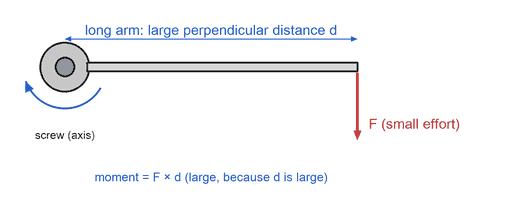
Step 3 — Say why this helps.
So a person can turn the screw with a small force and raise a heavy load such as a car.
Watch out: A long arm does not reduce the moment needed; it reduces the force needed to produce it.
Therefore, a jack screw has a long arm so that the perpendicular distance d of the effort from the axis is large; then a small effort produces the large moment of force (= F × d) needed to turn the screw and lift a heavy load.
- 43 marks
Board paper question 4
A uniform half metre rule balances horizontally on a knife edge at 29 cm mark when a weight of 20 gf is suspended from one end.
(i) Draw a diagram of the arrangement.
(ii) What is the weight of the half metre rule?
Solve with AIWritten solution
Solution:
Concept: The weight of a uniform rule acts at its middle (its centre of gravity): the 50 cm mark of a metre rule and the 25 cm mark of a half metre rule. Principle of moments: when a body is in equilibrium under several forces, the sum of the anticlockwise moments about any point equals the sum of the clockwise moments about the same point.
Given: Uniform half metre rule; knife edge at the 29 cm mark; 20 gf hung from one end.
Step 1 — Find where the weight of the rule acts.
The half metre rule is uniform, so its weight W acts at its middle, the 25 cm mark.
Step 2 — Decide where the 20 gf hangs.
The knife edge (29 cm) is to the right of the 25 cm mark, so W turns the rule anticlockwise. To balance it, the 20 gf must turn the rule clockwise, so it hangs from the right-hand end, the 50 cm mark.
Step 3 — Part (i): draw the arrangement.
The diagram shows the knife edge at 29 cm, the weight W at 25 cm and the 20 gf at the 50 cm end:
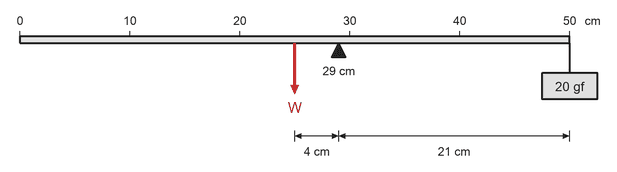
Step 4 — Part (ii): find the two arms.
We measure each distance from the knife edge:
Step 5 — Part (ii): apply the principle of moments.
The anticlockwise moment of W equals the clockwise moment of the 20 gf:
Step 6 — Check the answer.
The rule's weight acts only 4 cm from the knife edge, so it must be much heavier than the 20 gf that acts 21 cm away. 105 gf × 4 cm = 420 gf cm, and 20 gf × 21 cm = 420 gf cm, so the moments match.
Watch out: Measure every arm from the pivot (knife edge), not from the 0 cm end of the scale.
Therefore, (i) knife edge at 29 cm, the rule's weight W at 25 cm and the 20 gf at the 50 cm end; (ii) the weight of the half metre rule is 105 gf.
- 53 marks
Board paper question 5
A half metre rod is pivoted at the centre with two weights of 20 gf and 12 gf suspended at a perpendicular distance of 6 cm and 10 cm from the pivot respectively as shown below.
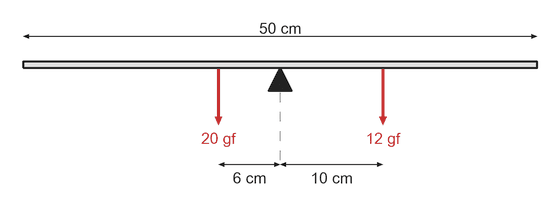
(i) Which of the two forces acting on the rigid rod causes clockwise moment?
(ii) Is the rod in equilibrium?
(iii) The direction of 20 gf force is reversed. What is the magnitude of the resultant moment of the forces on the rod?
Solve with AIWritten solution
Solution:
Concept: The moment of a force (its turning effect) about a point is the force multiplied by the perpendicular distance of its line of action from that point: moment = F × d. Its S.I. unit is the newton metre (N m); gf cm and kgf m are also used. Principle of moments: when a body is in equilibrium under several forces, the sum of the anticlockwise moments about any point equals the sum of the clockwise moments about the same point.
Given: 20 gf at 6 cm and 12 gf at 10 cm from the pivot at the centre of a half metre rod.
Step 1 — Part (i): find the clockwise force.
A downward force on the right of the pivot turns the rod clockwise, and one on the left turns it anticlockwise. In the figure the 12 gf hangs on the right, so the 12 gf causes the clockwise moment; the 20 gf, on the left, causes an anticlockwise moment. The rod's own weight acts at the pivot (its centre), so it has no moment.
Step 2 — Part (ii): work out the two moments.
Each moment is the force times its distance from the pivot:
Step 3 — Part (ii): compare them.
The anticlockwise and clockwise moments are equal, so by the principle of moments the rod is in equilibrium.
Step 4 — Part (iii): reverse the 20 gf.
Now the 20 gf acts upwards on the left of the pivot, so it also turns the rod clockwise. Both moments are now in the same sense, so they add:

Watch out: When a force is reversed its moment changes sense: the moments no longer cancel, they add.
Therefore, (i) the 12 gf force causes the clockwise moment; (ii) yes, the rod is in equilibrium (120 gf cm each way); (iii) the resultant moment is 240 gf cm (clockwise).
- 62 marks
Board paper question 6
(i) Define couple.
(ii) State the S.I. unit of moment of couple.
Solve with AIWritten solution
Solution:
Concept: A couple is a pair of equal and opposite parallel forces whose lines of action are not the same. Their resultant is zero, so they do not move the body as a whole, but they turn it. Moment of the couple = either force × the perpendicular distance between the two lines of action (the couple arm).
Step 1 — Part (i): define a couple.
Two equal and opposite parallel forces, not acting along the same line, form a couple.
Step 2 — Part (i): see what it does.
The two forces cancel as far as moving the body is concerned (their resultant is zero), but both turn the body in the same sense. So a couple produces rotation only. Turning a steering wheel with both hands, or opening a water tap, are examples.

Step 3 — Part (ii): find the unit.
The moment of a couple is a force multiplied by a distance:
So its S.I. unit is newton × metre, the newton metre (N m).
Watch out: The arm of a couple is the perpendicular distance between the two forces, not the distance from one force to the centre.
Therefore, (i) a couple is a pair of equal and opposite parallel forces not acting along the same line; it produces rotation only; (ii) the S.I. unit of the moment of a couple is the newton metre (N m).
All 33 board paper questions for this chapter, solved the same way.
Class 10 Physics Ch 1 questions students ask
How many questions are there in Class 10 Physics Ch 1?
99 questions. Every one is solved step by step on this page.
Are these Class 10 Physics solutions free?
Yes. Every question and its full working is free to read, with no account needed.
Can I download the Class 10 Physics Ch 1 solutions as a PDF?
There is no PDF to download. Every solution is on this page instead, which means it is searchable, always the current syllabus, and readable on a phone. Use your browser's print option if you want it on paper.