Solution:
Concept: The moment of a force (its turning effect) about a point is the force multiplied by the perpendicular distance of its line of action from that point: moment = F × d. Its S.I. unit is the newton metre (N m); gf cm and kgf m are also used. Principle of moments: when a body is in equilibrium under several forces, the sum of the anticlockwise moments about any point equals the sum of the clockwise moments about the same point.
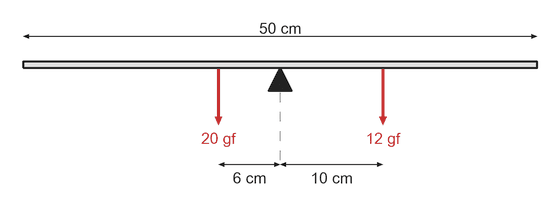
Given: 20 gf at 6 cm and 12 gf at 10 cm from the pivot at the centre of a half metre rod.
Step 1 — Part (i): find the clockwise force.
A downward force on the right of the pivot turns the rod clockwise, and one on the left turns it anticlockwise. In the figure the 12 gf hangs on the right, so the 12 gf causes the clockwise moment; the 20 gf, on the left, causes an anticlockwise moment. The rod's own weight acts at the pivot (its centre), so it has no moment.
Step 2 — Part (ii): work out the two moments.
Each moment is the force times its distance from the pivot:
anticlockwise moment=20×6=120 gf cm
clockwise moment=12×10=120 gf cm
Step 3 — Part (ii): compare them.
The anticlockwise and clockwise moments are equal, so by the principle of moments the rod is in equilibrium.
Step 4 — Part (iii): reverse the 20 gf.
Now the 20 gf acts upwards on the left of the pivot, so it also turns the rod clockwise. Both moments are now in the same sense, so they add:

resultant moment=20×6+12×10=120+120=240 gf cm
Watch out: When a force is reversed its moment changes sense: the moments no longer cancel, they add.
Therefore, (i) the 12 gf force causes the clockwise moment; (ii) yes, the rod is in equilibrium (120 gf cm each way); (iii) the resultant moment is 240 gf cm (clockwise).