
Opening your dashboard
Class 10 Physics Chapter 1 Force: Previous Year Questions
33 questions on Chapter 1, each solved step by step. Class 10 Physics, ICSE 2026-27.
33 questions with solutions
1–3 marks · Mixed difficulty
- 13 marks
Question 1
A stone of mass 'm' is rotated in a circular path with a uniform speed by tying a strong string with the help of your hand. Answer the following questions:
(i) Is the stone moving with a uniform or variable speed?
(ii) Is the stone moving with a uniform acceleration? In which direction does the acceleration act?
(iii) What kind of force acts on the hand and state its direction?
Solve with AIWritten solution
Solution:
Concept: In uniform circular motion the speed stays the same, but the direction of motion changes at every point, so the velocity changes and the body is accelerated. The acceleration, and the force causing it (the centripetal force), act along the radius, towards the centre of the circle.
Given: A stone of mass m whirled in a circle on a string with a uniform speed.
Step 1 — Part (i): look at the speed.
The question says the stone goes round with a uniform speed, so the distance it covers every second stays the same. Its speed is uniform. Only the direction of its motion keeps changing, so its velocity is not uniform.
Step 2 — Part (ii): decide whether the acceleration is uniform.
Acceleration is the rate of change of velocity. The velocity changes in direction all the time, so the stone is accelerated. The size of this acceleration stays the same, but its direction keeps turning as the stone goes round. A quantity whose direction changes is not uniform, so the acceleration is not uniform; it is variable.
Step 3 — Part (ii): find its direction.
At every instant the acceleration acts along the string, towards the centre of the circular path (towards the hand). That is why it is called the centripetal acceleration.
Step 4 — Part (iii): find the force on the hand.
The string pulls the stone towards the centre with a tension T; this tension is the centripetal force on the stone. By Newton's third law the stone pulls back on the string with an equal force, and the string passes this pull to the hand. So the hand feels an outward pull, away from the centre, along the string towards the stone.
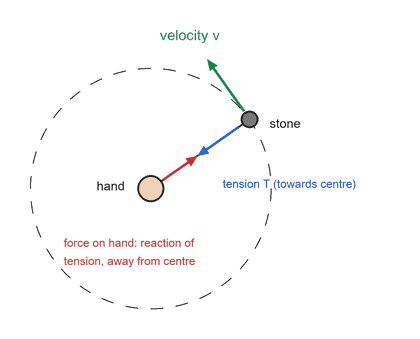
Watch out: Uniform speed does not mean uniform velocity or uniform acceleration: both change direction all the time.
Note: Many answer keys name the outward pull on the hand the "centrifugal force". Strictly, the centrifugal force is the fictitious force imagined on the stone; the pull on the hand is the real reaction of the tension. Both act away from the centre.
Therefore, (i) the speed is uniform; (ii) no, the acceleration is variable (its direction changes), and it acts towards the centre of the circle; (iii) an outward pull acts on the hand, away from the centre along the string (the reaction to the tension).
- 22 marks
Question 2
A brass ball is hanging from a stiff cotton thread. Draw a neat labelled diagram showing the forces acting on the brass ball and the cotton thread.
Solve with AIWritten solution
Solution:
Concept: A body at rest is in equilibrium, so the forces on it add up to zero. A stretched string pulls inwards at both its ends with the same force, called the tension T.
Step 1 — Forces on the ball.
The ball is at rest, so the forces on it must balance. Its weight W acts vertically downwards through its centre. The thread pulls it up with the tension T, acting vertically upwards at the point where the thread is tied. Since the ball is in equilibrium, T = W.
Step 2 — Forces on the thread.
The thread is pulled at both ends. At its lower end the ball pulls it downwards with a force T (the reaction to the thread's pull on the ball). At its upper end the support pulls it upwards with an equal force T. These two equal and opposite pulls keep the thread stretched; this stretched state is its tension.
Step 3 — Draw the labelled diagram.
The diagram shows the arrangement, the two forces on the ball, and the two forces on the thread, each with its direction:

Watch out: The tension on the ball acts upwards (the thread pulls the ball up), while the ball pulls the thread downwards.
Therefore, on the ball: weight W downwards and tension T upwards (T = W); on the thread: a downward pull T by the ball at its lower end and an upward pull T by the support at its upper end.
- 32 marks
Question 3
Why is a jack screw provided with a long arm?
Solve with AIWritten solution
Solution:
Concept: The moment of a force (its turning effect) about a point is the force multiplied by the perpendicular distance of its line of action from that point: moment = F × d. Its S.I. unit is the newton metre (N m); gf cm and kgf m are also used.
Step 1 — Write the turning effect.
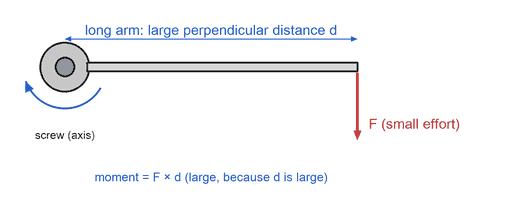
To turn the screw of the jack, the effort must produce a certain moment about the axis of the screw:
Here F is the effort applied at the end of the arm and d is the perpendicular distance of its line of action from the axis of the screw.
Step 2 — See what a long arm does.
The moment needed to turn the screw is fixed by the load on the jack. Since F = moment ÷ d, a larger d means a smaller F. A long arm makes d large, so a small effort gives the large moment needed.
Step 3 — Say why this helps.
So a person can turn the screw with a small force and raise a heavy load such as a car.
Watch out: A long arm does not reduce the moment needed; it reduces the force needed to produce it.
Therefore, a jack screw has a long arm so that the perpendicular distance d of the effort from the axis is large; then a small effort produces the large moment of force (= F × d) needed to turn the screw and lift a heavy load.
- 43 marks
Question 4
A uniform half metre rule balances horizontally on a knife edge at 29 cm mark when a weight of 20 gf is suspended from one end.
(i) Draw a diagram of the arrangement.
(ii) What is the weight of the half metre rule?
Solve with AIWritten solution
Solution:
Concept: The weight of a uniform rule acts at its middle (its centre of gravity): the 50 cm mark of a metre rule and the 25 cm mark of a half metre rule. Principle of moments: when a body is in equilibrium under several forces, the sum of the anticlockwise moments about any point equals the sum of the clockwise moments about the same point.
Given: Uniform half metre rule; knife edge at the 29 cm mark; 20 gf hung from one end.
Step 1 — Find where the weight of the rule acts.
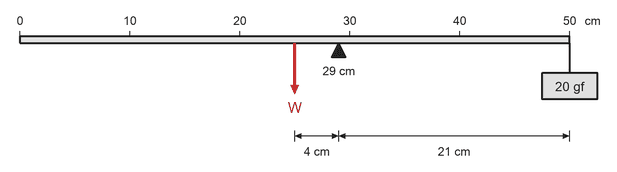
The half metre rule is uniform, so its weight W acts at its middle, the 25 cm mark.
Step 2 — Decide where the 20 gf hangs.
The knife edge (29 cm) is to the right of the 25 cm mark, so W turns the rule anticlockwise. To balance it, the 20 gf must turn the rule clockwise, so it hangs from the right-hand end, the 50 cm mark.
Step 3 — Part (i): draw the arrangement.
The diagram shows the knife edge at 29 cm, the weight W at 25 cm and the 20 gf at the 50 cm end:
Step 4 — Part (ii): find the two arms.
We measure each distance from the knife edge:
Step 5 — Part (ii): apply the principle of moments.
The anticlockwise moment of W equals the clockwise moment of the 20 gf:
Step 6 — Check the answer.
The rule's weight acts only 4 cm from the knife edge, so it must be much heavier than the 20 gf that acts 21 cm away. 105 gf × 4 cm = 420 gf cm, and 20 gf × 21 cm = 420 gf cm, so the moments match.
Watch out: Measure every arm from the pivot (knife edge), not from the 0 cm end of the scale.
Therefore, (i) knife edge at 29 cm, the rule's weight W at 25 cm and the 20 gf at the 50 cm end; (ii) the weight of the half metre rule is 105 gf.
- 53 marks
Question 5
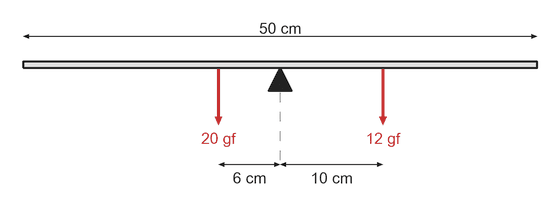
A half metre rod is pivoted at the centre with two weights of 20 gf and 12 gf suspended at a perpendicular distance of 6 cm and 10 cm from the pivot respectively as shown below.
(i) Which of the two forces acting on the rigid rod causes clockwise moment?
(ii) Is the rod in equilibrium?
(iii) The direction of 20 gf force is reversed. What is the magnitude of the resultant moment of the forces on the rod?
Solve with AIWritten solution
Solution:
Concept: The moment of a force (its turning effect) about a point is the force multiplied by the perpendicular distance of its line of action from that point: moment = F × d. Its S.I. unit is the newton metre (N m); gf cm and kgf m are also used. Principle of moments: when a body is in equilibrium under several forces, the sum of the anticlockwise moments about any point equals the sum of the clockwise moments about the same point.
Given: 20 gf at 6 cm and 12 gf at 10 cm from the pivot at the centre of a half metre rod.
Step 1 — Part (i): find the clockwise force.
A downward force on the right of the pivot turns the rod clockwise, and one on the left turns it anticlockwise. In the figure the 12 gf hangs on the right, so the 12 gf causes the clockwise moment; the 20 gf, on the left, causes an anticlockwise moment. The rod's own weight acts at the pivot (its centre), so it has no moment.
Step 2 — Part (ii): work out the two moments.
Each moment is the force times its distance from the pivot:
Step 3 — Part (ii): compare them.
The anticlockwise and clockwise moments are equal, so by the principle of moments the rod is in equilibrium.
Step 4 — Part (iii): reverse the 20 gf.
Now the 20 gf acts upwards on the left of the pivot, so it also turns the rod clockwise. Both moments are now in the same sense, so they add:

Watch out: When a force is reversed its moment changes sense: the moments no longer cancel, they add.
Therefore, (i) the 12 gf force causes the clockwise moment; (ii) yes, the rod is in equilibrium (120 gf cm each way); (iii) the resultant moment is 240 gf cm (clockwise).
- 62 marks
Question 6
(i) Define couple.
(ii) State the S.I. unit of moment of couple.
Solve with AIWritten solution
Solution:
Concept: A couple is a pair of equal and opposite parallel forces whose lines of action are not the same. Their resultant is zero, so they do not move the body as a whole, but they turn it. Moment of the couple = either force × the perpendicular distance between the two lines of action (the couple arm).
Step 1 — Part (i): define a couple.
Two equal and opposite parallel forces, not acting along the same line, form a couple.
Step 2 — Part (i): see what it does.
The two forces cancel as far as moving the body is concerned (their resultant is zero), but both turn the body in the same sense. So a couple produces rotation only. Turning a steering wheel with both hands, or opening a water tap, are examples.

Step 3 — Part (ii): find the unit.
The moment of a couple is a force multiplied by a distance:
So its S.I. unit is newton × metre, the newton metre (N m).
Watch out: The arm of a couple is the perpendicular distance between the two forces, not the distance from one force to the centre.
Therefore, (i) a couple is a pair of equal and opposite parallel forces not acting along the same line; it produces rotation only; (ii) the S.I. unit of the moment of a couple is the newton metre (N m).
- 73 marks
Question 7
A uniform metre scale is in equilibrium as shown in the diagram :
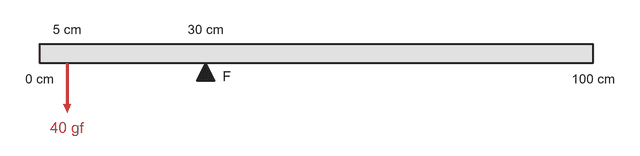
(i) Calculate the weight of the metre scale.
(ii) Which of the following options is correct to keep the ruler in equilibrium when 40 gf wt is shifted to 0 cm mark?
F is shifted towards 0 cm
or
F is shifted towards 100 cm.
Solve with AIWritten solution
Solution:
Concept: The weight of a uniform rule acts at its middle (its centre of gravity): the 50 cm mark of a metre rule and the 25 cm mark of a half metre rule. Principle of moments: when a body is in equilibrium under several forces, the sum of the anticlockwise moments about any point equals the sum of the clockwise moments about the same point.
Given: Uniform metre scale; fulcrum at 30 cm; 40 gf at the 5 cm mark.
Step 1 — Part (i): read the figure.
The scale is uniform, so its weight W acts at the 50 cm mark. The fulcrum F is at 30 cm and the 40 gf hangs at 5 cm. So the 40 gf (left of F) turns the scale anticlockwise and W (right of F) turns it clockwise.
Step 2 — Part (i): find the arms.
Each distance is measured from the fulcrum:
Step 3 — Part (i): apply the principle of moments.
The anticlockwise moment equals the clockwise moment:
Step 4 — Part (ii): see what the shift does.
With the 40 gf moved to the 0 cm mark, its arm becomes 30 cm, so its anticlockwise moment grows while the clockwise moment of the scale stays the same:
The scale would tip down at the 0 cm end.
Step 5 — Part (ii): move the fulcrum.
To balance it again, the arm of the 40 gf must get shorter and the arm of the scale's weight longer, so F must be shifted towards 0 cm. If the new fulcrum is at x cm, the principle of moments gives:
So F moves from 30 cm to about 27.8 cm, towards the 0 cm end.

Watch out: Measure every arm from the pivot (knife edge), not from the 0 cm end of the scale.
Therefore, (i) the weight of the metre scale is 50 gf; (ii) F is shifted towards 0 cm (to about the 27.8 cm mark).
- 82 marks
Question 8
(i) Define moment of force.
(ii) Write the relationship between the S.I. and C.G.S. unit of moment of force.
Solve with AIWritten solution
Solution:
Concept: The moment of a force (its turning effect) about a point is the force multiplied by the perpendicular distance of its line of action from that point: moment = F × d. Its S.I. unit is the newton metre (N m); gf cm and kgf m are also used.
Step 1 — Part (i): define the moment of a force.
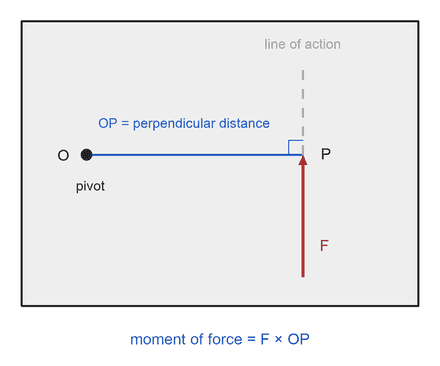
The moment of a force about an axis is the product of the magnitude of the force and the perpendicular distance of its line of action from the axis of rotation:
Here OP is the perpendicular distance from the pivot O to the line of action of F. It measures the turning effect of the force.
Step 2 — Part (ii): write the two units.
The S.I. unit is the newton metre (N m) and the C.G.S. unit is the dyne centimetre (dyne cm). We use 1 N = dyne and 1 m = cm:
Watch out: Convert both the force and the distance: , not .
Therefore, (i) the moment of a force is the force × the perpendicular distance of its line of action from the axis of rotation; (ii) 1 N m = dyne cm.
- 93 marks
Question 9
(i) With reference to the direction of action, how does a centripetal force differ from a centrifugal force during uniform circular motion?
(ii) Is centrifugal force the force of reaction of centripetal force?
(iii) Compare the magnitudes of centripetal and centrifugal force.
Solve with AIWritten solution
Solution:
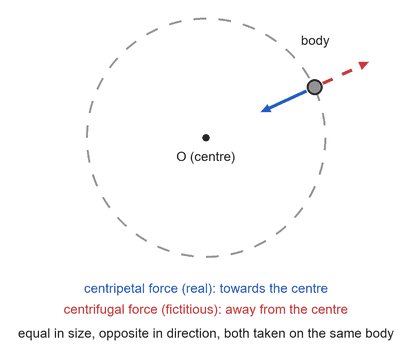
Concept: The centripetal force is a real force (tension, friction, gravity) that keeps a body on a circular path; it acts towards the centre. The centrifugal force is not a real force: an observer moving round with the body imagines it, acting on the same body, equal in size to the centripetal force and directed away from the centre.
Step 1 — Part (i): compare the directions.
The centripetal force acts towards the centre of the circular path, along the radius. The centrifugal force acts away from the centre, along the same radius. So they act in opposite directions.
Step 2 — Part (ii): test the action-reaction idea.
Action and reaction always act on two different bodies. The centrifugal force is taken to act on the same body as the centripetal force, so it cannot be its reaction. (It is not a real force at all; the real reaction of the centripetal force acts on whatever supplies it, such as the hand holding the string.)
Step 3 — Part (iii): compare the sizes.
The centrifugal force is imagined to be just large enough to cancel the centripetal force for an observer moving with the body, so the two are equal in magnitude: their ratio is 1 : 1.
Watch out: Equal and opposite forces are not automatically action and reaction; those must act on two different bodies.
Therefore, (i) the centripetal force acts towards the centre and the centrifugal force away from it; (ii) no, the centrifugal force is not the reaction of the centripetal force (both are taken on the same body); (iii) they are equal in magnitude (1 : 1).
- 101 mark
Question 10
Clockwise moment produced by a force about a fulcrum is considered to be:
Solve with AIAnswer
(A) Positive
- Correct
(B) Negative
(C) Zero
(D) None of these
Answer: (B) Negative
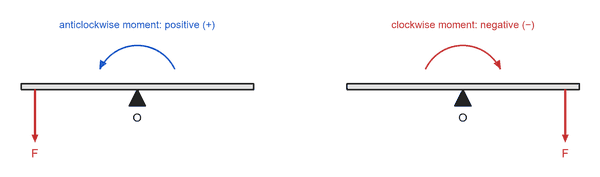
Concept: By convention an anticlockwise moment is taken as positive and a clockwise moment as negative, so moments in opposite senses can be added algebraically.
Step 1 — Recall the sign convention.
Moments in opposite senses are given opposite signs so that they can be added. In Selina and the ICSE papers, anticlockwise moments are positive and clockwise moments are negative.
Step 2 — Apply it.
A clockwise moment is therefore taken as negative, which is option (B).
Watch out: The sign is a convention for the sense of turning; it does not mean the moment is small or absent.
Why the other options are wrong:
- (A) Positive: positive is the sign given to an anticlockwise moment.
- (C) Zero: a force whose line of action does not pass through the fulcrum always has a non-zero moment; the moment is zero only when the line of action passes through the fulcrum.
- (D) None of these: the convention does give a clockwise moment a sign, negative, so 'none of these' is not right.
Therefore, a clockwise moment is considered negative, option (B).
- 112 marks
Question 11
(a) What is the position of centre of gravity of a triangular lamina?
(b) When this triangular lamina is suspended freely from any one vertex, what is the moment of force produced by its own weight in its rest position?
Solve with AIWritten solution
Solution:
Concept: The centre of gravity (C.G.) of a body is the point through which the whole weight of the body acts, however the body is placed. A body balances when it is supported directly under its C.G. A freely suspended body comes to rest with its centre of gravity vertically below the point of suspension, because only then does its weight pass through that point and have no moment about it.
Step 1 — Part (a): find the C.G. of the triangle.
A uniform triangular lamina balances on each of its medians (each median divides it into two parts of equal weight on either side), so its C.G. lies on all three medians. It is at the point of intersection of the three medians (the centroid).
Step 2 — Part (b): see where the C.G. goes when it hangs.
When the lamina hangs freely from a vertex and comes to rest, its C.G. lies vertically below the point of suspension. Its weight, acting vertically down through the C.G., then passes through the point of suspension.

Step 3 — Part (b): find the moment.
The line of action of the weight passes through the pivot, so its perpendicular distance from the pivot is zero:
That is why the lamina stays at rest in this position.
Watch out: The moment is zero because the arm is zero, not because the weight is zero.
Therefore, (a) the C.G. of a triangular lamina is at the point of intersection of its three medians; (b) the moment of its weight about the point of suspension is zero.
- 122 marks
Question 12
The diagram shows wheel O pivoted at point A. Three equal forces , and act at point B on the wheel.
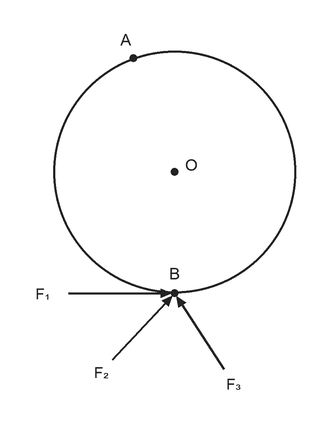
(a) Which force will produce maximum moment about A?
(b) Give a reason for your answer in (a).
Solve with AIWritten solution
Solution:
Concept: The moment of a force (its turning effect) about a point is the force multiplied by the perpendicular distance of its line of action from that point: moment = F × d. Its S.I. unit is the newton metre (N m); gf cm and kgf m are also used.
Given: Wheel O pivoted at A; equal forces , , at B.
Step 1 — Compare the forces.
The three forces are equal, so their moments about A depend only on their perpendicular distances , and from A.
Step 2 — Part (a): find the force with the largest arm.
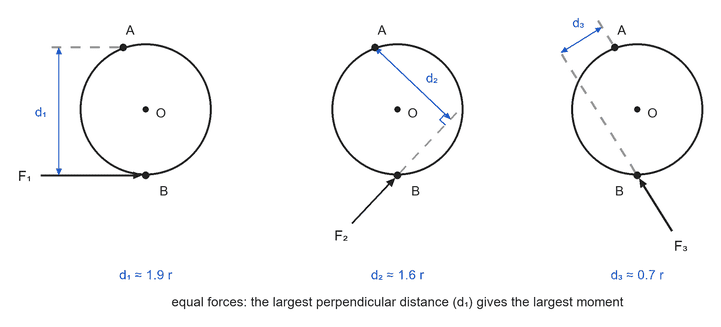
acts along the tangent at B, nearly at right angles to the line AB, so the perpendicular from A to its line of action is almost the whole length AB. The lines of action of and slant towards A, so their perpendicular distances are smaller. Measured on the figure, taking r as the radius of the wheel, ≈ 1.9r, ≈ 1.6r and ≈ 0.7r:
Step 3 — Part (b): give the reason.
Since moment = force × perpendicular distance and the forces are equal, the force with the largest perpendicular distance from A, , gives the largest moment.
Watch out: The moment depends on the perpendicular distance of the line of action from A, not on the distance AB alone, which is the same for all three forces.
Therefore, (a) produces the maximum moment about A; (b) its line of action is farthest from A (largest perpendicular distance), and the forces are equal.
- 133 marks
Question 13
A metre scale of weight 50 gf can be balanced at 40 cm mark without any weight suspended on it.
(a) If this ruler is cut at its centre then state which part [0 to 50 cm or 50 to 100 cm] of the ruler will weigh more than 25 gf.

(b) What minimum weight placed on this metre ruler can balance this ruler when it is pivoted at its centre?
Solve with AIWritten solution
Solution:
Concept: The centre of gravity (C.G.) of a body is the point through which the whole weight of the body acts, however the body is placed. A body balances when it is supported directly under its C.G. Principle of moments: when a body is in equilibrium under several forces, the sum of the anticlockwise moments about any point equals the sum of the clockwise moments about the same point.
Given: Metre scale of weight 50 gf, balanced at the 40 cm mark with no weight on it.
Step 1 — Part (a): locate the C.G.
The scale balances at the 40 cm mark with nothing hung on it, so its C.G. is at 40 cm, not at 50 cm. The scale is therefore not uniform: more of its weight lies towards the 0 cm end.
Step 2 — Part (a): decide which half is heavier.
The C.G. (40 cm) lies in the 0 to 50 cm half, so the weight is concentrated towards that end. So the 0 to 50 cm part weighs more than half of 50 gf, that is, more than 25 gf.
Step 3 — Part (b): find the moment of the scale's weight.
With the pivot at the centre (50 cm), the weight 50 gf acts at 40 cm, 10 cm to the left, and turns the scale anticlockwise:
Step 4 — Part (b): choose where to put the weight.
The least weight is needed when its arm is the largest possible. So it is placed at the 100 cm end, 50 cm from the pivot, on the side away from the C.G.
Step 5 — Part (b): apply the principle of moments.
Its clockwise moment must equal 500 gf cm:

Watch out: The scale's weight acts at its C.G. (40 cm), not at 50 cm, because this scale is not uniform.
Note: Strictly, the balance point alone does not fix how the weight is split between the halves; the answer above assumes the mass of the ruler changes steadily along its length. For example, if the mass per cm falls evenly from the 0 cm end to the 100 cm end with the C.G. at 40 cm, the 0 to 50 cm part weighs 32.5 gf and the other part 17.5 gf.
Therefore, (a) the 0 to 50 cm part weighs more than 25 gf; (b) the minimum weight is 10 gf, placed at the 100 cm mark.
- 141 mark
Question 14
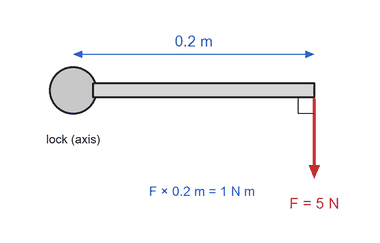
A door lock is opened by turning the lever (handle) of length 0.2 m. If the moment of force produced is 1 Nm, then the minimum force required is:
Solve with AIAnswer
- Correct
(A) 5 N
(B) 10 N
(C) 20 N
(D) 0.2 N
Answer: (A) 5 N
Concept: The moment of a force (its turning effect) about a point is the force multiplied by the perpendicular distance of its line of action from that point: moment = F × d. Its S.I. unit is the newton metre (N m); gf cm and kgf m are also used.
Step 1 — Choose the arm.
The force is least when it is applied at the end of the handle and at right angles to it, so its perpendicular distance from the axis is the full length, 0.2 m.
Step 2 — Write the relation.
The moment of the force equals the force times this distance:
Step 3 — Solve for F.
We divide the moment by the arm:
Watch out: Divide the moment by the arm; multiplying 1 × 0.2 gives 0.2 N, which is option (D) and is wrong.
Why the other options are wrong:
- (B) 10 N: 10 N × 0.2 m = 2 N m, double the moment stated.
- (C) 20 N: 20 N × 0.2 m = 4 N m, four times the moment stated.
- (D) 0.2 N: 0.2 N comes from multiplying 1 by 0.2 instead of dividing; it would give only 0.2 × 0.2 = 0.04 N m.
Therefore, the minimum force required is 5 N, option (A).
- 152 marks
Question 15
Fill in the blanks :
(a) When a stone tied to a string is rotated in a horizontal plane, the tension in the string provides ............... force necessary for circular motion.
(b) Work done by this force at any instant is ............... .
Solve with AIWritten solution
Solution:
Concept: In uniform circular motion the speed stays the same, but the direction of motion changes at every point, so the velocity changes and the body is accelerated. The acceleration, and the force causing it (the centripetal force), act along the radius, towards the centre of the circle. A force does work only when the body moves along the direction of the force (W = FS cos θ).
Step 1 — Part (a): name the force.
The tension acts along the string, towards the centre of the circle. It keeps changing the stone's direction of motion and holds it on the circle, so it provides the centripetal force.
Step 2 — Part (b): find the angle with the displacement.
At every instant the stone moves along the tangent to the circle, which is at right angles to the string. So the angle θ between the force and the displacement is 90°.

Step 3 — Part (b): find the work.
Work done = force × displacement × cos θ, and cos 90° = 0:
Watch out: The stone does move, but at right angles to the tension, so the tension does no work on it.
Therefore, (a) centripetal; (b) zero.
- 162 marks
Question 16
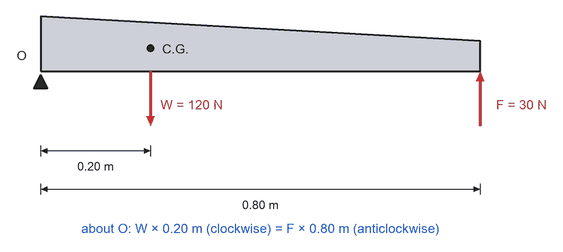
A non uniform beam of weight 120 N pivoted at one end is shown in the diagram below. Calculate the value of F to keep the beam in equilibrium.
 Solve with AI
Written solution
Solution:
Concept: Principle of moments: when a body is in equilibrium under several forces, the sum of the anticlockwise moments about any point equals the sum of the clockwise moments about the same point.
Given: Beam of weight 120 N pivoted at O; C.G. 0.20 m from O; F at 0.80 m from O.
Step 1 — Read the figure.
The beam is pivoted at O. Its weight 120 N acts at its C.G., 0.20 m from O, and F acts upwards at the free end, 0.80 m from O. The beam is not uniform, so we use the C.G. shown, not the middle of the beam.
Step 2 — Find the sense of each moment.
The weight acts downwards to the right of O, so it turns the beam clockwise. F acts upwards to the right of O, so it turns the beam anticlockwise.
Step 3 — Apply the principle of moments.
In equilibrium the anticlockwise moment equals the clockwise moment about O:
Step 4 — Check the answer.
F is a quarter of the weight because its arm (0.80 m) is four times the arm of the weight (0.20 m): 30 N × 0.80 m = 24 N m and 120 N × 0.20 m = 24 N m.
Watch out: Take moments about the pivot O, so that the unknown force at the pivot has no moment.
Therefore, F = 30 N, acting upwards.
- 173 marks
Question 17
(a) Define Centre of Gravity.
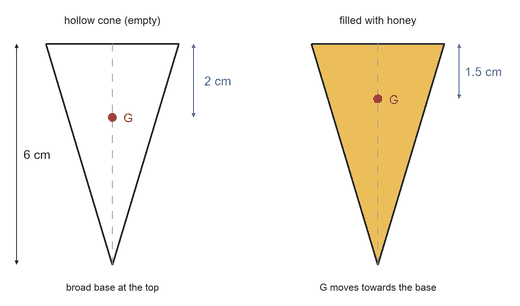
(b) A hollow ice cream cone has height 6 cm.
-
Where is the position of its centre of gravity from the broad base?
-
Will its position change when it is filled completely with honey? Write Yes or No.
Solve with AIWritten solution
Solution:
Concept: The centre of gravity (C.G.) of a body is the point through which the whole weight of the body acts, however the body is placed. A body balances when it is supported directly under its C.G. The C.G. depends on how the mass of a body is spread.
Given: A hollow ice cream cone of height h = 6 cm.
Step 1 — Part (a): define the centre of gravity.
The centre of gravity of a body is the point about which the algebraic sum of the moments of the weights of all the particles of the body is zero. The whole weight of the body can be taken to act at this point, however the body is placed.
Step 2 — Part (b) 1: C.G. of the hollow cone.
In a hollow cone all the mass is in the thin conical wall. For such a cone the C.G. lies on its axis at one-third of its height from the broad base:
Step 3 — Part (b) 2: fill it with honey.
The honey fills the whole inside, so most of the mass is now in the filling, and more of the filling lies near the broad base, where the cone is wide. The C.G. therefore shifts towards the base. A solid cone has its C.G. at one-quarter of its height from the base, so the filled cone's C.G. moves to about h/4:
(It is exactly 1.5 cm only if the cone's own mass is negligible compared with the honey's.)
Watch out: A hollow cone (h/3 from the base) and a solid cone (h/4 from the base) have their C.G. at different heights.
Therefore, (a) the C.G. is the point where the whole weight of the body acts; (b) 1. the C.G. is 2 cm from the broad base, on the axis; 2. yes, it changes: it moves towards the base, to about 1.5 cm.
-
- 181 mark
Question 18
A body is acted upon by two equal and opposite forces, that are NOT along the same straight line. The body will :
Solve with AIAnswer
(A) remain stationary
- Correct
(B) have only rotational motion
(C) have only rectilinear motion
(D) have both rectilinear and rotational motion
Answer: (B) have only rotational motion
Concept: A couple is a pair of equal and opposite parallel forces whose lines of action are not the same. Their resultant is zero, so they do not move the body as a whole, but they turn it. Moment of the couple = either force × the perpendicular distance between the two lines of action (the couple arm).
Step 1 — Check for translation.
The two forces are equal and opposite, so their resultant is zero. There is no net force to move the body as a whole, so it has no rectilinear motion.
Step 2 — Check for rotation.
The forces are not along the same line, so they form a couple. Both turn the body in the same sense, and the moment of the couple (F × the perpendicular distance between them) is not zero, so the body rotates.
Watch out: Zero resultant force does not mean zero turning effect; that needs the forces to act along the same line.
Why the other options are wrong:
- (A) remain stationary: the body stays stationary only if the equal and opposite forces act along the same line; then their moments cancel too.
- (C) have only rectilinear motion: rectilinear motion needs a non-zero resultant force, but here the resultant is zero.
- (D) have both rectilinear and rotational motion: moving as a whole as well as turning needs a non-zero resultant force, as when a single force pushes one end of a free body; here the resultant is zero.
Therefore, the body will have only rotational motion, option (B).
- 191 mark
Question 19
Which among the following is a vector quantity?
Solve with AIAnswer
(A) work
(B) power
(C) energy
- Correct
(D) moment of couple
Answer: (D) moment of couple
Concept: A vector quantity has both magnitude and direction; a scalar has magnitude only.
Step 1 — Test each quantity for direction.
Work, power and energy are amounts with no direction, so they are scalars.
Step 2 — See why a moment has a direction.
A moment (of a force or of a couple) has a sense of rotation. Its direction is taken along the axis of rotation: outwards (towards the observer) for an anticlockwise moment and inwards for a clockwise one. So the moment of a couple is a vector, which is option (D).
Watch out: Work and moment can both be written in N m, but work is a scalar while a moment is a vector.
Why the other options are wrong:
- (A) work: work is force × displacement along the force; it has no direction, so it is a scalar.
- (B) power: power is the rate of doing work, a scalar.
- (C) energy: energy is the capacity to do work, a scalar.
Therefore, the moment of a couple is a vector quantity, option (D).
- 201 mark
Question 20
Complete the following by choosing the correct answers from the bracket:
In uniform circular motion the centrifugal force acts ............... [towards the centre/away from the centre/along the tangential direction].
Solve with AIWritten solution
Solution:
Concept: The centripetal force is a real force (tension, friction, gravity) that keeps a body on a circular path; it acts towards the centre. The centrifugal force is not a real force: an observer moving round with the body imagines it, acting on the same body, equal in size to the centripetal force and directed away from the centre.
Step 1 — Recall the centripetal force.
The centripetal force on a body moving in a circle acts towards the centre.
Step 2 — Find the centrifugal force's direction.
The centrifugal force is imagined equal and opposite to the centripetal force, so it acts away from the centre. The velocity, not either force, is along the tangent.
Watch out: The tangential direction is that of the velocity, not of any force in uniform circular motion.
Therefore, in uniform circular motion the centrifugal force acts away from the centre.
- 212 marks
Question 21
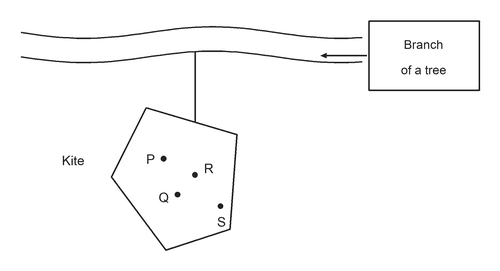
A non-uniform kite is hanging freely from the branch of a tree as shown. Study the figure and answer the following :
(a) Fill in the blank.
............... [P, Q, R or S] is the most probable position of its centre of gravity.
(b) Support your answer to (a) with a reason
Solve with AIWritten solution
Solution:
Concept: A freely suspended body comes to rest with its centre of gravity vertically below the point of suspension, because only then does its weight pass through that point and have no moment about it.
Step 1 — Use the rule for a hanging body.
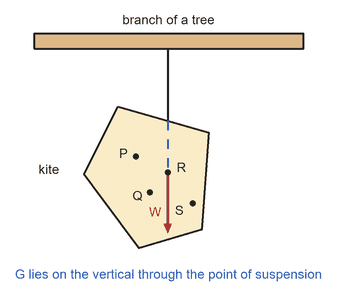
The kite hangs freely and is at rest, so its weight, acting at the C.G., must pass through the point of suspension; otherwise the weight would have a moment about that point and the kite would turn.
Step 2 — Part (a): find the point on the vertical.
So the C.G. lies on the vertical line through the point where the string holds the kite. In the figure, R is the only one of the four points on this vertical; P, Q and S lie to one side of it. So R is the most probable position of the C.G.
Step 3 — Part (b): give the reason.
The kite is non-uniform, so its C.G. need not be at its geometric centre; the way it hangs shows where the C.G. is.
Watch out: Do not pick the point that looks like the middle of the kite; a non-uniform body's C.G. can be anywhere on the vertical through the point of suspension.
Therefore, (a) R; (b) a freely suspended body rests with its C.G. vertically below the point of suspension, and R is the point directly below the string.
- 223 marks
Question 22
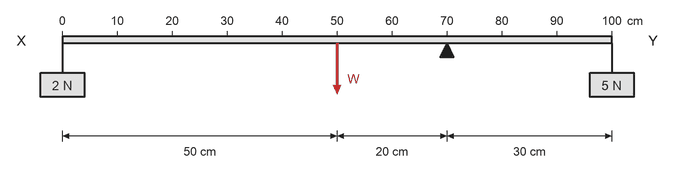
Akash takes a uniform metre scale and suspends a weight of 2 N at one end ‘X’, and a weight of 5 N on the other end ‘Y’. He then balances the ruler horizontally on a knife edge placed at 70 cm from X. Draw a diagram of the arrangement and calculate the weight of the ruler.
Solve with AIWritten solution
Solution:
Concept: The weight of a uniform rule acts at its middle (its centre of gravity): the 50 cm mark of a metre rule and the 25 cm mark of a half metre rule. Principle of moments: when a body is in equilibrium under several forces, the sum of the anticlockwise moments about any point equals the sum of the clockwise moments about the same point.
Given: Uniform metre scale; 2 N at X (0 cm), 5 N at Y (100 cm); knife edge at 70 cm from X.
Step 1 — Read the arrangement.
Measuring from X (0 cm), the knife edge is at 70 cm. The ruler is uniform, so its weight W acts at 50 cm. The 2 N at X and W are on the left of the knife edge, so they turn the ruler anticlockwise; the 5 N at Y (100 cm) is on the right and turns it clockwise.
Step 2 — Find the arms.
Each distance is measured from the knife edge:
Step 3 — Apply the principle of moments.
The sum of the anticlockwise moments equals the clockwise moment:
Step 4 — Check the answer.
The 5 N alone gives 150 N cm clockwise against 140 N cm from the 2 N, so the ruler's own weight has to supply only 10 N cm; 0.5 N × 20 cm = 10 N cm.
Watch out: Measure every arm from the pivot (knife edge), not from the 0 cm end of the scale.
Therefore, the weight of the ruler is 0.5 N (diagram: knife edge at 70 cm, W at 50 cm, 2 N at X and 5 N at Y).
- 231 mark
Question 23
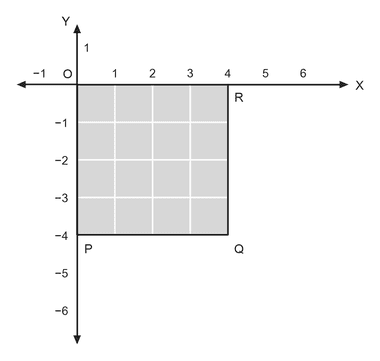
Centre of gravity of the given square PQRO lies at:
 Solve with AI
Answer
- Correct
(A) (2, –2)
(B) (3, –2)
(C) (–2, 2)
(D) (–2, 1)
Answer: (A) (2, –2)
Concept: The C.G. of a uniform square lamina is at the point of intersection of its diagonals, its geometric centre.
Step 1 — Read the corners.
From the figure the corners of the square are O (0, 0), R (4, 0), Q (4, −4) and P (0, −4).
Step 2 — Find the meeting point of the diagonals.
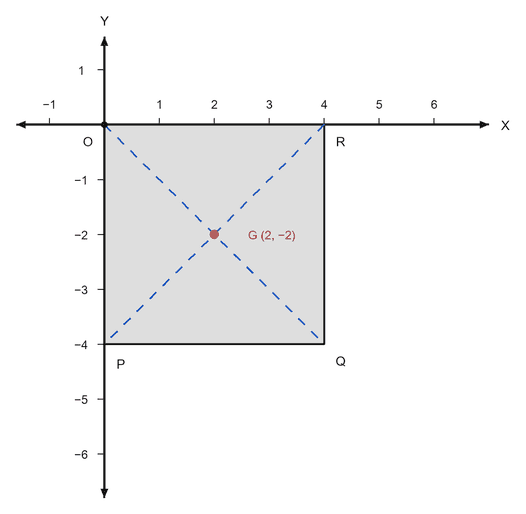
The C.G. of a uniform square lamina is where its diagonals meet, at their common mid-point. The mid-point of OQ is:
So the C.G. is at (2, −2).
Watch out: The square lies below the X axis, so the y-coordinate of its centre is negative.
Why the other options are wrong:
- (B) (3, –2): (3, −2) lies 1 unit to the right of the centre, nearer the side RQ than the side OP.
- (C) (–2, 2): (−2, 2) has both signs reversed; it lies outside the square, in the second quadrant.
- (D) (–2, 1): (−2, 1) is in the second quadrant too, outside the square altogether.
Therefore, the centre of gravity of the square PQRO lies at (2, −2), option (A).
- 242 marks
Question 24
Will the position of the centre of gravity change if a hollow sphere is completely filled with mercury? Give a reason for your answer.
Solve with AIWritten solution
Solution:
Concept: The centre of gravity (C.G.) of a body is the point through which the whole weight of the body acts, however the body is placed. A body balances when it is supported directly under its C.G. It depends on how the mass of the body is distributed.
Step 1 — Find the C.G. of the hollow sphere.
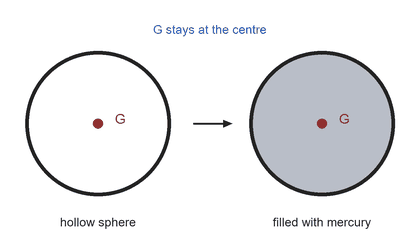
The mass of a hollow sphere is spread evenly round its centre, so its C.G. is at its geometric centre, even though there is no material there.
Step 2 — Find the C.G. of the mercury.
Mercury filling the sphere completely is a solid ball, spread evenly round the same centre, so its C.G. is also at that centre.
Step 3 — Combine them.
Both parts have their C.G. at the same point, so the combined C.G. stays at the centre of the sphere. It does not change.
Watch out: Filling changes the total weight, not the position of the C.G., when the filling is symmetric about the same centre (unlike a cone, where the filling is heavier near the base).
Therefore, no, the C.G. does not change; it stays at the centre of the sphere, because the mercury is spread symmetrically round that centre, just like the shell.
- 253 marks
Question 25
A uniform metre ruler is balanced horizontally on a knife edge placed at 60 cm mark when a mass m is suspended from 75 cm mark. Draw the diagram of the arrangement. State with reason (through mathematical steps) whether the mass of the scale is greater than, less than or equal to the mass m?
Solve with AIWritten solution
Solution:
Concept: The weight of a uniform rule acts at its middle (its centre of gravity): the 50 cm mark of a metre rule and the 25 cm mark of a half metre rule. Principle of moments: when a body is in equilibrium under several forces, the sum of the anticlockwise moments about any point equals the sum of the clockwise moments about the same point.
Given: Uniform metre ruler; knife edge at 60 cm; mass m hung at 75 cm.
Step 1 — Draw the arrangement.
The ruler is uniform, so its weight Mg (M is its mass) acts at the 50 cm mark. The knife edge is at 60 cm and the mass m hangs at 75 cm:

Step 2 — Find the arms.
Each distance is measured from the knife edge:
Step 3 — Apply the principle of moments.
Mg (left of the knife edge) turns the ruler anticlockwise and mg (right of it) turns it clockwise. In equilibrium:
We cancel g and divide both sides by 10:
Step 4 — Compare the masses.
So M is 1.5 times m: the mass of the scale is greater than m. Its weight acts at a shorter distance (10 cm) than m (15 cm), so to give an equal moment it must be heavier.
Watch out: Measure every arm from the pivot (knife edge), not from the 0 cm end of the scale.
Therefore, the mass of the scale is greater than m: it is 1.5 m.
- 261 mark
Question 26
For a body to be in dynamic equilibrium, its:
Solve with AIAnswer
(A) momentum should be zero
- Correct
(B) acceleration should be zero
(C) kinetic energy should be zero
(D) velocity should be zero
Answer: (B) acceleration should be zero
Concept: A body is in dynamic equilibrium when it stays in the same state of motion (constant velocity) under the action of several forces; this needs a zero resultant force.
Step 1 — Link equilibrium to the resultant force.
A body is in equilibrium when the resultant of all the forces on it is zero. Since resultant force = mass × acceleration, this means its acceleration is zero.
Step 2 — Apply it to a moving body.
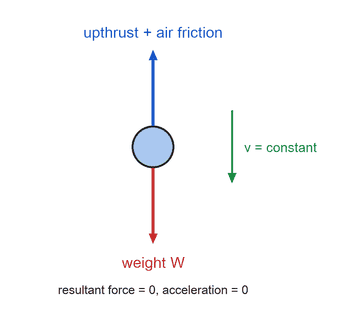
With zero acceleration a moving body keeps a constant velocity, as a raindrop does when it falls at a steady speed. This is dynamic equilibrium, so the condition is option (B).
Watch out: Dynamic equilibrium is about a MOVING body: its velocity is constant but not zero.
Why the other options are wrong:
- (A) momentum should be zero: momentum = mass × velocity; a body in dynamic equilibrium is moving, so its momentum is not zero.
- (C) kinetic energy should be zero: a moving body has kinetic energy; zero kinetic energy would mean the body is at rest.
- (D) velocity should be zero: zero velocity describes a body at rest, which is static equilibrium, not dynamic equilibrium.
Therefore, for dynamic equilibrium the acceleration should be zero, option (B).
- 271 mark
Question 27
Complete the following by choosing the correct answers from the bracket:
A car is moving in uniform circular motion. The direction of friction between the tyres and the path is ............... [towards the centre / tangential to the path].
Solve with AIWritten solution
Solution:
Concept: In uniform circular motion the speed stays the same, but the direction of motion changes at every point, so the velocity changes and the body is accelerated. The acceleration, and the force causing it (the centripetal force), act along the radius, towards the centre of the circle.
Step 1 — Find what keeps the car on the circle.
A car going round a level circular path needs a centripetal force towards the centre. The only horizontal force on it from the road is the friction between the tyres and the road.
Step 2 — Name the direction.
So this friction acts towards the centre. The car's velocity is along the tangent; the friction, at right angles to it, keeps turning the velocity and holds the car on the circle. On a slippery road there is too little friction and the car skids outward.
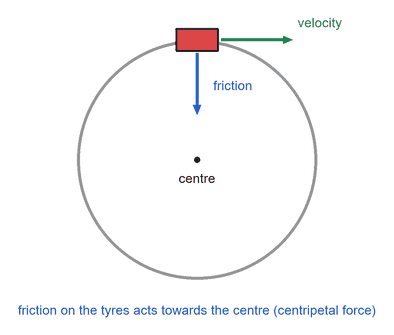
Watch out: The velocity is tangential; the force (friction) is not.
Therefore, the direction of friction between the tyres and the path is towards the centre.
- 282 marks
Question 28
State two factors on which the position of Center of Gravity of a body depends.
Solve with AIWritten solution
Solution:
Concept: The centre of gravity (C.G.) of a body is the point through which the whole weight of the body acts, however the body is placed. A body balances when it is supported directly under its C.G.
Step 1 — Factor 1: the shape of the body.
If the body changes shape, its C.G. moves. A straight uniform wire has its C.G. at its middle; bent into a ring, its C.G. is at the centre of the ring, a point with no wire at all.
Step 2 — Factor 2: the distribution of mass.
If more mass is placed in one part of the body (for example a heavier material at one end), the C.G. moves towards that part. A rod made heavier at one end has its C.G. shifted towards that end.
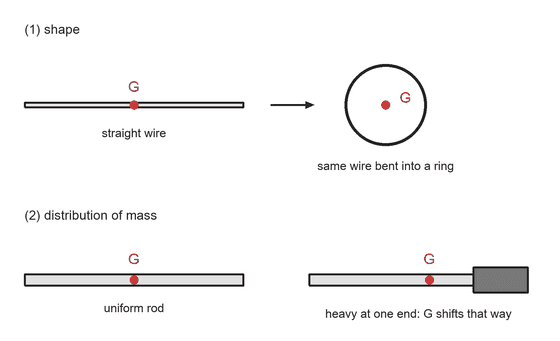
Watch out: The total mass alone does not decide the C.G.; how the mass is spread does.
Therefore, the position of the C.G. depends on (1) the shape of the body and (2) the distribution of mass in it.
- 293 marks
Question 29
The diagram shows a wheel with a handle. Two forces, and of equal magnitudes are acting on the handle as shown in the diagram.

(a) Which force produces negative moment?
(b) Is the wheel in equilibrium? (Yes or No)
(c) Justify your answer stated in (b).
Solve with AIWritten solution
Solution:
Concept: By convention an anticlockwise moment is taken as positive and a clockwise moment as negative, so moments in opposite senses can be added algebraically. The moment of a force (its turning effect) about a point is the force multiplied by the perpendicular distance of its line of action from that point: moment = F × d. Its S.I. unit is the newton metre (N m); gf cm and kgf m are also used.
Given: Equal forces and on the handle of a wheel pivoted at O.
Step 1 — Read the figure.
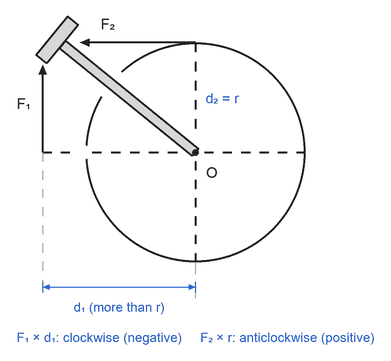
Both forces act on the handle, whose end lies outside the rim, to the left of O and at a height r above O (r is the radius of the wheel). acts upwards and acts to the left.
Step 2 — Part (a): find the sense of each moment.
acts upwards at a point to the left of O, so it turns the wheel clockwise: a negative moment. acts to the left at a point above O, so it turns the wheel anticlockwise: a positive moment. So produces the negative moment.
Step 3 — Part (b) and (c): compare the arms.
The line of action of is horizontal, at height r above O, so its arm is . The line of action of is vertical, through the handle end, which lies outside the rim, so its arm (the horizontal distance from O) is more than r:
Step 4 — Part (b) and (c): compare the moments.
The forces are equal but , so the clockwise moment is greater than the anticlockwise moment . The principle of moments is not satisfied, so the wheel is not in equilibrium; it turns clockwise.
Watch out: Equal forces do not give equal moments unless their perpendicular distances from O are equal.
Therefore, (a) produces the negative (clockwise) moment; (b) no; (c) the perpendicular distance of from O is more than that of (which is r), so the clockwise moment is larger than the anticlockwise moment and the moments do not balance.
- 301 mark
Question 30
If three equal forces , and are acting at the end A of the rod AB, pivoted at the center O, as shown in the diagram given below, then the moment of force is:
 Solve with AI
Answer
(A) least for and maximum for
(B) least for and maximum for
- Correct
(C) least for and maximum for
(D) least for and maximum for
Answer: (C) least for and maximum for
Concept: The moment of a force (its turning effect) about a point is the force multiplied by the perpendicular distance of its line of action from that point: moment = F × d. Its S.I. unit is the newton metre (N m); gf cm and kgf m are also used. The three forces are equal, so we compare their perpendicular distances from O.
Step 1 — Moment of .
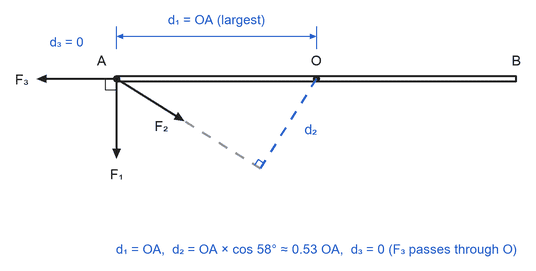
acts at right angles to the rod, so its perpendicular distance from O is the whole length OA, the largest possible. Its moment is the maximum.
Step 2 — Moment of .
acts at a slant, so the perpendicular from O to its line of action is shorter than OA. Its moment is less than that of , but not zero.
Step 3 — Moment of .
acts along the rod, so its line of action passes through O. Its perpendicular distance is zero, so its moment is zero, the least. This matches option (C).
Watch out: A force along the rod has zero moment even though it acts at the end of the rod.
Why the other options are wrong:
- (A) least for and maximum for : does have some moment; the least moment (zero) belongs to .
- (B) least for and maximum for : has the largest arm (OA), not the smallest, and has no moment at all.
- (D) least for and maximum for : acts along the rod through O, so its moment is zero; it cannot be the maximum.
Therefore, the moment is least for and maximum for , option (C).
- 312 marks
Question 31
Rekha has a metre ruler weighing 200 gf, half (50 cm) made of wood and half made of steel.
(a) Rekha wants to balance the ruler. To which part (wooden or steel) should she keep the knife edge?
(b) The above metre-rule is to be balanced by placing the knife edge at 50 cm mark using a known weight. Name the principle which can be used to calculate the position of the weight.
Solve with AIWritten solution
Solution:
Concept: The centre of gravity (C.G.) of a body is the point through which the whole weight of the body acts, however the body is placed. A body balances when it is supported directly under its C.G. Principle of moments: when a body is in equilibrium under several forces, the sum of the anticlockwise moments about any point equals the sum of the clockwise moments about the same point.
Given: A metre ruler of weight 200 gf, half wood and half steel.
Step 1 — Part (a): compare the two halves.
Steel is much denser than wood, so the steel half of the ruler is heavier than the wooden half. The C.G. lies nearer the heavier part, so it is in the steel half, away from the 50 cm mark.
Step 2 — Part (a): place the knife edge.
A ruler balances when the knife edge is directly under its C.G., so Rekha should keep the knife edge under the steel part.
Step 3 — Part (b): name the principle.
With the knife edge at 50 cm, the ruler's own weight (200 gf at its C.G. in the steel half) turns it towards the steel side. A known weight hung on the wooden side balances it at the position where the principle of moments holds:
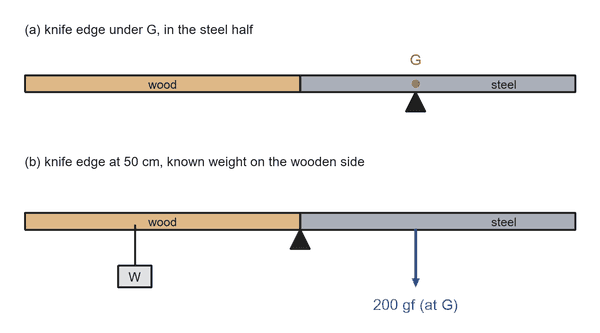
Watch out: The C.G. of this ruler is not at 50 cm, because its two halves have different weights.
Therefore, (a) under the steel part; (b) the principle of moments.
- 323 marks
Question 32
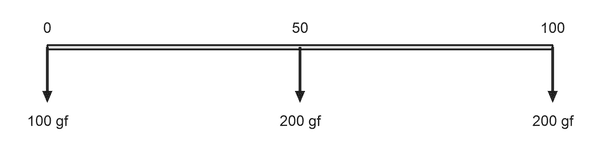
Observe the diagram of a uniform metre scale of mass 200 g given below. Weights of 200 gf and 100 gf are suspended from its ends. At which marking will the ruler be balanced?
 Solve with AI
Written solution
Solution:
Concept: The weight of a uniform rule acts at its middle (its centre of gravity): the 50 cm mark of a metre rule and the 25 cm mark of a half metre rule. Principle of moments: when a body is in equilibrium under several forces, the sum of the anticlockwise moments about any point equals the sum of the clockwise moments about the same point.
Given: Uniform metre scale of mass 200 g (weight 200 gf); 100 gf at 0 cm, 200 gf at 100 cm.
Step 1 — Read the forces.
The scale is uniform, so its own weight (200 gf) acts at 50 cm. 100 gf hangs at the 0 cm end and 200 gf at the 100 cm end. The heavier end pulls the balance point towards it, so the knife edge must be beyond 50 cm. Let it be at x cm, with 50 < x < 100.
Step 2 — Write the moments about x.
The 100 gf and the scale's weight are on the left of x (anticlockwise); the 200 gf at 100 cm is on the right (clockwise):
Step 3 — Solve for x.
We expand both sides and collect the terms in x:
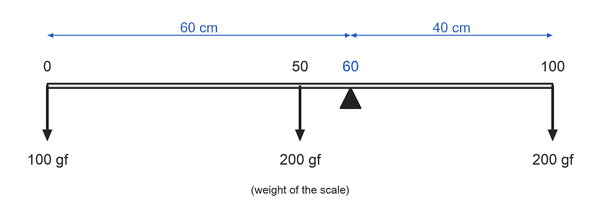
Step 4 — Check the answer.
About 60 cm the moments are:
They are equal, so the ruler balances there.
Watch out: Include the scale's own weight (200 gf at 50 cm); leaving it out gives the wrong balance point.
Therefore, the ruler is balanced at the 60 cm mark.
- 333 marks
Question 33
A constant force F acts on a horizontal uniform ruler AB at point A.
Case 1. The ruler is pivoted at the end B.
Case 2. Ruler is not pivoted.
(a) In which case is the moment of force greater? (Case 1 or Case 2)
(b) Give a reason for your answer in (a) above.
(c) In which case does the ruler exhibit both translational and rotational motion simultaneously? (Case 1 or Case 2)
Solve with AIWritten solution
Solution:
Concept: A pivoted body turns about its pivot. A free body acted on by a single force that does not pass through its C.G. turns about its C.G. and also moves as a whole. The moment of a force (its turning effect) about a point is the force multiplied by the perpendicular distance of its line of action from that point: moment = F × d. Its S.I. unit is the newton metre (N m); gf cm and kgf m are also used.
Step 1 — Part (a): Case 1.
When the ruler is pivoted at B it turns about B, so the perpendicular distance of F (at A, taken at right angles to the ruler) from the axis is the whole length AB:
Step 2 — Part (a): Case 2.
A free ruler acted on by a single force turns about its centre of gravity G, which is at the middle because the ruler is uniform. So the arm is AB/2:
F is the same in both cases, so the moment in Case 1 is twice that in Case 2.
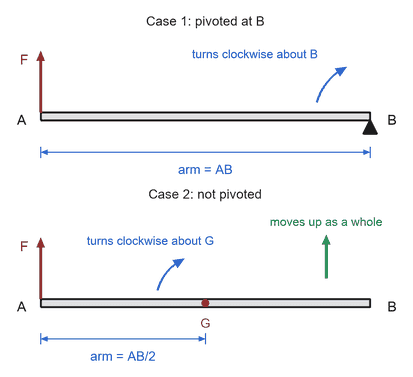
Step 3 — Part (b): give the reason.
The moment of a force is F × its perpendicular distance from the axis of rotation, and the axis is farther from A in Case 1 (at B) than in Case 2 (at G).
Step 4 — Part (c): find the case with both motions.
In Case 2 the single force F has a non-zero resultant, so the ruler moves as a whole (translational motion). F does not pass through G, so it also turns the ruler about G (rotational motion). In Case 1 the pivot holds B fixed, so the ruler only rotates about B.
Watch out: The axis of a free body is its C.G., not its end.
Therefore, (a) Case 1; (b) in Case 1 the arm of F is AB, while in Case 2 the ruler turns about its C.G. at the middle, so the arm is only AB/2; (c) Case 2.