Solution:
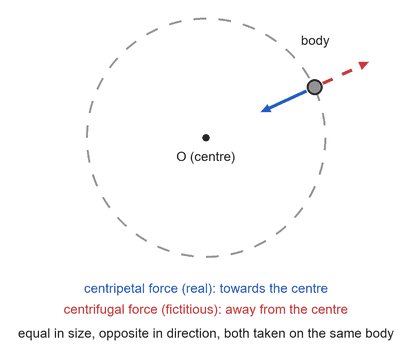
Concept: The centripetal force is a real force (tension, friction, gravity) that keeps a body on a circular path; it acts towards the centre. The centrifugal force is not a real force: an observer moving round with the body imagines it, acting on the same body, equal in size to the centripetal force and directed away from the centre.
Step 1 — Part (i): compare the directions.
The centripetal force acts towards the centre of the circular path, along the radius. The centrifugal force acts away from the centre, along the same radius. So they act in opposite directions.
Step 2 — Part (ii): test the action-reaction idea.
Action and reaction always act on two different bodies. The centrifugal force is taken to act on the same body as the centripetal force, so it cannot be its reaction. (It is not a real force at all; the real reaction of the centripetal force acts on whatever supplies it, such as the hand holding the string.)
Step 3 — Part (iii): compare the sizes.
The centrifugal force is imagined to be just large enough to cancel the centripetal force for an observer moving with the body, so the two are equal in magnitude: their ratio is 1 : 1.
Watch out: Equal and opposite forces are not automatically action and reaction; those must act on two different bodies.
Therefore, (i) the centripetal force acts towards the centre and the centrifugal force away from it; (ii) no, the centrifugal force is not the reaction of the centripetal force (both are taken on the same body); (iii) they are equal in magnitude (1 : 1).
