Solution:
Concept: The weight of a uniform rule acts at its middle (its centre of gravity): the 50 cm mark of a metre rule and the 25 cm mark of a half metre rule. Principle of moments: when a body is in equilibrium under several forces, the sum of the anticlockwise moments about any point equals the sum of the clockwise moments about the same point.
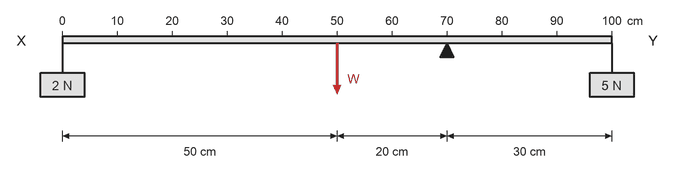
Given: Uniform metre scale; 2 N at X (0 cm), 5 N at Y (100 cm); knife edge at 70 cm from X.
Step 1 — Read the arrangement.
Measuring from X (0 cm), the knife edge is at 70 cm. The ruler is uniform, so its weight W acts at 50 cm. The 2 N at X and W are on the left of the knife edge, so they turn the ruler anticlockwise; the 5 N at Y (100 cm) is on the right and turns it clockwise.
Step 2 — Find the arms.
Each distance is measured from the knife edge:
arm of 2 N=70−0=70 cm
arm of W=70−50=20 cm
arm of 5 N=100−70=30 cm
Step 3 — Apply the principle of moments.
The sum of the anticlockwise moments equals the clockwise moment:
2×70+W×20=5×30
140+20W=150
W=20150−140=2010=0.5 N
Step 4 — Check the answer.
The 5 N alone gives 150 N cm clockwise against 140 N cm from the 2 N, so the ruler's own weight has to supply only 10 N cm; 0.5 N × 20 cm = 10 N cm.
Watch out: Measure every arm from the pivot (knife edge), not from the 0 cm end of the scale.
Therefore, the weight of the ruler is 0.5 N (diagram: knife edge at 70 cm, W at 50 cm, 2 N at X and 5 N at Y).
