Solution:
Concept: A freely suspended body comes to rest with its centre of gravity vertically below the point of suspension, because only then does its weight pass through that point and have no moment about it.
Step 1 — Use the rule for a hanging body.
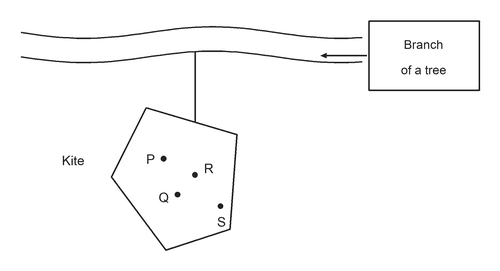
The kite hangs freely and is at rest, so its weight, acting at the C.G., must pass through the point of suspension; otherwise the weight would have a moment about that point and the kite would turn.
Step 2 — Part (a): find the point on the vertical.
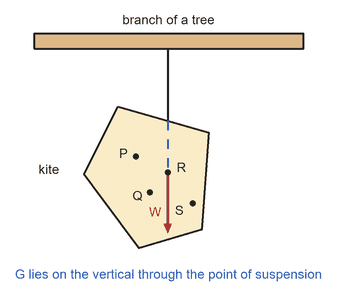
So the C.G. lies on the vertical line through the point where the string holds the kite. In the figure, R is the only one of the four points on this vertical; P, Q and S lie to one side of it. So R is the most probable position of the C.G.
Step 3 — Part (b): give the reason.
The kite is non-uniform, so its C.G. need not be at its geometric centre; the way it hangs shows where the C.G. is.
Watch out: Do not pick the point that looks like the middle of the kite; a non-uniform body's C.G. can be anywhere on the vertical through the point of suspension.
Therefore, (a) R; (b) a freely suspended body rests with its C.G. vertically below the point of suspension, and R is the point directly below the string.