Solution:
Concept: The weight of a uniform rule acts at its middle (its centre of gravity): the 50 cm mark of a metre rule and the 25 cm mark of a half metre rule. Principle of moments: when a body is in equilibrium under several forces, the sum of the anticlockwise moments about any point equals the sum of the clockwise moments about the same point.
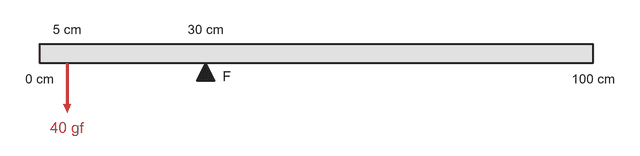
Given: Uniform metre scale; fulcrum at 30 cm; 40 gf at the 5 cm mark.
Step 1 — Part (i): read the figure.
The scale is uniform, so its weight W acts at the 50 cm mark. The fulcrum F is at 30 cm and the 40 gf hangs at 5 cm. So the 40 gf (left of F) turns the scale anticlockwise and W (right of F) turns it clockwise.
Step 2 — Part (i): find the arms.
Each distance is measured from the fulcrum:
arm of 40 gf=30−5=25 cm
arm of W=50−30=20 cm
Step 3 — Part (i): apply the principle of moments.
The anticlockwise moment equals the clockwise moment:
40×25=W×20
W=2040×25=201000=50 gf
Step 4 — Part (ii): see what the shift does.
With the 40 gf moved to the 0 cm mark, its arm becomes 30 cm, so its anticlockwise moment grows while the clockwise moment of the scale stays the same:
anticlockwise moment=40×30=1200 gf cm
clockwise moment=50×20=1000 gf cm
The scale would tip down at the 0 cm end.
Step 5 — Part (ii): move the fulcrum.
To balance it again, the arm of the 40 gf must get shorter and the arm of the scale's weight longer, so F must be shifted towards 0 cm. If the new fulcrum is at x cm, the principle of moments gives:
40×x=50×(50−x)
x=902500=27.8 cm (about)
So F moves from 30 cm to about 27.8 cm, towards the 0 cm end.

Watch out: Measure every arm from the pivot (knife edge), not from the 0 cm end of the scale.
Therefore, (i) the weight of the metre scale is 50 gf; (ii) F is shifted towards 0 cm (to about the 27.8 cm mark).