Solution:
Concept: In uniform circular motion the speed stays the same, but the direction of motion changes at every point, so the velocity changes and the body is accelerated. The acceleration, and the force causing it (the centripetal force), act along the radius, towards the centre of the circle.
Given: A stone of mass m whirled in a circle on a string with a uniform speed.
Step 1 — Part (i): look at the speed.
The question says the stone goes round with a uniform speed, so the distance it covers every second stays the same. Its speed is uniform. Only the direction of its motion keeps changing, so its velocity is not uniform.
Step 2 — Part (ii): decide whether the acceleration is uniform.
Acceleration is the rate of change of velocity. The velocity changes in direction all the time, so the stone is accelerated. The size of this acceleration stays the same, but its direction keeps turning as the stone goes round. A quantity whose direction changes is not uniform, so the acceleration is not uniform; it is variable.
Step 3 — Part (ii): find its direction.
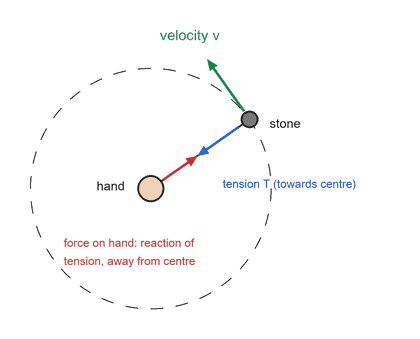
At every instant the acceleration acts along the string, towards the centre of the circular path (towards the hand). That is why it is called the centripetal acceleration.
Step 4 — Part (iii): find the force on the hand.
The string pulls the stone towards the centre with a tension T; this tension is the centripetal force on the stone. By Newton's third law the stone pulls back on the string with an equal force, and the string passes this pull to the hand. So the hand feels an outward pull, away from the centre, along the string towards the stone.
Watch out: Uniform speed does not mean uniform velocity or uniform acceleration: both change direction all the time.
Note: Many answer keys name the outward pull on the hand the "centrifugal force". Strictly, the centrifugal force is the fictitious force imagined on the stone; the pull on the hand is the real reaction of the tension. Both act away from the centre.
Therefore, (i) the speed is uniform; (ii) no, the acceleration is variable (its direction changes), and it acts towards the centre of the circle; (iii) an outward pull acts on the hand, away from the centre along the string (the reaction to the tension).
