Solution:
Concept: The centre of gravity (C.G.) of a body is the point through which the whole weight of the body acts, however the body is placed. A body balances when it is supported directly under its C.G. Principle of moments: when a body is in equilibrium under several forces, the sum of the anticlockwise moments about any point equals the sum of the clockwise moments about the same point.
Given: A metre ruler of weight 200 gf, half wood and half steel.
Step 1 — Part (a): compare the two halves.
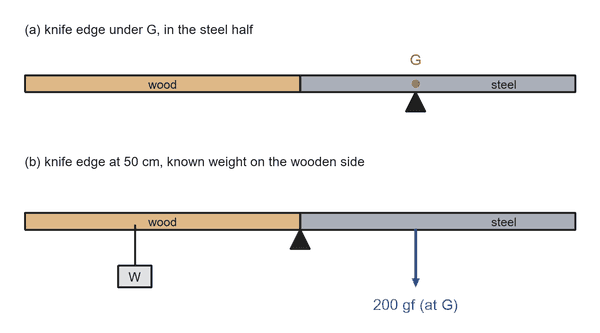
Steel is much denser than wood, so the steel half of the ruler is heavier than the wooden half. The C.G. lies nearer the heavier part, so it is in the steel half, away from the 50 cm mark.
Step 2 — Part (a): place the knife edge.
A ruler balances when the knife edge is directly under its C.G., so Rekha should keep the knife edge under the steel part.
Step 3 — Part (b): name the principle.
With the knife edge at 50 cm, the ruler's own weight (200 gf at its C.G. in the steel half) turns it towards the steel side. A known weight hung on the wooden side balances it at the position where the principle of moments holds:
sum of anticlockwise moments=sum of clockwise moments
Watch out: The C.G. of this ruler is not at 50 cm, because its two halves have different weights.
Therefore, (a) under the steel part; (b) the principle of moments.
