
Question 301 markMCQAsked 2026Easy
If three equal forces , and are acting at the end A of the rod AB, pivoted at the center O, as shown in the diagram given below, then the moment of force is:

Confirming your payment
Sign up now and get 250 free tokens.
Previous Year Questions · Question 30 of 33
If three equal forces , and are acting at the end A of the rod AB, pivoted at the center O, as shown in the diagram given below, then the moment of force is:
(A) least for and maximum for
(B) least for and maximum for
(C) least for and maximum for
(D) least for and maximum for
Answer: (C) least for and maximum for
Concept: The moment of a force (its turning effect) about a point is the force multiplied by the perpendicular distance of its line of action from that point: moment = F × d. Its S.I. unit is the newton metre (N m); gf cm and kgf m are also used. The three forces are equal, so we compare their perpendicular distances from O.
Step 1 — Moment of .
acts at right angles to the rod, so its perpendicular distance from O is the whole length OA, the largest possible. Its moment is the maximum.
Step 2 — Moment of .
acts at a slant, so the perpendicular from O to its line of action is shorter than OA. Its moment is less than that of , but not zero.
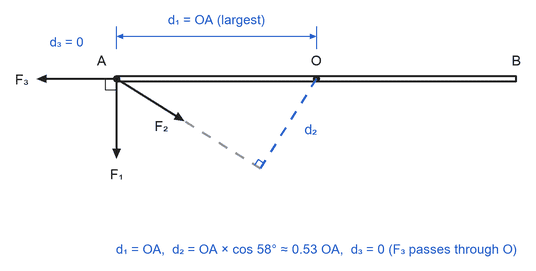
Step 3 — Moment of .
acts along the rod, so its line of action passes through O. Its perpendicular distance is zero, so its moment is zero, the least. This matches option (C).
Watch out: A force along the rod has zero moment even though it acts at the end of the rod.
Why the other options are wrong:
Therefore, the moment is least for and maximum for , option (C).