Solution:
Concept: By convention an anticlockwise moment is taken as positive and a clockwise moment as negative, so moments in opposite senses can be added algebraically. The moment of a force (its turning effect) about a point is the force multiplied by the perpendicular distance of its line of action from that point: moment = F × d. Its S.I. unit is the newton metre (N m); gf cm and kgf m are also used.
Given: Equal forces F1 and F2 on the handle of a wheel pivoted at O.
Step 1 — Read the figure.
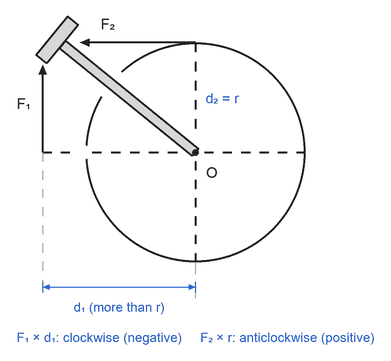
Both forces act on the handle, whose end lies outside the rim, to the left of O and at a height r above O (r is the radius of the wheel). F1 acts upwards and F2 acts to the left.
Step 2 — Part (a): find the sense of each moment.
F1 acts upwards at a point to the left of O, so it turns the wheel clockwise: a negative moment. F2 acts to the left at a point above O, so it turns the wheel anticlockwise: a positive moment. So F1 produces the negative moment.
Step 3 — Part (b) and (c): compare the arms.
The line of action of F2 is horizontal, at height r above O, so its arm is d2=r. The line of action of F1 is vertical, through the handle end, which lies outside the rim, so its arm d1 (the horizontal distance from O) is more than r:
Step 4 — Part (b) and (c): compare the moments.
The forces are equal but d1>d2, so the clockwise moment F1×d1 is greater than the anticlockwise moment F2×r. The principle of moments is not satisfied, so the wheel is not in equilibrium; it turns clockwise.
Watch out: Equal forces do not give equal moments unless their perpendicular distances from O are equal.
Therefore, (a) F1 produces the negative (clockwise) moment; (b) no; (c) the perpendicular distance of F1 from O is more than that of F2 (which is r), so the clockwise moment is larger than the anticlockwise moment and the moments do not balance.

