Solution:
Concept: A pivoted body turns about its pivot. A free body acted on by a single force that does not pass through its C.G. turns about its C.G. and also moves as a whole. The moment of a force (its turning effect) about a point is the force multiplied by the perpendicular distance of its line of action from that point: moment = F × d. Its S.I. unit is the newton metre (N m); gf cm and kgf m are also used.
Step 1 — Part (a): Case 1.
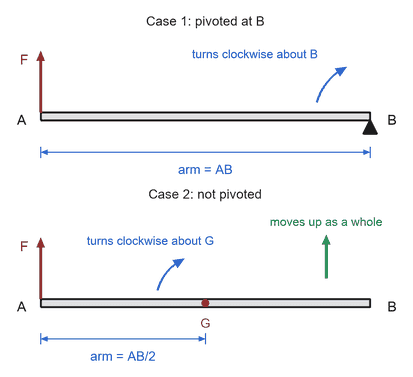
When the ruler is pivoted at B it turns about B, so the perpendicular distance of F (at A, taken at right angles to the ruler) from the axis is the whole length AB:
moment=F×AB
Step 2 — Part (a): Case 2.
A free ruler acted on by a single force turns about its centre of gravity G, which is at the middle because the ruler is uniform. So the arm is AB/2:
moment=F×2AB
F is the same in both cases, so the moment in Case 1 is twice that in Case 2.
Step 3 — Part (b): give the reason.
The moment of a force is F × its perpendicular distance from the axis of rotation, and the axis is farther from A in Case 1 (at B) than in Case 2 (at G).
Step 4 — Part (c): find the case with both motions.
In Case 2 the single force F has a non-zero resultant, so the ruler moves as a whole (translational motion). F does not pass through G, so it also turns the ruler about G (rotational motion). In Case 1 the pivot holds B fixed, so the ruler only rotates about B.
Watch out: The axis of a free body is its C.G., not its end.
Therefore, (a) Case 1; (b) in Case 1 the arm of F is AB, while in Case 2 the ruler turns about its C.G. at the middle, so the arm is only AB/2; (c) Case 2.
