
Question 122 marksAsked 2023Medium
The diagram shows wheel O pivoted at point A. Three equal forces , and act at point B on the wheel.
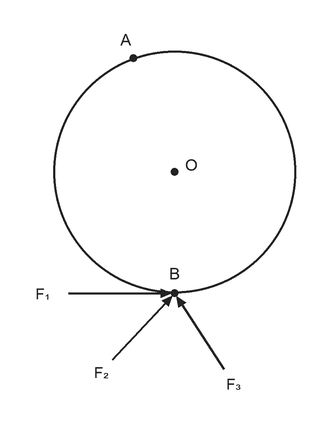
(a) Which force will produce maximum moment about A?
(b) Give a reason for your answer in (a).
Confirming your payment
Sign up now and get 250 free tokens.
Previous Year Questions · Question 12 of 33
The diagram shows wheel O pivoted at point A. Three equal forces , and act at point B on the wheel.
(a) Which force will produce maximum moment about A?
(b) Give a reason for your answer in (a).
Solution:
Concept: The moment of a force (its turning effect) about a point is the force multiplied by the perpendicular distance of its line of action from that point: moment = F × d. Its S.I. unit is the newton metre (N m); gf cm and kgf m are also used.
Given: Wheel O pivoted at A; equal forces , , at B.
Step 1 — Compare the forces.
The three forces are equal, so their moments about A depend only on their perpendicular distances , and from A.
Step 2 — Part (a): find the force with the largest arm.
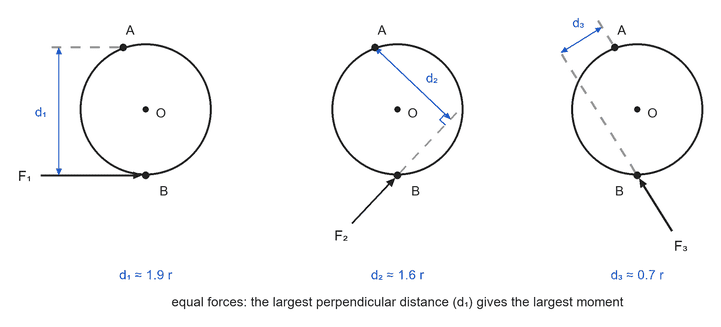
acts along the tangent at B, nearly at right angles to the line AB, so the perpendicular from A to its line of action is almost the whole length AB. The lines of action of and slant towards A, so their perpendicular distances are smaller. Measured on the figure, taking r as the radius of the wheel, ≈ 1.9r, ≈ 1.6r and ≈ 0.7r:
Step 3 — Part (b): give the reason.
Since moment = force × perpendicular distance and the forces are equal, the force with the largest perpendicular distance from A, , gives the largest moment.
Watch out: The moment depends on the perpendicular distance of the line of action from A, not on the distance AB alone, which is the same for all three forces.
Therefore, (a) produces the maximum moment about A; (b) its line of action is farthest from A (largest perpendicular distance), and the forces are equal.