
Question 261 markMCQAsked 2026Easy
For a body to be in dynamic equilibrium, its:
Confirming your payment
Sign up now and get 250 free tokens.
Previous Year Questions · Question 26 of 33
For a body to be in dynamic equilibrium, its:
(A) momentum should be zero
(B) acceleration should be zero
(C) kinetic energy should be zero
(D) velocity should be zero
Answer: (B) acceleration should be zero
Concept: A body is in dynamic equilibrium when it stays in the same state of motion (constant velocity) under the action of several forces; this needs a zero resultant force.
Step 1 — Link equilibrium to the resultant force.
A body is in equilibrium when the resultant of all the forces on it is zero. Since resultant force = mass × acceleration, this means its acceleration is zero.
Step 2 — Apply it to a moving body.
With zero acceleration a moving body keeps a constant velocity, as a raindrop does when it falls at a steady speed. This is dynamic equilibrium, so the condition is option (B).
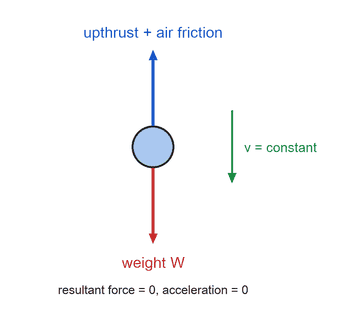
Watch out: Dynamic equilibrium is about a MOVING body: its velocity is constant but not zero.
Why the other options are wrong:
Therefore, for dynamic equilibrium the acceleration should be zero, option (B).