
Question 112 marksEasy
State the condition when on applying a force, a body has :
(a) translational motion, (b) rotational motion.
Confirming your payment
Sign up now and get 250 free tokens.
Force · Question 11 of 99
State the condition when on applying a force, a body has :
(a) translational motion, (b) rotational motion.
Solution:
Concept: What a force does to a rigid body depends on whether the body is free or pivoted (fixed at a point).
Step 1 — (a) Translational motion.
When the body is free to move (not fixed at any point), the force moves the whole body in a straight line in the direction of the force. Every particle moves through the same distance, as when a ball is pushed along the floor.
Step 2 — (b) Rotational motion.
When the body is pivoted (fixed) at a point and the line of action of the force does not pass through the pivot, the force turns the body about an axis through the pivot, as when a door turns about its hinges.
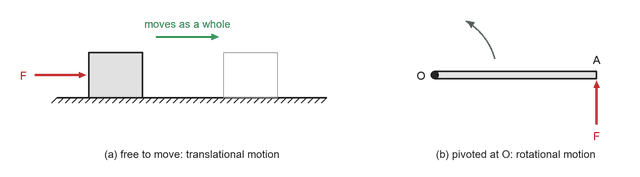
Watch out: A pivoted body does not rotate if the line of action of the force passes through the pivot (zero moment).
Therefore, a force gives (a) translational motion to a free body and (b) rotational motion to a pivoted body when its line of action does not pass through the pivot.