Answer: (B) (1), (2) and (3)
Concept: A body is in static equilibrium when it stays at rest under the forces acting on it, and in dynamic equilibrium when it keeps the same state of motion (uniform motion, rotation or revolution).
Step 1 — Check statement 1.
The moon keeps revolving round the earth in the same way, so it is in dynamic equilibrium.
Step 2 — Check statement 2.
The pebble keeps whirling round its circle in the same way, so it is in dynamic equilibrium.
Step 3 — Check statement 3.
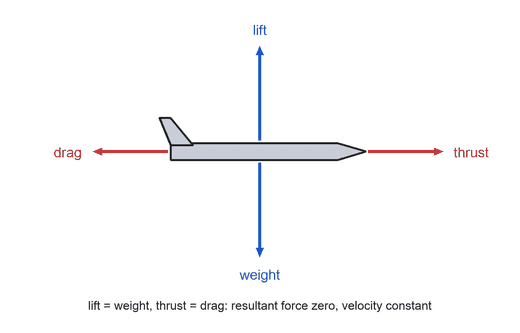
The aeroplane keeps flying at a constant height: the lift balances its weight while it moves, so it is in dynamic equilibrium.
Step 4 — Check statement 4.
A balanced beam balance is at rest, so it is in static equilibrium, not dynamic.
Watch out: A body at rest is in static equilibrium even though several forces act on it.
Note: Selina calls a body that keeps moving in the same way, even round a circle at constant speed, a body in dynamic equilibrium, and that is the answer expected here. Strictly, a body moving in a circle has a centripetal acceleration and an unbalanced (centripetal) force, so a physicist would not call it equilibrium in the strict sense.
Why the other options are wrong:
- (A) (3) and (4): it includes statement 4, which is static, and leaves out statements 1 and 2.
- (C) (1) and (2): it leaves out statement 3, the aeroplane.
- (D) (1) and (3): it leaves out statement 2, the whirling pebble.
Therefore, statements 1, 2 and 3 are examples of dynamic equilibrium, option (B).
