Solution:
Concept: The turning effect of a force is called its moment (or torque): moment of force = force × perpendicular distance of its line of action from the axis of rotation, τ = F × d. Its S.I. unit is the newton metre (N m). A larger force at a smaller distance may give more or less torque, so work out both and compare.
Given: F₁ = 100 N, applied at d₁ = 0.5 m; then the force is increased by 20%, applied at d₂ = 0.4 m.
Step 1 — Find the first torque.
The force acts at the end of the 0.5 m spanner.
τ1=100 N×0.5 m=50 N m
Step 2 — Find the new force.
The force is increased by 20% of 100 N.
F2=100 N+20 N=120 N
Step 3 — Find the new torque.
The mechanic now holds the spanner at 0.4 m.
τ2=120 N×0.4 m=48 N m
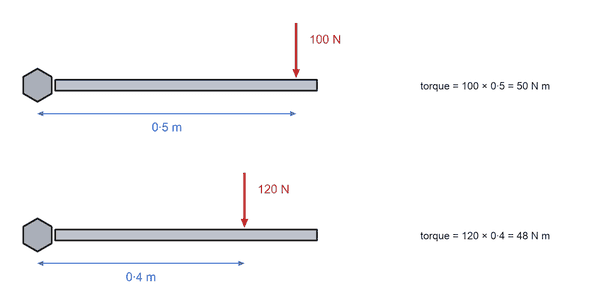
Step 4 — Compare.
The new torque is smaller than the first one.
τ1−τ2=50 N m−48 N m=2 N m
The force is multiplied by 1.2 but the distance by 0.8, and 1.2 × 0.8 = 0.96, so the torque falls by 4%.
Watch out: A 20% rise in force does not make up for a 20% fall in distance, because the torque depends on the product.
Therefore, the torque at first is 50 N m, and the change gives a decrease of 2 N m (to 48 N m).
