
Question 302 marksEasy
State two conditions for a body, acted upon by several forces, to be in equilibrium.
Confirming your payment
Sign up now and get 250 free tokens.
Force · Question 30 of 99
State two conditions for a body, acted upon by several forces, to be in equilibrium.
Solution:
Concept: A body can change its state in two ways, by moving as a whole or by turning, so there are two conditions.
Step 1 — Condition 1: no translation.
The resultant of all the forces acting on the body must be zero: the forces in one direction balance the forces in the opposite direction.
Step 2 — Condition 2: no rotation.
The algebraic sum of the moments of all the forces about the point of rotation must be zero: the sum of the anticlockwise moments equals the sum of the clockwise moments.
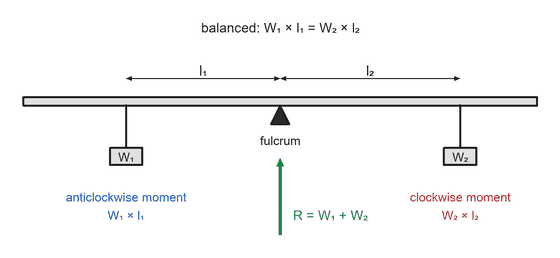
Step 3 — See both in the balanced rule.
In the balanced metre rule, the upward push R of the fulcrum equals W₁ + W₂ (condition 1), and W₁ × l₁ = W₂ × l₂ (condition 2).
Therefore, for equilibrium the resultant force on the body must be zero and the algebraic sum of the moments about the point of rotation must be zero.