
Question 293 marksEasy
State the condition when a body is in (i) static, (ii) dynamic equilibrium. Give one example each of static and dynamic equilibrium.
Confirming your payment
Sign up now and get 250 free tokens.
Force · Question 29 of 99
State the condition when a body is in (i) static, (ii) dynamic equilibrium. Give one example each of static and dynamic equilibrium.
Solution:
Concept: In both kinds of equilibrium the forces balance; the difference is whether the body is at rest or moving.
Step 1 — (i) Static equilibrium.
When a body remains in the state of rest under the action of several forces, it is in static equilibrium. Example: a beam balance with its beam balanced horizontally, or a book lying on a table (its weight is balanced by the reaction of the table).
Step 2 — (ii) Dynamic equilibrium.
When a body remains in the same state of motion (uniform translational or rotational motion) under the action of several forces, it is in dynamic equilibrium. Example: an aeroplane flying at a constant height and speed (lift balances its weight and thrust balances air drag), or a raindrop falling with its constant terminal velocity.
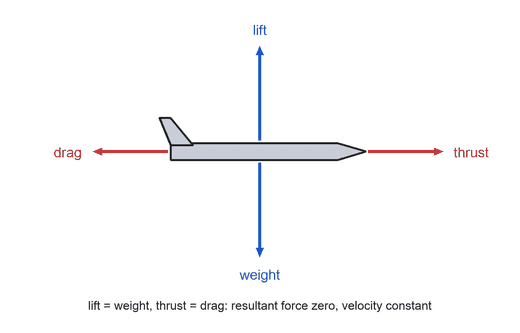
Therefore, a body at rest under balanced forces is in static equilibrium (a balanced beam balance), and a body moving uniformly under balanced forces is in dynamic equilibrium (an aeroplane at constant height and speed).