Solution:
Concept: The stone moves at constant speed, but its direction of motion changes at every point. The tension in the thread pulls it towards the centre and keeps it on the circle.
Step 1 — (a) Velocity.
Variable. The speed is constant, but the direction of motion (along the tangent) changes at every point, so the velocity changes.
Step 2 — (b) Acceleration.
Variable. Its magnitude is constant, but its direction, towards the centre, changes continuously as the stone goes round.
Step 3 — (c) Direction of acceleration.
Towards the centre of the circular path, along the radius (along the thread, towards the hand).
Step 4 — (d) Source of the centripetal force.
The tension in the thread provides it.
Step 5 — (e) Force on the hand.
The reaction of the tension acts on the hand. The stone pulls the thread, and the thread pulls the hand outward, away from the centre of the circular path, towards the stone.
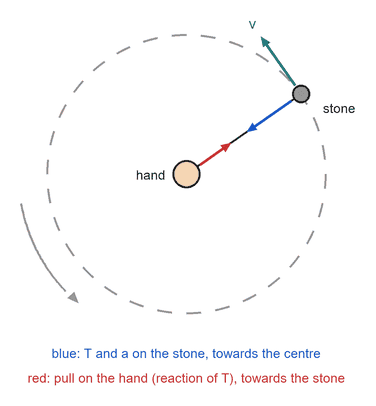
Watch out: This outward pull on the hand is a REAL force (the reaction of the tension); the centrifugal force is a different, fictitious force imagined on the stone by an observer moving with it.
Therefore, (a) velocity variable, (b) acceleration variable, (c) towards the centre, (d) tension in the thread, and (e) the reaction of the tension acts on the hand, outward towards the stone.
