Solution:
Concept: An observer at rest (outside the disc) explains the motion with the real centripetal force alone. An observer rotating with the disc sees the pebble at rest, and has to imagine an outward centrifugal force to balance the tension.
Step 1 — (a) Observation from outside.
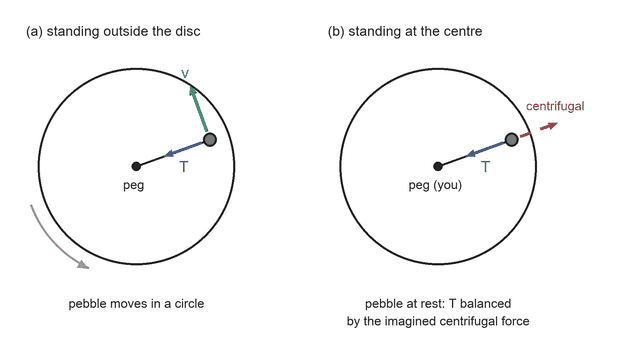
Standing outside the disc, at rest, I see the pebble moving in a circular path along with the disc.
Step 2 — (a) Explanation.
The pebble tends to move along the tangent, but the tension in the string, directed towards the peg at the centre, provides the centripetal force. This keeps pulling it towards the centre, so it keeps going round in a circle.
Step 3 — (b) Observation from the centre.
Standing at the centre and rotating with the disc, I see the pebble stationary, always at the same place on the disc in front of me.
Step 4 — (b) Explanation.
In my rotating frame, I see the string pulling the pebble inward with a tension, yet the pebble does not move towards me. To explain this I imagine an outward centrifugal force on the pebble, equal and opposite to the tension, which balances it. This centrifugal force is fictitious; it appears only because I am rotating with the disc.
Therefore, (a) from outside the pebble is seen moving in a circle under the centripetal force (the tension), and (b) from the centre it is seen at rest, the tension being balanced by an imagined centrifugal force.
