Solution:
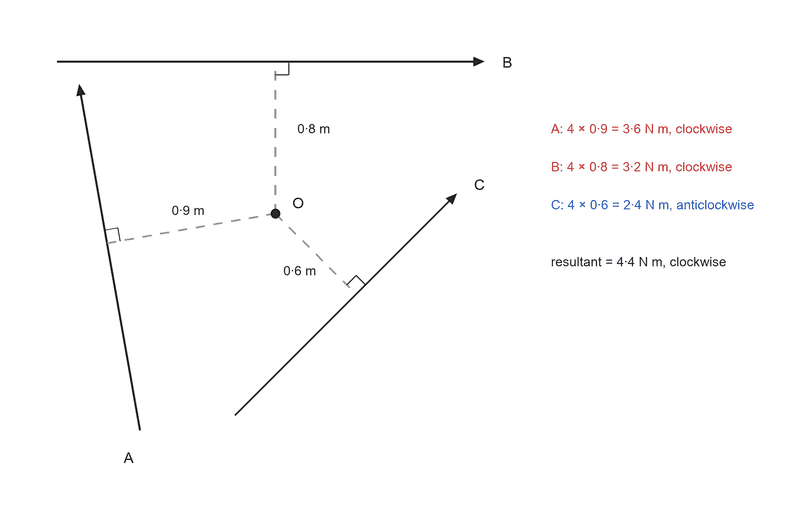
Concept: All three forces have the same size (4 N), so their moments about O, 4 N × d, differ only through the perpendicular distance d of each line of action from O. By convention an anticlockwise moment is taken as positive and a clockwise moment as negative.
Step 1 — Find the moment of each force.
Multiply 4 N by each perpendicular distance.
τA=4 N×0.9 m=3.6 N m
τB=4 N×0.8 m=3.2 N m
τC=4 N×0.6 m=2.4 N m
Step 2 — (i) Least moment.
Force C has the least moment, 2.4 N m, because its line of action is nearest to O (0.6 m).
Step 3 — (ii) Greatest moment.
Force A has the greatest moment, 3.6 N m, because its line of action is farthest from O (0.9 m).
Step 4 — (iii) Sense of each moment.
Imagine each force acting alone on a body pivoted at O. (a) A and B turn it clockwise: A acts upward on the left of O, and B acts towards the right above O. (b) C turns it anticlockwise: it acts upward and to the right along a line passing below and to the right of O.
Step 5 — (iv) Resultant torque.
Add the moments with their signs (anticlockwise +, clockwise −).
τ=+2.4−3.6−3.2=−4.4 N m
The negative sign means the resultant torque is clockwise.
Watch out: Compare the PERPENDICULAR distances (the dashed lines meet the forces at right angles), not the distances to the tails of the arrows.
Therefore, (i) C has the least moment, (ii) A has the greatest, (iii) A and B give clockwise and C anticlockwise moments, and (iv) the resultant torque about O is 4.4 N m, clockwise.

