
Question 21 markMCQEasy
The motion of a door when a force is applied on its handle is :
Confirming your payment
Sign up now and get 250 free tokens.
Force · Question 2 of 99
The motion of a door when a force is applied on its handle is :
(A) rotational motion
(B) linear motion
(C) angular motion
(D) zig-zag motion
Answer: (A) rotational motion
Concept: A body that is pivoted (fixed at a point or along a line) cannot move as a whole. A force on it, acting away from the pivot, turns it about the axis through the pivot: this is rotational motion.
Step 1 — Find the pivot.
A door is fixed to the frame at its hinges, which form a vertical axis.
Step 2 — See what the force does.
A force on the handle acts far from this axis, so it has a turning effect about the hinges. The door turns about the hinge axis instead of moving as a whole.
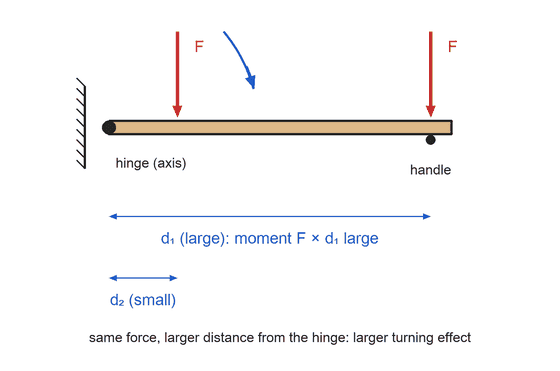
Step 3 — Name the motion.
Turning of a body about a fixed axis is rotational motion.
Watch out: The door does move, but every point of it moves along an arc about the hinges, not along a straight line.
Why the other options are wrong:
Therefore, the door has rotational motion, option (A).