
Question 31 markMCQEasy
The moment of a force about a given axis depends on :
Confirming your payment
Sign up now and get 250 free tokens.
Force · Question 3 of 99
The moment of a force about a given axis depends on :
(A) only the magnitude of force
(B) only the perpendicular distance of force from the axis
(C) neither the force nor the perpendicular distance of force from the axis
(D) both the force and its perpendicular distance from the axis.
Answer: (D) both the force and its perpendicular distance from the axis.
Concept: The turning effect of a force is called its moment (or torque): moment of force = force × perpendicular distance of its line of action from the axis of rotation, τ = F × d. Its S.I. unit is the newton metre (N m).
Step 1 — Write the formula.
The moment of a force about an axis is the product of two quantities.
Here F is the force and d is the perpendicular distance of its line of action from the axis.
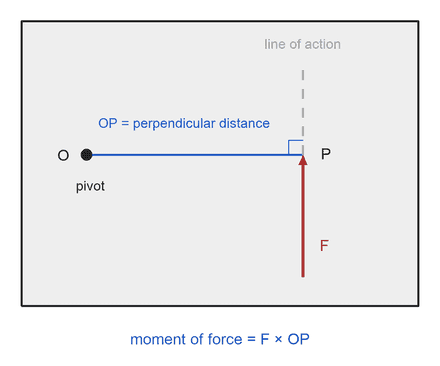
Step 2 — Change each factor in turn.
If F is doubled with d unchanged, the moment doubles. If d is doubled with F unchanged, the moment also doubles. So the moment depends on both the force and its perpendicular distance.
Watch out: Use the perpendicular distance of the line of action from the axis, not just any distance to the force.
Why the other options are wrong:
Therefore, the moment depends on both the force and its perpendicular distance from the axis, option (D).