
Question 11 markMCQEasy
The motion of a stationary rigid body in a straight path when a force is applied in the direction of force is called :
Confirming your payment
Sign up now and get 250 free tokens.
Force · Question 1 of 99
The motion of a stationary rigid body in a straight path when a force is applied in the direction of force is called :
(A) rotational motion
(B) linear motion
(C) angular motion
(D) zigzag motion
Answer: (B) linear motion
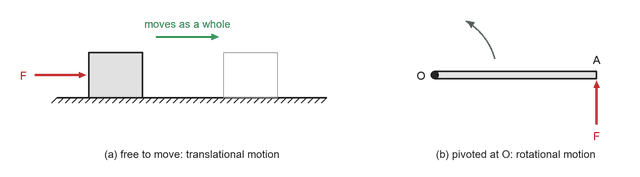
Concept: When a rigid body is free to move (not fixed at any point), a force applied on it moves the whole body in the direction of the force. This is linear (translational) motion.
Step 1 — Look at the body.
The body is stationary and not fixed anywhere, and the force acts in the direction in which the body is to move.
Step 2 — See how its particles move.
Every particle of the body moves through the same distance in the same direction, so the whole body moves along a straight line, in the direction of the force.
Step 3 — Name the motion.
Motion of a whole body along a straight path is called linear (or translational) motion, as when a ball is pushed along the floor.
Watch out: Rotation needs a pivot; a free body pushed in the direction of motion simply moves along a straight line.
Why the other options are wrong:
Therefore, the motion is linear motion, option (B).