
Question 581 markMCQEasy
With respect to centre of gravity, which of the following statements are correct ?
Confirming your payment
Sign up now and get 250 free tokens.
Force · Question 58 of 99
With respect to centre of gravity, which of the following statements are correct ?
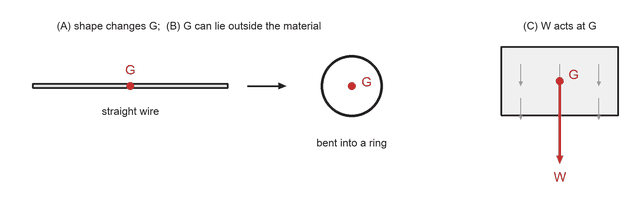
(A) The position of centre of gravity of a body depends on its shape.
(B) It is not necessary that the centre of gravity of a body should always be within the material of the body.
(C) A body of weight W can be considered as a point particle of weight W at its centre of gravity.
(D) All of the above
Answer: (D) All of the above
Concept: The centre of gravity (C.G.) of a body is the point through which the whole weight of the body acts, however the body is placed. It is the point about which the algebraic sum of the moments of the weights of all the particles of the body is zero. Its position depends on how the mass of the body is spread out.
Step 1 — Check statement (A).
It is true. The C.G. depends on the shape, that is, on the distribution of mass. A straight wire has its C.G. at its middle; bend the same wire into a ring and the C.G. moves to the centre of the ring.
Step 2 — Check statement (B).
It is true. The C.G. need not lie in the material: for a ring it is at the centre, where there is no material.
Step 3 — Check statement (C).
It is true. The whole weight W acts at the C.G., so the body can be treated as a point particle of weight W placed at its C.G.
Step 4 — Choose the option.
All three statements are correct, so the answer is the option that includes all of them.
Watch out: When every listed statement is true, a single statement is an incomplete answer.
Why the other options are wrong:
Therefore, all three statements are correct, option (D).