
Opening your dashboard
Class 10 Physics Chapter 1 Force: Practice Questions
44 questions on Chapter 1, each worked through on its own page with the AI tutor. Class 10 Physics, ICSE 2026-27.
44 questions
1–5 marks · Mixed difficulty
- 11 mark
Question 1
Bloom's level: Remember
The S.I. unit of moment of force is newton metre (N m) and its C.G.S. unit is dyne cm. Then 1 N m is equal to :
- 21 mark
Question 2
Bloom's level: Remember
Which one of the following correctly states the position of the centre of gravity ?
- 31 mark
Question 3
Bloom's level: Understand
The front wheel of a bicycle moving along a straight road has :
- 41 mark
Question 4
Bloom's level: Apply
A gate is pushed with a force of 30 N, applied at right angles to the gate at a point 0.4 m from its hinges. The moment of the force about the hinges is :
- 51 mark
Question 5
Bloom's level: Apply
A uniform beam is balanced at its centre. A packet of 60 gf hangs from the beam 30 cm to the left of the centre.

Where must a packet of 90 gf hang to keep the beam level ?
- 61 mark
Question 6
Bloom's level: Analyse
A light rod is pivoted at its middle point O. Three forces act on it, all vertically downwards :
Force Position 4 N 30 cm to the left of O 3 N 50 cm to the right of O 2 N 20 cm to the right of O 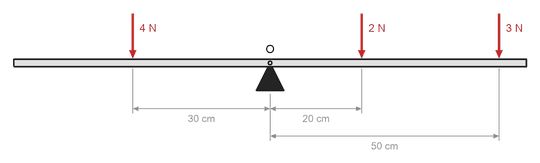
What happens to the rod ?
- 71 mark
Question 7
Bloom's level: Understand
A car goes round a circular track at a constant speed of 36 km h⁻¹. Which statement about the car is correct ?
- 81 mark
Question 8
Bloom's level: Evaluate
A ceiling fan rotates at a constant speed. Anu says, "The fan cannot be in equilibrium because it is moving." Which is the best judgement of her statement ?
- 91 mark
Question 9
Bloom's level: Understand
In which of these situations is a couple applied ?
- 101 mark
Question 10
Bloom's level: Understand
Read the Assertion (A) and the Reason (R) and choose the correct option.
Assertion (A): The handle of a door is fixed near its free edge, far from the hinges.
Reason (R): The S.I. unit of moment of force is newton metre.
- 111 mark
Question 11
Bloom's level: Remember
Read the Assertion (A) and the Reason (R) and choose the correct option.
Assertion (A): Centrifugal force is a real force that acts on a body moving in a circle.
Reason (R): Centrifugal force is directed away from the centre of the circular path.
- 121 mark
Question 12
Bloom's level: Analyse
Read the Assertion (A) and the Reason (R) and choose the correct option.
Assertion (A): A double-decker bus is more likely to topple on a sharp turn when the upper deck is full and the lower deck is empty than when the lower deck is full and the upper deck is empty.
Reason (R): The lower the centre of gravity of a body and the wider its base, the more stable the body is.
- 131 mark
Question 13
Bloom's level: Remember
A stone tied to a string is whirled in a horizontal circle at a steady speed. At any instant, how is the direction of its velocity related to the string (the radius) at that instant ?
- 142 marks
Question 14
Bloom's level: Understand
Classify the motion of each of the following as translational, rotational, or both. Give the reason in each case.
(a) A drawer being pulled out
(b) The blades of a running ceiling fan
(c) A ball rolling along the ground
(d) A merry-go-round
- 152 marks
Question 15
Bloom's level: Apply
A moment of 0.6 N m is needed to turn a stiff valve. Its handle is 6 cm long.
(a) Find the least force needed at the end of the handle.
(b) What would be the least force if the handle were 12 cm long ?
- 162 marks
Question 16
Bloom's level: Apply
A driver turns a steering wheel of diameter 40 cm by pushing up with her left hand and down with her right hand, each with a force of 15 N, at the two ends of a horizontal diameter.
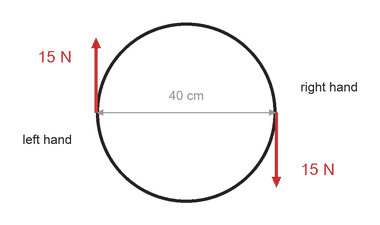
Find the moment of the couple and state its direction as seen by the driver.
- 172 marks
Question 17
Bloom's level: Apply
Meena (weight 25 kgf) and Arjun (weight 30 kgf) play on a see-saw that is 3 m long and pivoted at its centre. Meena sits right at one end.

How far from the pivot must Arjun sit for the see-saw to stay level ?
- 182 marks
Question 18
Bloom's level: Understand
A person carrying a heavy bucket of water in the right hand leans towards the left and often stretches out the left arm. Explain why.
- 192 marks
Question 19
Bloom's level: Apply
A uniform signboard of weight 40 N hangs at rest from two vertical chains, one at each end.
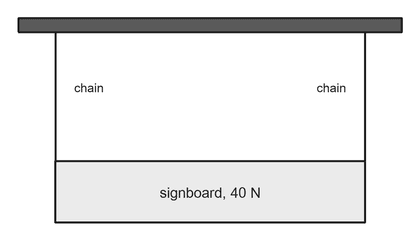
(a) Find the tension in each chain.
(b) A flower pot of weight 10 N is now hung from the board at a point one-quarter of its length from the left end. Find the new tension in each chain.
- 202 marks
Question 20
Bloom's level: Analyse
In the spin-dryer of a washing machine, wet clothes are spun at high speed inside a drum that has many small holes in its wall. Which force keeps the clothes moving in a circle ? Why does the water leave the clothes through the holes ?
- 212 marks
Question 21
Bloom's level: Evaluate
Rohan wants to loosen a very tight nut. He says, "I should hold the spanner close to the nut, because then I can push harder." Is Rohan right ? Justify your answer.
- 222 marks
Question 22
Bloom's level: Analyse
A uniform wire 100 cm long is bent at its middle into an L shape, so that its two arms are each 50 cm long and at right angles.
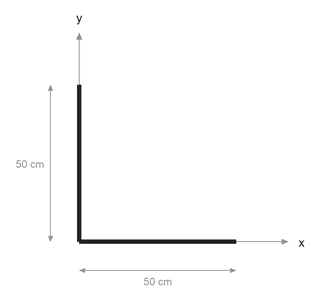
Taking the corner as the origin and the arms along the x- and y-axes, find the position of its centre of gravity. Does the centre of gravity lie on the wire ?
- 234 marks
Question 23
Bloom's level: Apply
A uniform metre rule of weight 40 gf balances horizontally on a knife edge at the 40 cm mark when a weight W is hung at the 20 cm mark.

(a) Find W.
(b) A weight of 20 gf is now also hung at the 100 cm mark. To which mark must the knife edge be moved to balance the rule again ?
(c) What is the force exerted by the knife edge on the rule in part (b) ?
- 245 marks
Question 24
Bloom's level: Create
You have a light rod 60 cm long, a light rod 30 cm long, some thread, and three toys: P of 60 gf, Q of 10 gf and R of 30 gf. Design a two-level hanging mobile in which both rods hang horizontally.
(a) Describe your arrangement - which toys hang from which rod and where the rods are tied.
(b) Calculate the point on the lower rod where its thread must be tied.
(c) Calculate the point on the upper rod where the main (top) thread must be tied.
(d) Find the tension in the top thread, and say how you would check your mobile before hanging it up.
- 254 marks
Question 25
Bloom's level: Apply
Case study: A car goes round a level, circular roundabout at a steady 30 km h⁻¹. The passengers feel as if they are being pushed outwards, away from the centre. On a rainy day, the driver slows down much more before entering the roundabout.
(a) Is the motion of the car accelerated ? Give a reason.
(b) Which force makes the car go round the circle ? In which direction does this force act ?
(c) Explain why the passengers feel pushed outwards, and why the driver must slow down more on a wet road.
- 264 marks
Question 26
Bloom's level: Evaluate
Case study: For a school trip to the hills, the bus driver loads all the heavy trunks on the roof carrier and keeps the light sleeping bags in the luggage space under the floor. A student, Kabir, says, "It does not matter where the luggage goes, because the total weight of the bus is the same either way."
(a) How does the driver's loading change the position of the centre of gravity of the bus ?
(b) Why could this be dangerous on the sharp turns of a hill road ?
(c) Judge Kabir's statement and suggest a better way to load the bus.
- 274 marks
Question 27
Bloom's level: Analyse
A uniform plank 3 m long and of weight 300 N rests horizontally on two supports, one at each end. A man of weight 600 N stands on the plank 1 m from the left end.
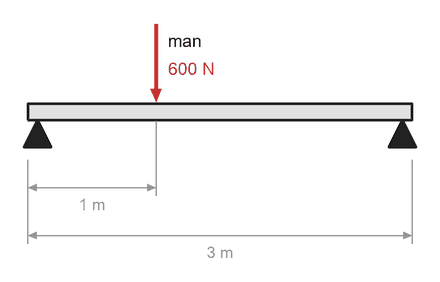
(a) Find the upward force exerted by each support.
(b) Which support carries more load ? Explain why, in terms of the man's position.
(c) Where should the man stand so that both supports carry equal loads ?
- 284 marks
Question 28
Bloom's level: Apply
A door is 0.8 m wide. A force of 20 N is applied at its free edge, in a horizontal plane.
(a) Find the moment about the hinges when the force is at right angles to the door.
(b) Find the moment when the force makes an angle of 30° with the plane of the door. (Hint: the perpendicular distance of the line of action from the hinge is .)
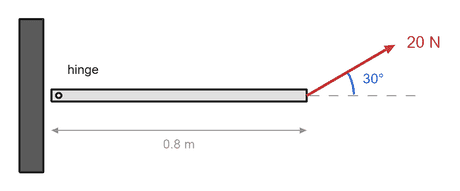
(c) Find the moment when the force acts along the door, towards the hinges.
(d) What force, applied at 30° as in (b), would produce the same moment as in (a) ?
- 293 marks
Question 29
Bloom's level: Understand
(a) A single force acts on a body that is not pivoted, and its line of action does not pass through the centre of gravity of the body. Describe the motion produced.
(b) Explain why a couple produces only rotation and no translation.
(c) When a single force is applied at the rim of a wheel fixed on an axle, the wheel only rotates. Explain this in terms of a couple.
- 304 marks
Question 30
Bloom's level: Create
Case study: For a science-fair stall, you want to show visitors that a body moving in a circle needs a force towards the centre, and that it flies off along the tangent when this force is removed. You may use a rubber ball or a small cork tied to a strong string, a smooth table, a hollow plastic pipe, and some chalk.
(a) Plan how you will show that a force towards the centre is needed to keep the body moving in a circle.
(b) Plan how you will show the direction in which the body moves when the string is let go, and how you will record it.
(c) Plan a simple way to show that a larger speed needs a larger centripetal force, and state one safety precaution.
- 311 mark
Question 31
A force applied at right angles to a door, at a distance from its hinges, has a moment about the hinges. If the force is halved and is applied, again at right angles to the door, at a distance from the hinges, its moment about the hinges becomes :
- 321 mark
Question 32
Which one of the following statements about the centre of gravity of a body is not correct ?
- 331 mark
Question 33
Assertion (A): A couple acting on a body cannot produce translational motion of the body.
Reason (R): The two forces of a couple are equal in magnitude and opposite in direction, so their resultant is zero.
- 342 marks
Question 34
A uniform metre rule lies at rest on a smooth horizontal table. A horizontal force is applied to it at right angles to its length. State the kind of motion produced in the rule when :
(i) the rule is free to move and the force is applied at its mid-point,
(ii) a nail is fixed through the mid-point of the rule into the table and the force is applied at one end.
- 352 marks
Question 35
A mechanic applies a force of 60 N on a spanner, at right angles to it, at a distance of 20 cm from the centre of a nut.
(i) Calculate the moment of the force about the centre of the nut, in N m.
(ii) The nut does not turn. It needs a moment of 18 N m. At what distance from the centre of the nut must the same force of 60 N be applied, at right angles to the spanner, to turn it ?
- 362 marks
Question 36
(i) State one difference between static equilibrium and dynamic equilibrium.
(ii) State the kind of equilibrium in each case : (1) a beam balance at rest with its beam horizontal, (2) a lift moving up with a constant velocity.
- 372 marks
Question 37
A coin is placed on a horizontal turntable. The turntable rotates at a steady speed and the coin goes round in a circle with it, without slipping.
(i) Name the force which provides the centripetal force on the coin, and state its direction.
(ii) An observer sitting on the turntable sees the coin at rest. Name the force which this observer has to assume to explain why the coin is at rest. State its direction and compare its magnitude with that of the centripetal force.
- 384 marks
Question 38
A uniform metre rule rests horizontally on a pivot at its 50 cm mark. A weight of 40 gf hangs from the 10 cm mark and a weight of 60 gf hangs from the 30 cm mark, as shown in the diagram.

(i) Calculate the total anticlockwise moment of the two weights about the pivot.
(ii) At which mark must a weight of 80 gf be hung so that the rule stays balanced in the horizontal position ? Name the principle you have used.
(iii) Explain why the weight of the metre rule is not needed in this calculation.
- 393 marks
Question 39
The cross-bar handle of a tap is 10 cm long and turns about an axis through its mid-point. To open the tap, a girl applies two equal and opposite forces of 4 N each at the two ends of the handle, each at right angles to the handle.
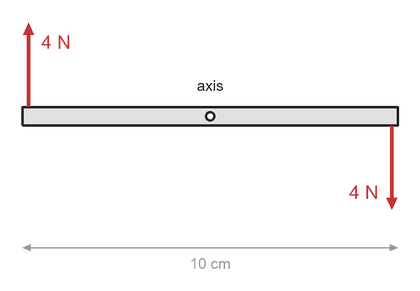
(i) What name is given to such a pair of forces ? State the kind of motion it produces.
(ii) Calculate the moment of this pair of forces, in N m.
(iii) The girl now pushes with one finger only, applying a single force of 4 N at one end of the handle, at right angles to it. Calculate the moment of this force about the axis and compare it with your answer to part (ii).
- 403 marks
Question 40
A toy car moves round a circular track of radius 7 m at a constant speed. It completes one round in 22 s.
(i) Calculate the distance covered by the car in one round, and its speed.
(ii) Is the velocity of the car uniform ? Give a reason for your answer.
(iii) Is the motion of the car accelerated ? If so, state the direction of its acceleration.
- 412 marks
Question 41
A girl of mass 20 kg is sitting at a distance of 4 m from the middle of a see-saw.
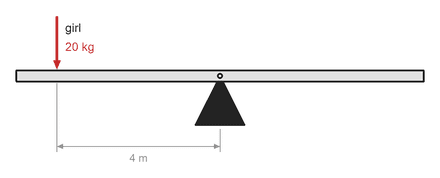
Where should a girl of mass 40 kg sit so as to balance the see-saw ?
- 421 mark
Question 42
A man walks along a tight rope, carrying a long pole in his hands. Why does he carry the pole ?
- 431 mark
Question 43
Write one condition to make a body more stable.
- 442 marks
Question 44
The figure shows five forces acting on a body which is free to turn about the point O. The perpendicular distance of the line of action of each force from O is marked. The line of action of the 200 N force passes through O.
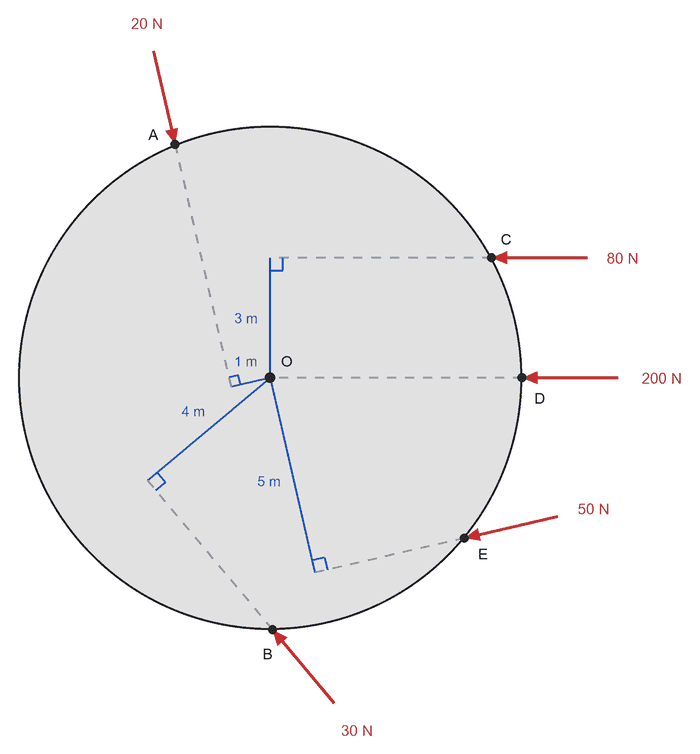
Calculate the resultant torque (moment of force) about the point O.