Solution:
Concept: As the roller is lifted onto the pavement it does not turn about its axle O. Friction stops it slipping at the edge, so it turns about the edge X of the pavement, where it touches the step. To raise it with the least force, the applied force must have the largest possible moment about X.
Step 1 — Choose the point of application.
Apply the force at the point P of the roller that is diametrically opposite to X, at the other end of the diameter through X. This is the point of the roller farthest from X: its distance from X is the full diameter.
Step 2 — Choose the direction.
Apply the force perpendicular to the diameter XP, in the sense that turns the roller about X up onto the pavement. Then the whole diameter XP is the perpendicular distance, so the moment about X is the largest and the force needed is the least.
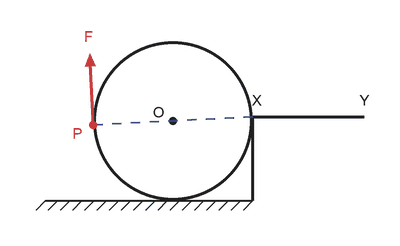
Step 3 — Decide whether it goes up.
The roller turns about the edge X as a pivot. Its weight W acts at O and tries to turn it back down about X. When the moment of the applied force about X becomes greater than the moment of W about X, the roller turns about X and rolls up onto the pavement XY.
Watch out: The pivot is the edge X, not the axle O; a force that only has a moment about O would just spin the roller in place.
Therefore, the force is applied at P, the end of the diameter through X, perpendicular to XP; the roller turns about X as the pivot, and yes, it goes up onto the pavement.

