Solution:
Concept: The weight of the uniform rule (100 gf) acts at its 50 cm mark, 10 cm to the right of the fulcrum at 40 cm, so it gives a clockwise moment. The mass m on the left gives an anticlockwise moment. Principle of moments: when a body is in equilibrium under several forces, the sum of the anticlockwise moments about the pivot equals the sum of the clockwise moments (their algebraic sum is zero).
Given: Uniform metre rule of mass 100 g; fulcrum at 40 cm; mass m at 20 cm.
Step 1 — (i) Find m.
m is at the 20 cm mark, 40 − 20 = 20 cm to the left of the fulcrum.
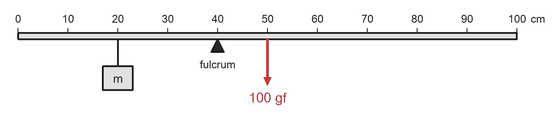
m×20 cm=100 g×10 cm
m=20 cm1000 g cm=50 g
Step 2 — (ii) Moments with m at the 10 cm mark.
m is now 40 − 10 = 30 cm from the fulcrum.
τanti=50 gf×30 cm=1500 gf cm
τclock=100 gf×10 cm=1000 gf cm
The anticlockwise moment is larger, so the rule tilts towards the side of the mass m (the 0 cm end).
Step 3 — (iii) Resultant moment.
Subtract the clockwise moment from the anticlockwise moment.
τ=1500 gf cm−1000 gf cm=500 gf cm
It is anticlockwise.
Step 4 — (iv) Balance with another 50 g.
The 50 g must add a clockwise moment of 500 gf cm on the right of the fulcrum.
50 gf×d=500 gf cm
d=50 gf500 gf cm=10 cm
10 cm to the right of the 40 cm mark is the 50 cm mark.
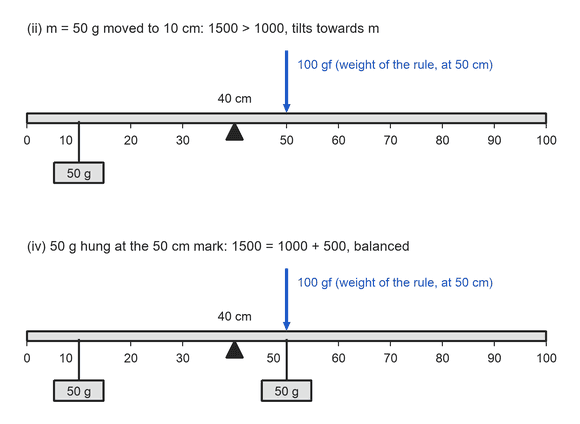
Watch out: The rule's weight acts at 50 cm, 10 cm from the fulcrum, so it DOES have a moment here.
Therefore, (i) m = 50 g, (ii) the rule tilts towards m, (iii) the resultant moment is 500 gf cm anticlockwise, and (iv) the extra 50 g is hung at the 50 cm mark.

