Solution:
Concept: A half metre rule is 50 cm long, so its weight acts at its mid-point, the 25 cm mark. The balance point (29 cm) is on the side of the 50 cm end, so the 20 g mass hangs from the 50 cm end. Principle of moments: when a body is in equilibrium under several forces, the sum of the anticlockwise moments about the pivot equals the sum of the clockwise moments (their algebraic sum is zero).
Given: Uniform half metre rule balanced at the 29 cm mark with 20 g hung from one end.
Step 1 — (a) Draw the arrangement.
The rule rests on a knife edge at the 29 cm mark, its weight Mg acts at 25 cm, and 20 g hangs at the 50 cm end.
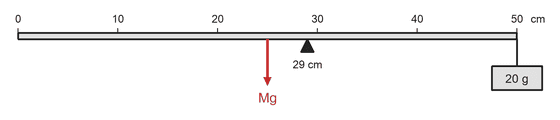
Step 2 — Find the distances from the knife edge.
The rule's weight acts 29 − 25 = 4 cm to the left; the 20 g acts 50 − 29 = 21 cm to the right.
Step 3 — (b) Apply the principle of moments.
Equate the moments (g cancels on both sides, so masses can be used).
M×4 cm=20 g×21 cm
M=4 cm420 g cm=105 g
Step 4 — (c) Shift of the balancing point.
If the 20 g mass is moved inward from the end, its distance from the balance point falls, so its moment falls. The rule's own weight now has the larger moment and the rule tips towards the 25 cm side. To balance again, the support must move towards the rule's own centre of gravity, that is, towards the 25 cm mark. For example, with the 20 g at the 40 cm mark the new balance point is at 27.4 cm.
Watch out: The rule's mass acts at its OWN middle (25 cm for a half metre rule), not at 50 cm.
Therefore, (b) the mass of the half metre rule is 105 g, and (c) the balancing point shifts towards the 25 cm mark (the centre of the rule).
