
Question 473 marksEasy
A uniform metre rule is pivoted at its mid-point. A weight of 50 gf is suspended at one end of it.

Where should a weight of 100 gf be suspended to keep the rule horizontal ?
Confirming your payment
Sign up now and get 250 free tokens.
Force · Question 47 of 99
A uniform metre rule is pivoted at its mid-point. A weight of 50 gf is suspended at one end of it.
Where should a weight of 100 gf be suspended to keep the rule horizontal ?
Solution:
Concept: A uniform rule (or bar) has its weight acting at its mid-point, its centre of gravity. If the pivot is at that mid-point, the rule's own weight has no moment about the pivot. Principle of moments: when a body is in equilibrium under several forces, the sum of the anticlockwise moments about the pivot equals the sum of the clockwise moments (their algebraic sum is zero).
Given: Metre rule pivoted at its mid-point (50 cm); 50 gf at one end; 100 gf to be placed.
Step 1 — Place the 50 gf.
Let the 50 gf hang at one end, say the 0 cm mark. It is 50 cm from the pivot, so it turns the rule anticlockwise. The 100 gf must hang on the other side at a distance d.
Step 2 — Apply the principle of moments.
Equate the anticlockwise and clockwise moments.
Step 3 — Solve for d.
Divide both sides by 100 gf.
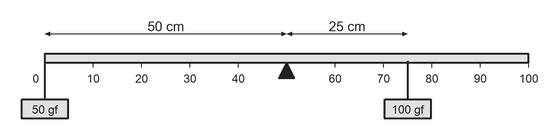
Step 4 — Locate the mark.
25 cm from the pivot on the other side is the 50 + 25 = 75 cm mark, which is 25 cm from the other end of the rule.
Watch out: The heavier weight balances when it is at HALF the distance, on the opposite side of the pivot.
Therefore, the 100 gf weight should be hung at the 75 cm mark, 25 cm from the pivot on the other side.