
Question 484 marksMedium
A uniform metre rule balances horizontally on a knife edge placed at the 58 cm mark when a weight of 20 gf is suspended from one end.
(i) Draw a diagram of the arrangement.
(ii) What is the weight of the rule ?
Confirming your payment
Sign up now and get 250 free tokens.
Force · Question 48 of 99
A uniform metre rule balances horizontally on a knife edge placed at the 58 cm mark when a weight of 20 gf is suspended from one end.
(i) Draw a diagram of the arrangement.
(ii) What is the weight of the rule ?
Solution:
Concept: A uniform rule (or bar) has its weight acting at its mid-point, its centre of gravity. If the pivot is at that mid-point, the rule's own weight has no moment about the pivot. The knife edge is at 58 cm, so the 20 gf must hang from the end on the same side as the knife edge (the 100 cm end); only then can it balance the rule's weight, which lies on the other side.
Given: Knife edge at 58 cm; 20 gf hung from one end; uniform rule, so its weight W acts at 50 cm.
Step 1 — (i) Draw the arrangement.
The rule rests on a knife edge at the 58 cm mark, its weight W acts at the 50 cm mark, and 20 gf hangs at the 100 cm end.
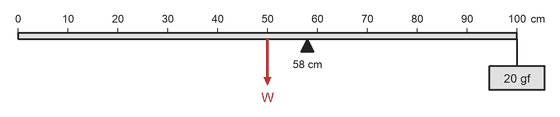
Step 2 — Find the distances from the knife edge.
The weight W acts to the left of the knife edge (anticlockwise), and the 20 gf acts to the right of it (clockwise).
Step 3 — (ii) Apply the principle of moments.
Equate the anticlockwise and clockwise moments.
Watch out: The rule's own weight acts at 50 cm, which is NOT at the knife edge here, so it has a moment and must be included.
Therefore, the weight of the rule is 105 gf.