
Question 81 markMCQEasy
As per the principle of moments in equilibrium :
Confirming your payment
Sign up now and get 250 free tokens.
Force · Question 8 of 99
As per the principle of moments in equilibrium :
(A) Sum of anticlockwise moments is greater than sum of clockwise moments
(B) Sum of anticlockwise moments is equal to sum of clockwise moments
(C) Sum of anticlockwise moments is less than sum of clockwise moments
(D) none of the above
Answer: (B) Sum of anticlockwise moments is equal to sum of clockwise moments
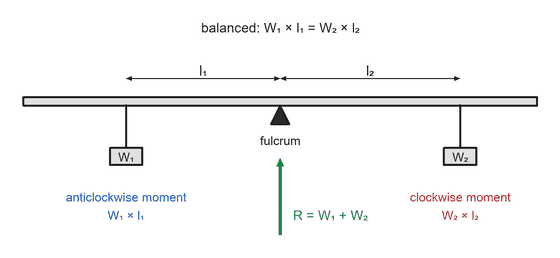
Concept: Principle of moments: when a body is in equilibrium under several forces, the sum of the anticlockwise moments about the pivot equals the sum of the clockwise moments (their algebraic sum is zero). By convention an anticlockwise moment is taken as positive and a clockwise moment as negative.
Step 1 — Write the condition.
For no rotation, the algebraic sum of the moments about the pivot is zero.
Step 2 — Split it by sense.
Anticlockwise moments are positive and clockwise moments negative, so a zero sum means the two totals are equal.
Why the other options are wrong:
Therefore, in equilibrium the sum of anticlockwise moments equals the sum of clockwise moments, option (B).