
Question 71 markMCQEasy
A couple is formed when ........ are not acting along the same line.
Confirming your payment
Sign up now and get 250 free tokens.
Force · Question 7 of 99
A couple is formed when ........ are not acting along the same line.
(A) two unequal and parallel forces
(B) two equal and parallel forces
(C) two equal and opposite parallel forces
(D) two unequal and opposite parallel forces
Answer: (C) two equal and opposite parallel forces
Concept: A couple is a pair of equal and opposite parallel forces not acting along the same line. Its resultant is zero, so it produces rotation only, and moment of couple = either force × couple arm (the perpendicular distance between the two lines of action).
Step 1 — Check the resultant.
Two forces that are equal and opposite add up to zero, so the body does not move as a whole.
Step 2 — Check the turning effect.
Acting along different lines, the two forces turn the body in the same sense, so the body rotates.
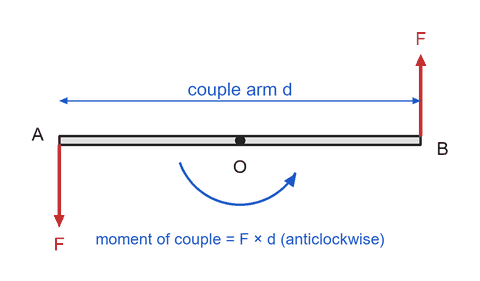
Watch out: A couple needs all three: equal size, opposite directions and different (parallel) lines of action.
Why the other options are wrong:
Therefore, a couple is formed by two equal and opposite parallel forces, option (C).