Answer: (C) assertion is false but reason is true
Concept: The turning effect of a force is called its moment (or torque): moment of force = force × perpendicular distance of its line of action from the axis of rotation, τ = F × d. Its S.I. unit is the newton metre (N m). Both factors matter.
Step 1 — Judge the assertion.
It is false. A heavier object at a greater distance has both factors larger, so its moment is greater, not the same. For example, 40 gf at 40 cm gives 1600 gf cm, but 10 gf at 10 cm gives only 100 gf cm. Equal moments need the heavier object closer to the pivot:
40 gf×10 cm=400 gf cm=10 gf×40 cm
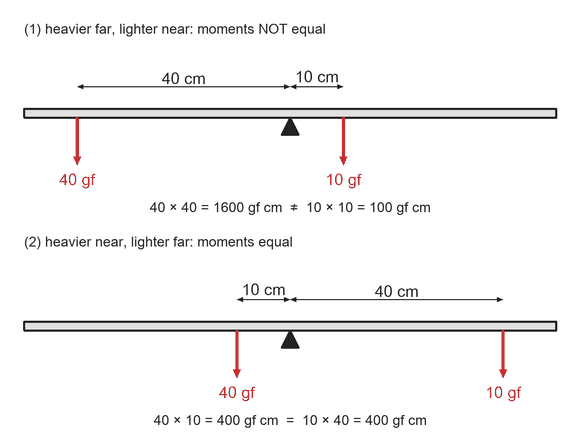
Step 2 — Judge the reason.
It is true: the moment depends on the size of the force and on its distance from the pivot.
Why the other options are wrong:
- (A) both A and R are true and R is the correct explanation of A: it is wrong because the assertion is false.
- (B) both A and R are True and R is not the correct explanation of A: it is wrong because the assertion is false.
- (D) assertion is true but reason is false: it has it the wrong way round: the assertion is false and the reason is true.
Therefore, the assertion is false but the reason is true, option (C).
