Solution:
Concept: The turning effect of a force is called its moment (or torque): moment of force = force × perpendicular distance of its line of action from the axis of rotation, τ = F × d. Its S.I. unit is the newton metre (N m). A downward force on the left of the pivot turns the rod anticlockwise; one on the right turns it clockwise. By convention an anticlockwise moment is taken as positive and a clockwise moment as negative.
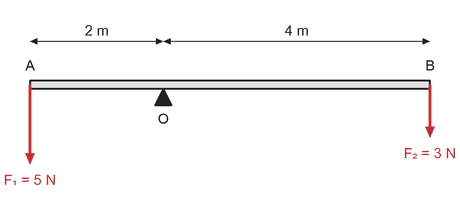
Given: F₁ = 5 N at A, OA = 2 m; F₂ = 3 N at B, OB = 4 m; both downward, on opposite sides of O.
Step 1 — (i) Moment of F₁ about O.
F₁ = 5 N acts downward at A, 2 m to the left of O.
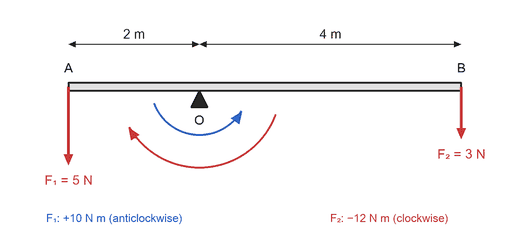
τ1=5 N×2 m=10 N m
It turns the rod anticlockwise, so it is +10 N m.
Step 2 — (ii) Moment of F₂ about O.
F₂ = 3 N acts downward at B, 4 m to the right of O.
τ2=3 N×4 m=12 N m
It turns the rod clockwise, so it is −12 N m.
Step 3 — (iii) Total moment about O.
Add the two moments with their signs.
τ=+10 N m−12 N m=−2 N m
The negative sign means the total moment is clockwise, so the rod turns clockwise.
Watch out: The smaller force (3 N) has the larger moment here, because it acts twice as far from O.
Therefore, (i) the moment of F₁ is 10 N m anticlockwise, (ii) the moment of F₂ is 12 N m clockwise, and (iii) the total moment is 2 N m clockwise.