
Question 375 marksMedium
Describe a simple experiment to verify the principle of moments, if you are supplied with a metre rule, a fulcrum and two springs with slotted weights.
Confirming your payment
Sign up now and get 250 free tokens.
Force · Question 37 of 99
Describe a simple experiment to verify the principle of moments, if you are supplied with a metre rule, a fulcrum and two springs with slotted weights.
Solution:
Concept: Balance a metre rule with weights on both sides of the fulcrum and compare the anticlockwise and clockwise moments about the fulcrum. Principle of moments: when a body is in equilibrium under several forces, the sum of the anticlockwise moments about the pivot equals the sum of the clockwise moments (their algebraic sum is zero).
Step 1 — Aim and apparatus.
Aim: to verify that, in equilibrium, the sum of the anticlockwise moments equals the sum of the clockwise moments. Apparatus: a uniform metre rule, a sharp fulcrum (knife edge), and two spring hooks to hang slotted weights.
Step 2 — Balance the rule alone.
Place the metre rule on the fulcrum and adjust it until it balances horizontally. A uniform rule balances at its middle, the 50 cm mark, so its weight then acts through the fulcrum and has no moment.
Step 3 — Hang the weights.
Hang a weight W₁ from a spring on one side of the fulcrum, say the left, at a distance l₁ from it. Hang a second weight W₂ on the other side and slide it along the rule until the rule is again horizontal. Note its distance l₂ from the fulcrum.
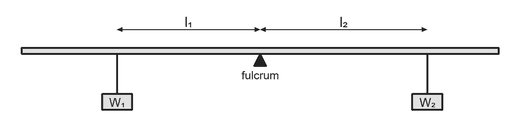
Step 4 — Calculate and repeat.
Calculate the anticlockwise moment W₁ × l₁ and the clockwise moment W₂ × l₂. Repeat with different weights and positions, and record the results in a table with columns W₁, l₁, W₁ × l₁, W₂, l₂ and W₂ × l₂.
Step 5 — Observation and conclusion.
In every case the two products are equal:
So, when the rule is in equilibrium, the sum of the anticlockwise moments about the fulcrum equals the sum of the clockwise moments. This verifies the principle of moments.
Step 6 — Precautions.
The rule must be horizontal before readings are taken, and each distance is measured from the fulcrum to the point where the weight hangs.
Therefore, the equal products W₁ × l₁ = W₂ × l₂ in every reading verify the principle of moments.