
Opening your dashboard
Class 10 Physics Chapter 1 Force: Competency-Based Questions (CBQ)
40 questions on Chapter 1, each worked through on its own page with the AI tutor. Class 10 Physics, ICSE 2026-27.
40 questions
1–5 marks · Mixed difficulty
- 11 mark
Question 1
Competency: Analysis & Application
The diagrams below show a force F = 40 N acting on a rod AB pivoted at A in different directions. Identify the correct statement.

- 21 mark
Question 2
Competency: Analysis
In the diagram below, four cones are depicted, each with a height of 12cm. The position of the center of gravity is indicated by dots located at 9cm, 8cm, 4cm, and 3cm from the apex of each cone. Which of these cones is completely solid?

- 31 mark
Question 3
Competency: Analysis
A metal ball is whirled inside a ring placed on a table, as shown in the diagram P. The diagram Q shows the motion of the ball after the ring is lifted.

Which of the following diagrams shows the correct position of the metal ball in the ring when the ring is lifted?
- 42 marks
Question 4
Competency: Analysis & Application
Anu and Amy purchased ice creams in plastic balls and cones, respectively, during their outing at the science fair. After consuming their ice creams, Anu stated that regardless of whether they were filled with ice cream or empty, the centre of gravity of the objects would remain unchanged. Do you agree with Anu? Why?
- 52 marks
Question 5
Competency: Analysis & Application
The picture below shows a boy climbing a rope ladder hanging from the branch of a tree. The boy in the picture finds it difficult to climb the ladder as it turns about the axis where he is holding. The instructor tells the boy to stretch the body with the hands stretched up and make the body parallel to the ladder and climb.

(a) Which force caused the ladder to turn?
(b) How does keeping the body parallel to the ladder make climbing easier?
- 62 marks
Question 6
Competency: Understanding & Application
Soumya took two right circular cones of the same vertical height. One of the two cones is a solid one, while the other is hollow from inside. By measuring the cross-sectional areas of the cones and from the knowledge of symmetry, by using suitable formulas, he found the positions of the centre of gravity of both cones. He found that the difference is about 1.5 cm. What is the vertical height of the two cones?
- 72 marks
Question 7
Competency: Application
Will the centre of gravity of a hollow sphere filled half with mercury and half with oil be identical to that of an empty hollow sphere? Give reasons for your answer.
- 82 marks
Question 8
Competency: Analysis
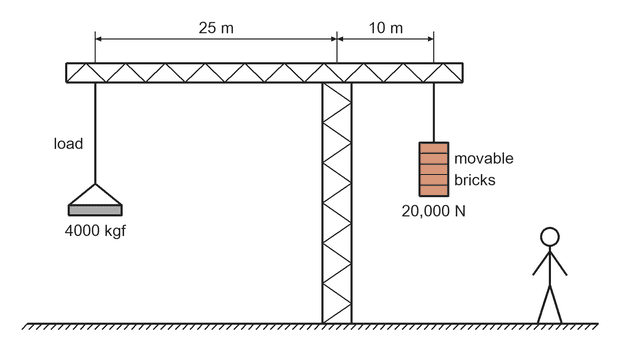
Study the diagram and answer the questions that follow.
(a) In the diagram, is the worker attempting to raise or lower the load?
(b) Justify your answer to (a) with the necessary calculation.
- 92 marks
Question 9
Competency: Recall & Understanding
In a gold atom (atomic number 79), an electron revolves around the nucleus in a circular orbit. There is a strong electrostatic force between the positively charged nucleus and the negatively charged electron. Though the total positive charge possessed by the nucleus is much higher than the negative charge of the electron, there is no displacement of the electron in the direction of the force.
(a) Name the force responsible for the movement of the electron around the nucleus in its own orbit.
(b) In the absence of such force, what would happen to the movement of the electron?
- 102 marks
Question 10
Competency: Application
A metre rod is half made of copper and half made of iron. If the mass of the copper part is 900 g and the mass of iron is 800g, then calculate the position at which the rod can remain in equilibrium.

- 113 marks
Question 11
Competency: Analysis & Application
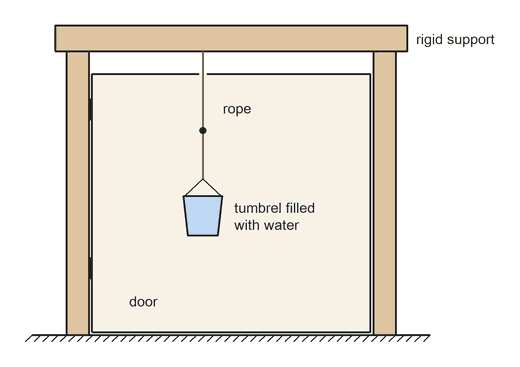
Bandish and Parag, on a trek to Sandakpu, halted at a tea house in Tumbling. The picture above shows the entrance door of the tea house. They saw the tumbrel filled with water hanging from top rigid support passing through the door. On enquiring about the tumbrel, the owner of the tea house, he said that it acts as a pullback (door closure) after opening and releasing the door.
(a) Explain how the tumbrel helps to close the door on its own.
(b) Name the principle involved.
- 123 marks
Question 12
Competency: Analysis & Application
Pavel took an earthen pot which was filled with water up to its brim. The earthen pot was conical in shape and kept with its apex in downward direction.

(a) If the vertical height of the earthen pot is 12 cm, where does its centre of gravity lie?
(b) Pavel poured out all the water from the pot. How will its centre of gravity shift – towards the open end or towards its apex?
(c) Pavel wanted to grow a plant in the given pot. So, he filled it completely again with some soil. What will be the new position of its centre of gravity?
- 133 marks
Question 13
Competency: Analysis & Evaluation
A roller with a diameter of 0.2 m is raised over a pavement AB by applying forces and , as shown in the diagram.
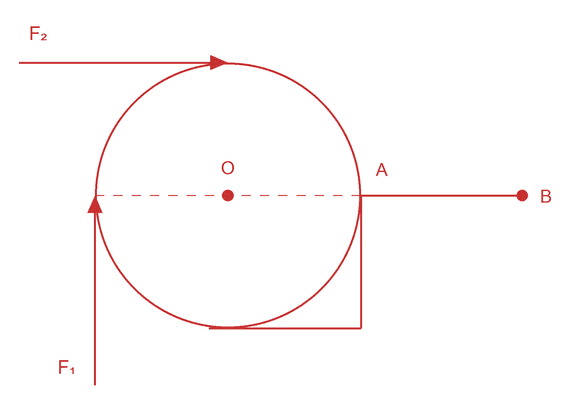
If the magnitude of both forces is 20 N, then compare the magnitudes of the torques produced by the two forces.
- 141 mark
Question 14
Competency: Application
Assertion (A): A driver turns a steering wheel of diameter 40 cm by pulling one side of the rim down with a force of 15 N and pushing the opposite side up with a force of 15 N, both forces being along the tangents to the rim. The moment of the couple on the wheel is 6 N m.
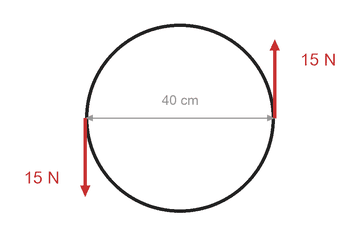
Reason (R): The moment of a couple is equal to the product of either force and the perpendicular distance between the lines of action of the two forces.
- 151 mark
Question 15
Competency: Understanding
Assertion (A): A cyclist going round a circular track at a steady speed of 18 km h has no acceleration.
Reason (R): In uniform circular motion, the speed of the body remains constant.
- 164 marks
Question 16
Competency: Analysis & Evaluation
Case study: In a park, a uniform see-saw plank 4.0 m long is pivoted at its centre, so that each arm is 2.0 m long. Three children use it. Their weights are given below.
Child Weight Riya 30 kgf Ammu 20 kgf Kabir 45 kgf 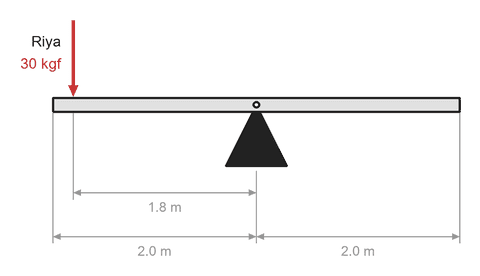
(a) Riya sits 1.8 m to the left of the pivot. How far to the right of the pivot must Kabir sit so that the plank stays horizontal ?
(b) Ammu now also sits on the left, 0.9 m from the pivot, while Riya stays where she is. Can Kabir alone still balance the plank ? If so, where must he sit ?
(c) The park attendant says, "The side that carries the greater weight always goes down." Use your results to judge this statement.
- 173 marks
Question 17
Competency: Analysis & Evaluation
Case study: A skydiver jumps from an aircraft and falls vertically downward. An instrument on her wrist records her speed. The total mass of the skydiver and her equipment is 70 kg. (Take = 10 m s.)
Time after the jump (s) 0 4 8 12 16 20 24 Speed (m s) 0 33 47 52 54 54 54 (a) From which reading onwards is the skydiver in equilibrium ? State, with a reason, whether this equilibrium is static or dynamic.
(b) Find the force of air resistance on her at 20 s.
(c) Her friend says, "From 16 s to 24 s no force acts on her, because she is in equilibrium." Judge this statement. Also state whether the air resistance on her at 4 s is more than, equal to or less than her weight.
- 184 marks
Question 18
Competency: Application & Creation
Case study: The outlet valve of a school's overhead water tank is opened by turning a hand wheel of diameter 20 cm. The caretaker holds the rim with both hands at the opposite ends of a diameter and applies equal and opposite forces along the tangents to the rim. The greatest force he can apply with each hand is 60 N. After the rains the valve has become stiff, and it now needs a moment of 18 N m to turn it.
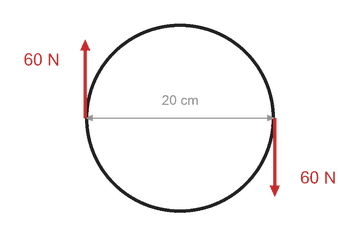
(a) Calculate the greatest moment of the couple that the caretaker can apply to the wheel. Can he open the valve ?
(b) The caretaker cannot push any harder. Design a change to the wheel, or a simple tool to use with it, that will let him open the valve. State the size you choose and show by calculation that your design works.
(c) Explain why he should use both hands in this way instead of pushing the rim at one point with one hand.
- 191 mark
Question 19
Competency: Analysis
Neha finds the centre of gravity G of an irregular piece of uniform cardboard. She hangs the card from a pin through a hole P near its edge, lets it come to rest, and marks the line of a plumb line hung from the same pin. She repeats this with a second hole Q, and the two lines cross at G. As a check, she hangs the card from a third hole R, but this time the plumb line passes about 6 mm away from G. Which is the most likely reason for this?
- 201 mark
Question 20
Competency: Application
A farmer digs a hole for a fence post with a soil auger, a long screw-like rod turned by a T-shaped handle. The handle is 80 cm long from end to end, and the rod is fixed at its middle. He holds the two ends and pushes them with equal forces in opposite directions, each at right angles to the handle in a horizontal plane. The hard soil needs a moment of 36 N m to turn the auger. (Hypothetical data.)
What is the least force he must apply with each hand?
- 211 mark
Question 21
Competency: Analysis
A person stands in a lift that carries her from the ground floor to the top floor of a building and stops there. The graph shows how the speed of the lift changes with time. (Hypothetical data.)

During which time interval(s) is the person in equilibrium?
- 221 mark
Question 22
Competency: Analysis
A vegetable vendor carries two baskets on a light bamboo pole resting across his shoulder. The basket in front weighs 12 kgf and hangs 40 cm in front of his shoulder. The basket behind weighs 6 kgf and hangs 80 cm behind his shoulder. The pole stays horizontal on his shoulder without his holding it. (Hypothetical data.)
He now puts 2 kgf more vegetables into each basket, and the baskets stay at the same places on the pole. What happens if he still does not hold the pole?
- 231 mark
Question 23
Competency: Application
A uniform circular metal disc of radius 15 cm has its centre at O. A circular hole of radius 6 cm is cut out of it, with the centre of the hole 8 cm from O. The points P, Q and S lie on the diameter through the centre of the hole (the figure is drawn to scale).

At which point does the centre of gravity of the remaining disc lie?
- 241 mark
Question 24
Competency: Understanding
Assertion (A): A force applied to the free edge of a door, in the plane of the door and directed towards its hinges, cannot make the door turn, however large the force is.
Reason (R): The moment of a force about an axis is zero when the line of action of the force passes through the axis.
- 251 mark
Question 25
Competency: Evaluation
Assertion (A): A farmer's well-sweep (dhenkli) is a long pole pivoted on a post at its own centre of gravity. It stays horizontal when a bucket of water weighing 20 kgf hangs 3 m from the pivot on one side and a stone weighing 30 kgf is tied 2 m from the pivot on the other side.
Reason (R): The stone is heavier than the bucket of water.
- 261 mark
Question 26
Competency: Evaluation
A teacher lists four examples of circular motion, each with the force that supplies the centripetal force. In one of the entries the force is wrongly named. Which one is it?
- 271 mark
Question 27
Competency: Application
A rod OA of length 40 cm can turn about the point O. A force of 25 N acts at the end A along the direction shown, not at right angles to the rod. The perpendicular distance of O from the line of action of the force is 24 cm.

What is the moment of the force about O?
- 282 marks
Question 28
Competency: Analysis
A carpenter drives a screw into a wooden plank with a screwdriver.
(a) Name the type of motion of the screw as it goes into the wood.
(b) A screwdriver with a thick handle is easier to turn than one with a thin handle, even though the fingers push on the handle with the same force. Explain why.
- 292 marks
Question 29
Competency: Application
A children's roundabout of radius 1.5 m turns about its vertical axle. Rohan pushes at the rim with a force of 80 N along the tangent, trying to turn it anticlockwise. Sana pushes with a force of 150 N along the tangent at a point 0.5 m from the axle, trying to turn it clockwise. (Hypothetical data.)
(a) Find the resultant moment about the axle and state the direction in which the roundabout begins to turn.
(b) Tara now also pushes clockwise along the tangent at the rim. What is the least force she must apply so that the roundabout does not turn at all?
- 302 marks
Question 30
Competency: Understanding
A mechanic loosens a wheel nut in two ways. In the first, he pushes with a force of 40 N at right angles to the end of a single-arm spanner 30 cm long. In the second, he uses a cross-shaped wheel wrench whose two opposite arms are 15 cm each from the nut, and pushes down with 40 N at the end of one arm and up with 40 N at the end of the opposite arm. (Hypothetical data.)
(a) Calculate the moment produced in each case.
(b) State one difference between the two ways in the effect on the nut apart from turning it.
- 312 marks
Question 31
Competency: Understanding
A wall clock is running correctly. Its minute hand turns steadily, and its tip moves in a circle.
(a) Is the motion of the tip a uniform circular motion? Is it accelerated? Give a reason.
(b) When the hand points to 3 (the tip is at the right of the dial's centre), state the direction of the velocity of the tip and the direction of the force that must act on it.
- 322 marks
Question 32
Competency: Application
A passenger plane cruises in level flight at a constant velocity. Its weight is 600 kN and the thrust of its engines is 45 kN. The lift is the upward push of the air on the wings, and the drag is the backward push of the air (air resistance) on the plane. (Hypothetical data.)
(a) Name the type of equilibrium of the plane and state the lift on it and the drag on it, with the direction of each.
(b) The pilot now increases the thrust to 60 kN. State whether the plane is still in equilibrium. Give the resultant force and say what happens to its speed.
- 333 marks
Question 33
Competency: Evaluation
A plumber must loosen a rusted pipe joint that needs a moment of at least 24 N m. He can push with at most 60 N, at right angles to the tool, at its end. His toolbox has three pipe wrenches. (Hypothetical data.)
Wrench Length (cm) A 20 B 35 C 45 (a) Find the greatest moment each wrench can give with his best push.
(b) Which wrench can loosen the joint?
(c) He slides a 15 cm hollow pipe over the end of wrench B, so that his push is applied 15 cm farther from the joint. Will wrench B now loosen the joint? Show with a calculation.
- 343 marks
Question 34
Competency: Creativity
A 'balancing bird' toy is a bird cut-out whose beak rests on a fingertip without falling. Meena cuts the same bird shape from uniform thick card, with its wings swept forward, but it tips over when she rests its beak on her finger. She has two identical coins and some tape.
(a) Why does the plain cut-out tip over when its beak is on her finger?
(b) Describe how she can place the two coins so that the bird balances on its beak.
(c) Explain, using the centre of gravity, why the bird now balances, and what she should do if it still tips backward.
- 353 marks
Question 35
Competency: Understanding
At a fun fair, riders in the 'Rotor' ride stand with their backs against the inside wall of a large vertical cylinder. The cylinder spins steadily about its vertical axis, so each rider goes round in a horizontal circle.
(a) Name the force that supplies the centripetal force on a rider and give its direction.
(b) A rider says, "I am being thrown outward against the wall." Name the force she feels and say whether it is a real force.
(c) State how the push of the rider on the wall differs from this force.
- 363 marks
Question 36
Competency: Analysis
A stiff tap has a lever handle. Priya needs a push of 8 N at right angles to the end of the handle to turn it. After the end of the handle breaks off, making it 5 cm shorter, she needs a push of 12 N at right angles to the end of the shortened handle. (Hypothetical data.)
(a) Find the original length of the handle.
(b) Find the moment needed to turn the tap.
(c) Find the length of the shortened handle, and show that it needs the same moment.
- 374 marks
Question 37
Competency: Evaluation
Case study: A school laboratory has a uniform metre rule of weight 100 gf, with its centre at the 50 cm mark. Four groups verify the principle of moments. Each group balances the rule horizontally on a knife edge, hangs a weight on the left of the knife edge, and moves a weight on the right until the rule is horizontal. The distances and are measured from the knife edge. Group 3 placed its knife edge at the 56 cm mark; the other three used the 50 cm mark. (Hypothetical data.)
Group Knife edge at (cm) (gf) (cm) (gf) (cm) 1 50 50 20 25 40 2 50 40 30 60 20 3 56 30 26 40 34.5 4 50 60 10 20 30 (a) Show that the readings of groups 1, 2 and 4 agree with the principle of moments.
(b) For group 3, find and . What do you notice?
(c) Group 3 says, "Our result shows that the principle of moments is wrong." Use the weight of the rule to evaluate their claim.
- 384 marks
Question 38
Competency: Analysis
Case study: At a village fair, a giant wheel turns clockwise at a steady rate and takes 4 minutes to make one complete turn. The figure shows four cabins, A at the top, B on the right, C at the bottom and D on the left, at the start of a ride (time ). Rakesh sits in cabin A. Each cabin moves in a circle at constant speed. (Hypothetical data.)
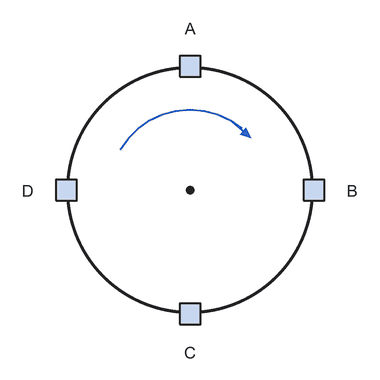
Time after the start (min) 1 3 6 9 (a) At , state the direction of Rakesh's velocity and the direction of the centripetal force on him.
(b) At each time in the table, say which of the four positions (top, right, bottom or left) Rakesh is at.
(c) At min Rakesh says, "My speed is constant, so no force is acting on me." Evaluate his statement.
- 395 marks
Question 39
Competency: Evaluation
Case study: A vegetable seller uses a steelyard. A light rod AB rests on a knife edge at F, and the pan hangs from end A, 10 cm from F. A single sliding weight (poise) of 0.5 kgf hangs on the long arm FB, at a distance from F, and the seller reads the load from on a scale. The weights of the pan, the hook and the rod are so small that they can be ignored. The long arm is 90 cm long. (Hypothetical data.)
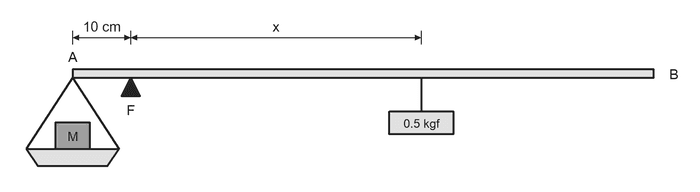
(a) Find the distance at which the poise must hang to balance a load of 2.5 kgf.
(b) Find the greatest load that this steelyard can weigh, and the distance on the scale that corresponds to a change of 100 g in the load.
(c) The seller wants to weigh loads up to 6 kgf, using the same 90 cm arm and keeping the pan at 10 cm from F. What poise must he use? For the new steelyard, find the distance on the scale that corresponds to a change of 100 g, and compare it with your answer to (b).
- 404 marks
Question 40
Competency: Analysis
Case study: A cyclist pushes a pedal straight down with a force of 200 N. The pedal is at the end of a crank 17 cm long that turns about the axle O. The turning effect of the push depends on the perpendicular distance of its line of action from O, and changes as the crank turns. The figure shows the crank in three positions P, Q and R, and the table gives for each. (Hypothetical data.)
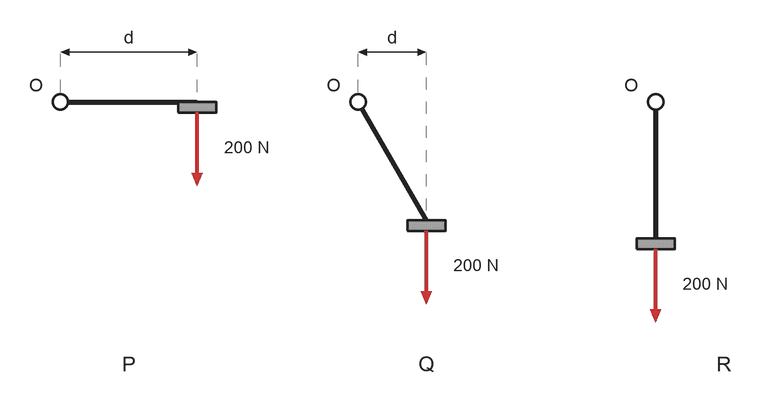
Crank position (cm) P 17 Q 8.5 R 0 (a) Find the moment of the push about O when the crank is at P.
(b) Find the moment at Q and compare it with the moment at P.
(c) What is the moment at R? Explain why the cyclist cannot turn the crank by pushing at R, and why the cycle still gets past it.