
Question 404 marksMedium
Competency: Analysis
Case study: A cyclist pushes a pedal straight down with a force of 200 N. The pedal is at the end of a crank 17 cm long that turns about the axle O. The turning effect of the push depends on the perpendicular distance of its line of action from O, and changes as the crank turns. The figure shows the crank in three positions P, Q and R, and the table gives for each. (Hypothetical data.)
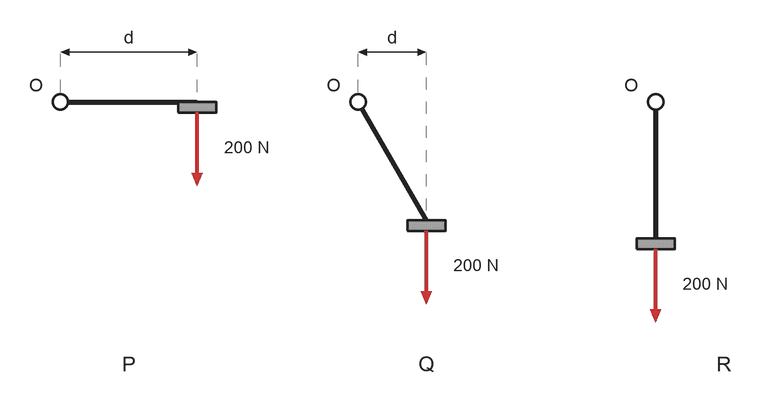
| Crank position | (cm) |
|---|---|
| P | 17 |
| Q | 8.5 |
| R | 0 |
(a) Find the moment of the push about O when the crank is at P.
(b) Find the moment at Q and compare it with the moment at P.
(c) What is the moment at R? Explain why the cyclist cannot turn the crank by pushing at R, and why the cycle still gets past it.