
Opening your dashboard
Class 10 Chemistry Chapter 7: Metallurgy Solutions
85 textbook questions with step-by-step answers, free to read, for ICSE 2026-27.
Get talked through Ch 7, not just shown the answer
Reading a finished solution is not the same as being able to do it. The AI tutor takes one question at a time and works it with you, in your own words, until you can.
- Ask it out loud, in your own words
- It gives you the next step, not the answer
- Stuck on part (ii)? Start there
85 questions with solutions
1–5 marks · Mixed difficulty
- 13 marks
Question 1
(a) Name the three classes in which elements are classified. Which was the first metal used by man ?
(b) Name the metal and non-metal present in abundance in the earth crust.
Solve with AIWritten solution
Solution:
Concept: Elements are grouped by their properties into metals, non-metals and metalloids. In the earth's crust, oxygen is by far the most common element, and aluminium is the most common metal.
Step 1 — (a) Name the three classes.
Elements are classified as metals, non-metals and metalloids. Metalloids, such as silicon and germanium, show some properties of metals and some of non-metals.
Step 2 — (a) Name the first metal used by man.
The first metal used by man was copper, for making utensils and weapons. It was used first because it is found free (uncombined) in nature and is soft enough to shape.
Step 3 — (b) Read the abundance of elements in the crust.
The chart compares the main elements of the earth's crust by mass.
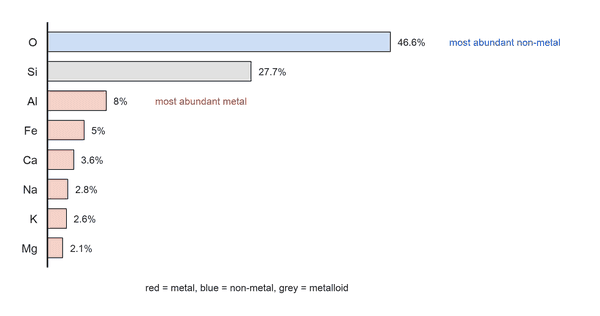
- Most abundant metal: aluminium (about 8%).
- Most abundant non-metal: oxygen (about 46.6%; it is also the most abundant element of all).
Watch out: Silicon (27.7%) is second in the crust, but it is a metalloid, not a metal. The most abundant metal is aluminium.
Note: the chart uses the commonly quoted value of about 2.6% for potassium; some tables print 2.8%.
Therefore, (a) the classes are metals, non-metals and metalloids, and the first metal used by man was copper; (b) the most abundant metal in the earth's crust is aluminium and the most abundant non-metal is oxygen.
- 22 marks
Question 2
Name the metal which is a constituent of :
(a) blood pigment, (b) plant pigment.
Solve with AIWritten solution
Solution:
Concept: Small amounts of some metals are essential for living things. Each of these two pigments is built around one metal atom.
Step 1 — (a) Blood pigment.
The red pigment of blood is haemoglobin. It contains iron, and it carries oxygen from the lungs to all parts of the body.
Step 2 — (b) Plant pigment.
The green pigment of plants is chlorophyll. It contains magnesium, and it traps sunlight for photosynthesis.
Watch out: Do not swap the two: iron is in haemoglobin (blood), magnesium is in chlorophyll (plants).
Therefore, (a) the metal in the blood pigment (haemoglobin) is iron, and (b) the metal in the plant pigment (chlorophyll) is magnesium.
- 35 marks
Question 3
Give the importance of the following for living beings :
(a) Nitrogen, (b) Hydrogen,
(c) Carbon.
Solve with AIWritten solution
Solution:
Concept: Nitrogen, hydrogen and carbon are non-metals, yet life depends on them. They are building blocks of the molecules that make up living things.
Step 1 — (a) Nitrogen.
Nitrogen is an essential part of proteins, amino acids and nucleic acids (DNA, RNA), which are needed for growth and for repair of the body.
Plants take it up from the soil as nitrates for healthy growth. Nitrogen in the air also dilutes the oxygen, so burning and respiration do not become too fast.
Step 2 — (b) Hydrogen.
Hydrogen is present in water, which is essential for all life.
It is also present in all food materials (carbohydrates, fats and proteins), because all of them are compounds of carbon, hydrogen and oxygen.
Step 3 — (c) Carbon.
Carbon is the basic element of all organic compounds in living beings: carbohydrates, fats, proteins, enzymes and vitamins.
Green plants take in carbon dioxide for photosynthesis and make food from it.
Watch out: The question asks why each element matters to living beings, so give its role in the body or in plants, not its industrial uses.
Therefore, nitrogen is needed for proteins and nucleic acids (and as nitrates for plants), hydrogen is present in water and in all food materials, and carbon is the basic element of all organic compounds in living things.
- 44 marks
Question 4
State the position of the following in the Periodic Table :
(a) Alkali metals, (b) Alkaline earth metals,
(c) Halogens, (d) Aluminium.
Solve with AIWritten solution
Solution:
Concept: In the periodic table a group is a vertical column and a period is a horizontal row. Metals sit on the left and in the middle, non-metals on the right.
Step 1 — (a) Alkali metals.
The alkali metals (Li, Na, K, ...) are in Group 1 (IA), at the extreme left of the table. Hydrogen sits at the top of this column but is not an alkali metal.
Step 2 — (b) Alkaline earth metals.
The alkaline earth metals (Be, Mg, Ca, ...) are in Group 2 (IIA), next to the alkali metals.
Step 3 — (c) Halogens.
The halogens (F, Cl, Br, I) are in Group 17 (VIIA), on the right, just before the noble gases of group 18.
Step 4 — (d) Aluminium.
Aluminium has 13 electrons, arranged as 2, 8, 3. We read its place from this arrangement.
- It has three shells, so it is in Period 3.
- It has three valence electrons, so it is in Group 13 (IIIA).

Watch out: The period number is the number of shells, not the number of valence electrons.
Therefore, alkali metals are in group 1 (IA), alkaline earth metals in group 2 (IIA), halogens in group 17 (VIIA), and aluminium is in period 3, group 13 (IIIA).
- 55 marks
Question 5
Name :
(a) a liquid non-metal,
(b) two metalloids
(c) a metal which does not corrode easily
(d) two metals which react with cold water,
(e) a non-metal which can form a positive ion,
(f) a non-metal which shows reducing property,
Solve with AIWritten solution
Solution:
Concept: Each answer comes from a typical property of metals or non-metals. Most non-metals form negative ions, but a few special cases break the pattern.
Step 1 — (a) A liquid non-metal.
Bromine is the only non-metal that is a liquid at room temperature.
Step 2 — (b) Two metalloids.
Silicon and germanium (arsenic and antimony are also metalloids). They show properties of both metals and non-metals.
Step 3 — (c) A metal which does not corrode easily.
Gold (or platinum). It is so unreactive that air and moisture do not attack it.
Step 4 — (d) Two metals which react with cold water.
Sodium and potassium (calcium also reacts). They are at the top of the activity series, so they displace hydrogen even from cold water:
Step 5 — (e) A non-metal which can form a positive ion.
Hydrogen. Like a metal, it loses its one electron to form the positive ion H⁺:
Step 6 — (f) A non-metal which shows reducing property.
Carbon (or hydrogen). It removes oxygen from metal oxides, for example from zinc oxide:
Watch out: Mercury is the liquid metal; the liquid non-metal is bromine.
Therefore, (a) bromine; (b) silicon and germanium; (c) gold; (d) sodium and potassium; (e) hydrogen; (f) carbon.
- 65 marks
Question 6
From the list of characteristics given below, select the five which are relevant to non-metals and their compounds :
A. Ductile, B. Conduct electricity.
C. Brittle, D. Acidic oxides,
E. Basic oxides, F. Discharged at anode,
G. Discharged at cathode, H. Ionic chlorides,
I. Covalent chlorides,
J. Reaction with dilute sulphuric acid yields hydrogen,
K. 1, 2 or 3 valence electrons,
L. 5, 6, 7 valence electrons.
(Write the five letters corresponding to the correct characteristics).
Solve with AIWritten solution
Solution:
Concept: Non-metals have 5, 6 or 7 valence electrons, so they gain electrons and form negative ions. Their other properties follow from this: acidic oxides, covalent chlorides and discharge at the anode.
Step 1 — Sort the characteristics.
We take each letter and ask whether it describes a metal or a non-metal.
Step 2 — Pick the five that belong to non-metals.
These five describe non-metals and their compounds:
- C, brittle: solid non-metals such as sulphur break easily; they are neither malleable nor ductile.
- D, acidic oxides: oxides of non-metals, such as and , dissolve in water to form acids.
- F, discharged at anode: non-metals form anions, which move to the positive electrode (anode) during electrolysis.
- I, covalent chlorides: non-metals share electrons with chlorine, as in and .
- L, 5, 6, 7 valence electrons: this is why they gain electrons to complete an octet.
Step 3 — Check the rest.
The other characteristics (A, B, E, G, H, J, K) belong to metals: ductile, good conductors, basic oxides, discharged at the cathode, ionic chlorides, hydrogen with dilute acids, and 1, 2 or 3 valence electrons.
Watch out: 'discharged at anode' goes with non-metals: negative ions (anions) are discharged at the positive electrode.
Therefore, the five characteristics of non-metals and their compounds are C, D, F, I and L.
- 75 marks
Question 7
(a) Why are alkali metals kept in kerosene oil ?
(b) Why is hydrogen kept in the metal activity series ?
(c) Why do gold ornaments look new even after several years of use ?
Solve with AIWritten solution
Solution:
Concept: All three answers depend on how reactive the element is, that is, on its place in the activity series.
Step 1 — (a) Alkali metals are kept in kerosene oil.
Alkali metals such as sodium and potassium are very reactive. In air they react quickly with oxygen, carbon dioxide and water vapour, and they react violently with water.
Kerosene does not react with them, and it cuts them off from air and moisture.
Step 2 — (b) Hydrogen is kept in the metal activity series.
Like metals, hydrogen loses an electron to form a positive ion:
It is placed between lead and copper as a reference point. Metals above hydrogen displace it from dilute acids; metals below it do not.
Step 3 — (c) Gold ornaments look new for years.
Gold is among the least reactive metals, at the bottom of the series. It does not react with air, moisture or the gases in the atmosphere, so it does not tarnish or corrode and keeps its shine.
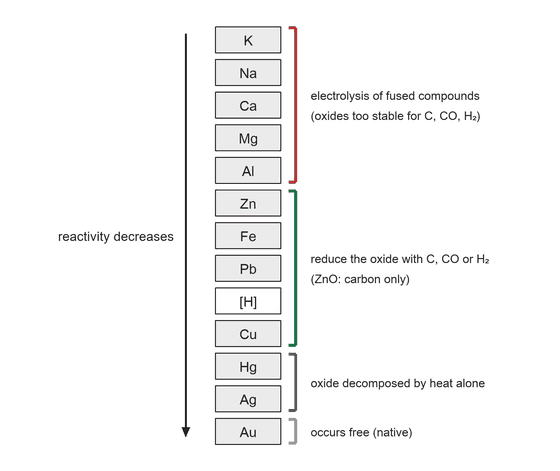
Watch out: Kerosene is used because it is unreactive and keeps air and moisture away; water must never be used, since these metals react violently with it.
Therefore, (a) alkali metals are kept in kerosene because they react quickly with air and moisture; (b) hydrogen is kept in the series because, like metals, it forms positive ions and it is the reference for displacement from acids; (c) gold is so unreactive that it does not tarnish or corrode.
- 83 marks
Question 8
From the metals : copper, iron, magnesium, sodium, and zinc, select a different metal in each case which :
(a) does not react with dilute hydrochloric acid,
(b) can form 2 + and 3 + ions,
(c) arrange the above metals in the decreasing order of reactivity.
Solve with AIWritten solution
Solution:
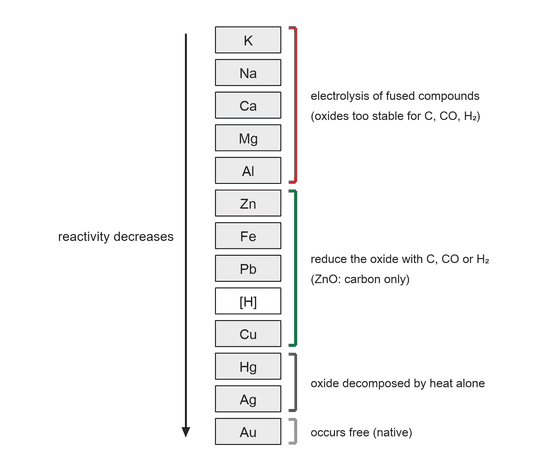
Concept: Use the activity series. For the given metals the order is Na > Mg > Zn > Fe > [H] > Cu.
Step 1 — Place the five metals in the activity series.
The full series is K > Na > Ca > Mg > Al > Zn > Fe > Pb > [H] > Cu > Hg > Ag > Au, so the given metals fall in the order sodium, magnesium, zinc, iron, then copper below hydrogen.
Step 2 — (a) The metal which does not react with dilute hydrochloric acid.
Copper lies below hydrogen, so it cannot displace hydrogen from the acid. The others do, for example zinc:
Step 3 — (b) The metal which can form 2+ and 3+ ions.
Iron forms the ferrous ion and the ferric ion , as in and .
Step 4 — (c) Decreasing order of reactivity.
Reading the given metals from the top of the series downwards gives sodium > magnesium > zinc > iron > copper.
Watch out: The question asks for a different metal in (a) and (b); copper and iron are different, as required.
Therefore, (a) copper; (b) iron; (c) sodium > magnesium > zinc > iron > copper.
- 94 marks
Question 9
Which metal occurs as :
(a) a sulphide, (b) a halide,
(c) a carbonate, (d) an oxide.
Also give the names of their respective ores.
Solve with AIWritten solution
Solution:
Concept: Reactive metals occur combined with other elements. The kind of compound (sulphide, halide, carbonate, oxide) gives the kind of ore.
Step 1 — (a) A sulphide.
Zinc occurs as a sulphide; its ore is zinc blende, ZnS. (Lead also occurs as a sulphide: galena, PbS.)
Step 2 — (b) A halide.
Sodium occurs as a halide; its ore is rock salt, NaCl. (Silver also occurs as a halide: horn silver, AgCl.)
Step 3 — (c) A carbonate.
Calcium occurs as a carbonate; its ore is limestone, . (Zinc also occurs as a carbonate: calamine, .)
Step 4 — (d) An oxide.
Aluminium occurs as an oxide; its ore is bauxite, . (Iron also occurs as an oxide: haematite, .)
Step 5 — Collect the answers.
The table puts the four answers side by side.
Type Metal Ore Sulphide Zn zinc blende, ZnS Halide Na rock salt, NaCl Carbonate Ca limestone, Oxide Al bauxite, Watch out: Name the ore as well as the metal; the question asks for both.
Therefore, (a) zinc as zinc blende (ZnS); (b) sodium as rock salt (NaCl); (c) calcium as limestone (CaCO₃); (d) aluminium as bauxite (Al₂O₃·2H₂O).
- 104 marks
Question 10
Distinguish between :
(a) a mineral and an ore,
(b) an ore and a metallic compound.
Solve with AIWritten solution
Solution:
Concept: An ore is a special kind of mineral: one from which the metal can be extracted profitably. So every ore is a mineral, but not every mineral is an ore.
Step 1 — (a) Mineral and ore.
The table compares the two.
Mineral Ore A naturally occurring compound of a metal, mixed with earthy impurities (gangue). A mineral from which the metal can be extracted conveniently and economically. The metal may or may not be extractable from it profitably. Contains a good percentage of the metal. e.g. clay is a mineral of aluminium. e.g. bauxite is the ore of aluminium. All ores are minerals, but all minerals are not ores.
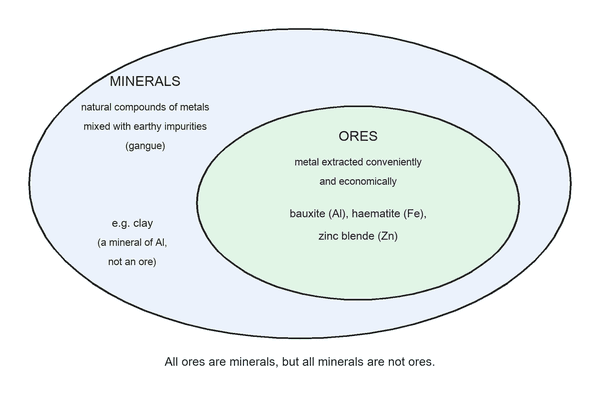
Step 2 — (b) Ore and metallic compound.
The difference is where the substance comes from and whether the metal can be extracted from it economically.
- An ore occurs naturally in the earth's crust, mixed with gangue, and is used to extract the metal.
- A metallic compound is any compound containing a metal. It may be made in the laboratory, is generally pure, and the metal need not be extractable from it economically (e.g. copper sulphate).
Watch out: The deciding word for an ore is profitably (economically); having the metal in it is not enough.
Therefore, (a) a mineral is any natural compound of a metal, while an ore is a mineral from which the metal is extracted profitably; (b) an ore is natural and used for extraction, while a metallic compound is any compound of a metal, often made in the laboratory.
- 113 marks
Question 11
Which metal can be extracted from each one of the following ores :
(a) bauxite (b) calamine (c) haematite.
Solve with AIWritten solution
Solution:
Concept: Each common ore is the chief source of one metal; its formula shows which metal it contains.
Step 1 — (a) Bauxite.
Bauxite is hydrated aluminium oxide, , so aluminium is extracted from it.
Step 2 — (b) Calamine.
Calamine is zinc carbonate, , so zinc is extracted from it.
Step 3 — (c) Haematite.
Haematite is iron(III) oxide, , so iron is extracted from it.
Watch out: Calamine is an ore of zinc, not of calcium; the similar spelling misleads many students.
Therefore, (a) aluminium from bauxite; (b) zinc from calamine; (c) iron from haematite.
- 124 marks
Question 12
Explain the following terms :
(a) ore, (b) gangue.
Solve with AIWritten solution
Solution:
Concept: A metal is extracted from an ore, but the ore comes out of the ground mixed with rock and earth. That unwanted part is the gangue, and it is removed first.
Step 1 — (a) Ore.
An ore is a naturally occurring mineral from which a metal can be extracted conveniently and profitably (at low cost).
Examples: bauxite for aluminium; haematite for iron.
Step 2 — (b) Gangue (matrix).
Gangue is the earthy and rocky impurities, such as sand, clay and silica (), present in an ore.
It is removed during concentration (dressing) of the ore.
Watch out: Gangue is the impurity in the ore, not the waste formed later when the metal is extracted.
Therefore, (a) an ore is a mineral from which a metal is extracted conveniently and profitably; (b) gangue is the earthy and rocky impurity present in the ore.
- 135 marks
Question 13
Give the principles of :
(a) hydrolytic method, (b) froth floatation process,
(c) electromagnetic separation.
Solve with AIWritten solution
Solution:
Concept: Every method of concentration (dressing) uses some difference in a physical property between the ore particles and the gangue.
Step 1 — (a) Hydrolytic method (hydraulic washing, gravity separation).
Principle: the difference in densities of the ore and the gangue.
The crushed ore is poured over a sloping, vibrating, corrugated table and a jet of water flows over it. The heavier ore particles settle in the grooves, while the lighter gangue is washed away. It is used for heavy oxide ores, e.g. haematite.
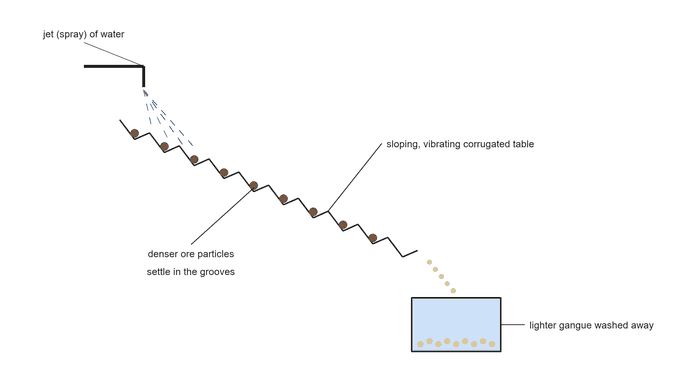
Step 2 — (b) Froth floatation process.
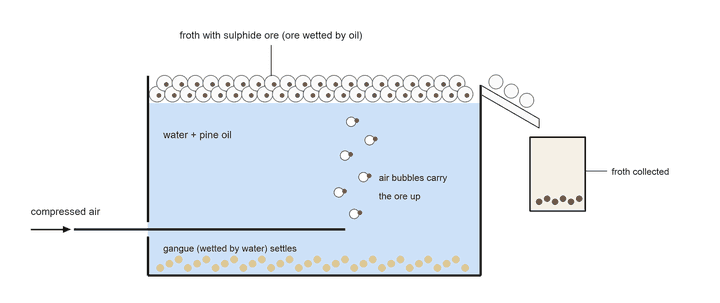
Principle: the ore particles are preferentially wetted by oil (pine oil) and the gangue particles by water.
The powdered ore is put in a tank of water and pine oil, and compressed air is blown in. The ore particles, wetted by oil, rise with the froth and are skimmed off; the gangue, wetted by water, settles. It is used for sulphide ores, e.g. zinc blende.
Step 3 — (c) Electromagnetic separation.
Principle: the difference in magnetic properties of the ore and the gangue.
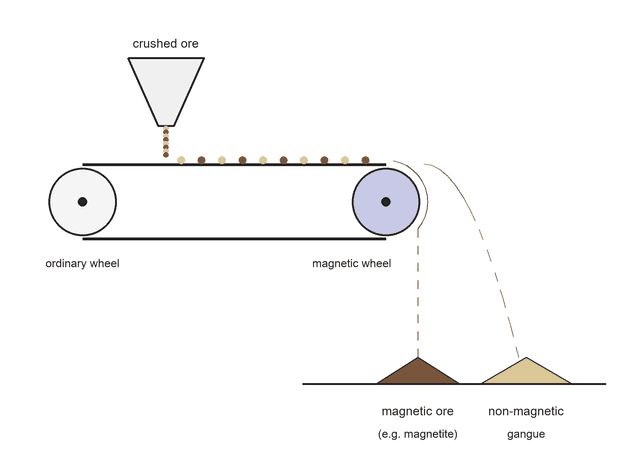
The crushed ore falls on a belt moving over a magnetic wheel. The magnetic particles cling to the belt over the wheel and drop close to it, while the non-magnetic particles are thrown farther away. It is used for magnetic ores, e.g. magnetite ().
Watch out: A principle is the property difference the method uses (density, wetting by oil, magnetism), not a description of the apparatus.
Therefore, the hydrolytic method works on the difference in density, froth floatation on the ore being wetted by oil and the gangue by water, and electromagnetic separation on the difference in magnetic properties.
- 143 marks
Question 14
(a) Name the methods by which concentrated ore is converted to metallic oxide.
(b) State three objectives achieved during the roasting of ores.
Solve with AIWritten solution
Solution:
Concept: A concentrated ore is first turned into the oxide, because a metal oxide is easier to reduce to the metal than a sulphide or a carbonate.
Step 1 — (a) Methods of converting the ore to the oxide.
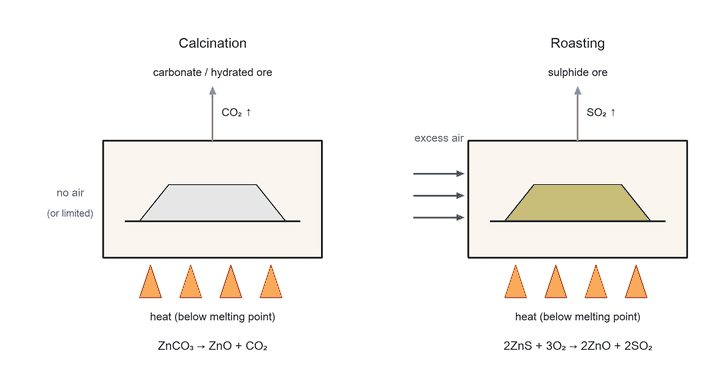
Two heating methods are used, chosen by the type of ore:
- Roasting, for sulphide ores (heated in excess of air);
- Calcination, for carbonate and hydrated ores (heated in the absence or a limited supply of air).
Step 2 — (b) First objective of roasting.
Moisture is removed from the ore.
Step 3 — (b) Second objective of roasting.
Volatile impurities are removed. Sulphur, arsenic and phosphorus are oxidised and escape as volatile oxides, for example:
Step 4 — (b) Third objective of roasting.
The sulphide ore is converted into the oxide, which can then be reduced:
The roasted mass also becomes porous, so it is easier to reduce.
Watch out: Roasting needs excess air; calcination is done without air (or with very little).
Therefore, (a) the methods are roasting and calcination; (b) roasting removes moisture, removes volatile impurities as their oxides, and converts the sulphide ore into the oxide.
- 153 marks
Question 15
Name :
(a) the processes involved in
(i) dressing of the ores (ii) refining of ores.
(b) two metallic oxides which cannot be reduced by carbon, carbon monoxide or hydrogen.
Solve with AIWritten solution
Solution:
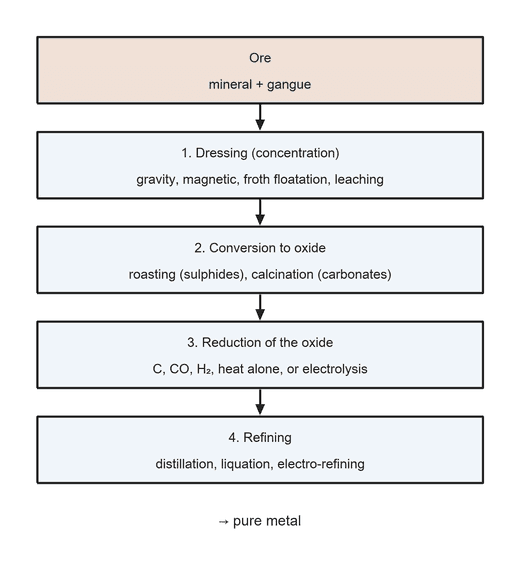
Concept: Extraction runs ore → dressing → conversion to oxide → reduction → refining. Dressing removes the gangue from the ore; refining purifies the crude metal obtained at the end.
Step 1 — See where each stage fits.
The flow chart shows the order of the stages of extraction.
Step 2 — (a)(i) Processes for dressing (concentration) of ores.
The gangue is removed by:
- hydraulic washing (gravity separation);
- magnetic separation;
- froth floatation;
- the chemical method (leaching).
Step 3 — (a)(ii) Processes for refining.
The impure metal is purified by:
- distillation (volatile metals such as zinc and mercury);
- liquation (low-melting metals such as lead and tin);
- electro-refining (electrolytic refining, e.g. copper).
Step 4 — (b) Two oxides not reduced by carbon, carbon monoxide or hydrogen.
Aluminium oxide () and magnesium oxide (MgO). (The oxides of Na, K and Ca are not reduced either.)
These metals have a very strong affinity for oxygen, so their oxides are too stable for these reducing agents; the metals are obtained by electrolysis.
Watch out: Dressing works on the ore, before any metal is made; refining works on the metal, after extraction.
Therefore, (a)(i) dressing uses hydraulic washing, magnetic separation, froth floatation and leaching; (a)(ii) refining uses distillation, liquation and electro-refining; (b) aluminium oxide and magnesium oxide cannot be reduced by C, CO or H₂.
- 162 marks
Question 16
Why does iron or zinc not occur free in nature ?
Solve with AIWritten solution
Solution:
Concept: Only the least reactive metals, such as gold and platinum, occur free (native). Reactive metals are always found combined.
Step 1 — Place iron and zinc in the activity series.
Iron and zinc are fairly reactive metals; they lie above hydrogen in the activity series.
Step 2 — Say what this reactivity does in nature.
They readily combine with oxygen, carbon dioxide, sulphur and moisture, so they are found only in the combined state, as oxides, carbonates and sulphides.
Examples: iron as haematite (); zinc as zinc blende (ZnS) and calamine ().
Watch out: A metal found free must be very unreactive; iron and zinc are not.
Therefore, iron and zinc do not occur free because they are reactive metals that combine with oxygen, carbon dioxide, sulphur and moisture, so they occur only as compounds.
- 172 marks
Question 17
What do you observe when hydrogen is passed over heated copper oxide ?
Solve with AIWritten solution
Solution:
Concept: Copper lies below hydrogen in the activity series, so hydrogen can remove oxygen from copper(II) oxide. Hydrogen acts as a reducing agent.
Step 1 — Picture the experiment.
Dry hydrogen is passed over heated copper(II) oxide in a hard-glass tube.

Step 2 — State the observations.
Two changes are seen:
- the black copper(II) oxide turns reddish brown, as copper metal is formed;
- droplets of water collect on the cooler parts of the tube.
Step 3 — Write the equation.
The oxygen of the oxide combines with hydrogen to form water:
Watch out: Keep passing hydrogen while the copper cools; otherwise the hot copper is oxidised back by air.
Therefore, the black copper(II) oxide turns reddish-brown copper and water droplets collect in the tube: CuO + H₂ → Cu + H₂O.
- 182 marks
Question 18
Compare roasting and calcination.
Solve with AIWritten solution
Solution:
Concept: Both roasting and calcination turn a concentrated ore into its oxide, by heating below the melting point. They differ in the type of ore and in whether air is supplied.
Step 1 — Compare the two processes.
The table sets the two side by side.
Roasting Calcination Ore is heated in excess of air. Ore is heated in the absence (or a limited supply) of air. Used for sulphide ores. Used for carbonate and hydrated ores. Sulphur dioxide is given off. Carbon dioxide (or water vapour) is given off. Volatile impurities are removed as oxides. Moisture and organic matter are removed. Step 2 — Give an example of roasting.
Zinc blende is roasted in excess air:
Step 3 — Give an example of calcination.
Calamine is calcined in the absence of air:
Watch out: Both are done below the melting point of the ore; nothing is melted.
Therefore, roasting heats a sulphide ore in excess air (SO₂ given off), while calcination heats a carbonate or hydrated ore without air (CO₂ or water given off); both give the metal oxide.
- 194 marks
Question 19
(a) Name an ore of zinc.
(b) Which process is applied to concentrate it ?
(c) How is concentrated ore changed to oxide ?
Solve with AIWritten solution
Solution:
Concept: Zinc blende is a sulphide ore. Sulphide ores are concentrated by froth floatation and converted to the oxide by roasting.
Step 1 — (a) An ore of zinc.
Zinc blende, ZnS (calamine, ZnCO₃, is another).
Step 2 — (b) Concentration.
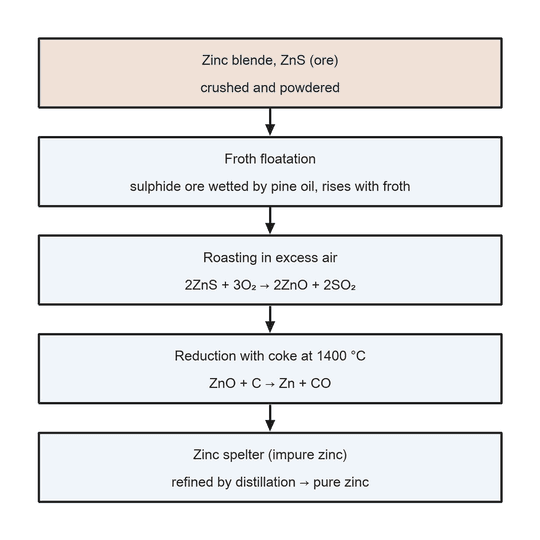
Zinc blende is concentrated by the froth floatation process. The sulphide ore is wetted by pine oil and rises with the froth, while the gangue is wetted by water and is left behind.
Step 3 — (c) Conversion to the oxide.
The concentrated ore is roasted: it is heated strongly in excess of air, below its melting point.
Watch out: Roasting, not calcination, is used for zinc blende, because it is a sulphide.
Therefore, (a) zinc blende (ZnS); (b) froth floatation; (c) roasting in excess air, which gives zinc oxide and sulphur dioxide.
- 204 marks
Question 20
(a) Some metallic oxides can be reduced by hydrogen, carbon and carbon monoxide and some cannot. Explain.
(b) Write balanced equation for the reduction of copper (II) oxide by hydrogen. (2019)
Solve with AIWritten solution
Solution:
Concept: A reducing agent can take oxygen away only from the oxide of a metal that holds oxygen less strongly than the reducing agent does. How strongly a metal holds oxygen follows the activity series.
Step 1 — (a) Oxides that can be reduced.
Oxides of less reactive metals (zinc, iron, lead, copper) are less stable. Hydrogen, carbon or carbon monoxide can remove their oxygen. (Zinc oxide is reduced by carbon at about 1400 °C.)
Step 2 — (a) Oxides that cannot be reduced.
Oxides of highly reactive metals (K, Na, Ca, Mg, Al) are very stable, because these metals have a very strong affinity for oxygen. Common reducing agents cannot reduce them, so these metals are obtained by electrolysis.
Step 3 — (b) Reduction of copper(II) oxide by hydrogen.
Hydrogen takes the oxygen from the heated oxide and forms water; the black oxide turns reddish-brown copper.
Watch out: The deciding factor is the metal's affinity for oxygen, that is, its place in the activity series.
Therefore, (a) oxides of less reactive metals are reduced by H₂, C or CO, but oxides of very reactive metals are too stable and need electrolysis; (b) CuO + H₂ → Cu + H₂O.
- 214 marks
Question 21
How are the following metallic oxides reduced. Write equations :
(a) Iron (II) oxide, (b) Zinc oxide.
Solve with AIWritten solution
Solution:
Concept: Iron and zinc are in the middle of the activity series. Their oxides are reduced by heating with carbon or carbon monoxide.
Step 1 — (a) Iron(II) oxide.
It is reduced by heating with carbon monoxide (carbon or hydrogen also work):
Step 2 — (b) Zinc oxide.
It is reduced by heating with coke (carbon) at about 1400 °C:
The zinc formed is a vapour at this temperature and is condensed.
Watch out: Zinc oxide needs carbon (coke) at a high temperature; the book does not use carbon monoxide or hydrogen for it.
Therefore, (a) iron(II) oxide is reduced by carbon monoxide: FeO + CO → Fe + CO₂; (b) zinc oxide is reduced by coke at 1400 °C: ZnO + C → Zn + CO.
- 222 marks
Question 22
State why aluminium is extracted from its oxide by electrolysis while copper, lead, iron by reducing agents and mercury and silver by thermal decomposition.
Solve with AIWritten solution
Solution:
Concept: The method used to get a metal from its oxide depends on its place in the activity series: the more reactive the metal, the more strongly it holds oxygen, and the more powerful the method needed.
Step 1 — Aluminium: electrolysis.
Aluminium is highly reactive, with a very strong affinity for oxygen. Its oxide is very stable and cannot be reduced by carbon, CO or hydrogen, so it is reduced by electrolysis of fused alumina.
Step 2 — Copper, lead, iron: reducing agents.
These are moderately reactive; their oxides are less stable and are reduced by carbon, carbon monoxide or hydrogen, for example:
Step 3 — Mercury, silver: heat alone.
These are among the least reactive metals; their oxides are so unstable that they decompose on heating alone:
Watch out: The more reactive the metal, the stronger the method needed: heat alone, then reducing agents, then electrolysis.
Therefore, the method depends on reactivity: aluminium holds oxygen too strongly and needs electrolysis, copper, lead and iron oxides are reduced by C, CO or H₂, and mercury and silver oxides decompose on heating alone.
- 231 mark
Question 23
An ore on being heated in air forms sulphurous anhydride. Write the process used for the concentration of this ore.
Solve with AIWritten solution
Solution:
Concept: Sulphurous anhydride is sulphur dioxide, . An ore that gives sulphur dioxide when heated in air must be a sulphide ore.
Step 1 — Identify the ore.
Heating a sulphide in air gives sulphur dioxide, for example:
So the ore is a sulphide, such as zinc blende.
Step 2 — Choose the concentration method.
Sulphide ores are concentrated by the froth floatation process: the ore particles are wetted by pine oil and rise with the froth, while the gangue is wetted by water.
Watch out: 'sulphurous anhydride' is SO₂ (it forms sulphurous acid with water), not SO₃.
Therefore, the ore is a sulphide ore, and it is concentrated by the froth floatation process.
- 244 marks
Question 24
(a) Define roasting. Name an ore on which roasting is done. Give balanced equation.
(b) Define calcination. Give an example and equation for calcination.
Solve with AIWritten solution
Solution:
Concept: Roasting is for sulphide ores in excess air; calcination is for carbonate (or hydrated) ores in the absence of air. Both are done below the melting point of the ore.
Step 1 — (a) Define roasting.
Roasting is the process of heating the concentrated ore strongly in excess of air, to a temperature below its melting point, to convert it into the oxide and remove volatile impurities.
Step 2 — (a) Ore and equation.
Roasting is done on zinc blende, ZnS:
Step 3 — (b) Define calcination.
Calcination is the process of heating the concentrated ore strongly in the absence of air (or in a limited supply), to a temperature below its melting point, to convert it into the oxide.
Step 4 — (b) Example and equation.
Calcination is done on calamine, :
Watch out: Check that each equation is balanced: 2ZnS + 3O₂ gives 2ZnO + 2SO₂ (2 Zn, 2 S and 6 O on each side).
Therefore, (a) roasting is heating a sulphide ore in excess air below its melting point, e.g. 2ZnS + 3O₂ → 2ZnO + 2SO₂; (b) calcination is heating a carbonate ore without air below its melting point, e.g. ZnCO₃ → ZnO + CO₂.
- 252 marks
Question 25
How are the metals like sodium, potassium and calcium obtained. Give equations.
Solve with AIWritten solution
Solution:
Concept: Sodium, potassium and calcium are at the top of the activity series. No chemical reducing agent can reduce their compounds, so they are obtained by electrolysis of their fused (molten) chlorides.
Step 1 — Why fused salts are used.
These metals react with water, so they cannot be set free from aqueous solutions. In the molten salt, the metal ion is discharged at the cathode and chlorine at the anode.

Step 2 — Sodium, from fused NaCl.
Sodium ions gain electrons at the cathode; chloride ions lose electrons at the anode:
Step 3 — Potassium, from fused KCl.
In the same way, potassium ions are discharged at the cathode:
Step 4 — Calcium, from fused CaCl₂.
Each calcium ion needs two electrons at the cathode:
Watch out: The metal is always set free at the cathode (it is a positive ion); chlorine is set free at the anode.
Therefore, sodium, potassium and calcium are obtained by electrolysis of their fused chlorides, the metal being set free at the cathode: Na⁺ + e⁻ → Na, K⁺ + e⁻ → K, Ca²⁺ + 2e⁻ → Ca.
- 265 marks
Question 26
Give equations for the reduction of
(a) Iron (II) oxide (b) Iron (III) oxide
(c) Lead (II) oxide (d) Zinc oxide
Solve with AIWritten solution
Solution:
Concept: These oxides belong to metals in the middle of the activity series. They are reduced by heating with carbon or carbon monoxide (iron and lead oxides also by hydrogen).
Step 1 — (a) Iron(II) oxide.
Carbon monoxide takes the oxygen and becomes carbon dioxide:
Step 2 — (b) Iron(III) oxide.
Each Fe₂O₃ has three oxygen atoms, so three CO molecules are needed:
Step 3 — (c) Lead(II) oxide.
Heating with carbon gives grey lead metal:
Step 4 — (d) Zinc oxide.
Zinc oxide needs coke (carbon) at about 1400 °C:
Watch out: Balance the oxygen: Fe₂O₃ gives up three oxygen atoms, so it needs 3CO and forms 3CO₂.
Therefore, FeO + CO → Fe + CO₂; Fe₂O₃ + 3CO → 2Fe + 3CO₂; PbO + C → Pb + CO; ZnO + C → Zn + CO.
- 275 marks
Question 27
(a) On which factors does purification of metals depend ?
(b) Name the methods used for purification.
(c) With a labelled diagram explain electro-refining of a particular metal.
Solve with AIWritten solution
Solution:
Concept: In electro-refining, the impure metal is the anode, a thin sheet of pure metal is the cathode, and a solution of a salt of the same metal is the electrolyte. Metal moves from anode to cathode; impurities are left behind.
Step 1 — (a) Factors on which purification depends.
The method chosen depends on:
- the nature of the metal;
- the nature of the impurities present in it;
- the purpose for which the metal is to be used.
Step 2 — (b) Methods of purification.
The common methods are distillation (volatile metals, e.g. zinc, mercury), liquation (low-melting metals, e.g. lead, tin) and electro-refining (e.g. copper).
Step 3 — (c) Set up the cell for copper.
The labelled diagram shows the electrolytic cell.

- Anode: a thick block of impure copper, joined to the positive terminal.
- Cathode: a thin sheet of pure copper, joined to the negative terminal.
- Electrolyte: copper sulphate solution with a little dilute sulphuric acid.
Step 4 — (c) Write the electrode reactions.
Copper atoms of the anode lose electrons and go into solution as copper ions:
At the cathode, an equal number of copper ions gain electrons and are deposited as pure copper:
Step 5 — (c) State the result.
The anode becomes thinner and the cathode becomes thicker with pure copper. The insoluble impurities (such as gold and silver) settle below the anode as anode mud.
Watch out: The impure metal is made the anode (it dissolves); making it the cathode would only coat more metal on it.
Therefore, purification depends on the metal, its impurities and its use; the methods are distillation, liquation and electro-refining; in electro-refining of copper, impure copper (anode) dissolves and pure copper deposits on the cathode from copper sulphate solution.
- 281 mark
Question 28
Choose the correct option :
(a) The metal other than aluminium, which has a strong affinity for oxygen is :
Solve with AIAnswer
(A) Copper
- Correct
(B) Magnesium
(C) Silver
(D) Gold
Answer: (B) Magnesium
Concept: Metals high in the activity series, such as K, Na, Ca, Mg and Al, have a strong affinity for oxygen and form very stable oxides.
Step 1 — Place the options in the activity series.
Magnesium lies just above aluminium; copper, silver and gold lie below hydrogen.
Step 2 — Pick the metal that holds oxygen strongly.
Magnesium burns readily in air to form MgO, which cannot be reduced by carbon, CO or hydrogen; magnesium is obtained by electrolysis.
Watch out: A shiny metal that does not react (gold, silver) has a weak affinity for oxygen, not a strong one.
Why the other options are wrong:
- (A) Copper: copper is low in the series (below hydrogen); its oxide is easily reduced by hydrogen.
- (C) Silver: silver is very unreactive; its oxide breaks down on heating alone.
- (D) Gold: gold is among the least reactive metals and does not combine with oxygen directly.
Therefore, the metal other than aluminium with a strong affinity for oxygen is magnesium, option (B).
- 291 mark
Question 29
Choose the correct option :
(b) A metallic oxide which cannot be reduced by normal reducing agents :
Solve with AIAnswer
(A) Zinc oxide
- Correct
(B) Magnesium oxide
(C) Copper (II) oxide
(D) Iron (III) oxide
Answer: (B) Magnesium oxide
Concept: Normal reducing agents (C, CO, H₂) can reduce the oxides only of metals from zinc downwards in the activity series.
Step 1 — Place each metal in the series.
Of the four metals, only magnesium is above zinc; zinc, iron and copper are at or below it.
Step 2 — Decide which oxide is too stable.
Magnesium has a very strong affinity for oxygen, so MgO is too stable to be reduced by C, CO or H₂. Magnesium is obtained by electrolysis of its fused chloride.
Watch out: Zinc oxide is harder to reduce than iron or copper oxide, but carbon at about 1400 °C still reduces it.
Why the other options are wrong:
- (A) Zinc oxide: zinc oxide is reduced by coke (carbon) at about 1400 °C.
- (C) Copper (II) oxide: copper(II) oxide is reduced by hydrogen, carbon or carbon monoxide.
- (D) Iron (III) oxide: iron(III) oxide is reduced by carbon monoxide in the blast furnace.
Therefore, the oxide that cannot be reduced by normal reducing agents is magnesium oxide, option (B).
- 303 marks
Question 30
Fill in the blanks :
(a) Usually .................... (sulphide/carbonate) ores are subjected to .................... (calcination/roasting) which is done in the absence of air.
(b) Zinc blende is converted to oxide by .................... (roasting/calcination) process.
(c) Froth floatation process is generally used to concentrate .................... ores (sulphide/carbonate).
Solve with AIWritten solution
Solution:
Concept: Carbonate ores are calcined (no air); sulphide ores are roasted (excess air) and concentrated by froth floatation.
Step 1 — (a) Heating without air.
Heating in the absence of air is calcination, and it is used for carbonate ores, which give off carbon dioxide:
Usually carbonate ores are subjected to calcination which is done in the absence of air.
Step 2 — (b) Zinc blende.
Zinc blende is a sulphide, so it is heated in excess air, giving ZnO and SO₂.
Zinc blende is converted to oxide by roasting process.
Step 3 — (c) Froth floatation.
Sulphide ore particles are wetted by oil and rise with the froth.
Froth floatation process is generally used to concentrate sulphide ores.
Watch out: Match the pairs: carbonate with calcination, sulphide with roasting.
Therefore, (a) carbonate, calcination; (b) roasting; (c) sulphide.
- 311 mark
Question 31
State the position of aluminium in the Periodic Table.
Solve with AIWritten solution
Solution:
Concept: The period number equals the number of shells, and for groups 13 to 17 the group number is 10 + the number of valence electrons.
Step 1 — Write the electronic configuration.
Aluminium (atomic number 13) has the configuration 2, 8, 3.
Step 2 — Read the period and the group.
From the configuration:
- 3 shells, so period 3;
- 3 valence electrons, so group 13 (IIIA).
Watch out: Group 13 is not 'group 3': in the long form of the table, groups 3 to 12 are the transition elements.
Therefore, aluminium is in period 3, group 13 (IIIA) of the periodic table.
- 325 marks
Question 32
(a) Give the chemical names and formulae of main ores of (i) aluminium (ii) iron (iii) zinc.
(b) Which impurities are present in bauxite ?
(c) What is red mud, how is it removed ?
Solve with AIWritten solution
Solution:
Concept: Each of these metals has one chief ore. In Bayer's process the aluminium oxide of bauxite dissolves in caustic soda, but its impurities do not; they are left behind as red mud.
Step 1 — (a) Main ores.
The table gives the chief ore of each metal.
Metal Ore Chemical name Formula Aluminium Bauxite hydrated aluminium oxide Iron Haematite iron(III) oxide (anhydrous ferric oxide) Zinc Zinc blende zinc sulphide ZnS (Other ores: cryolite for aluminium, magnetite for iron, calamine for zinc.)
Step 2 — (b) Impurities in bauxite.
Besides aluminium oxide, bauxite contains iron(III) oxide () and sand (silica, ), with a little titanium oxide.
Step 3 — (c) Red mud: how it forms.
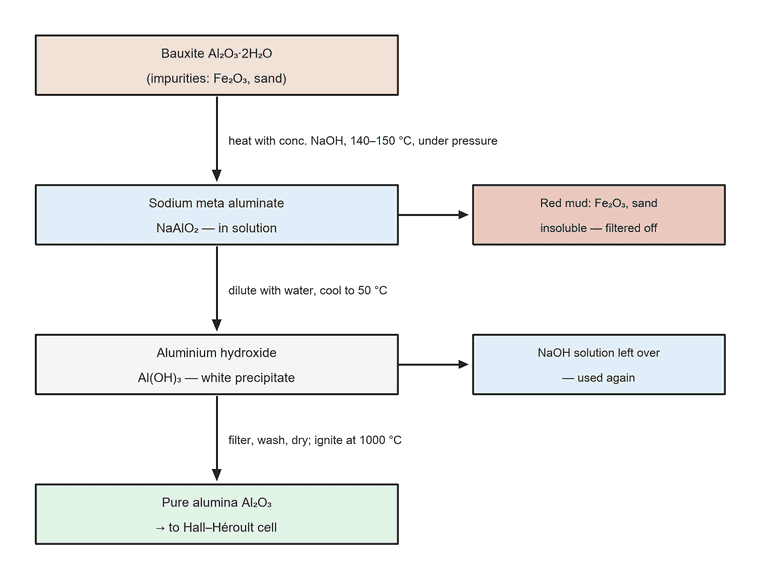
When bauxite is heated with concentrated caustic soda solution, the aluminium oxide dissolves as sodium meta aluminate:
Step 4 — (c) Red mud: how it is removed.
The impurities (mainly iron(III) oxide and sand) do not dissolve. This insoluble residue is red mud (red because of the iron(III) oxide), and it is removed by filtration.
Watch out: Red mud is the impurity left behind, not a product of the aluminium; it is filtered off and thrown away.
Therefore, (a) bauxite Al₂O₃·2H₂O, haematite Fe₂O₃ and zinc blende ZnS; (b) iron(III) oxide and sand; (c) red mud is the insoluble residue of iron(III) oxide and sand, removed by filtration.
- 335 marks
Question 33
In order to obtain 1 tonne of aluminium, the following inputs are required. 4 tonnes of bauxite, 150 kg of sodium hydroxide and 600 kg of graphite. The aluminium compound in bauxite is aluminium oxide and the main impurity is iron (III) oxide. Aluminium is obtained by the electrolysis of aluminium oxide dissolved in cryolite.
(a) When bauxite is treated with sodium hydroxide solution, what happens to :
(i) the aluminium oxide,
(ii) the iron (III) oxide ?
(b) (i) Name the process used for the purification of bauxite.
(ii) Write the equation for the action of heat on aluminium hydroxide.
(c) (i) Write the formulae of cryolite.
(ii) Write down the word which correctly completes the following sentence.
By dissolving aluminium oxide in cryolite a ......... (conducting/non conducting) solution is produced.
(iii) Why is so much graphite required for the electrolytic process ?
(iv) Write the equation for the reaction which takes place at cathode.
(v) What is the cathode made up of ?
Solve with AIWritten solution
Solution:
Concept: Alumina is amphoteric, so it dissolves in sodium hydroxide; iron(III) oxide is basic and does not. The pure alumina is then electrolysed while dissolved in molten cryolite, with graphite anodes that burn away.
Step 1 — (a)(i) The aluminium oxide.
It dissolves, forming soluble sodium meta aluminate:
Step 2 — (a)(ii) The iron(III) oxide.
It does not dissolve. It stays behind as an insoluble residue (red mud) and is filtered off.
Step 3 — (b)(i) Process for purifying bauxite.
This is Bayer's process.
Step 4 — (b)(ii) Action of heat on aluminium hydroxide.
On heating to about 1000 °C it loses water and gives pure alumina:
Step 5 — (c)(i) Formula of cryolite.
Cryolite is sodium aluminium fluoride, .
Step 6 — (c)(ii) Complete the sentence.
Molten cryolite dissolves alumina and conducts electricity well.
By dissolving aluminium oxide in cryolite a conducting solution is produced.
Step 7 — (c)(iii) Why so much graphite is needed.
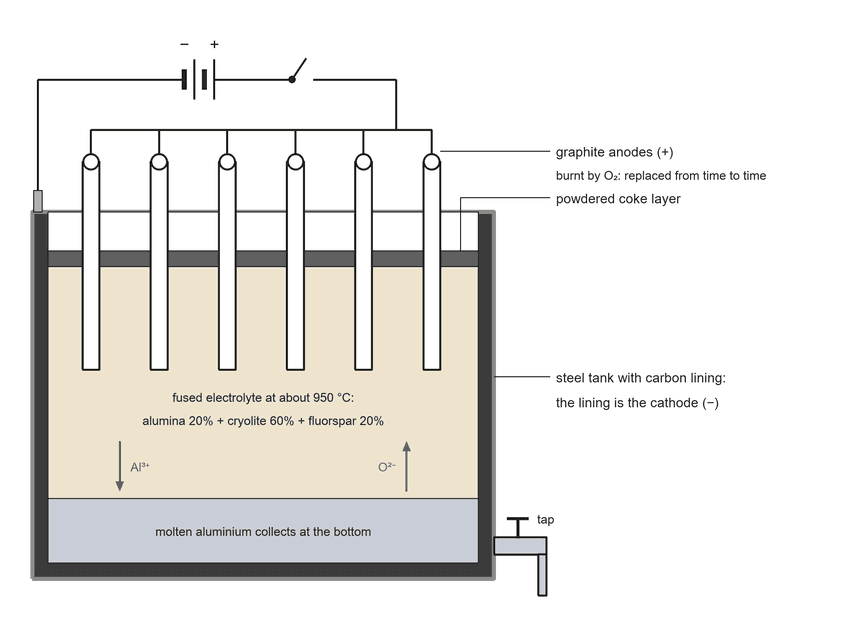
The oxygen set free at the graphite anodes reacts with the hot graphite and burns it away as carbon monoxide and carbon dioxide:
The anodes are gradually used up and have to be replaced, so a large mass of graphite (600 kg per tonne of aluminium) is needed.
Step 8 — (c)(iv) Reaction at the cathode.
Aluminium ions gain electrons and become aluminium:
Step 9 — (c)(v) What the cathode is made of.
The cathode is the carbon (graphite) lining of the steel tank.
Watch out: The graphite is used up at the anode (oxygen is set free there), not at the cathode.
Therefore, (a) alumina dissolves as sodium meta aluminate while iron(III) oxide stays as red mud; (b) Bayer's process, 2Al(OH)₃ → Al₂O₃ + 3H₂O; (c) Na₃AlF₆, conducting, the anodes burn away in the oxygen set free, Al³⁺ + 3e⁻ → Al, and the cathode is the carbon lining of the tank.
- 345 marks
Question 34
Aluminium is extracted from its chief ore, bauxite. The ore is first purified and then the metal is extracted from it by electrolytic reduction.
(a) Write three balanced equations for the purification of bauxite.
(b) Name a chemical used for dissolving aluminium oxide. In which state is the chemical used ?
(c) Write an equation for the reaction which takes place at the anode during the extraction of aluminium by the electrolytic process.
Solve with AIWritten solution
Solution:
Concept: Bayer's process purifies bauxite in three steps: dissolve the alumina in NaOH, precipitate it as , then ignite it to pure alumina. In the electrolysis that follows, oxide ions are discharged at the anode.
Step 1 — (a) First equation: dissolve.
Bauxite is heated with concentrated NaOH at 140–150 °C under pressure; the alumina dissolves:
Step 2 — (a) Second equation: precipitate.
The filtered solution is diluted and cooled to about 50 °C; aluminium hydroxide is precipitated:
Step 3 — (a) Third equation: ignite.
The precipitate is filtered, washed, dried and ignited at 1000 °C:
Step 4 — (b) Chemical used for dissolving aluminium oxide.
In the electrolytic step alumina is dissolved in cryolite, used in the molten (fused) state. (In Bayer's process the alumina of bauxite is dissolved in sodium hydroxide, used as a concentrated aqueous solution.)
Step 5 — (c) Reaction at the anode.
Oxide ions lose electrons and oxygen is set free:
The oxygen atoms then join in pairs:
Watch out: In the second equation, check the water: NaAlO₂ + 2H₂O gives NaOH + Al(OH)₃ (4 O and 4 H on each side).
Therefore, (a) Al₂O₃·2H₂O + 2NaOH → 2NaAlO₂ + 3H₂O, NaAlO₂ + 2H₂O → NaOH + Al(OH)₃, 2Al(OH)₃ → Al₂O₃ + 3H₂O; (b) cryolite in the molten state (NaOH as a concentrated solution in Bayer's process); (c) 6O²⁻ − 12e⁻ → 6[O], then 6[O] → 3O₂.
- 355 marks
Question 35
(a) A to F below relate to the source and extraction of either zinc or aluminium :
A. Bauxite, B. Coke,
C. Cryolite, D. Froth floatation,
E. Sodium hydroxide solution,
F. Zinc blende.
(i) Write down the three letters each from the above list which are relevant to :
- Zinc, 2. Aluminium.
(ii) Fill in the blanks using the most appropriate words from A to F.
-
The ore from which aluminium is extracted must first be treated with .............. so that pure aluminium oxide can be obtained.
-
Pure aluminium oxide is dissolved in .................... to make a conducting solution.
(iii) Write the formula of cryolite.
Solve with AIWritten solution
Solution:
Concept: Zinc comes from a sulphide ore (froth floatation, then reduction by coke). Aluminium comes from bauxite, purified with NaOH and electrolysed in cryolite.
Step 1 — Sort the letters into the two routes.
The chart follows each metal from ore to metal.
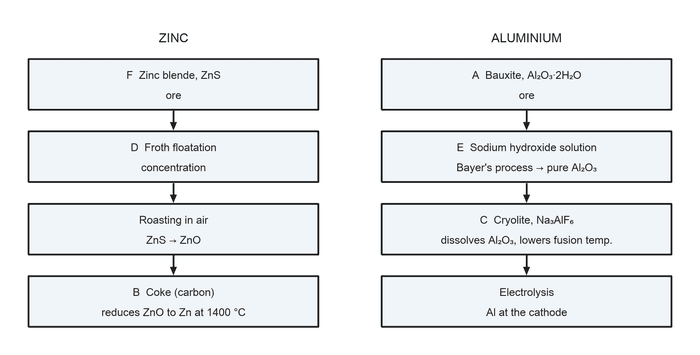
Step 2 — (i) 1. Letters for zinc.
B, D, F:
- F, zinc blende, is the ore;
- D, froth floatation, concentrates it (it is a sulphide);
- B, coke, reduces the zinc oxide to zinc.
Step 3 — (i) 2. Letters for aluminium.
A, C, E:
- A, bauxite, is the ore;
- E, sodium hydroxide solution, purifies it (Bayer's process);
- C, cryolite, dissolves the alumina for electrolysis.
Step 4 — (ii) Fill in the blanks.
Each blank is one stage of the aluminium route.
-
The ore from which aluminium is extracted must first be treated with sodium hydroxide solution (E) so that pure aluminium oxide can be obtained.
-
Pure aluminium oxide is dissolved in cryolite (C) to make a conducting solution.
Step 5 — (iii) Formula of cryolite.
Cryolite is .
Watch out: Coke (B) belongs to zinc: aluminium oxide cannot be reduced by carbon.
Therefore, (i) zinc: B, D, F and aluminium: A, C, E; (ii) 1. sodium hydroxide solution, 2. cryolite; (iii) Na₃AlF₆.
- 365 marks
Question 36
Explain with reasons :
(a) In the electrolytic reduction of alumina, the graphite anode is gradually consumed. OR
Why the anode has to be replaced from time to time in this process ?
(b) Roasting is carried out on sulphide ores and not on carbonate ores.
(c) Carbon can reduce lead oxide but not aluminium oxide.
(d) Electrolytic reduction is done to obtain aluminium ?
(e) Why 'the food containing iron salts' should not be cooked in aluminium utensils ?
(f) A neutral gas other than oxygen is formed at the anode during electrolysis of fused alumina.
(g) Why is powdered coke sprinkled on top of the electrolyte?
Solve with AIWritten solution
Solution:
Concept: Most of these follow from aluminium's high reactivity and its strong affinity for oxygen, and from what happens at the graphite anode.
Step 1 — (a) The graphite anode is gradually used up.
The oxygen set free at the anode reacts with the hot graphite and forms carbon monoxide and carbon dioxide, which escape:
So the anode is gradually burnt away and has to be replaced from time to time.
Step 2 — (b) Roasting for sulphide ores, not carbonate ores.
A sulphide ore needs oxygen (excess air) to be converted into the oxide; the sulphur leaves as SO₂. A carbonate ore breaks down into the oxide by heat alone (calcination), so it does not need roasting:
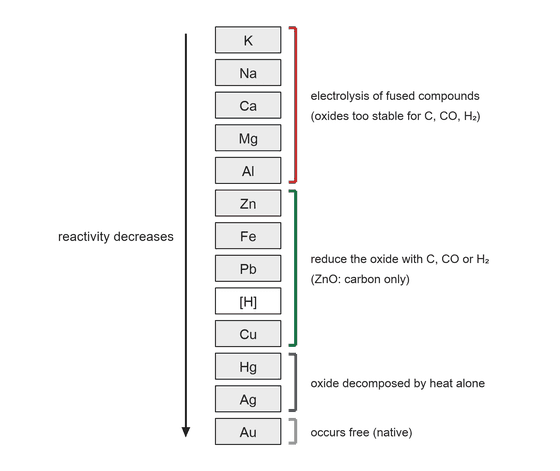
Step 3 — (c) Carbon reduces lead oxide, not aluminium oxide.
Carbon has a greater affinity for oxygen than lead, but less than aluminium. So carbon can take oxygen from lead oxide, but aluminium oxide is too stable:
Step 4 — (d) Electrolytic reduction is used for aluminium.
Aluminium is a highly reactive metal with a strong affinity for oxygen. Alumina is very stable and cannot be reduced by common reducing agents such as carbon, CO or hydrogen, so electrolytic reduction is used.
Step 5 — (e) Food with iron salts is not cooked in aluminium utensils.
Aluminium is more reactive than iron, so it displaces iron from the iron salts in the food. The utensil gets corroded and aluminium salts pass into the food, which is harmful:
Step 6 — (f) A neutral gas other than oxygen at the anode.
The oxygen formed at the anode reacts with the carbon anode. Where oxygen is limited it forms carbon monoxide, a neutral oxide:
Step 7 — (g) Powdered coke on top of the electrolyte.
The layer of powdered coke:
- reduces the loss of heat by radiation from the electrolyte; and
- prevents the burning of the anodes in the air above the bath.
Watch out: Carbon dioxide is acidic, not neutral; the neutral gas in (f) is carbon monoxide.
Therefore, the anode burns in the oxygen set free; sulphides need air but carbonates do not; carbon holds oxygen more strongly than lead but less than aluminium; alumina is too stable for reducing agents; aluminium displaces iron from iron salts; the neutral gas is CO; and the coke layer cuts heat loss and protects the anodes.
- 375 marks
Question 37
For each substance listed below, explain its significance in the extraction of aluminium :
(a) Bauxite, (b) Sodium hydroxide,
(c) Cryolite, (d) Graphite. (2015)
Solve with AIWritten solution
Solution:
Concept: Each substance has one job: bauxite is the source, NaOH purifies it (Bayer's process), cryolite makes the electrolysis possible, and graphite forms the electrodes (Hall–Héroult process).
Step 1 — (a) Bauxite.
It is the main ore of aluminium, : the source of the alumina.
Step 2 — (b) Sodium hydroxide.
It is used in Bayer's process to dissolve the alumina (which is amphoteric) as sodium meta aluminate, separating it from the insoluble impurities (red mud):
Step 3 — (c) Cryolite.
It acts as a solvent for alumina. It lowers the fusion temperature of the electrolyte from about 2050 °C to about 950 °C, and increases its electrical conductivity.
Step 4 — (d) Graphite.
Thick graphite rods dipping in the electrolyte act as the anodes; the graphite (gas carbon) lining of the tank acts as the cathode.
Watch out: Cryolite does not take part in the reaction; it is the solvent that lets alumina melt at a lower temperature.
Therefore, bauxite is the ore, sodium hydroxide purifies it to alumina, cryolite dissolves the alumina and lowers the fusion temperature, and graphite forms the anodes and the cathode lining.
- 382 marks
Question 38
Distinguish between electrolytic methods of reduction and refining.
Solve with AIWritten solution
Solution:
Concept: Electrolytic reduction gets a metal out of its compound; electrolytic refining purifies a metal already obtained.
Step 1 — Compare the two processes.
The table lists the differences.
Electrolytic reduction Electrolytic refining The metal is obtained from its compound (e.g. Al from fused alumina). An impure metal is purified (e.g. crude copper). Electrolyte is the molten (fused) compound of the metal. Electrolyte is an aqueous solution of a salt of the metal (e.g. ). Anode is inert (e.g. graphite). Anode is the impure metal, which dissolves. Used for highly reactive metals (Na, K, Ca, Mg, Al). Used for metals such as Cu, Ag, Zn and Al. Step 2 — Example of reduction.
In the reduction of alumina, aluminium ions are discharged at the cathode:
Step 3 — Example of refining.
In the refining of copper, the impure copper anode dissolves:
Watch out: In refining, the anode itself is used up; in reduction the anode is inert (it may burn, but it is not the source of the metal).
Therefore, electrolytic reduction obtains a reactive metal from its fused compound with an inert anode, while electrolytic refining purifies an impure metal, made the anode, in an aqueous solution of its salt.
- 392 marks
Question 39
Give three ways in which the metal zinc differs from the non-metal carbon. At least one of the differences must be a chemical difference.
Solve with AIWritten solution
Solution:
Concept: Zinc shows typical metallic properties and carbon typical non-metallic ones. A chemical difference shows up in how each reacts with acids, or in the nature of its oxide.
Step 1 — Compare the two elements.
The table gives the differences (both kinds are shown; at least one must be chemical).
Zinc (metal) Carbon (non-metal) Lustrous and malleable (physical) Dull and brittle, except graphite, which has a lustre (physical) Good conductor of electricity (physical) Non-conductor, except graphite (physical) Displaces hydrogen from dilute acids (chemical) Does not displace hydrogen from dilute acids (chemical) Forms an amphoteric oxide, ZnO, and a positive ion (chemical) Forms an acidic oxide, , and covalent compounds (chemical) Step 2 — Show the chemical difference with acid.
Zinc gives hydrogen with dilute sulphuric acid; carbon does not react:
Watch out: Three differences are asked for, and at least one must be chemical (such as the reaction with acids).
Therefore, zinc is lustrous and malleable, conducts electricity and displaces hydrogen from dilute acids, while carbon is dull and brittle, does not conduct (except graphite) and does not displace hydrogen from acids.
- 404 marks
Question 40
(a) Aluminium is a more active metal than iron, but suffers less corrosion. Why ?
(b) Explain and give reasons why aluminium vessels should not be cleaned with powders containing alkalis.
Solve with AIWritten solution
Solution:
Concept: Aluminium is protected by a thin, tough oxide film. That film is amphoteric, so alkalis dissolve it and then attack the metal.
Step 1 — (a) Aluminium corrodes less than iron.
Aluminium reacts with air to form a thin, tough, non-porous layer of aluminium oxide that sticks to the surface and protects the metal underneath from further attack.
Rust on iron is porous and flakes off, so fresh iron is exposed and keeps corroding.

Step 2 — (b) Alkalis dissolve the protective film.
Alkalis dissolve the protective oxide layer, because alumina is amphoteric:
Step 3 — (b) Alkalis then attack the metal.
With the film gone, the alkali attacks the aluminium itself, giving off hydrogen, so the vessel gets corroded:
Watch out: Aluminium is more reactive than iron; it corrodes less only because its oxide film protects it.
Therefore, (a) aluminium is protected by a tough, non-porous oxide film, while rust is porous and flakes off; (b) alkalis dissolve the amphoteric oxide film and then corrode the aluminium.
- 413 marks
Question 41
Given below in column A is a schematic diagram of the electrolytic reduction of alumina. Identify the parts labelled as A, B and C with the correct options from the Column B.
Column A:

Column B:
-
Platinum
-
Anode
-
Cathode
-
Electrolyte mixture
-
Bauxite
Solve with AIWritten solution
Solution:
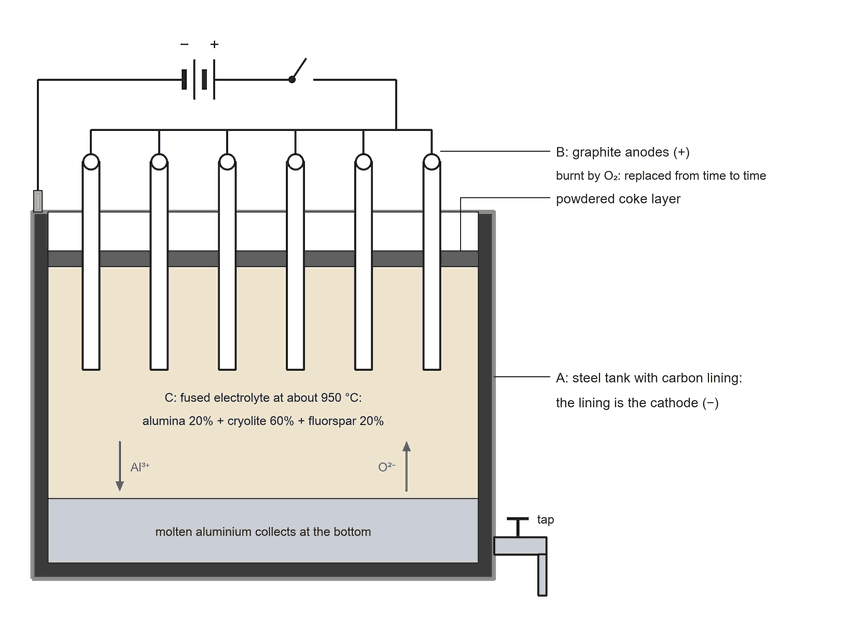
Concept: In the cell for alumina, the carbon lining of the tank is joined to the negative terminal, so it is the cathode; the graphite blocks are joined to the positive terminal, so they are the anodes. The tank holds the fused electrolyte.
Step 1 — Identify A.
A is the lining of the tank, joined to the negative terminal, so A is 3. Cathode.
Step 2 — Identify B.
B is the set of graphite blocks dipping into the melt, joined to the positive terminal, so B is 2. Anode.
Step 3 — Identify C.
C is the molten mixture of alumina, cryolite and fluorspar, so C is 4. Electrolyte mixture.
Step 4 — Rule out the other options.
Platinum (1) is not used in this cell, and bauxite (5) is purified to alumina before it goes into the cell.
Watch out: The electrode joined to the negative terminal is the cathode, where aluminium is formed.
Therefore, A is 3 (cathode), B is 2 (anode) and C is 4 (electrolyte mixture).
-
- 423 marks
Question 42
Fill in the blanks :
(a) During the concentration of bauxite ore, aluminium goes in ........................ (soluble/insoluble) part because of its ........................ (acidic/basic/ amphoteric) nature.
(b) In Hoope's process, pure aluminium is collected at the .................. (top/bottom) of the electrolytic cell.
Solve with AIWritten solution
Solution:
Concept: Alumina is amphoteric, so it dissolves in caustic soda. In Hoope's cell the molten layers float according to their density, and pure aluminium is the lightest.
Step 1 — (a) Concentration of bauxite.
Alumina dissolves as sodium meta aluminate, while iron(III) oxide and sand stay insoluble (red mud).
During the concentration of bauxite ore, aluminium goes in soluble part because of its amphoteric nature.
Step 2 — (b) Hoope's process.
The cell has three molten layers. Impure aluminium forms the bottom layer (anode), the molten fluorides the middle layer, and pure aluminium the top layer (cathode).
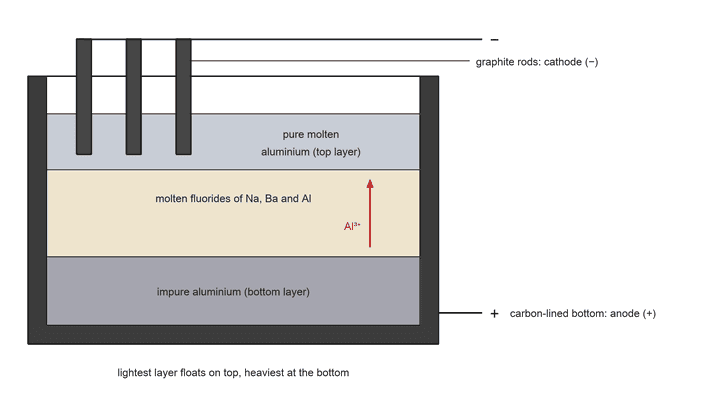
In Hoope's process, pure aluminium is collected at the top of the electrolytic cell.
Watch out: In Hoope's cell pure aluminium floats on top; in the Hall–Héroult cell molten aluminium collects at the bottom. Do not mix up the two cells.
Therefore, (a) soluble, amphoteric; (b) top.
- 434 marks
Question 43
Explain the following :
(a) Zinc is used to cover iron so as to prevent rusting of iron. Why ?
(b) In construction work, why is the alloy of aluminium-duralumin used rather than pure aluminium ?
Solve with AIWritten solution
Solution:
Concept: Zinc protects iron in two ways: as a barrier and as a more reactive metal that corrodes first. Alloying aluminium makes it strong without losing its lightness.
Step 1 — (a) Zinc keeps air and moisture away.
The zinc layer keeps air and moisture away from the iron, so rusting cannot start. This coating of iron with zinc is galvanisation.
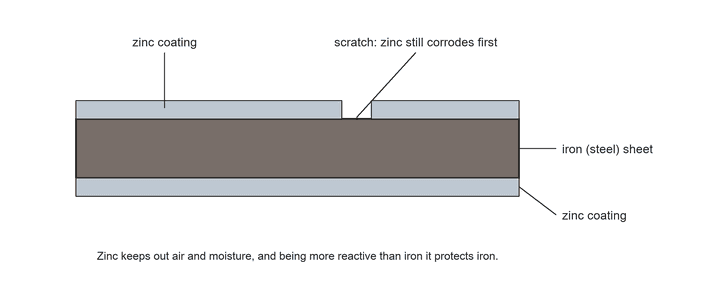
Step 2 — (a) Zinc corrodes first.
Zinc is more reactive than iron (higher in the activity series). Even if the coating is scratched, zinc corrodes in preference to iron, so the iron still does not rust. Zinc itself is protected by a thin layer of basic zinc carbonate that forms on it.
Step 3 — (b) Duralumin rather than pure aluminium.
Pure aluminium is soft and weak. Duralumin (Al 95%, Cu 4%, Mg 0.5%, Mn 0.5%) is much harder and stronger.
It is still light and resistant to corrosion, so it is better for construction work, aircraft and bus bodies.
Watch out: Zinc protects iron even where it is scratched, because the more reactive metal corrodes first; paint does not do this.
Therefore, (a) zinc shuts out air and moisture and, being more reactive, corrodes in place of iron; (b) duralumin is used because it is much stronger than pure aluminium while still light and corrosion-resistant.
- 444 marks
Question 44
What is an alloy ? How do the properties of an alloy differ from its constituents ?
Solve with AIWritten solution
Solution:
Concept: An alloy is made to improve the useful properties of its main metal, so its properties are usually quite different from those of its constituents.
Step 1 — Define an alloy.
An alloy is a homogeneous mixture of two or more metals, or of one or more metals with certain non-metallic elements. Example: steel is iron with a little carbon.
Step 2 — State how its properties differ.
Compared with its constituents, an alloy usually:
- is harder and stronger (brass is harder than copper);
- has a lower melting point (solder melts at about 183 °C, lower than lead or tin);
- is more resistant to corrosion (stainless steel does not rust);
- has a lower electrical conductivity, that is, a higher resistance (nichrome);
- may have a different colour and can be cast more easily (aluminium bronze looks like gold).
Watch out: An alloy is a mixture, not a compound: its constituents are not in a fixed ratio by formula.
Therefore, an alloy is a homogeneous mixture of metals (or of metals with some non-metals), and it is usually harder, lower-melting, more corrosion-resistant and less conducting than its constituents.
- 452 marks
Question 45
Both brass and bronze contain copper as major constituents. Name other elements in these alloys.
Solve with AIWritten solution
Solution:
Concept: Both are copper alloys. Brass has zinc with the copper; bronze has tin.
Step 1 — Brass.
Brass is copper (60–70%) with zinc (40–30%).
Step 2 — Bronze.
Bronze is copper (80%) with tin (18%) and a little zinc (2%).

Watch out: Brass has zinc, bronze has tin; a common error is to swap them.
Therefore, the other element in brass is zinc, and the other elements in bronze are tin (with a little zinc).
- 464 marks
Question 46
Name an alloy of :
(a) aluminium used in aircraft construction.
(b) lead used in electrical wiring or electrical work in joining metals.
(c) copper in electrical appliances or household vessels.
(d) zinc used in naval ships.
Solve with AIWritten solution
Solution:
Concept: Each alloy is chosen for a property its use needs: lightness and strength for aircraft, a low melting point for joining, corrosion resistance for marine work.
Step 1 — (a) Aluminium alloy for aircraft.
Duralumin (or magnalium). It is light, strong and resists corrosion.
Step 2 — (b) Lead alloy for joining metals in electrical work.
Solder (lead 50%, tin 50%). Its low melting point (about 183 °C) makes it easy to melt for joining wires.
Step 3 — (c) Copper alloy for electrical appliances or household vessels.
Brass (copper and zinc), used for electrical goods and utensils; bronze is also used for vessels.
Step 4 — (d) Zinc alloy used in naval ships.
Brass (naval brass), used for ship fittings and marine engine parts because it resists corrosion by sea water.
Watch out: Solder is an alloy of lead and tin; it is not pure lead.
Therefore, (a) duralumin; (b) solder; (c) brass; (d) brass.
- 472 marks
Question 47
What is an amalgam ? State its use with an example.
Solve with AIWritten solution
Solution:
Concept: 'Amalgam' is the special name for any alloy that contains mercury.
Step 1 — Define an amalgam.
An amalgam is an alloy of mercury with one or more other metals, such as sodium, zinc, gold or silver.
Step 2 — Give a use with an example.
Dental amalgam, mercury with a silver–tin alloy, is used for filling cavities in teeth.
(Sodium amalgam is much less reactive than sodium and is used as a reducing agent. Mercury does not form an amalgam with iron, so it is stored in iron bottles.)
Watch out: Every amalgam contains mercury; an alloy without mercury is never called an amalgam.
Therefore, an amalgam is an alloy of mercury with other metals, e.g. dental amalgam (mercury with silver and tin) used to fill teeth.
- 483 marks
Question 48
(a) State two properties of brass that render it more useful for some purposes than its components.
(b) Name a metal which forms a liquid alloy at ordinary temperature.
Solve with AIWritten solution
Solution:
Concept: Brass combines the useful features of copper and zinc and adds some of its own.
Step 1 — (a) First property of brass.
Brass is harder and stronger than copper or zinc, and it resists corrosion.
Step 2 — (a) Second property of brass.
It can be easily cast into shapes, and it has an attractive yellow (golden) colour. That is why it is used for decorative hardware, screws, taps and parts of watches.
Step 3 — (b) A metal forming a liquid alloy at ordinary temperature.
Sodium: its alloy with potassium, and its alloy with mercury (sodium amalgam, when rich in mercury), are liquid at room temperature. (Mercury is also accepted: it forms liquid amalgams with many metals.)
Watch out: The question asks for properties that make brass more useful than its components, so compare it with copper and zinc.
Therefore, (a) brass is harder and more corrosion-resistant than copper or zinc, and it is easily cast with an attractive colour; (b) sodium (or mercury).
- 494 marks
Question 49
Name the constituents of :
(a) Duralumin, (b) Solder,
(c) Bronze, (d) Brass.
Solve with AIWritten solution
Solution:
Concept: Each alloy has a main metal with small, chosen amounts of others.
Step 1 — List the constituents.
The table gives the composition of each alloy.
Alloy Constituents (a) Duralumin aluminium 95%, copper 4%, magnesium 0.5%, manganese 0.5% (b) Solder lead 50%, tin 50% (c) Bronze copper 80%, tin 18%, zinc 2% (d) Brass copper 60–70%, zinc 40–30% Step 2 — Check the totals.
Each composition adds up to 100%, for example duralumin: 95 + 4 + 0.5 + 0.5 makes 100.
Watch out: Duralumin is mostly aluminium; copper is only 4% of it.
Therefore, duralumin is Al, Cu, Mg and Mn; solder is Pb and Sn; bronze is Cu, Sn and Zn; brass is Cu and Zn.
- 505 marks
Question 50
Name the following :
(a) A metal which is liquid at room temperature.
(b) A metal which is always present in amalgam.
(c) The process of heating an ore to a high temperature in the presence of air.
(d) The compound formed by the reaction between calcium oxide and silica.
(e) A compound which is added to lower the fusion temperature of the electrolytic bath in the extraction of aluminium.
(f) Name an allotrope of a non-metal that allows electricity to pass through it.
Solve with AIWritten solution
Solution:
Concept: One-word answers from the whole chapter: metals, amalgams, roasting, slag formation and the electrolytic bath for aluminium.
Step 1 — (a) A metal liquid at room temperature.
Mercury is the only metal that is a liquid at room temperature.
Step 2 — (b) The metal always present in an amalgam.
Mercury: an amalgam is, by definition, an alloy of mercury.
Step 3 — (c) Heating an ore strongly in air.
This is roasting: the ore (usually a sulphide) is heated strongly in excess of air.
Step 4 — (d) Calcium oxide with silica.
The product is calcium silicate (slag), . The basic oxide CaO removes the acidic silica:
Step 5 — (e) Compound that lowers the fusion temperature.
Cryolite (). It lowers the fusion temperature from about 2050 °C to about 950 °C.
Step 6 — (f) An allotrope of a non-metal that conducts.
Graphite. This allotrope of carbon conducts electricity because it has free (mobile) electrons.
Watch out: In (c), heating in air is roasting; heating without air would be calcination.
Therefore, (a) mercury; (b) mercury; (c) roasting; (d) calcium silicate; (e) cryolite; (f) graphite.
- 515 marks
Question 51
Name the alloy used for the following purposes.
(a) Making electric circuits (b) Making medals
(c) Making parts of watches (d) Surgical instruments
(e) Aircraft
Solve with AIWritten solution
Solution:
Concept: Each use needs a particular property, and the alloy is chosen for it.
Step 1 — (a) Making electric circuits.
Solder (lead and tin). Its low melting point makes it easy to join wires in a circuit.
Step 2 — (b) Making medals.
Bronze. It is hard, takes a polish and resists corrosion.
Step 3 — (c) Making parts of watches.
Brass. It is easily cast and machined into small parts.
Step 4 — (d) Surgical instruments.
Stainless steel. It does not rust and resists attack by acids and alkalis.
Step 5 — (e) Aircraft.
Duralumin (or magnalium). It is light, strong and resists corrosion.
Watch out: Medals and statues are made of bronze, not brass.
Therefore, (a) solder; (b) bronze; (c) brass; (d) stainless steel; (e) duralumin.
- 525 marks
Question 52
Using the information in the table below, complete the following :
X Y Normal electronic Configuration 2, 8, 7 2, 8, 2 Nature of oxide Dissolves in water and turns blue litmus red Very low solubility in water. Dissolves in hydrochloric acid Tendency for oxidising and reducing reactions Tends to oxidise elements and compounds Tends to act as a reducing agent Electrical and Thermal conductivity Very poor electrical conductor Poor thermal conductivity Good Electrical conductor Good thermal conductor Tendency to form alloys and amalgams No tendency to form alloys Forms alloys (a) .............. is the metallic element.
(b) Metal atoms tend to have a maximum of .............. electrons in the outermost energy level.
(c) Non-metallic elements tend to form .............. oxides while metals tend to form .............. oxides.
(d) Non-metallic elements tend to be .............. conductors of heat and electricity.
(e) Metals tend to .............. electrons and act as .............. agents in their reactions with elements and compounds.
Solve with AIWritten solution
Solution:
Concept: The electronic configuration decides everything. Y (2, 8, 2) has 2 valence electrons, loses them and behaves as a metal (it is magnesium). X (2, 8, 7) has 7 valence electrons, gains one and behaves as a non-metal (it is chlorine).
Step 1 — Read the valence electrons.
The shell diagrams show the outer electrons of X and Y.

Step 2 — (a) The metallic element.
Y's oxide dissolves in acid (basic), Y is a reducing agent, a good conductor, and forms alloys.
Y is the metallic element.
Step 3 — (b) Outer electrons of metal atoms.
Metals have few outer electrons, which they lose easily.
Metal atoms tend to have a maximum of three electrons in the outermost energy level.
Step 4 — (c) Nature of oxides.
X's oxide turns blue litmus red (acidic); Y's oxide dissolves in hydrochloric acid (basic).
Non-metallic elements tend to form acidic oxides while metals tend to form basic oxides.
Step 5 — (d) Conductivity of non-metals.
X is a very poor conductor of heat and electricity.
Non-metallic elements tend to be poor (bad) conductors of heat and electricity.
Step 6 — (e) Electrons and reducing action.
Y gives away electrons, so it reduces other substances.
Metals tend to lose electrons and act as reducing agents in their reactions with elements and compounds.
Watch out: Losing electrons is oxidation of the metal itself, which makes the metal a reducing agent for others.
Therefore, (a) Y; (b) three; (c) acidic, basic; (d) poor; (e) lose, reducing.
- 531 mark
Question 53
The main ore used for the extraction of iron is:
Solve with AIAnswer
- Correct
(A) Haematite
(B) Calamine
(C) Bauxite
(D) Cryolite
Answer: (A) Haematite
Concept: Iron is extracted mainly from its chief ore haematite, which is iron(III) oxide, .
Step 1 — Match each ore to its metal.
Haematite is an ore of iron; calamine is an ore of zinc; bauxite and cryolite are ores of aluminium.
Step 2 — Pick the ore of iron.
Haematite is an oxide ore of iron, so after concentration it is reduced directly by carbon monoxide.
Watch out: Calamine is a zinc ore (ZnCO₃), not an iron or calcium ore.
Why the other options are wrong:
- (B) Calamine: calamine () is an ore of zinc.
- (C) Bauxite: bauxite () is the main ore of aluminium.
- (D) Cryolite: cryolite () is an ore of aluminium, used as a solvent in its extraction.
Therefore, the main ore used for the extraction of iron is haematite, option (A).
- 541 mark
Question 54
Heating an ore in a limited supply of air or in the absence of air at a temperature just below its melting point is known as :
Solve with AIAnswer
(A) Smelting
(B) Ore dressing
- Correct
(C) Calcination
(D) Bessemerisation
Answer: (C) Calcination
Concept: Calcination is heating an ore (carbonate or hydrated) in the absence or a limited supply of air, below its melting point, to turn it into the oxide.
Step 1 — Match the description.
Heating without air (or with little air), below the melting point, is calcination.
Step 2 — See what happens in calcination.
A carbonate ore breaks down and carbon dioxide is given off:
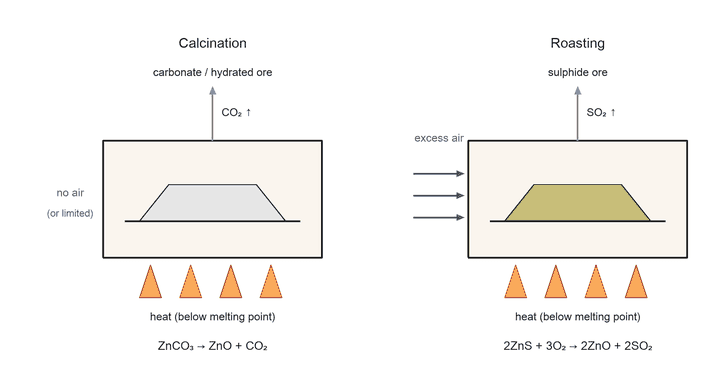
Watch out: Roasting is heating in excess air; the stem says limited air or no air, so it is calcination.
Why the other options are wrong:
- (A) Smelting: smelting is the reduction of the oxide to the molten metal at a high temperature, with a reducing agent.
- (B) Ore dressing: ore dressing is concentration of the ore (removal of gangue); no heating is involved.
- (D) Bessemerisation: Bessemerisation is blowing air through molten metal (as in making steel), not heating an ore below its melting point.
Therefore, heating an ore in limited or no air just below its melting point is calcination, option (C).
- 551 mark
Question 55
The compound that is not an ore of aluminium is :
Solve with AIAnswer
(A) Cryolite
(B) Corundum
- Correct
(C) Fluorspar
(D) Bauxite
Answer: (C) Fluorspar
Concept: An ore of aluminium must contain aluminium. Fluorspar is calcium fluoride, , so it has no aluminium in it.
Step 1 — Write the formula of each option.
Cryolite is , corundum is , bauxite is , and fluorspar is .
Step 2 — Find the one without aluminium.
Only fluorspar has no aluminium. It is merely added to the electrolyte in the extraction of aluminium, to lower the fusion temperature and increase conductivity.
Watch out: Fluorspar is used in the extraction of aluminium, but it is not an ore of aluminium.
Why the other options are wrong:
- (A) Cryolite: cryolite, (sodium aluminium fluoride), is an aluminium ore.
- (B) Corundum: corundum, (anhydrous aluminium oxide), is an aluminium ore.
- (D) Bauxite: bauxite, , is the main aluminium ore.
Therefore, the compound that is not an ore of aluminium is fluorspar, option (C).
- 561 mark
Question 56
Fused alumina is reduced to aluminium by electrolytic reduction, since :
Solve with AIAnswer
(A) alumina is highly stable.
(B) alumina is least stable.
(C) alumina is not reduced by drying agents.
- Correct
(D) alumina is not reduced by reducing agents.
Answer: (D) alumina is not reduced by reducing agents.
Concept: Aluminium has so strong an affinity for oxygen that common reducing agents (carbon, CO, hydrogen) cannot remove oxygen from alumina. Electrolysis is the only way left.
Step 1 — Ask why ordinary reduction fails.
Carbon, carbon monoxide and hydrogen hold oxygen less strongly than aluminium does, so they cannot reduce alumina.
Step 2 — See how electrolysis does it.
Fused alumina contains Al³⁺ and O²⁻ ions. On electrolysis, aluminium is set free at the cathode:
Watch out: The phrase 'highly stable' is true but is only the background; the stated reason for electrolysis is that reducing agents fail.
Why the other options are wrong:
- (A) alumina is highly stable: alumina is indeed highly stable, but that alone does not name why electrolysis is chosen; the direct reason is that common reducing agents fail to reduce it.
- (B) alumina is least stable: alumina is very stable, not least stable.
- (C) alumina is not reduced by drying agents: drying agents remove water; they have nothing to do with reduction.
Therefore, fused alumina is reduced by electrolysis since alumina is not reduced by reducing agents, option (D).
- 571 mark
Question 57
The chemical name of the principal ore of aluminium is:
Solve with AIAnswer
(A) sodium aluminium fluoride
(B) aluminium oxide
(C) hydrated aluminium fluoride
- Correct
(D) hydrated aluminium oxide
Answer: (D) hydrated aluminium oxide
Concept: The principal ore of aluminium is bauxite, : aluminium oxide combined with water of crystallisation, that is, hydrated aluminium oxide.
Step 1 — Name the principal ore.
Aluminium is extracted mainly from bauxite.
Step 2 — Read its chemical name from the formula.
The formula Al₂O₃·2H₂O is aluminium oxide with water of crystallisation, so its chemical name is hydrated aluminium oxide.
Watch out: Anhydrous aluminium oxide (corundum) and hydrated aluminium oxide (bauxite) are different; the principal ore is the hydrated one.
Why the other options are wrong:
- (A) sodium aluminium fluoride: sodium aluminium fluoride is cryolite, , not the principal ore.
- (B) aluminium oxide: aluminium oxide (anhydrous) is corundum.
- (C) hydrated aluminium fluoride: hydrated aluminium fluoride is not an ore of aluminium.
Therefore, the chemical name of the principal ore of aluminium (bauxite) is hydrated aluminium oxide, option (D).
- 581 mark
Question 58
Brass is an alloy of :
Solve with AIAnswer
(A) Copper and tin,
- Correct
(B) Copper and zinc,
(C) Zinc and lead,
(D) Lead and tin.
Answer: (B) Copper and zinc,
Concept: Brass is an alloy of copper (60–70%) and zinc (40–30%).
Step 1 — Recall the composition of brass.
The alloy chart gives brass as copper with zinc.
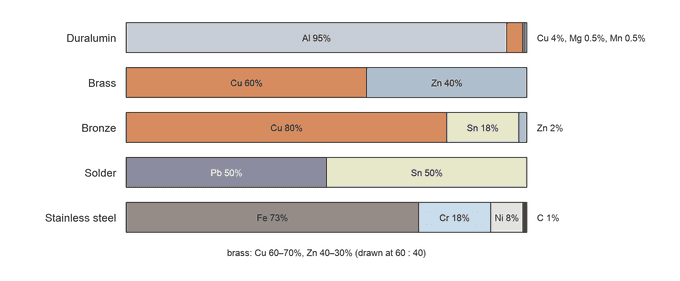
Step 2 — Compare with the options.
Only option (B) names copper and zinc.
Watch out: Copper with tin is bronze; copper with zinc is brass.
Why the other options are wrong:
- (A) Copper and tin,: copper and tin are the main metals of bronze.
- (C) Zinc and lead,: zinc and lead do not form a common named alloy.
- (D) Lead and tin: lead and tin make solder (fuse metal).
Therefore, brass is an alloy of copper and zinc, option (B).
- 591 mark
Question 59
Steel is an alloy of iron and :
Solve with AIAnswer
(A) Nickel,
(B) Zinc,
- Correct
(C) Carbon,
(D) Aluminium.
Answer: (C) Carbon,
Concept: Steel is iron with a small percentage of carbon (up to about 1.5%). The carbon greatly changes the hardness and strength of the iron.
Step 1 — Recall what makes iron into steel.
Adding a small amount of carbon to iron makes steel.
Step 2 — Check with a special steel.
Even special steels contain carbon, e.g. stainless steel is Fe 73%, Cr 18%, Ni 8%, C 1%.
Watch out: Nickel and chromium are added only to special steels; carbon is in every steel.
Why the other options are wrong:
- (A) Nickel,: nickel is added only to special steels such as stainless steel; it is not what makes iron into steel.
- (B) Zinc,: zinc is used to coat (galvanise) iron, not to make steel.
- (D) Aluminium: aluminium is not a constituent of steel.
Therefore, steel is an alloy of iron and carbon, option (C).
- 601 mark
Question 60
The reason for using aluminium in the alloy duralumin is : (2019)
Solve with AIAnswer
(A) Al is brittle
(B) Al gives strength
- Correct
(C) Al brings lightness
(D) Al lowers melting point
Answer: (C) Al brings lightness
Concept: In duralumin (Al 95%, Cu 4%, Mg 0.5%, Mn 0.5%), aluminium gives lightness, while the small amounts of copper and magnesium give strength.
Step 1 — Ask what each metal contributes.
Aluminium is a light metal; copper and magnesium harden it.
Step 2 — Link to the use.
That is why duralumin is used for the bodies of aircraft, buses and trains: it is light and strong.
Watch out: The strength of duralumin comes from the copper and magnesium, not from the aluminium.
Why the other options are wrong:
- (A) Al is brittle: aluminium is not brittle; it is malleable and ductile.
- (B) Al gives strength: the strength comes from the added Cu and Mg; pure aluminium is soft and weak.
- (D) Al lowers melting point: lowering the melting point is not the purpose of duralumin.
Therefore, aluminium is used in duralumin because it brings lightness, option (C).
- 611 mark
Question 61
Duralumin is an alloy with composition :
P Al and Mg Q Al, Cu and Mg
R Al and Mn
Solve with AIAnswer
(A) Only P
- Correct
(B) Only Q
(C) Both P and R
(D) Only R
Answer: (B) Only Q
Concept: Duralumin is Al 95%, Cu 4%, Mg 0.5%, Mn 0.5%. Its main constituents are aluminium, copper and magnesium, which is composition Q.
Step 1 — Recall the composition.
The alloy chart lists duralumin as aluminium with copper, magnesium and a little manganese.
Step 2 — Test P, Q and R.
P (Al and Mg) and R (Al and Mn) both leave out copper. Only Q (Al, Cu and Mg) contains the essential copper.
Watch out: Al with Mg alone is magnalium, a different alloy.
Why the other options are wrong:
- (A) Only P: Al and Mg alone make magnalium, not duralumin.
- (C) Both P and R: P and R both leave out copper, an essential constituent of duralumin.
- (D) Only R: R (Al and Mn) leaves out copper and magnesium.
Therefore, duralumin has the composition Q only, option (B).
- 621 mark
Question 62
The following questions are Assertion-Reason based questions. Choose the answer based on the codes given below.
(1) Both A and R are true and R is the correct explanation of A.
(2) Both A and R are true but R is not the correct explanation of A.
(3) A is true but R is false.
(4) A is false but R is true.
Assertion (A) : Hydrogen is a non--metal and can even form positive ions.
Reason (R) : Metals are defined as the elements which form positive ions by the loss of electrons.
Solve with AIAnswer
(A) (1) Both A and R are true and R is the correct explanation of A.
- Correct
(B) (2) Both A and R are true but R is not the correct explanation of A.
(C) (3) A is true but R is false.
(D) (4) A is false but R is true.
Answer: (B) (2) Both A and R are true but R is not the correct explanation of A.
Concept: Check the Assertion and the Reason separately, then ask whether the Reason explains the Assertion.
Step 1 — Test the Assertion.
Hydrogen is a non-metal, yet it can lose its one electron to form a positive ion, H⁺. So the Assertion is true.
Step 2 — Test the Reason.
Metals are indeed defined as elements that form positive ions by losing electrons. So the Reason is true.
Step 3 — Does the Reason explain the Assertion.
A definition of metals cannot explain why a non-metal forms a positive ion. R does not explain A.
Watch out: A true Reason is not automatically the explanation; it must say why the Assertion happens.
Why the other options are wrong:
- (A) (1) Both A and R are true and R is the correct explanation of A: This needs both statements true and R to explain A, but R does not explain A.
- (C) (3) A is true but R is false: This needs A true and R false, but the Reason is true.
- (D) (4) A is false but R is true: This needs A false and R true, but the Assertion is true.
Therefore, both statements are true, but R is not the correct explanation of A, option (B).
- 631 mark
Question 63
The following questions are Assertion-Reason based questions. Choose the answer based on the codes given below.
(1) Both A and R are true and R is the correct explanation of A.
(2) Both A and R are true but R is not the correct explanation of A.
(3) A is true but R is false.
(4) A is false but R is true.
Assertion (A) : Sodium and potassium are reactive elements.
Reason (R) : Sodium and potassium occur in free states.
Solve with AIAnswer
(A) (1) Both A and R are true and R is the correct explanation of A.
(B) (2) Both A and R are true but R is not the correct explanation of A.
- Correct
(C) (3) A is true but R is false.
(D) (4) A is false but R is true.
Answer: (C) (3) A is true but R is false.
Concept: Very reactive metals never occur free; they are always found combined.
Step 1 — Test the Assertion.
Sodium and potassium are at the top of the activity series; they are very reactive. So the Assertion is true.
Step 2 — Test the Reason.
Because they are so reactive, they never occur in the free state. They occur as compounds, e.g. sodium as rock salt, NaCl. So the Reason is false.
Watch out: The Reason is the opposite of the truth: high reactivity is exactly why these metals are never found free.
Why the other options are wrong:
- (A) (1) Both A and R are true and R is the correct explanation of A: This needs both statements true and R to explain A, but the Reason is false.
- (B) (2) Both A and R are true but R is not the correct explanation of A: This needs both statements true with R not explaining A, but the Reason is false.
- (D) (4) A is false but R is true: This needs A false and R true, but the Assertion is true.
Therefore, A is true but R is false, option (C).
- 641 mark
Question 64
The following questions are Assertion-Reason based questions. Choose the answer based on the codes given below.
(1) Both A and R are true and R is the correct explanation of A.
(2) Both A and R are true but R is not the correct explanation of A.
(3) A is true but R is false.
(4) A is false but R is true.
Assertion (A) : Minerals are the substances from which metals can be extracted profitably.
Reason (R) : Ores are those minerals from which metals are extracted commercially and profitably.
Solve with AIAnswer
(A) (1) Both A and R are true and R is the correct explanation of A.
(B) (2) Both A and R are true but R is not the correct explanation of A.
(C) (3) A is true but R is false.
- Correct
(D) (4) A is false but R is true.
Answer: (D) (4) A is false but R is true.
Concept: Minerals are naturally occurring compounds of metals; only those minerals from which a metal can be extracted profitably are ores.
Step 1 — Test the Assertion.
The Assertion describes ores, not all minerals. Clay is a mineral of aluminium, but aluminium is not extracted from it profitably. So the Assertion is false.
Step 2 — Test the Reason.
It is the correct definition of an ore. So the Reason is true.
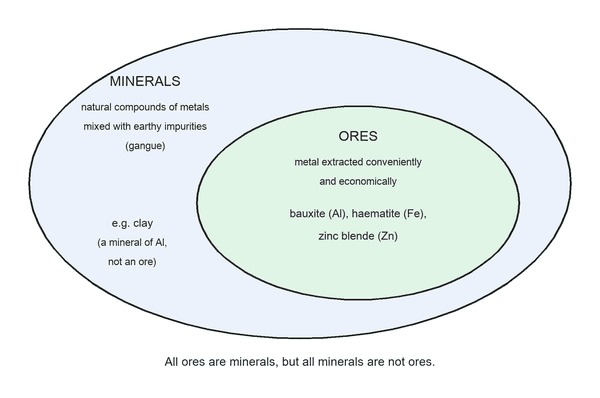
Watch out: Every ore is a mineral, but not every mineral is an ore.
Why the other options are wrong:
- (A) (1) Both A and R are true and R is the correct explanation of A: This needs both statements true and R to explain A, but the Assertion is false.
- (B) (2) Both A and R are true but R is not the correct explanation of A: This needs both statements true with R not explaining A, but the Assertion is false.
- (C) (3) A is true but R is false: This needs A true and R false, but the Assertion is false and the Reason is true.
Therefore, A is false but R is true, option (D).
- 651 mark
Question 65
The following questions are Assertion-Reason based questions. Choose the answer based on the codes given below.
(1) Both A and R are true and R is the correct explanation of A.
(2) Both A and R are true but R is not the correct explanation of A.
(3) A is true but R is false.
(4) A is false but R is true.
Assertion (A) : Aluminium is extracted from its ore bauxite.
Reason (R) : Bauxite is the only ore of aluminium.
Solve with AIAnswer
(A) (1) Both A and R are true and R is the correct explanation of A.
(B) (2) Both A and R are true but R is not the correct explanation of A.
- Correct
(C) (3) A is true but R is false.
(D) (4) A is false but R is true.
Answer: (C) (3) A is true but R is false.
Concept: Bauxite is the main ore of aluminium, but not the only one.
Step 1 — Test the Assertion.
Aluminium is extracted from bauxite, . So the Assertion is true.
Step 2 — Test the Reason.
Aluminium has other ores too: cryolite () and corundum (). So the Reason is false.
Watch out: 'main ore' and 'only ore' are different claims; watch for words like 'only' in a Reason.
Why the other options are wrong:
- (A) (1) Both A and R are true and R is the correct explanation of A: This needs both statements true and R to explain A, but the Reason is false.
- (B) (2) Both A and R are true but R is not the correct explanation of A: This needs both statements true with R not explaining A, but the Reason is false.
- (D) (4) A is false but R is true: This needs A false and R true, but the Assertion is true.
Therefore, A is true but R is false, option (C).
- 661 mark
Question 66
The following questions are Assertion-Reason based questions. Choose the answer based on the codes given below.
(1) Both A and R are true and R is the correct explanation of A.
(2) Both A and R are true but R is not the correct explanation of A.
(3) A is true but R is false.
(4) A is false but R is true.
Assertion (A) : Metallurgy deals with the production and purification of metals.
Reason (R) : Reduction is one of the methods of extraction of metals.
Solve with AIAnswer
(A) (1) Both A and R are true and R is the correct explanation of A.
- Correct
(B) (2) Both A and R are true but R is not the correct explanation of A.
(C) (3) A is true but R is false.
(D) (4) A is false but R is true.
Answer: (B) (2) Both A and R are true but R is not the correct explanation of A.
Concept: Metallurgy is the whole set of processes from ore to pure metal; reduction is only one of its steps.
Step 1 — Test the Assertion.
Metallurgy deals with the extraction (production) of metals from their ores and their purification (refining). So the Assertion is true.
Step 2 — Test the Reason.
Reduction of the metal oxide is indeed one step in extracting a metal. So the Reason is true.
Step 3 — Does the Reason explain the Assertion.
Naming one step does not explain what metallurgy as a whole deals with. R does not explain A.
Watch out: A true statement on the same topic is not necessarily the explanation of the Assertion.
Why the other options are wrong:
- (A) (1) Both A and R are true and R is the correct explanation of A: This needs both statements true and R to explain A, but R does not explain A.
- (C) (3) A is true but R is false: This needs A true and R false, but the Reason is true.
- (D) (4) A is false but R is true: This needs A false and R true, but the Assertion is true.
Therefore, both statements are true, but R is not the correct explanation of A, option (B).
- 671 mark
Question 67
The following questions are Assertion-Reason based questions. Choose the answer based on the codes given below.
(1) Both A and R are true and R is the correct explanation of A.
(2) Both A and R are true but R is not the correct explanation of A.
(3) A is true but R is false.
(4) A is false but R is true.
Assertion (A) : The concentration of aluminium is not done by leaching process.
Reason (R) : In leaching process, the ore is dissolved in an acid or alkali.
Solve with AIAnswer
(A) (1) Both A and R are true and R is the correct explanation of A.
(B) (2) Both A and R are true but R is not the correct explanation of A.
(C) (3) A is true but R is false.
- Correct
(D) (4) A is false but R is true.
Answer: (D) (4) A is false but R is true.
Concept: Leaching is the chemical method of concentration: the ore is dissolved in a suitable reagent (acid, alkali or other), the impurities are not, and they are filtered off.
Step 1 — Test the Assertion.
Bauxite is concentrated by leaching: it is dissolved in caustic soda in Bayer's process, and the red mud is filtered off. So the Assertion is false:
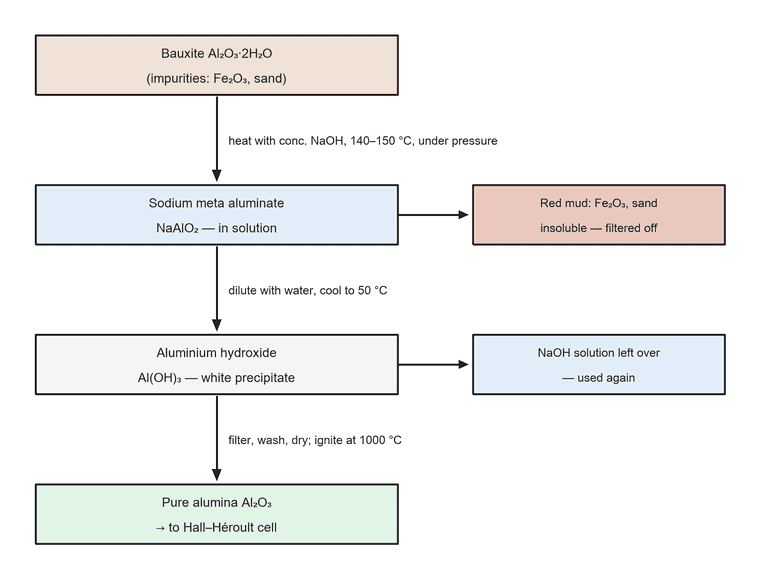
Step 2 — Test the Reason.
It correctly describes leaching. So the Reason is true.
Watch out: Bayer's process is a leaching (chemical) method of concentration, even though it is not called 'leaching' in its name.
Why the other options are wrong:
- (A) (1) Both A and R are true and R is the correct explanation of A: This needs both statements true and R to explain A, but the Assertion is false.
- (B) (2) Both A and R are true but R is not the correct explanation of A: This needs both statements true with R not explaining A, but the Assertion is false.
- (C) (3) A is true but R is false: This needs A true and R false, but the Assertion is false and the Reason is true.
Therefore, A is false but R is true, option (D).
- 681 mark
Question 68
The following questions are Assertion-Reason based questions. Choose the answer based on the codes given below.
(1) Both A and R are true and R is the correct explanation of A.
(2) Both A and R are true but R is not the correct explanation of A.
(3) A is true but R is false.
(4) A is false but R is true.
Assertion (A) : Bayer's process is used in the extraction of aluminium from its main ore.
Reason (R) : Bayer's process is done for the refinement of aluminium.
Solve with AIAnswer
(A) (1) Both A and R are true and R is the correct explanation of A.
(B) (2) Both A and R are true but R is not the correct explanation of A.
- Correct
(C) (3) A is true but R is false.
(D) (4) A is false but R is true.
Answer: (C) (3) A is true but R is false.
Concept: Bayer's process purifies the ore (bauxite → pure alumina). Refining of aluminium metal is a different process, done by Hoope's electrolytic process.
Step 1 — Test the Assertion.
Bayer's process is used in the extraction of aluminium from bauxite. So the Assertion is true.
Step 2 — Test the Reason.
Bayer's process does not refine aluminium; it purifies bauxite before the metal is even produced. So the Reason is false.
Watch out: Purifying the ore (Bayer) and refining the metal (Hoope) are different stages.
Why the other options are wrong:
- (A) (1) Both A and R are true and R is the correct explanation of A: This needs both statements true and R to explain A, but the Reason is false.
- (B) (2) Both A and R are true but R is not the correct explanation of A: This needs both statements true with R not explaining A, but the Reason is false.
- (D) (4) A is false but R is true: This needs A false and R true, but the Assertion is true.
Therefore, A is true but R is false, option (C).
- 691 mark
Question 69
The following questions are Assertion-Reason based questions. Choose the answer based on the codes given below.
(1) Both A and R are true and R is the correct explanation of A.
(2) Both A and R are true but R is not the correct explanation of A.
(3) A is true but R is false.
(4) A is false but R is true.
Assertion (A) : Reactive metals like calcium, magnesium cannot be obtained by reduction.
Reason (R) : Reactive metals have a great affinity towards oxygen.
Solve with AIAnswer
- Correct
(A) (1) Both A and R are true and R is the correct explanation of A.
(B) (2) Both A and R are true but R is not the correct explanation of A.
(C) (3) A is true but R is false.
(D) (4) A is false but R is true.
Answer: (A) (1) Both A and R are true and R is the correct explanation of A.
Concept: A reducing agent can remove oxygen only from an oxide whose metal holds oxygen less strongly than the reducing agent does.
Step 1 — Test the Assertion.
Calcium and magnesium are not obtained by reduction with carbon, CO or hydrogen; they are obtained by electrolysis of their fused chlorides. So the Assertion is true.
Step 2 — Test the Reason.
Reactive metals have a great affinity towards oxygen. So the Reason is true.
Step 3 — Does the Reason explain the Assertion.
Because Ca and Mg hold oxygen so strongly, carbon, CO or hydrogen cannot remove it. R is exactly why A happens.
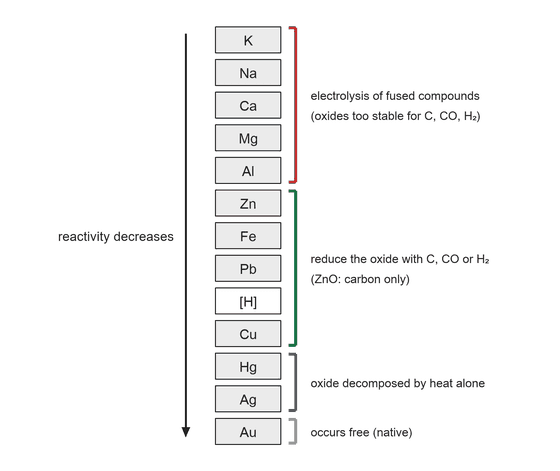
Watch out: Here 'reduction' means chemical reduction by C, CO or H₂; electrolysis also reduces the ions, but by electricity.
Why the other options are wrong:
- (B) (2) Both A and R are true but R is not the correct explanation of A: This needs both statements true with R not explaining A, but R is the correct explanation of A.
- (C) (3) A is true but R is false: This needs A true and R false, but the Reason is true.
- (D) (4) A is false but R is true: This needs A false and R true, but the Assertion is true.
Therefore, both statements are true and R is the correct explanation of A, option (A).
- 701 mark
Question 70
The following questions are Assertion-Reason based questions. Choose the answer based on the codes given below.
(1) Both A and R are true and R is the correct explanation of A.
(2) Both A and R are true but R is not the correct explanation of A.
(3) A is true but R is false.
(4) A is false but R is true.
Assertion (A) : Aluminium is obtained from its oxide by electrolysis.
Reason (R) : Aluminium has a great affinity towards oxygen so common reducing agents are not able to reduce it.
Solve with AIAnswer
- Correct
(A) (1) Both A and R are true and R is the correct explanation of A.
(B) (2) Both A and R are true but R is not the correct explanation of A.
(C) (3) A is true but R is false.
(D) (4) A is false but R is true.
Answer: (A) (1) Both A and R are true and R is the correct explanation of A.
Concept: When common reducing agents fail, the only way left to reduce an oxide is electrolysis.
Step 1 — Test the Assertion.
Aluminium is obtained by the electrolysis of fused alumina (Hall–Héroult process). So the Assertion is true.
Step 2 — Test the Reason.
Aluminium has a great affinity for oxygen, so carbon, CO and hydrogen cannot reduce alumina. So the Reason is true.
Step 3 — Does the Reason explain the Assertion.
Since common reducing agents fail, electrolytic reduction is used. R explains A.
Why the other options are wrong:
- (B) (2) Both A and R are true but R is not the correct explanation of A: This needs both statements true with R not explaining A, but R is the correct explanation of A.
- (C) (3) A is true but R is false: This needs A true and R false, but the Reason is true.
- (D) (4) A is false but R is true: This needs A false and R true, but the Assertion is true.
Therefore, both statements are true and R is the correct explanation of A, option (A).
- 711 mark
Question 71
The following questions are Assertion-Reason based questions. Choose the answer based on the codes given below.
(1) Both A and R are true and R is the correct explanation of A.
(2) Both A and R are true but R is not the correct explanation of A.
(3) A is true but R is false.
(4) A is false but R is true.
Assertion (A) : For electrical heating devices like electric iron and heater, alloys are used.
Reason (R) : Alloys have a greater resistance and low melting point.
Solve with AIAnswer
(A) (1) Both A and R are true and R is the correct explanation of A.
- Correct
(B) (2) Both A and R are true but R is not the correct explanation of A.
(C) (3) A is true but R is false.
(D) (4) A is false but R is true.
Answer: (B) (2) Both A and R are true but R is not the correct explanation of A.
Concept: A heating element must have a high resistance (to produce heat) and a high melting point (so that it does not melt when red hot).
Step 1 — Test the Assertion.
Heating elements of electric irons and heaters are made of alloys such as nichrome. So the Assertion is true.
Step 2 — Test the Reason.
Alloys generally have greater resistance and a lower melting point than their constituent metals. As a general statement, the Reason is true.
Step 3 — Does the Reason explain the Assertion.
The high resistance helps, but a low melting point is the opposite of what a heater needs. So R, as stated, is not the correct explanation of A.
Watch out: A heater element needs a high melting point; nichrome is chosen for high resistance and a high melting point.
Why the other options are wrong:
- (A) (1) Both A and R are true and R is the correct explanation of A: This needs both statements true and R to explain A, but R does not explain A.
- (C) (3) A is true but R is false: This needs A true and R false, but the Reason is true.
- (D) (4) A is false but R is true: This needs A false and R true, but the Assertion is true.
Therefore, both statements are true, but R is not the correct explanation of A, option (B).
- 721 mark
Question 72
The following questions are Assertion-Reason based questions. Choose the answer based on the codes given below.
(1) Both A and R are true and R is the correct explanation of A.
(2) Both A and R are true but R is not the correct explanation of A.
(3) A is true but R is false.
(4) A is false but R is true.
Assertion (A) : Brass is used in making medals, statues, etc.
Reason (R) : Brass is hard and easily cast.
Solve with AIAnswer
(A) (1) Both A and R are true and R is the correct explanation of A.
(B) (2) Both A and R are true but R is not the correct explanation of A.
(C) (3) A is true but R is false.
- Correct
(D) (4) A is false but R is true.
Answer: (D) (4) A is false but R is true.
Concept: Check the uses in the table of alloys: bronze, not brass, is the alloy used for medals and statues.
Step 1 — Test the Assertion.
Medals and statues are made of bronze (Cu 80%, Sn 18%, Zn 2%), which is hard, takes a polish and resists corrosion. Brass is used for decorative hardware, screws, taps and parts of watches. So the Assertion is false.
Step 2 — Test the Reason.
Brass is harder than its constituents and can be easily cast. So the Reason is true.
Watch out: Do not mix up brass (copper and zinc) with bronze (copper and tin).
Why the other options are wrong:
- (A) (1) Both A and R are true and R is the correct explanation of A: This needs both statements true and R to explain A, but the Assertion is false.
- (B) (2) Both A and R are true but R is not the correct explanation of A: This needs both statements true with R not explaining A, but the Assertion is false.
- (C) (3) A is true but R is false: This needs A true and R false, but the Assertion is false and the Reason is true.
Therefore, A is false but R is true, option (D).
- 735 marks
Question 73
Name the following :
(a) A metal which is found abundantly in the earth's crust.
(b) The process used for the enrichment of sulphide ore.
(c) A metal present in cryolite other than sodium.
(d) A metal which is unaffected by dilute or concentrated acids.
(e) A metal present in period 3, group 1 of the periodic table.
(f) The property possessed by metals by which they can be beaten into sheets.
(g) A compound added to lower the fusion temperature of electrolytic bath in the extraction of aluminium.
(h) The ore of zinc containing its sulphide.
(i) The solution used to react with Bauxite as a first step in obtaining pure aluminium oxide, in the Baeyer's process.
(j) The compound added to pure alumina to lower the fusion temperature during the electrolytic reduction of alumina.
Solve with AIWritten solution
Solution:
Concept: One-word answers from the whole chapter; a short reason is given with each.
Step 1 — (a) A metal found abundantly in the earth's crust.
Aluminium, the most abundant metal in the crust (about 8%).
Step 2 — (b) Enrichment of a sulphide ore.
Froth floatation: sulphide ore particles are wetted by pine oil and rise with the froth.
Step 3 — (c) A metal in cryolite other than sodium.
Aluminium: cryolite is sodium aluminium fluoride, .
Step 4 — (d) A metal unaffected by dilute or concentrated acids.
Gold (or platinum): it is so unreactive that ordinary acids do not attack it.
Step 5 — (e) The metal in period 3, group 1.
Sodium: its configuration 2, 8, 1 has three shells (period 3) and one valence electron (group 1).
Step 6 — (f) Being beaten into sheets.
Malleability: metals can be hammered into thin sheets.
Step 7 — (g) Compound that lowers the fusion temperature of the bath.
Cryolite: it lowers the fusion temperature from about 2050 °C to about 950 °C.
Step 8 — (h) The sulphide ore of zinc.
Zinc blende (ZnS).
Step 9 — (i) The solution used first in Baeyer's process.
Concentrated sodium hydroxide (caustic soda) solution: it dissolves the amphoteric alumina as sodium meta aluminate:
Step 10 — (j) The compound added to lower the fusion temperature.
Cryolite ().
Watch out: (g) and (j) ask the same thing in different words; both answers are cryolite.
Therefore, (a) aluminium; (b) froth floatation; (c) aluminium; (d) gold; (e) sodium; (f) malleability; (g) cryolite; (h) zinc blende; (i) concentrated sodium hydroxide solution; (j) cryolite.
- 744 marks
Question 74
Choose the most appropriate answer from the following list of oxides which fits the description. Each answer may only be used once :
[, , , MgO, CO, ]
(a) A basic oxide.
(b) An oxide which dissolves in water forming an acid.
(c) An amphoteric oxide.
(d) A covalent oxide of a metalloid.
Solve with AIWritten solution
Solution:
Concept: Oxides of metals are basic (aluminium oxide is amphoteric); oxides of non-metals are acidic or neutral. Silicon is a metalloid.
Step 1 — (a) A basic oxide.
MgO (magnesium oxide). It reacts with acids to form a salt and water. ( is also basic, but each answer may be used only once.)
Step 2 — (b) An oxide which dissolves in water forming an acid.
, which forms sulphurous acid:
Step 3 — (c) An amphoteric oxide.
. It reacts with both acids and alkalis, which is why it dissolves in NaOH in Bayer's process.
Step 4 — (d) A covalent oxide of a metalloid.
(silicon dioxide). Silicon is a metalloid, and its oxide is covalent.
Watch out: CO is a neutral oxide: it does not form an acid with water, so it fits none of the four descriptions.
Therefore, (a) MgO; (b) SO₂; (c) Al₂O₃; (d) SiO₂.
- 755 marks
Question 75
State the main components of the following alloys.
(a) Brass (b) Duralumin (c) Bronze
Solve with AIWritten solution
Solution:
Concept: Each alloy has one main metal with smaller, chosen amounts of others.
Step 1 — (a) Brass.
Brass is copper (60–70%) and zinc (40–30%).
Step 2 — (b) Duralumin.
Duralumin is aluminium (95%), copper (4%), magnesium (0.5%) and manganese (0.5%).
Step 3 — (c) Bronze.
Bronze is copper (80%), tin (18%) and zinc (2%).

Watch out: Brass has zinc, bronze has tin.
Therefore, brass is copper and zinc; duralumin is aluminium with copper, magnesium and manganese; bronze is copper, tin and a little zinc.
- 765 marks
Question 76
For each of the substances listed below, describe the role played in the extraction of aluminium.
(a) Cryolite (b) Sodium hydroxide
(c) Graphite
Solve with AIWritten solution
Solution:
Concept: Sodium hydroxide purifies bauxite (Bayer's process); cryolite makes the electrolysis of alumina possible; graphite forms the electrodes.
Step 1 — (a) Cryolite.
It dissolves alumina and lowers the fusion temperature of the electrolyte from about 2050 °C to about 950 °C. It also increases the electrical conductivity (pure alumina is almost a non-conductor).
Step 2 — (b) Sodium hydroxide.
In Bayer's process it dissolves the alumina from bauxite as sodium meta aluminate, leaving the impurities (iron(III) oxide, sand) as red mud:
Step 3 — (c) Graphite.
The thick graphite rods act as the anodes; the graphite (gas carbon) lining of the tank acts as the cathode.
Watch out: The graphite anodes are burnt by the oxygen set free and must be replaced; the cathode lining is not.
Therefore, cryolite dissolves alumina and lowers the fusion temperature, sodium hydroxide purifies bauxite to alumina, and graphite forms the anodes and the cathode lining.
- 772 marks
Question 77
Write the chemical formulae of one main ore of iron and aluminium.
Solve with AIWritten solution
Solution:
Concept: The chief ore of iron is an oxide (haematite); the chief ore of aluminium is a hydrated oxide (bauxite).
Step 1 — Ore of iron.
Haematite, (iron(III) oxide).
Step 2 — Ore of aluminium.
Bauxite, (hydrated aluminium oxide).
Watch out: Write the water of crystallisation in bauxite: Al₂O₃·2H₂O, not just Al₂O₃.
Therefore, the formula of haematite (iron) is Fe₂O₃ and that of bauxite (aluminium) is Al₂O₃·2H₂O.
- 784 marks
Question 78
State the property of the metal being utilized in the following :
Use of metal Property Zinc in Galvanization Aluminium in Thermite welding Solve with AIWritten solution
Solution:
Concept: Zinc protects iron because it is more reactive than iron. Aluminium reduces iron oxide because it has a great affinity for oxygen.
Step 1 — Fill in the table.
Each use depends on one property of the metal.
Use of metal Property Zinc in Galvanization Zinc is more reactive than iron and forms a protective layer, so it corrodes in preference to iron and prevents rusting. Aluminium in Thermite welding Aluminium has a great affinity for oxygen: it is a strong reducing agent, and the reaction gives out a great deal of heat. 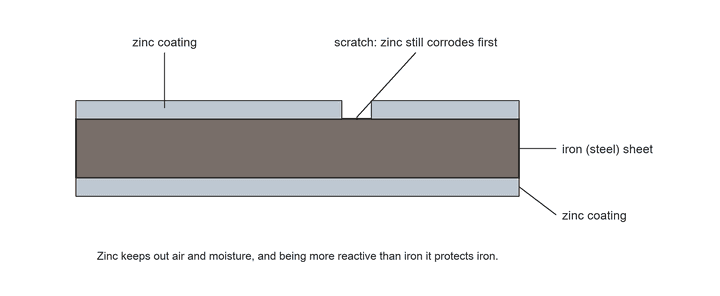
Step 2 — Write the thermite reaction.
Aluminium powder takes oxygen from iron(III) oxide; so much heat is produced that the iron is formed molten and welds the broken parts:
Watch out: In thermite welding aluminium is the reducing agent; it is not melted to join the parts.
Therefore, zinc is used because it is more reactive than iron and protects it, and aluminium because its great affinity for oxygen makes it a strong reducing agent.
- 795 marks
Question 79
The following questions are relevant to the extraction of Aluminium. Answer in brief :
(a) State the reason for addition of caustic alkali to bauxite ore during purification of bauxite.
(b) Give a balanced chemical equation for the above reaction.
(c) Along with cryolite and alumina, another substance is added to the electrolyte mixture. Name the substance and give one reason for the addition.
Solve with AIWritten solution
Solution:
Concept: Alumina is amphoteric, so it dissolves in caustic alkali, while the basic iron(III) oxide and sand do not. Fluorspar is added to the electrolyte to help it melt and flow.
Step 1 — (a) Reason for adding caustic alkali.
Caustic alkali dissolves the aluminium oxide (amphoteric) as soluble sodium meta aluminate. The impurities, such as iron(III) oxide and sand, stay insoluble and are filtered off as red mud. This gives pure alumina.
Step 2 — (b) Balanced equation.
The alumina of bauxite reacts with sodium hydroxide at 140–150 °C:
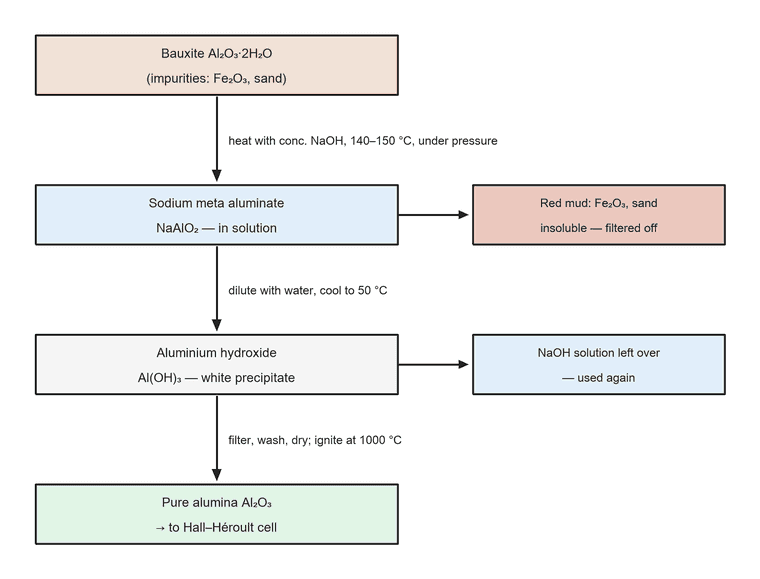
Step 3 — (c) Third substance in the electrolyte.
Fluorspar (). It acts as a solvent with cryolite and increases the conductivity of the electrolyte; it also makes it more fluid and helps lower its fusion temperature.
Watch out: Count the oxygen in (b): Al₂O₃·2H₂O + 2NaOH has 7 O, and 2NaAlO₂ + 3H₂O also has 7 O.
Therefore, (a) caustic alkali dissolves the amphoteric alumina and leaves the impurities; (b) Al₂O₃·2H₂O + 2NaOH → 2NaAlO₂ + 3H₂O; (c) fluorspar, added to increase the conductivity and fluidity of the electrolyte.
- 802 marks
Question 80
Write the constituents of electrolyte for the extraction of aluminium
Solve with AIWritten solution
Solution:
Concept: The electrolyte is a molten mixture of alumina, cryolite and fluorspar in the ratio 1 : 3 : 1, kept at about 950 °C.
Step 1 — List the constituents.
The table gives each constituent and its share.
Constituent Formula Share Alumina 20% Cryolite 60% Fluorspar 20% Step 2 — Check the ratio.
The shares 20 : 60 : 20 simplify (dividing by 20) to 1 : 3 : 1, and they add up to 100%.
Step 3 — Note the coke layer.
Powdered coke is sprinkled on the surface of the electrolyte to reduce heat loss and to stop the anodes burning in air.
Watch out: Pure alumina alone would need about 2050 °C; cryolite and fluorspar bring the working temperature down to about 950 °C.
Therefore, the electrolyte is fused alumina (20%), cryolite (60%) and fluorspar (20%).
- 812 marks
Question 81
Write the equation for the reaction where the aluminum oxide for the electrolytic extraction of aluminium is obtained by heating aluminium hydroxide.
Solve with AIWritten solution
Solution:
Concept: In the last step of Bayer's process, aluminium hydroxide is ignited at about 1000 °C; it loses water and gives pure alumina.
Step 1 — Write the reactant and the products.
Aluminium hydroxide, Al(OH)₃, breaks down into aluminium oxide and water.
Step 2 — Balance the equation.
Two Al(OH)₃ give one Al₂O₃, and the six H atoms form three H₂O:
Watch out: The coefficient 2 on Al(OH)₃ is needed because alumina contains two aluminium atoms.
Therefore, 2Al(OH)₃ → Al₂O₃ + 3H₂O (on heating at about 1000 °C).
- 822 marks
Question 82
Write the equation for the reaction that occurs at the cathode during the extraction of aluminium by electrolysis.
Solve with AIWritten solution
Solution:
Concept: At the cathode (the carbon lining of the tank), positive aluminium ions gain electrons and become aluminium atoms. This is reduction.
Step 1 — Write the cathode reaction.
Each Al³⁺ ion gains three electrons:
Step 2 — Write it for whole units of alumina.
For the ions from two units of alumina, the same reaction is:
The molten aluminium collects at the bottom of the tank.
Watch out: Aluminium ions are positive, so they go to the cathode (negative electrode), not the anode.
Therefore, the cathode reaction is Al³⁺ + 3e⁻ → Al.
- 832 marks
Question 83
Explain why it is preferable to use a number of graphite electrodes as anode instead of a single electrode, during the above electrolysis.
Solve with AIWritten solution
Solution:
Concept: The oxygen set free at the anodes burns them away, so they have to be replaced from time to time.
Step 1 — See why the anodes are used up.
The oxygen liberated at the anode reacts with the hot graphite and forms carbon dioxide:
So the anodes are gradually consumed and must be replaced.
Step 2 — See the advantage of several anodes.
With several anodes, each can be replaced one at a time without stopping the electrolysis. The many rods also give a larger surface area, so the current is spread evenly through the electrolyte.
Watch out: The reason is replacement without stopping the cell, not that one electrode would melt.
Therefore, several graphite anodes are used so that each burnt-away anode can be replaced without stopping the electrolysis, and the current is spread evenly.
- 845 marks
Question 84
The following is an extract from 'Metals in the Service of Man, Alexander and Street/Pelican 1976' :
'Alumina (aluminium oxide) has a very high melting point of over 2000°C so that it cannot readily be liquefied. However, conversion of alumina to aluminium and oxygen, by electrolysis, can occur when it is dissolved in some other substance.'
(a) Which solution is used to react with bauxite as a first step in obtaining pure aluminium oxide ?
(b) The aluminium oxide for the electrolytic extraction of aluminium is obtained by heating aluminium hydroxide. Write the equation for this reaction.
(c) Name the element which serves both as the anode and the cathode in the extraction of aluminium.
(d) Write the equation for the reaction that occurs at the cathode during the extraction of aluminium by electrolysis.
(e) Give the equation for the reaction which occurs at the anode when aluminium is purified by electrolysis.
Solve with AIWritten solution
Solution:
Concept: Three processes are involved: Bayer's process purifies bauxite to alumina, the Hall–Héroult process reduces alumina by electrolysis, and Hoope's process refines the aluminium.
Step 1 — (a) Solution used with bauxite.
Concentrated sodium hydroxide (caustic soda) solution. It dissolves the amphoteric alumina as sodium meta aluminate, leaving the impurities as red mud.
Step 2 — (b) Heating aluminium hydroxide.
On ignition at about 1000 °C it loses water:
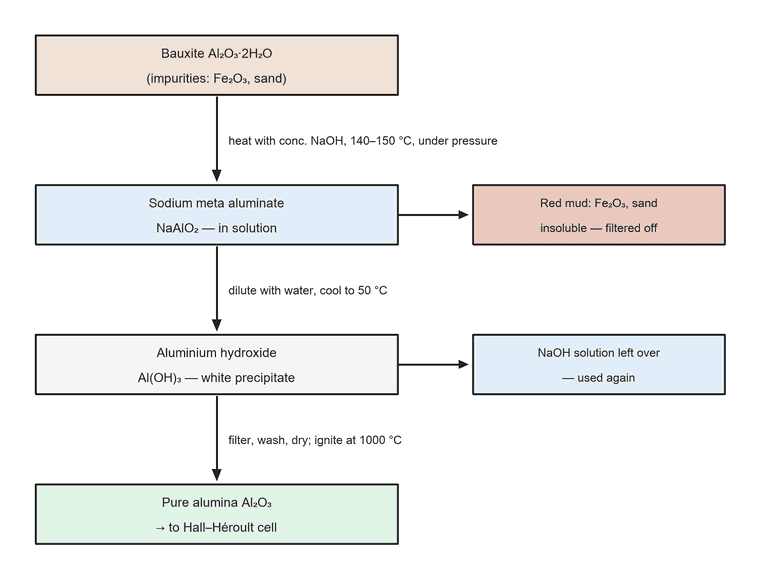
Step 3 — (c) Element serving as both anode and cathode.
Carbon (graphite). Graphite rods form the anodes, and the carbon lining of the tank forms the cathode.
Step 4 — (d) Reaction at the cathode.
Aluminium ions gain electrons:
Step 5 — (e) Reaction at the anode during purification.
In Hoope's process, the impure aluminium (bottom layer) is the anode; aluminium atoms lose electrons and pass into the electrolyte as ions:
At the cathode (top layer) the ions gain electrons again, giving pure aluminium.
Watch out: Part (e) is about purification (Hoope's cell), so the anode reaction is Al → Al³⁺, not the discharge of oxide ions.
Therefore, (a) concentrated NaOH solution; (b) 2Al(OH)₃ → Al₂O₃ + 3H₂O; (c) carbon; (d) Al³⁺ + 3e⁻ → Al; (e) Al − 3e⁻ → Al³⁺.
- 855 marks
Question 85
The following is a sketch of an electrolytic cell used in the extraction of aluminium :
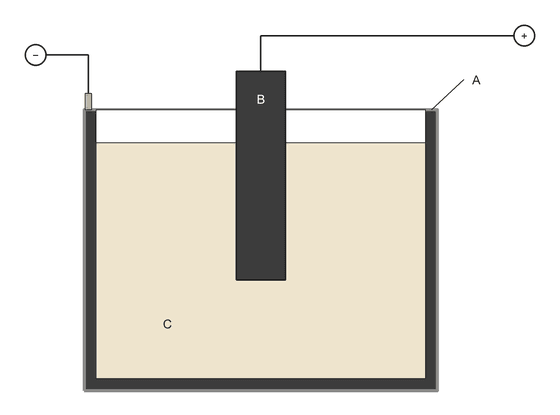
(i) What is the substance of which the electrodes A and B are made ?
(ii) At which electrode (A or B) is the aluminium formed ?
(iii) What are the two aluminium compounds in the electrolyte C ?
(iv) Why is it necessary for electrode B to be continuously replaced ?
Solve with AIWritten solution
Solution:
Concept: A is joined to the negative terminal, so it is the cathode (the carbon lining of the tank); B is joined to the positive terminal, so it is the anode (graphite). C is the molten electrolyte.
Step 1 — (i) Substance of electrodes A and B.
Both are made of carbon (graphite): A is the gas-carbon lining of the tank, B is a thick graphite block.

Step 2 — (ii) Electrode where aluminium is formed.
Aluminium is formed at A, the cathode, where aluminium ions gain electrons:
The molten aluminium collects at the bottom of the tank.
Step 3 — (iii) Two aluminium compounds in the electrolyte C.
Alumina () and cryolite (). (Fluorspar, , is also present but contains no aluminium.)
Step 4 — (iv) Why electrode B must be replaced.
The oxygen set free at the anode B reacts with the hot graphite and burns it away as carbon dioxide:
So B is gradually consumed and must be replaced.
Watch out: Fluorspar is in the electrolyte, but it is not an aluminium compound; the two asked for are alumina and cryolite.
Therefore, (i) both are carbon (graphite); (ii) at A, the cathode; (iii) alumina and cryolite; (iv) B is burnt away by the oxygen set free at it.
What Class 10 Chemistry Ch 7 covers
The sections of the chapter, in the order the book takes them. Every question above comes from one of these.
- 01Occurrence of Metals
- 02Minerals and Ores
- 03Common Ores of Aluminium, Iron and Zinc
- 04Dressing (Concentration) of Ores
- 05Conversion of Concentrated Ore to Its Oxide
- 06Reduction of Metal Oxides to Metals
More ways to study this chapter
The same chapter asked three other ways. Practise it, revise it, and see what the board has set on Ch 7 before.
- Competency-Based Questions (CBQ)Case study questions: a situation, and the part of the chapter that answers it.40questionsOpen
- Previous Year QuestionsQuestions that have actually appeared in board papers, each tagged with its year.57questionsOpen
- Practice QuestionsExtra questions per chapter, for when one attempt at a method is not enough.41questionsOpen
Ch 7 in past ICSE papers
The same chapter as the board has actually asked it. These are worded differently from the textbook exercise, which is the point of reading them.
- 11 mark
Board paper question 1
The two main metals in Bronze are:
Solve with AIAnswer
(A) Copper and zinc
(B) Copper and lead
(C) Copper and nickel
- Correct
(D) Copper and tin
Answer: (D) Copper and tin
Concept: An alloy is a homogeneous mixture of two or more metals, or of a metal with a non-metal, made to get useful properties such as greater hardness, lightness, a lower melting point or resistance to corrosion. The main metals of an alloy are the ones present in the largest proportions.
Step 1 — Recall the composition of bronze.
Bronze is an alloy of copper with tin and a little zinc: copper about 80%, tin about 18% and zinc about 2%.
Step 2 — Pick the two main metals.
The two largest shares belong to copper (80%) and tin (18%). Zinc is only about 2%, a minor part, so the two main metals of bronze are copper and tin.
Watch out: Brass and bronze both contain copper; brass is copper with ZINC, bronze is copper with TIN.
Why the other options are wrong:
- (A) Copper and zinc: copper and zinc are the metals of brass (copper 60–70%, zinc 40–30%); bronze has only about 2% zinc.
- (B) Copper and lead: lead is not a constituent of bronze; lead alloyed with tin gives solder.
- (C) Copper and nickel: copper alloyed with nickel gives cupronickel (used for coins); ordinary bronze, copper with tin and a little zinc, has no nickel.
Therefore, the two main metals in bronze are copper and tin, option (D).
- 21 mark
Board paper question 2
Identify the term/substance in each of the following:
The method used to separate ore from gangue by preferential wetting.
Solve with AIWritten solution
Solution:
Concept: Froth floatation concentrates sulphide ores. It works on preferential wetting: the ore particles are wetted by oil (pine oil) and the gangue particles are wetted by water.
Step 1 — Read the clue.
The question describes separating the ore from the gangue by preferential wetting, which means that one kind of particle is wetted by oil and the other by water.
Step 2 — Name the method and see how it works.
This is the froth floatation process. The finely powdered sulphide ore is put into a tank of water with a little pine oil, and air is blown through it. The ore particles, wetted by the oil, stick to the air bubbles and rise into the froth on the surface, which is skimmed off. The gangue particles, wetted by the water, sink to the bottom.
Watch out: Froth floatation does not work by density: the sulphide ore is often heavier than the gangue, yet it rises because the oil-coated particles cling to air bubbles.
Therefore, the method is the froth floatation process.
- 35 marks
Board paper question 3
(i) Name the solution used to react with Bauxite as a first step in obtaining pure aluminium oxide, in the Baeyer's process.
(ii) Write the equation for the reaction where the aluminium oxide for the electrolytic extraction of aluminium is obtained by heating aluminium hydroxide.
(iii) Name the compound added to pure alumina to lower the fusion temperature during the electrolytic reduction of alumina.
(iv) Write the equation for the reaction that occurs at the cathode during the extraction of aluminium by electrolysis.
(v) Explain why it is preferable to use a number of graphite electrodes as anode instead of a single electrode, during the above electrolysis.
Solve with AIWritten solution
Solution:
Concept: Aluminium is extracted in two stages. First, bauxite is purified to alumina (Al₂O₃) by Bayer's process, using concentrated sodium hydroxide. Then the alumina, dissolved in molten cryolite with fluorspar, is reduced to aluminium by electrolysis (Hall–Héroult process).
(i) Solution used with bauxite
Step 1 — Name the solution.
Bauxite is heated under pressure with concentrated sodium hydroxide (caustic soda) solution. Aluminium oxide is amphoteric, so it dissolves and forms soluble sodium meta aluminate, while the impurities, iron(III) oxide and sand, do not dissolve.
(ii) Heating aluminium hydroxide
Step 2 — Write the equation.
The aluminium hydroxide obtained in Bayer's process is filtered, washed and heated strongly at about 1000 °C. It loses water and leaves pure alumina.
Each side has 2 aluminium, 6 oxygen and 6 hydrogen atoms, so the equation is balanced.

(iii) Compound that lowers the fusion temperature
Step 3 — Name the compound.
Cryolite, , is added. Pure alumina fuses at about 2050 °C; dissolved in cryolite, the mixture is molten at about 950 °C, which saves a great deal of energy. Cryolite also makes the melt a better conductor. (Fluorspar, CaF₂, is added as well.)
(iv) Reaction at the cathode
Step 4 — Write the cathode equation.
At the cathode (the carbon lining of the tank) the aluminium ions gain electrons and become aluminium atoms; each Al³⁺ ion takes three electrons.
The charge on the left is 4 × (+3) + 12 × (−1), which is zero, the same as on the right.
(v) Why several graphite anodes
Step 5 — See what happens to the anodes.
Oxygen is set free at the anodes. At about 950 °C it reacts with the graphite and burns it to carbon dioxide (and some carbon monoxide), so the anodes are slowly used up.
Step 6 — Explain the use of many rods.
With a number of graphite rods, each worn-out rod can be replaced one at a time without stopping the electrolysis. Several rods also spread the current evenly through the large bath.
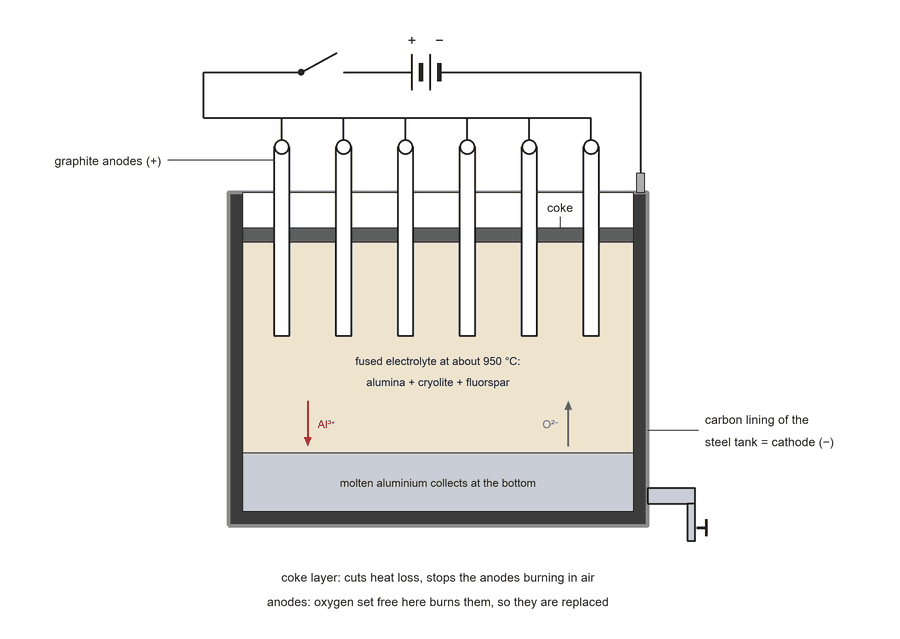
Watch out: The ANODES (graphite rods) are burnt away and replaced; the cathode lining is not used up.
Therefore, (i) concentrated sodium hydroxide solution; (ii) 2Al(OH)₃ → Al₂O₃ + 3H₂O on heating; (iii) cryolite, Na₃AlF₆; (iv) 4Al³⁺ + 12e⁻ → 4Al at the cathode; (v) the anodes are burnt away by the oxygen set free, so several rods let each one be replaced without stopping the process.
- 44 marks
Board paper question 4
Name the following:
(i) The process of coating of iron with zinc.
(ii) An alloy of lead and tin that is used in electrical circuits.
(iii) An ore of zinc containing its sulphide.
(iv) A metal oxide that can be reduced by hydrogen.
Solve with AIWritten solution
Solution:
Concept: Each answer is a term or a substance of this chapter: protecting iron from rusting, alloys, ores and the reduction of metal oxides.
(i) Coating iron with zinc
Step 1 — Name the process.
Coating iron with a layer of zinc is called galvanisation. The zinc keeps air and moisture away from the iron. Zinc is more reactive than iron, so even where the coating is scratched the zinc corrodes first and the iron is protected.
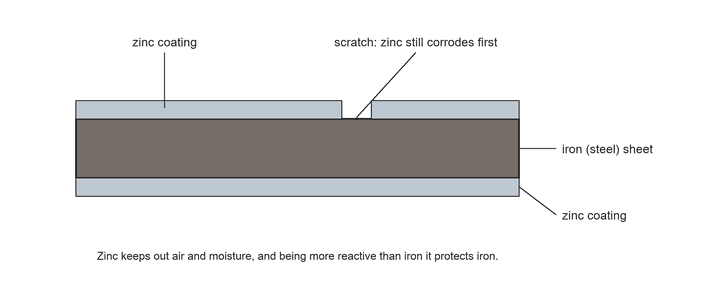
(ii) Lead–tin alloy used in electrical circuits
Step 2 — Name the alloy.
The alloy is solder (also called fuse metal), lead 50% and tin 50%. It starts to melt at about 183 °C, lower than lead or tin alone, so it is easy to melt for joining wires in circuits.
(iii) Sulphide ore of zinc
Step 3 — Name the ore.
The sulphide ore of zinc is zinc blende, ZnS.
(iv) Metal oxide reduced by hydrogen
Step 4 — Name an oxide and show the reduction.
Copper is below hydrogen in the activity series, so hot copper(II) oxide, CuO, gives up its oxygen to hydrogen. (Oxides of lead and iron are also reduced by hydrogen.)
Watch out: Galvanisation uses ZINC; tinning (coating with tin) is a different process.
Therefore, (i) galvanisation; (ii) solder (fuse metal); (iii) zinc blende, ZnS; (iv) copper(II) oxide, CuO.
- 53 marks
Board paper question 5
Answer the following questions with respect to the electrolytic process in the extraction of aluminum:
(i) Identify the components of the electrolyte other than pure alumina and the role played by each.
(ii) Explain why powdered coke is sprinkled over the electrolytic mixture.
Solve with AIWritten solution
Solution:
Concept: In the Hall–Héroult cell the electrolyte is a fused mixture of alumina (about 20%), cryolite, Na₃AlF₆ (about 60%) and fluorspar, CaF₂ (about 20%), kept at about 950 °C. Thick graphite rods dipping into it are the anodes (+), and the carbon lining of the steel tank is the cathode (−).
(i) Other components of the electrolyte and their roles
Step 1 — List the electrolyte.
The fused electrolyte is a mixture of three substances.
Substance Formula Share Alumina Al₂O₃ about 20% Cryolite Na₃AlF₆ about 60% Fluorspar CaF₂ about 20% Step 2 — Give the role of cryolite.
Cryolite dissolves the alumina and lowers the fusion temperature of the mixture from about 2050 °C (pure alumina) to about 950 °C. It also increases the electrical conductivity, since pure alumina is a very poor conductor.
Step 3 — Give the role of fluorspar.
Fluorspar acts, with cryolite, as a solvent for the alumina; it lowers the fusion temperature a little further and increases the conductivity of the melt.
(ii) Why powdered coke is sprinkled on the electrolyte
Step 4 — Explain the coke layer.
A layer of powdered coke on the surface of the bath does two jobs. It reduces the loss of heat by radiation from the hot surface, and it prevents the hot graphite anodes from burning in the air at the surface.
Watch out: Cryolite and fluorspar are added to the ELECTROLYTE; coke is only sprinkled on top of it.
Therefore, (i) cryolite (lowers the fusion temperature and increases conductivity) and fluorspar (solvent that increases conductivity); (ii) powdered coke reduces heat loss by radiation and prevents the anodes burning in air.
- 63 marks
Board paper question 6
Complete the following by selecting the correct option from the choices given:
(i) The metal which does not react with water or dilute but reacts with concentrated is ............... (Al/Cu/Zn/Fe)
(ii) The metal whose oxide, which is amphoteric, is reduced to metal by carbon reduction ............... (Fe/Mg/Pb/Al)
(iii) The divalent metal whose oxide is reduced to metal by electrolysis of its fused salt is ............... (Al/Na/Mg/K)
Solve with AIWritten solution
Solution:
Concept: The method used to get a metal from its oxide depends on its place in the activity series: K, Na, Ca, Mg, Al, Zn, Fe, Pb, [H], Cu, Hg, Ag, Au (most reactive first). Oxides of K to Al are too stable for chemical reducing agents, so these metals are obtained by electrolysis of their fused compounds; oxides of Zn to Cu are reduced by carbon, carbon monoxide or hydrogen (zinc oxide by carbon only).
(i) Metal that reacts with concentrated but not dilute sulphuric acid
Step 1 — Test each metal.
Aluminium, zinc and iron are above hydrogen in the activity series, so they all react with dilute sulphuric acid and give hydrogen. Copper is below hydrogen, so it does not react with water or with dilute sulphuric acid.
Step 2 — See why concentrated acid works.
Hot concentrated sulphuric acid is an oxidising agent, so it does react with copper and gives sulphur dioxide.
The answer is Cu (copper).
(ii) Metal whose amphoteric oxide is reduced by carbon
Step 3 — Find the amphoteric oxides.
Among the four, the oxides of lead (PbO) and aluminium (Al₂O₃) are amphoteric; the oxides of iron and magnesium are basic.
Step 4 — Check which one carbon reduces.
Lead is low in the activity series, so carbon removes the oxygen from lead oxide. Aluminium oxide is too stable for carbon.
The answer is Pb (lead).
(iii) Divalent metal got by electrolysis of its fused salt
Step 5 — Use the valency.
Aluminium is trivalent (Al³⁺), sodium and potassium are monovalent (Na⁺, K⁺), and magnesium is divalent (Mg²⁺). Magnesium is too reactive for carbon to reduce its oxide, so it is obtained by electrolysis of its fused salt; at the cathode:
The answer is Mg (magnesium).
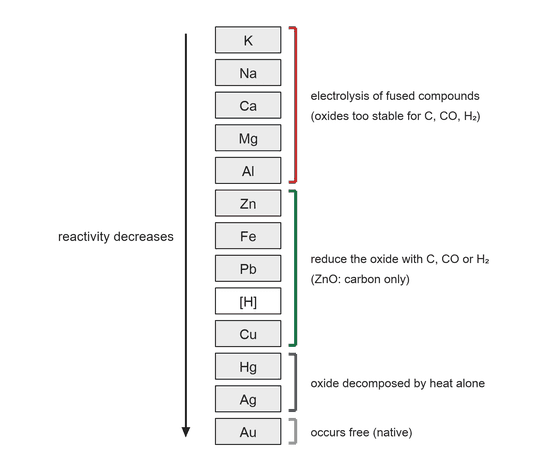
Watch out: 'Amphoteric' alone is not enough in (ii): aluminium oxide is amphoteric too, but carbon cannot reduce it.
Therefore, (i) Cu; (ii) Pb; (iii) Mg.
All 57 board paper questions for this chapter, solved the same way.
Class 10 Chemistry Ch 7 questions students ask
How many questions are there in Class 10 Chemistry Ch 7?
85 questions. Every one is solved step by step on this page.
Are these Class 10 Chemistry solutions free?
Yes. Every question and its full working is free to read, with no account needed.
Can I download the Class 10 Chemistry Ch 7 solutions as a PDF?
There is no PDF to download. Every solution is on this page instead, which means it is searchable, always the current syllabus, and readable on a phone. Use your browser's print option if you want it on paper.