
Question 143 marksEasy
(a) Name the methods by which concentrated ore is converted to metallic oxide.
(b) State three objectives achieved during the roasting of ores.
Confirming your payment
Sign up now and get 250 free tokens.
Metallurgy · Question 14 of 85
(a) Name the methods by which concentrated ore is converted to metallic oxide.
(b) State three objectives achieved during the roasting of ores.
Solution:
Concept: A concentrated ore is first turned into the oxide, because a metal oxide is easier to reduce to the metal than a sulphide or a carbonate.
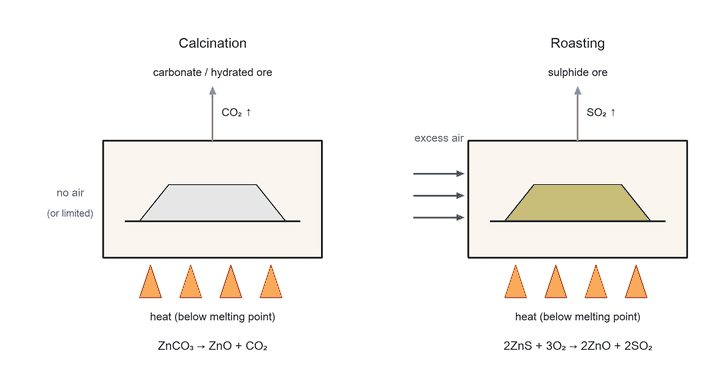
Step 1 — (a) Methods of converting the ore to the oxide.
Two heating methods are used, chosen by the type of ore:
Step 2 — (b) First objective of roasting.
Moisture is removed from the ore.
Step 3 — (b) Second objective of roasting.
Volatile impurities are removed. Sulphur, arsenic and phosphorus are oxidised and escape as volatile oxides, for example:
Step 4 — (b) Third objective of roasting.
The sulphide ore is converted into the oxide, which can then be reduced:
The roasted mass also becomes porous, so it is easier to reduce.
Watch out: Roasting needs excess air; calcination is done without air (or with very little).
Therefore, (a) the methods are roasting and calcination; (b) roasting removes moisture, removes volatile impurities as their oxides, and converts the sulphide ore into the oxide.