
Question 135 marksEasy
Give the principles of :
(a) hydrolytic method, (b) froth floatation process,
(c) electromagnetic separation.
Confirming your payment
Sign up now and get 250 free tokens.
Metallurgy · Question 13 of 85
Give the principles of :
(a) hydrolytic method, (b) froth floatation process,
(c) electromagnetic separation.
Solution:
Concept: Every method of concentration (dressing) uses some difference in a physical property between the ore particles and the gangue.
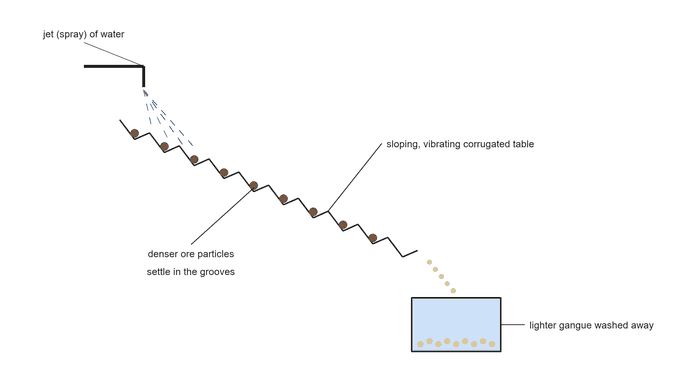
Step 1 — (a) Hydrolytic method (hydraulic washing, gravity separation).
Principle: the difference in densities of the ore and the gangue.
The crushed ore is poured over a sloping, vibrating, corrugated table and a jet of water flows over it. The heavier ore particles settle in the grooves, while the lighter gangue is washed away. It is used for heavy oxide ores, e.g. haematite.
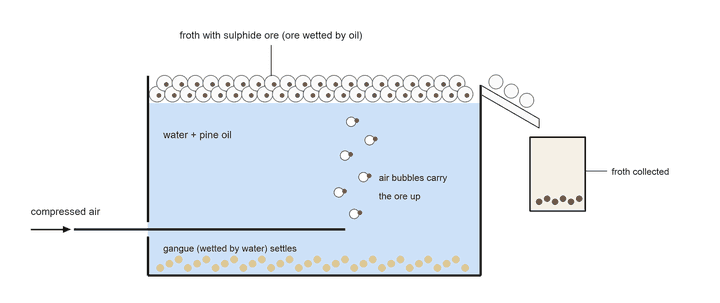
Step 2 — (b) Froth floatation process.
Principle: the ore particles are preferentially wetted by oil (pine oil) and the gangue particles by water.
The powdered ore is put in a tank of water and pine oil, and compressed air is blown in. The ore particles, wetted by oil, rise with the froth and are skimmed off; the gangue, wetted by water, settles. It is used for sulphide ores, e.g. zinc blende.
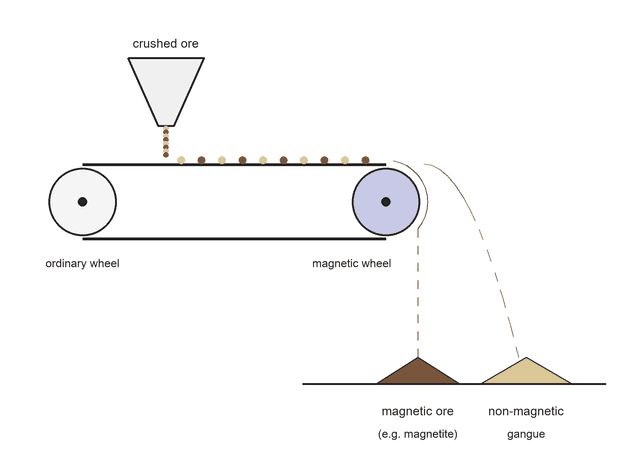
Step 3 — (c) Electromagnetic separation.
Principle: the difference in magnetic properties of the ore and the gangue.
The crushed ore falls on a belt moving over a magnetic wheel. The magnetic particles cling to the belt over the wheel and drop close to it, while the non-magnetic particles are thrown farther away. It is used for magnetic ores, e.g. magnetite ().
Watch out: A principle is the property difference the method uses (density, wetting by oil, magnetism), not a description of the apparatus.
Therefore, the hydrolytic method works on the difference in density, froth floatation on the ore being wetted by oil and the gangue by water, and electromagnetic separation on the difference in magnetic properties.