
Question 153 marksEasy
Name :
(a) the processes involved in
(i) dressing of the ores (ii) refining of ores.
(b) two metallic oxides which cannot be reduced by carbon, carbon monoxide or hydrogen.
Confirming your payment
Sign up now and get 250 free tokens.
Metallurgy · Question 15 of 85
Name :
(a) the processes involved in
(i) dressing of the ores (ii) refining of ores.
(b) two metallic oxides which cannot be reduced by carbon, carbon monoxide or hydrogen.
Solution:
Concept: Extraction runs ore → dressing → conversion to oxide → reduction → refining. Dressing removes the gangue from the ore; refining purifies the crude metal obtained at the end.
Step 1 — See where each stage fits.
The flow chart shows the order of the stages of extraction.
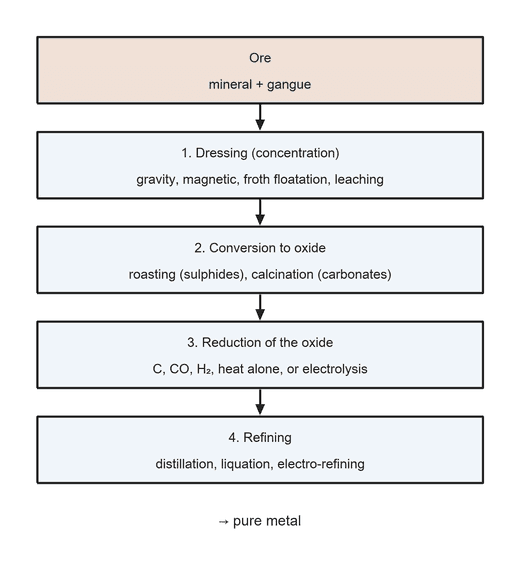
Step 2 — (a)(i) Processes for dressing (concentration) of ores.
The gangue is removed by:
Step 3 — (a)(ii) Processes for refining.
The impure metal is purified by:
Step 4 — (b) Two oxides not reduced by carbon, carbon monoxide or hydrogen.
Aluminium oxide () and magnesium oxide (MgO). (The oxides of Na, K and Ca are not reduced either.)
These metals have a very strong affinity for oxygen, so their oxides are too stable for these reducing agents; the metals are obtained by electrolysis.
Watch out: Dressing works on the ore, before any metal is made; refining works on the metal, after extraction.
Therefore, (a)(i) dressing uses hydraulic washing, magnetic separation, froth floatation and leaching; (a)(ii) refining uses distillation, liquation and electro-refining; (b) aluminium oxide and magnesium oxide cannot be reduced by C, CO or H₂.