
Question 244 marksEasy
(a) Define roasting. Name an ore on which roasting is done. Give balanced equation.
(b) Define calcination. Give an example and equation for calcination.
Confirming your payment
Sign up now and get 250 free tokens.
Metallurgy · Question 24 of 85
(a) Define roasting. Name an ore on which roasting is done. Give balanced equation.
(b) Define calcination. Give an example and equation for calcination.
Solution:
Concept: Roasting is for sulphide ores in excess air; calcination is for carbonate (or hydrated) ores in the absence of air. Both are done below the melting point of the ore.
Step 1 — (a) Define roasting.
Roasting is the process of heating the concentrated ore strongly in excess of air, to a temperature below its melting point, to convert it into the oxide and remove volatile impurities.
Step 2 — (a) Ore and equation.
Roasting is done on zinc blende, ZnS:
Step 3 — (b) Define calcination.
Calcination is the process of heating the concentrated ore strongly in the absence of air (or in a limited supply), to a temperature below its melting point, to convert it into the oxide.
Step 4 — (b) Example and equation.
Calcination is done on calamine, :
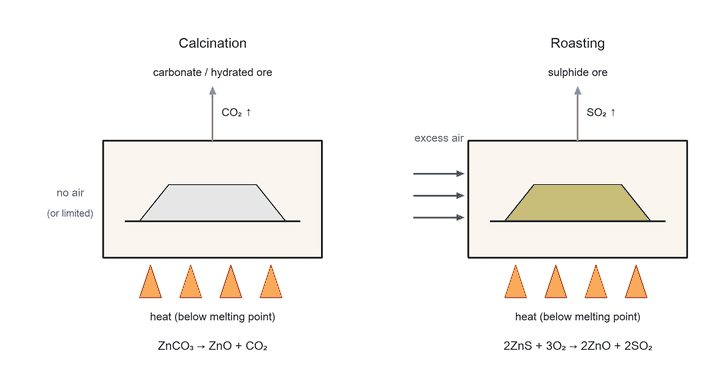
Watch out: Check that each equation is balanced: 2ZnS + 3O₂ gives 2ZnO + 2SO₂ (2 Zn, 2 S and 6 O on each side).
Therefore, (a) roasting is heating a sulphide ore in excess air below its melting point, e.g. 2ZnS + 3O₂ → 2ZnO + 2SO₂; (b) calcination is heating a carbonate ore without air below its melting point, e.g. ZnCO₃ → ZnO + CO₂.