(i) Name the solution used to react with Bauxite as a first step in obtaining pure aluminium oxide, in the Baeyer's…
Question 35 marksAsked 2016Medium
(i) Name the solution used to react with Bauxite as a first step in obtaining pure aluminium oxide, in the Baeyer's process.
(ii) Write the equation for the reaction where the aluminium oxide for the electrolytic extraction of aluminium is obtained by heating aluminium hydroxide.
(iii) Name the compound added to pure alumina to lower the fusion temperature during the electrolytic reduction of alumina.
(iv) Write the equation for the reaction that occurs at the cathode during the extraction of aluminium by electrolysis.
(v) Explain why it is preferable to use a number of graphite electrodes as anode instead of a single electrode, during the above electrolysis.
Solution:
Concept: Aluminium is extracted in two stages. First, bauxite is purified to alumina (Al₂O₃) by Bayer's process, using concentrated sodium hydroxide. Then the alumina, dissolved in molten cryolite with fluorspar, is reduced to aluminium by electrolysis (Hall–Héroult process).
(i) Solution used with bauxite
Step 1 — Name the solution.
Bauxite is heated under pressure with concentrated sodium hydroxide (caustic soda) solution. Aluminium oxide is amphoteric, so it dissolves and forms soluble sodium meta aluminate, while the impurities, iron(III) oxide and sand, do not dissolve.
Al2O3⋅2H2O+2NaOHΔ2NaAlO2+3H2O
(ii) Heating aluminium hydroxide
Step 2 — Write the equation.
The aluminium hydroxide obtained in Bayer's process is filtered, washed and heated strongly at about 1000 °C. It loses water and leaves pure alumina.
2Al(OH)31000 °CAl2O3+3H2O
Each side has 2 aluminium, 6 oxygen and 6 hydrogen atoms, so the equation is balanced.
(iii) Compound that lowers the fusion temperature
Step 3 — Name the compound.
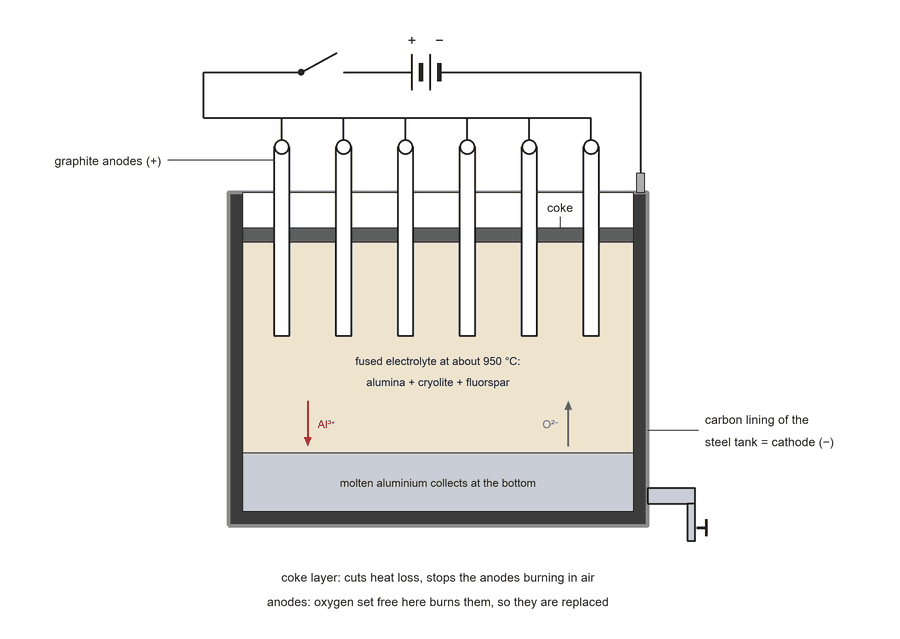
Cryolite, Na3AlF6, is added. Pure alumina fuses at about 2050 °C; dissolved in cryolite, the mixture is molten at about 950 °C, which saves a great deal of energy. Cryolite also makes the melt a better conductor. (Fluorspar, CaF₂, is added as well.)
(iv) Reaction at the cathode
Step 4 — Write the cathode equation.
At the cathode (the carbon lining of the tank) the aluminium ions gain electrons and become aluminium atoms; each Al³⁺ ion takes three electrons.
4Al3++12e−→4Al
The charge on the left is 4 × (+3) + 12 × (−1), which is zero, the same as on the right.
(v) Why several graphite anodes
Step 5 — See what happens to the anodes.
Oxygen is set free at the anodes. At about 950 °C it reacts with the graphite and burns it to carbon dioxide (and some carbon monoxide), so the anodes are slowly used up.
C+O2→CO2↑
Step 6 — Explain the use of many rods.
With a number of graphite rods, each worn-out rod can be replaced one at a time without stopping the electrolysis. Several rods also spread the current evenly through the large bath.
Watch out: The ANODES (graphite rods) are burnt away and replaced; the cathode lining is not used up.
Therefore, (i) concentrated sodium hydroxide solution; (ii) 2Al(OH)₃ → Al₂O₃ + 3H₂O on heating; (iii) cryolite, Na₃AlF₆; (iv) 4Al³⁺ + 12e⁻ → 4Al at the cathode; (v) the anodes are burnt away by the oxygen set free, so several rods let each one be replaced without stopping the process.