
Opening your dashboard
Class 10 Chemistry Chapter 7 Metallurgy: Previous Year Questions
57 questions on Chapter 7, each solved step by step. Class 10 Chemistry, ICSE 2026-27.
57 questions with solutions
1–5 marks · Mixed difficulty
- 11 mark
Question 1
The two main metals in Bronze are:
Solve with AIAnswer
(A) Copper and zinc
(B) Copper and lead
(C) Copper and nickel
- Correct
(D) Copper and tin
Answer: (D) Copper and tin
Concept: An alloy is a homogeneous mixture of two or more metals, or of a metal with a non-metal, made to get useful properties such as greater hardness, lightness, a lower melting point or resistance to corrosion. The main metals of an alloy are the ones present in the largest proportions.
Step 1 — Recall the composition of bronze.
Bronze is an alloy of copper with tin and a little zinc: copper about 80%, tin about 18% and zinc about 2%.
Step 2 — Pick the two main metals.
The two largest shares belong to copper (80%) and tin (18%). Zinc is only about 2%, a minor part, so the two main metals of bronze are copper and tin.
Watch out: Brass and bronze both contain copper; brass is copper with ZINC, bronze is copper with TIN.
Why the other options are wrong:
- (A) Copper and zinc: copper and zinc are the metals of brass (copper 60–70%, zinc 40–30%); bronze has only about 2% zinc.
- (B) Copper and lead: lead is not a constituent of bronze; lead alloyed with tin gives solder.
- (C) Copper and nickel: copper alloyed with nickel gives cupronickel (used for coins); ordinary bronze, copper with tin and a little zinc, has no nickel.
Therefore, the two main metals in bronze are copper and tin, option (D).
- 21 mark
Question 2
Identify the term/substance in each of the following:
The method used to separate ore from gangue by preferential wetting.
Solve with AIWritten solution
Solution:
Concept: Froth floatation concentrates sulphide ores. It works on preferential wetting: the ore particles are wetted by oil (pine oil) and the gangue particles are wetted by water.
Step 1 — Read the clue.
The question describes separating the ore from the gangue by preferential wetting, which means that one kind of particle is wetted by oil and the other by water.
Step 2 — Name the method and see how it works.
This is the froth floatation process. The finely powdered sulphide ore is put into a tank of water with a little pine oil, and air is blown through it. The ore particles, wetted by the oil, stick to the air bubbles and rise into the froth on the surface, which is skimmed off. The gangue particles, wetted by the water, sink to the bottom.
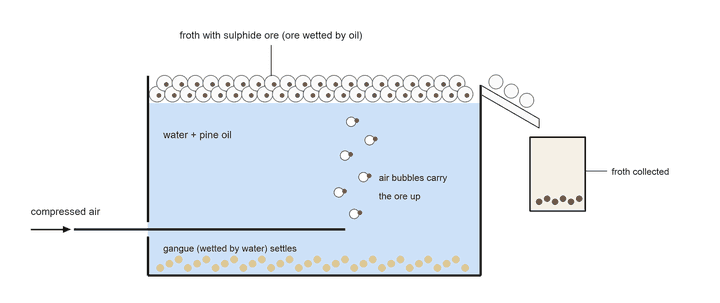
Watch out: Froth floatation does not work by density: the sulphide ore is often heavier than the gangue, yet it rises because the oil-coated particles cling to air bubbles.
Therefore, the method is the froth floatation process.
- 35 marks
Question 3
(i) Name the solution used to react with Bauxite as a first step in obtaining pure aluminium oxide, in the Baeyer's process.
(ii) Write the equation for the reaction where the aluminium oxide for the electrolytic extraction of aluminium is obtained by heating aluminium hydroxide.
(iii) Name the compound added to pure alumina to lower the fusion temperature during the electrolytic reduction of alumina.
(iv) Write the equation for the reaction that occurs at the cathode during the extraction of aluminium by electrolysis.
(v) Explain why it is preferable to use a number of graphite electrodes as anode instead of a single electrode, during the above electrolysis.
Solve with AIWritten solution
Solution:
Concept: Aluminium is extracted in two stages. First, bauxite is purified to alumina (Al₂O₃) by Bayer's process, using concentrated sodium hydroxide. Then the alumina, dissolved in molten cryolite with fluorspar, is reduced to aluminium by electrolysis (Hall–Héroult process).
(i) Solution used with bauxite
Step 1 — Name the solution.
Bauxite is heated under pressure with concentrated sodium hydroxide (caustic soda) solution. Aluminium oxide is amphoteric, so it dissolves and forms soluble sodium meta aluminate, while the impurities, iron(III) oxide and sand, do not dissolve.
(ii) Heating aluminium hydroxide
Step 2 — Write the equation.
The aluminium hydroxide obtained in Bayer's process is filtered, washed and heated strongly at about 1000 °C. It loses water and leaves pure alumina.
Each side has 2 aluminium, 6 oxygen and 6 hydrogen atoms, so the equation is balanced.

(iii) Compound that lowers the fusion temperature
Step 3 — Name the compound.
Cryolite, , is added. Pure alumina fuses at about 2050 °C; dissolved in cryolite, the mixture is molten at about 950 °C, which saves a great deal of energy. Cryolite also makes the melt a better conductor. (Fluorspar, CaF₂, is added as well.)
(iv) Reaction at the cathode
Step 4 — Write the cathode equation.
At the cathode (the carbon lining of the tank) the aluminium ions gain electrons and become aluminium atoms; each Al³⁺ ion takes three electrons.
The charge on the left is 4 × (+3) + 12 × (−1), which is zero, the same as on the right.
(v) Why several graphite anodes
Step 5 — See what happens to the anodes.
Oxygen is set free at the anodes. At about 950 °C it reacts with the graphite and burns it to carbon dioxide (and some carbon monoxide), so the anodes are slowly used up.
Step 6 — Explain the use of many rods.
With a number of graphite rods, each worn-out rod can be replaced one at a time without stopping the electrolysis. Several rods also spread the current evenly through the large bath.
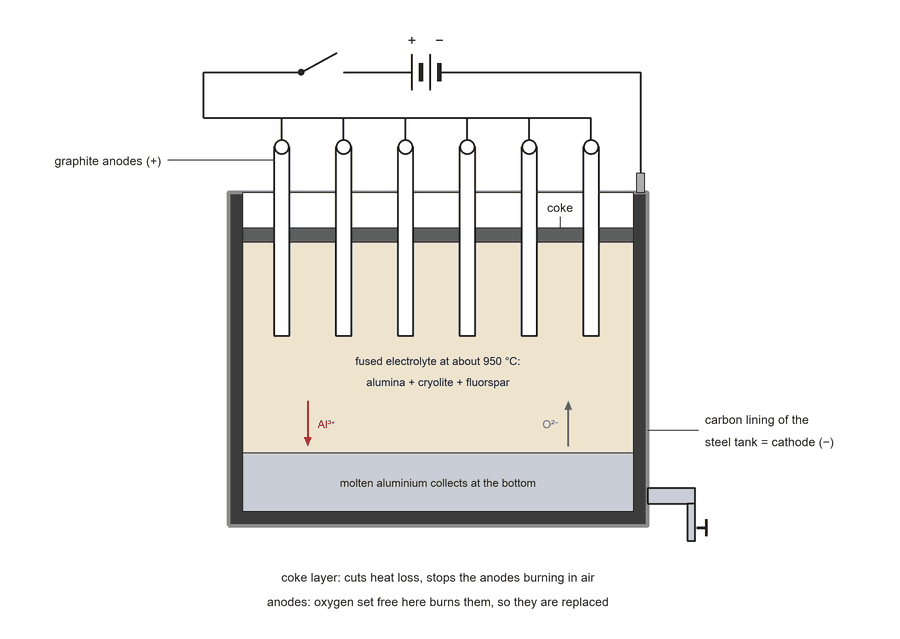
Watch out: The ANODES (graphite rods) are burnt away and replaced; the cathode lining is not used up.
Therefore, (i) concentrated sodium hydroxide solution; (ii) 2Al(OH)₃ → Al₂O₃ + 3H₂O on heating; (iii) cryolite, Na₃AlF₆; (iv) 4Al³⁺ + 12e⁻ → 4Al at the cathode; (v) the anodes are burnt away by the oxygen set free, so several rods let each one be replaced without stopping the process.
- 44 marks
Question 4
Name the following:
(i) The process of coating of iron with zinc.
(ii) An alloy of lead and tin that is used in electrical circuits.
(iii) An ore of zinc containing its sulphide.
(iv) A metal oxide that can be reduced by hydrogen.
Solve with AIWritten solution
Solution:
Concept: Each answer is a term or a substance of this chapter: protecting iron from rusting, alloys, ores and the reduction of metal oxides.
(i) Coating iron with zinc
Step 1 — Name the process.
Coating iron with a layer of zinc is called galvanisation. The zinc keeps air and moisture away from the iron. Zinc is more reactive than iron, so even where the coating is scratched the zinc corrodes first and the iron is protected.
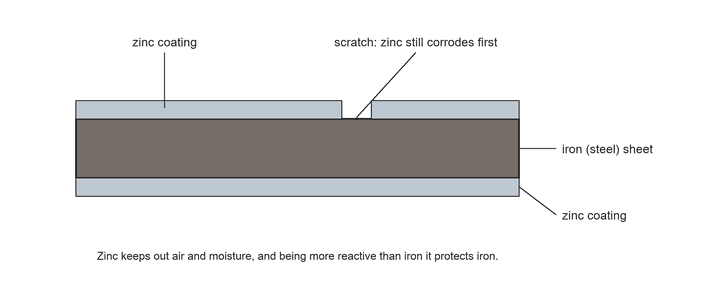
(ii) Lead–tin alloy used in electrical circuits
Step 2 — Name the alloy.
The alloy is solder (also called fuse metal), lead 50% and tin 50%. It starts to melt at about 183 °C, lower than lead or tin alone, so it is easy to melt for joining wires in circuits.
(iii) Sulphide ore of zinc
Step 3 — Name the ore.
The sulphide ore of zinc is zinc blende, ZnS.
(iv) Metal oxide reduced by hydrogen
Step 4 — Name an oxide and show the reduction.
Copper is below hydrogen in the activity series, so hot copper(II) oxide, CuO, gives up its oxygen to hydrogen. (Oxides of lead and iron are also reduced by hydrogen.)
Watch out: Galvanisation uses ZINC; tinning (coating with tin) is a different process.
Therefore, (i) galvanisation; (ii) solder (fuse metal); (iii) zinc blende, ZnS; (iv) copper(II) oxide, CuO.
- 53 marks
Question 5
Answer the following questions with respect to the electrolytic process in the extraction of aluminum:
(i) Identify the components of the electrolyte other than pure alumina and the role played by each.
(ii) Explain why powdered coke is sprinkled over the electrolytic mixture.
Solve with AIWritten solution
Solution:
Concept: In the Hall–Héroult cell the electrolyte is a fused mixture of alumina (about 20%), cryolite, Na₃AlF₆ (about 60%) and fluorspar, CaF₂ (about 20%), kept at about 950 °C. Thick graphite rods dipping into it are the anodes (+), and the carbon lining of the steel tank is the cathode (−).
(i) Other components of the electrolyte and their roles
Step 1 — List the electrolyte.
The fused electrolyte is a mixture of three substances.
Substance Formula Share Alumina Al₂O₃ about 20% Cryolite Na₃AlF₆ about 60% Fluorspar CaF₂ about 20% Step 2 — Give the role of cryolite.
Cryolite dissolves the alumina and lowers the fusion temperature of the mixture from about 2050 °C (pure alumina) to about 950 °C. It also increases the electrical conductivity, since pure alumina is a very poor conductor.
Step 3 — Give the role of fluorspar.
Fluorspar acts, with cryolite, as a solvent for the alumina; it lowers the fusion temperature a little further and increases the conductivity of the melt.
(ii) Why powdered coke is sprinkled on the electrolyte
Step 4 — Explain the coke layer.
A layer of powdered coke on the surface of the bath does two jobs. It reduces the loss of heat by radiation from the hot surface, and it prevents the hot graphite anodes from burning in the air at the surface.
Watch out: Cryolite and fluorspar are added to the ELECTROLYTE; coke is only sprinkled on top of it.
Therefore, (i) cryolite (lowers the fusion temperature and increases conductivity) and fluorspar (solvent that increases conductivity); (ii) powdered coke reduces heat loss by radiation and prevents the anodes burning in air.
- 63 marks
Question 6
Complete the following by selecting the correct option from the choices given:
(i) The metal which does not react with water or dilute but reacts with concentrated is ............... (Al/Cu/Zn/Fe)
(ii) The metal whose oxide, which is amphoteric, is reduced to metal by carbon reduction ............... (Fe/Mg/Pb/Al)
(iii) The divalent metal whose oxide is reduced to metal by electrolysis of its fused salt is ............... (Al/Na/Mg/K)
Solve with AIWritten solution
Solution:
Concept: The method used to get a metal from its oxide depends on its place in the activity series: K, Na, Ca, Mg, Al, Zn, Fe, Pb, [H], Cu, Hg, Ag, Au (most reactive first). Oxides of K to Al are too stable for chemical reducing agents, so these metals are obtained by electrolysis of their fused compounds; oxides of Zn to Cu are reduced by carbon, carbon monoxide or hydrogen (zinc oxide by carbon only).
(i) Metal that reacts with concentrated but not dilute sulphuric acid
Step 1 — Test each metal.
Aluminium, zinc and iron are above hydrogen in the activity series, so they all react with dilute sulphuric acid and give hydrogen. Copper is below hydrogen, so it does not react with water or with dilute sulphuric acid.
Step 2 — See why concentrated acid works.
Hot concentrated sulphuric acid is an oxidising agent, so it does react with copper and gives sulphur dioxide.
The answer is Cu (copper).
(ii) Metal whose amphoteric oxide is reduced by carbon
Step 3 — Find the amphoteric oxides.
Among the four, the oxides of lead (PbO) and aluminium (Al₂O₃) are amphoteric; the oxides of iron and magnesium are basic.
Step 4 — Check which one carbon reduces.
Lead is low in the activity series, so carbon removes the oxygen from lead oxide. Aluminium oxide is too stable for carbon.
The answer is Pb (lead).
(iii) Divalent metal got by electrolysis of its fused salt
Step 5 — Use the valency.
Aluminium is trivalent (Al³⁺), sodium and potassium are monovalent (Na⁺, K⁺), and magnesium is divalent (Mg²⁺). Magnesium is too reactive for carbon to reduce its oxide, so it is obtained by electrolysis of its fused salt; at the cathode:
The answer is Mg (magnesium).
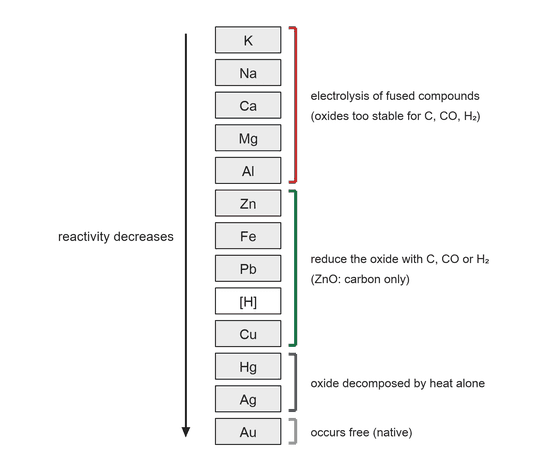
Watch out: 'Amphoteric' alone is not enough in (ii): aluminium oxide is amphoteric too, but carbon cannot reduce it.
Therefore, (i) Cu; (ii) Pb; (iii) Mg.
- 71 mark
Question 7
Give one word or a phrase for the following statements:
The process by which sulphide ore is concentrated.
Solve with AIWritten solution
Solution:
Concept: Froth floatation concentrates sulphide ores. It works on preferential wetting: the ore particles are wetted by oil (pine oil) and the gangue particles are wetted by water.
Step 1 — Identify the ore type.
The question is about a sulphide ore, such as zinc blende (ZnS) or galena (PbS). Sulphide ores are concentrated by the froth floatation process.
Step 2 — See how the ore is separated.
The powdered ore is stirred with water and pine oil while air is blown in. The oil-wetted ore particles cling to the air bubbles and rise with the froth, which is skimmed off; the water-wetted gangue sinks.
Watch out: The separation depends on wetting by oil and water, not on the ore being lighter than the gangue.
Therefore, a sulphide ore is concentrated by the froth floatation process.
- 81 mark
Question 8
Write a balanced chemical equation for each of the following:
Action of heat on aluminum hydroxide.
Solve with AIWritten solution
Solution:
Concept: When aluminium hydroxide is heated strongly (at about 1000 °C), it decomposes into aluminium oxide (alumina) and water vapour. This is the last step of Bayer's process.
Step 1 — Write the formulae.
Aluminium hydroxide is ; the products are alumina, , and water.
Step 2 — Balance the equation.
Alumina has two aluminium atoms, so two formula units of aluminium hydroxide are needed; they hold 6 oxygen and 6 hydrogen atoms, which give 3 molecules of water.
Each side has 2 Al, 6 O and 6 H atoms.
Watch out: The product is Al₂O₃, not Al: heating alone removes only water, never the oxygen bonded to aluminium.
Therefore, 2Al(OH)₃ → Al₂O₃ + 3H₂O on heating.
- 91 mark
Question 9
Fill up the blanks with the correct choice given in brackets.
The most common ore of iron is ............... (calamine / haematite)
Solve with AIWritten solution
Solution:
Concept: Iron is extracted mainly from its oxide ore, haematite.
Step 1 — Identify each choice.
Haematite is iron(III) oxide, , an ore of iron. Calamine is zinc carbonate, , an ore of zinc.
Step 2 — Choose.
Only haematite is an ore of iron, and it is the most common one used.
Watch out: Calamine (zinc) and haematite (iron) are often mixed up; link each ore to its metal.
Therefore, the most common ore of iron is haematite.
- 102 marks
Question 10
Name the main component of the following alloys:
(i) Brass
(ii) Duralumin
Solve with AIWritten solution
Solution:
Concept: An alloy is a homogeneous mixture of two or more metals, or of a metal with a non-metal, made to get useful properties such as greater hardness, lightness, a lower melting point or resistance to corrosion. The main component of an alloy is the metal present in the largest proportion.
Step 1 — Brass.
Brass is copper 60–70% with zinc 40–30%, so its main component is copper.
Step 2 — Duralumin.
Duralumin is aluminium about 95% with copper 4%, magnesium 0.5% and manganese 0.5%, so its main component is aluminium.
Alloy Main metal and other constituents One use Duralumin aluminium about 95%, copper 4%, magnesium 0.5%, manganese 0.5% bodies of aircraft Magnalium aluminium with about 5–10% magnesium aircraft parts, light tools, balance beams Stainless steel iron about 73%, chromium 18%, nickel 8%, a very little carbon surgical instruments, cutlery Brass copper 60–70%, zinc 40–30% decorative articles, screws, hardware Bronze copper about 80%, tin 18%, zinc 2% medals, statues, coins Solder (fuse metal) lead 50%, tin 50% joining wires, electric fuses Watch out: Duralumin contains copper, but only about 4%; its main metal is aluminium.
Therefore, (i) the main component of brass is copper; (ii) the main component of duralumin is aluminium.
- 114 marks
Question 11
(i) Name the most common ore of the metal aluminum from which the metal is extracted. Write the chemical formula of the ore.
(ii) Name the process by which impure ore of aluminum gets purified by using concentrated solution of an alkali.
(iii) Write the equation for the formation of aluminum at the cathode during the electrolysis of alumina.
Solve with AIWritten solution
Solution:
Concept: Aluminium is extracted in two stages. First, bauxite is purified to alumina (Al₂O₃) by Bayer's process, using concentrated sodium hydroxide. Then the alumina, dissolved in molten cryolite with fluorspar, is reduced to aluminium by electrolysis (Hall–Héroult process).
(i) Most common ore of aluminium
Step 1 — Name the ore.
The ore is bauxite, hydrated aluminium oxide, .
(ii) Purification with a concentrated alkali
Step 2 — Name the process.
The process is Bayer's (Baeyer's) process. Powdered bauxite is heated with concentrated sodium hydroxide solution under pressure; the amphoteric alumina dissolves as sodium meta aluminate and the impurities are filtered off as red mud.
(iii) Formation of aluminium at the cathode
Step 3 — Write the cathode equation.
Aluminium ions move to the cathode (the carbon lining) and each gains three electrons.
The molten aluminium collects at the bottom of the cell and is tapped off.
Watch out: The alkali step is Bayer's process; the electrolysis step is the Hall–Héroult process.
Therefore, (i) bauxite, Al₂O₃·2H₂O; (ii) Bayer's process; (iii) 4Al³⁺ + 12e⁻ → 4Al.
- 121 mark
Question 12
The reason for using Aluminium in the alloy duralumin is:
Solve with AIAnswer
(A) Aluminium is brittle.
(B) Aluminium gives strength.
- Correct
(C) Aluminium brings lightness.
(D) Aluminium lowers melting point.
Answer: (C) Aluminium brings lightness.
Concept: Duralumin is aluminium (about 95%) with small amounts of copper, magnesium and manganese. The base metal gives the alloy its main property; the small additions improve it.
Step 1 — Look at aluminium's property.
Aluminium has a low density, about 2.7 g/cm³, nearly one-third that of iron (about 7.9 g/cm³). An alloy that is mostly aluminium is therefore light.
Step 2 — See what the other metals add.
Pure aluminium is soft; the copper and magnesium make the alloy strong and hard. A light but strong alloy is just what aircraft bodies need, so aluminium is used for its lightness.
Watch out: The STRENGTH of duralumin comes from the added copper and magnesium; aluminium brings the lightness.
Why the other options are wrong:
- (A) Aluminium is brittle: aluminium is not brittle; it is malleable and ductile, and brittleness would be a reason not to use it.
- (B) Aluminium gives strength: pure aluminium is soft; the strength of duralumin comes mainly from the copper and magnesium added to it.
- (D) Aluminium lowers melting point: aluminium is the base metal of duralumin, not an additive put in to lower the melting point; the alloy is chosen for lightness with strength.
Therefore, aluminium is used in duralumin because it brings lightness, option (C).
- 131 mark
Question 13
Write a balanced chemical equation for each of the following reactions:
Reduction of copper (II) oxide by hydrogen.
Solve with AIWritten solution
Solution:
Concept: Copper is below hydrogen in the activity series, so hot hydrogen can remove the oxygen from copper(II) oxide. Hydrogen is the reducing agent and is itself oxidised to water.
Step 1 — Write the formulae.
The reactants are copper(II) oxide, CuO, and hydrogen, H₂; the products are copper and water.
Step 2 — Write the balanced equation.
The oxide is heated in a stream of dry hydrogen.
Each side has one Cu, one O and two H atoms.
Step 3 — Note what is seen.
The black copper(II) oxide turns reddish brown (copper), and droplets of water collect on the cooler part of the tube.

Watch out: The oxide must be heated; hydrogen does not reduce copper(II) oxide at room temperature.
Therefore, CuO + H₂ → Cu + H₂O on heating.
- 141 mark
Question 14
Give the appropriate term defined by the statements given below:
The process by which certain ores, specially carbonates, are converted to oxides in the absence of air.
Solve with AIWritten solution
Solution:
Concept: Before reduction, carbonate and hydrated ores are changed to oxides by heating. Heating below the melting point in the absence (or a limited supply) of air is calcination; heating in excess air is roasting.
Step 1 — Match the description.
The ore is a carbonate and is heated in the absence of air to form an oxide, which is calcination.
Step 2 — Show an example.
Calamine, zinc carbonate, loses carbon dioxide on calcination and leaves zinc oxide.
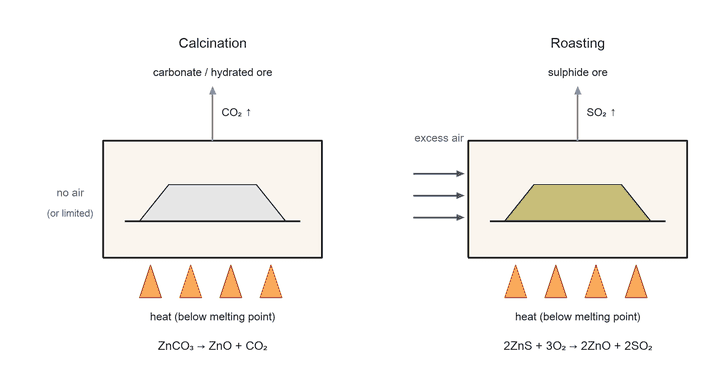
Watch out: Roasting needs EXCESS air and is used for sulphide ores.
Therefore, the process is calcination.
- 151 mark
Question 15
Arrange the following according to the instructions given in brackets:
K, Pb, Ca, Zn. (In the increasing order of the reactivity)
Solve with AIWritten solution
Solution:
Concept: The activity series, most reactive first, is K, Na, Ca, Mg, Al, Zn, Fe, Pb, [H], Cu, Hg, Ag, Au. Increasing order of reactivity is the reverse of this.
Step 1 — Place each metal in the series.
In the series, potassium comes first, then calcium, then zinc, and lead comes last of the four.
Step 2 — Write the increasing order.
Start with the least reactive (lead) and end with the most reactive (potassium).
Watch out: The question asks for INCREASING reactivity, so the most reactive metal, K, comes last.
Therefore, the increasing order of reactivity is Pb < Zn < Ca < K.
- 163 marks
Question 16
Give the chemical formula of:
(i) Bauxite
(ii) Cryolite
(iii) Sodium aluminate
Solve with AIWritten solution
Solution:
Concept: Bauxite and cryolite are ores of aluminium; sodium (meta) aluminate is the soluble compound formed when bauxite dissolves in caustic soda in Bayer's process.
Step 1 — Bauxite.
Bauxite is hydrated aluminium oxide, .
Step 2 — Cryolite.
Cryolite is sodium aluminium fluoride, . The charges balance: three Na⁺ and one Al³⁺ give +6, and six F⁻ give −6.
Step 3 — Sodium aluminate.
Sodium (meta) aluminate is : one Na⁺ and one Al³⁺ give +4, and two O²⁻ give −4. It forms in Bayer's process.
Watch out: Cryolite has SIX fluorine atoms (Na₃AlF₆), and sodium aluminate has two oxygen atoms (NaAlO₂).
Therefore, (i) bauxite Al₂O₃·2H₂O; (ii) cryolite Na₃AlF₆; (iii) sodium aluminate NaAlO₂.
- 173 marks
Question 17
Answer the following questions based on the extraction of aluminium from alumina by Hall-Heroult's Process.:
(i) What is the function of cryolite used along with alumina as the electrolyte?
(ii) Why is powdered coke sprinkled on top of the electrolyte?
(iii) Name the electrode, from which aluminium is collected.
Solve with AIWritten solution
Solution:
Concept: In the Hall–Héroult cell the electrolyte is a fused mixture of alumina (about 20%), cryolite, Na₃AlF₆ (about 60%) and fluorspar, CaF₂ (about 20%), kept at about 950 °C. Thick graphite rods dipping into it are the anodes (+), and the carbon lining of the steel tank is the cathode (−).
(i) Function of cryolite
Step 1 — Explain the role of cryolite.
Cryolite dissolves the alumina and lowers the fusion temperature of the electrolyte from about 2050 °C to about 950 °C, saving energy. It also increases the electrical conductivity, because pure alumina is a very poor conductor.
(ii) Why powdered coke is sprinkled on top
Step 2 — Explain the coke layer.
The coke layer reduces the loss of heat by radiation from the surface of the bath, and it prevents the hot graphite anodes from burning in the air.
(iii) Electrode from which aluminium is collected
Step 3 — Find the electrode.
Aluminium ions are positive, so they move to the cathode (the carbon lining of the steel tank) and gain electrons there.
The molten aluminium collects at the bottom of the tank, on the cathode, and is tapped off.
Watch out: Aluminium is collected at the CATHODE; oxygen is set free at the anodes.
Therefore, (i) cryolite lowers the fusion temperature and increases conductivity; (ii) coke reduces heat loss and stops the anodes burning in air; (iii) aluminium is collected from the cathode.
- 184 marks
Question 18
Match the alloys given in column I to the uses given in column II:
Column I Column II (i) Duralumin A: Electrical fuse (ii) Solder B: Surgical instruments (iii) Brass C: Aircraft body (iv) Stainless steel D: Decorative articles Solve with AIWritten solution
Solution:
Concept: An alloy is a homogeneous mixture of two or more metals, or of a metal with a non-metal, made to get useful properties such as greater hardness, lightness, a lower melting point or resistance to corrosion. Each use matches a property of the alloy.
Step 1 — Duralumin.
Duralumin is light, strong and resists corrosion, so it is used for C: aircraft body.
Step 2 — Solder.
Solder (fuse metal, lead 50% and tin 50%) has a low melting point, so a wire of it melts when too much current flows. It matches A: electrical fuse.
Step 3 — Brass.
Brass is bright yellow, easily cast and resists corrosion, so it is used for D: decorative articles.
Step 4 — Stainless steel.
Stainless steel does not rust, resists acids and stays hard and bright, so it is used for B: surgical instruments.
Alloy Main metal and other constituents One use Duralumin aluminium about 95%, copper 4%, magnesium 0.5%, manganese 0.5% bodies of aircraft Magnalium aluminium with about 5–10% magnesium aircraft parts, light tools, balance beams Stainless steel iron about 73%, chromium 18%, nickel 8%, a very little carbon surgical instruments, cutlery Brass copper 60–70%, zinc 40–30% decorative articles, screws, hardware Bronze copper about 80%, tin 18%, zinc 2% medals, statues, coins Solder (fuse metal) lead 50%, tin 50% joining wires, electric fuses Watch out: Solder is the low-melting alloy (fuses); stainless steel is the rust-free one (surgical instruments).
Therefore, (i) duralumin – C; (ii) solder – A; (iii) brass – D; (iv) stainless steel – B.
- 191 mark
Question 19
State one relevant observation for each of the following reactions:
(v) Sulphide ore is added to a tank containing oil and water, and then stirred or agitated with air.
Solve with AIWritten solution
Solution:
Concept: Froth floatation concentrates sulphide ores. It works on preferential wetting: the ore particles are wetted by oil (pine oil) and the gangue particles are wetted by water.
Step 1 — Identify the process.
Stirring a sulphide ore with oil and water while air is blown in is the froth floatation process.
Step 2 — State what is seen.
A froth forms on the surface, carrying the ore particles, and it is skimmed off; the gangue (earthy impurities) settles at the bottom of the tank.
Watch out: The ore is in the FROTH at the top, the gangue at the bottom.
Therefore, a froth carrying the ore particles forms on the surface, while the gangue settles at the bottom.
- 201 mark
Question 20
Give one word or a phrase for the following statements:
(iii) The substance prepared by adding other metals to a base metal in appropriate proportions to obtain certain desirable properties.
Solve with AIWritten solution
Solution:
Concept: An alloy is a homogeneous mixture of two or more metals, or of a metal with a non-metal, made to get useful properties such as greater hardness, lightness, a lower melting point or resistance to corrosion.
Step 1 — Match the description.
A substance made by adding other metals to a base metal in suitable proportions to get desirable properties is an alloy.
Step 2 — Give an example.
Adding chromium and nickel to iron gives stainless steel, which does not rust.
Watch out: An alloy is a mixture, not a compound: its composition can vary within limits.
Therefore, the substance is an alloy.
- 211 mark
Question 21
Fill in the blanks from the choices given in brackets:
(v) An alloy used to make statues is ...............
(bronze, brass, fuse metal)
Solve with AIWritten solution
Solution:
Concept: Bronze (copper about 80%, tin 18%, zinc 2%) is hard, can be cast into shapes, takes a polish and resists corrosion.
Step 1 — Match the use to a property.
A statue must be cast into shape and must stand outdoors for years without corroding. Bronze has both properties.
Step 2 — Rule out the others.
Brass is used for decorative hardware and screws, and fuse metal (solder) melts easily, so it is used for fuses, not statues.
Watch out: Fuse metal melts at a low temperature, so it is no use for a statue.
Therefore, the alloy used to make statues is bronze.
- 223 marks
Question 22
Baeyer's process is used to concentrate bauxite ore to alumina.
Give balanced chemical equations for the reaction taking place for its conversion from bauxite to alumina.
Solve with AIWritten solution
Solution:
Concept: Bayer's process uses the fact that alumina is amphoteric: it dissolves in a hot concentrated alkali, while the impurities (iron(III) oxide, sand) do not. The dissolved aluminium is then precipitated as aluminium hydroxide, which is heated to pure alumina.
Step 1 — Dissolve bauxite in caustic soda.
Powdered bauxite is heated with concentrated sodium hydroxide solution at 140–150 °C under pressure. The alumina dissolves as sodium meta aluminate.
The insoluble impurities are filtered off as red mud.
Step 2 — Precipitate aluminium hydroxide.
The sodium meta aluminate solution is diluted with water and cooled to about 50 °C; aluminium hydroxide separates out as a white precipitate.
Step 3 — Heat to alumina.
The precipitate is filtered, washed, dried and heated at about 1000 °C to give pure alumina.
Watch out: The first step needs CONCENTRATED alkali and heat; the second needs dilution and cooling.
Therefore, Al₂O₃·2H₂O + 2NaOH → 2NaAlO₂ + 3H₂O; NaAlO₂ + 2H₂O → NaOH + Al(OH)₃; 2Al(OH)₃ → Al₂O₃ + 3H₂O.
- 231 mark
Question 23
The ore of Aluminium is:
Solve with AIAnswer
(A) Calamine
(B) Haematite
(C) Magnetite
- Correct
(D) Cryolite
Answer: (D) Cryolite
Concept: An ore of a metal must contain that metal. The ores of aluminium are bauxite (Al₂O₃·2H₂O), cryolite (Na₃AlF₆) and corundum (Al₂O₃).
Step 1 — Check each option for aluminium.
Calamine is ZnCO₃, haematite is Fe₂O₃, magnetite is Fe₃O₄ and cryolite is Na₃AlF₆. Only cryolite contains aluminium.
Step 2 — Conclude.
Cryolite, sodium aluminium fluoride, is an ore of aluminium. Natural cryolite is now rare, and the cryolite used as the solvent in the electrolytic cell is mostly made in factories.
Watch out: Magnetite and haematite are both ores of IRON.
Why the other options are wrong:
- (A) Calamine: calamine is zinc carbonate, ZnCO₃, an ore of zinc.
- (B) Haematite: haematite is iron(III) oxide, Fe₂O₃, an ore of iron.
- (C) Magnetite: magnetite is Fe₃O₄, an ore of iron.
Therefore, the ore of aluminium among the options is cryolite, option (D).
- 241 mark
Question 24
Substance which helps to lower the fusion point of the mixture in Hall Heroult Process:
Solve with AIAnswer
(A) Coke
(B) Concentrated sodium hydroxide
- Correct
(C) Fluorspar
(D) Concentrated potassium hydroxide
Answer: (C) Fluorspar
Concept: In the Hall–Héroult cell the electrolyte is a fused mixture of alumina (about 20%), cryolite, Na₃AlF₆ (about 60%) and fluorspar, CaF₂ (about 20%), kept at about 950 °C. Thick graphite rods dipping into it are the anodes (+), and the carbon lining of the steel tank is the cathode (−).
Step 1 — Find which option is added to the bath.
Of the four substances, only fluorspar, CaF₂, is part of the electrolytic mixture in the Hall–Héroult process.
Step 2 — See what it does.
Together with cryolite (the main substance that lowers the fusion temperature), fluorspar acts as a solvent, lowers the fusion point of the mixture a little further and makes the melt conduct better.
Watch out: Cryolite is the main substance that lowers the fusion temperature; among these options, fluorspar is the one that does this job.
Why the other options are wrong:
- (A) Coke: coke is sprinkled on the surface to reduce heat loss and stop the anodes burning; it does not lower the fusion point.
- (B) Concentrated sodium hydroxide: concentrated sodium hydroxide is used earlier, in Bayer's process, to purify bauxite.
- (D) Concentrated potassium hydroxide: concentrated potassium hydroxide is not used in the extraction of aluminium.
Therefore, the substance that helps to lower the fusion point is fluorspar, option (C).
- 251 mark
Question 25
Define:
(b) Ores
Solve with AIWritten solution
Solution:
Concept: Metals occur in nature as compounds called minerals, mixed with earthy impurities (gangue). A mineral is called an ore only when the metal can be extracted from it profitably.
Step 1 — Give the definition.
Ores are those minerals from which a metal can be extracted commercially (economically), at a comparatively low cost and with little effort.
Step 2 — Give examples.
Bauxite is an ore of aluminium, and haematite is an ore of iron.
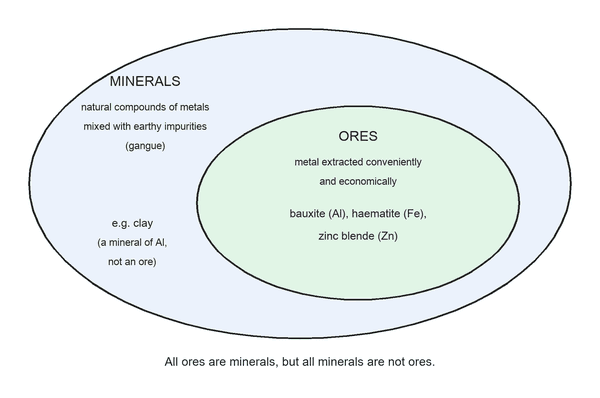
Watch out: All ores are minerals, but all minerals are not ores (clay contains aluminium but is not an ore of it).
Therefore, ores are minerals from which a metal can be extracted economically and conveniently.
- 262 marks
Question 26
State the relevant reason for the following:
(a) Concentrated alkali is used for the concentration of bauxite ore.
(b) Fused alumina is reduced to aluminium by electrolysis.
Solve with AIWritten solution
Solution:
Concept: Alumina is amphoteric, so it dissolves in a strong alkali while the impurities do not. Aluminium holds oxygen very strongly, so its oxide cannot be reduced by chemical reducing agents.
(a) Concentrated alkali for concentrating bauxite
Step 1 — Explain the reason.
Aluminium oxide is amphoteric, so it dissolves in hot concentrated sodium hydroxide and forms soluble sodium meta aluminate.
The impurities, iron(III) oxide (basic) and sand, do not dissolve and are filtered off as red mud. So the alkali separates the alumina from the gangue.
(b) Fused alumina is reduced by electrolysis
Step 2 — Explain the reason.
Aluminium is high in the activity series and has a very great affinity for oxygen, so aluminium oxide is very stable. Common reducing agents such as carbon, carbon monoxide and hydrogen cannot take the oxygen away from it.
Step 3 — See how electrolysis succeeds.
In electrolysis the electrons are supplied directly at the cathode, so the aluminium ions are reduced even though the oxide is so stable.
Watch out: The alkali dissolves the ALUMINA, not the impurities.
Therefore, (a) alumina is amphoteric and dissolves in the alkali while the impurities do not; (b) aluminium has so great an affinity for oxygen that its oxide is not reduced by common reducing agents, so electrolysis is used.
- 272 marks
Question 27
State one use of the given alloys:
(a) Magnalium
(b) Duralumin
Solve with AIWritten solution
Solution:
Concept: Magnalium and duralumin are both light alloys of aluminium, so they are used where lightness with strength is needed.
Step 1 — Magnalium.
Magnalium is aluminium with about 5–10% magnesium. It is light and strong, so it is used for making aircraft parts (also light tools and beams of balances).
Step 2 — Duralumin.
Duralumin is aluminium about 95% with copper, magnesium and manganese. It is light, strong and resists corrosion, so it is used for making bodies of aircraft.
Watch out: Both alloys are mainly aluminium; magnalium has magnesium only, duralumin also has copper and manganese.
Therefore, (a) magnalium is used for aircraft parts; (b) duralumin is used for the bodies of aircraft.
- 281 mark
Question 28
Identify the terms for the following:
(a) The process used to purify Alumina by electrolytic reduction.
Solve with AIWritten solution
Solution:
Concept: Aluminium is extracted in two stages. First, bauxite is purified to alumina (Al₂O₃) by Bayer's process, using concentrated sodium hydroxide. Then the alumina, dissolved in molten cryolite with fluorspar, is reduced to aluminium by electrolysis (Hall–Héroult process).
Step 1 — Identify the process.
The electrolytic reduction of fused alumina, dissolved in cryolite with fluorspar, to aluminium is the Hall–Héroult process.
Step 2 — See what the electrolysis does.
At the cathode the aluminium ions gain electrons and form the metal.
Watch out: The purifying of bauxite to alumina is Bayer's process; the electrolysis of alumina is the Hall–Héroult process.
Note: The paper says “purify alumina”; the electrolysis really reduces alumina to aluminium. The process meant is still the Hall–Héroult process.
Therefore, the process is the Hall–Héroult process.
- 292 marks
Question 29
Select the right answer from the brackets and complete the statements:
In electrolysis of fused Alumina, the anode is made of (a) ............... [gas carbon/graphite] and the product formed at cathode is (b) ............... [oxygen/aluminium].
Solve with AIWritten solution
Solution:
Concept: In the Hall–Héroult cell the electrolyte is a fused mixture of alumina (about 20%), cryolite, Na₃AlF₆ (about 60%) and fluorspar, CaF₂ (about 20%), kept at about 950 °C. Thick graphite rods dipping into it are the anodes (+), and the carbon lining of the steel tank is the cathode (−).
(a) Material of the anode
Step 1 — Choose the anode material.
The anodes are thick rods of graphite dipping into the electrolyte. (Gas carbon, or graphite, lines the tank and serves as the cathode.)
(b) Product at the cathode
Step 2 — Choose the cathode product.
Aluminium ions are positive, so they move to the cathode and gain electrons, forming aluminium.
Oxygen is formed at the anode, not at the cathode.
Watch out: Oxygen ions are NEGATIVE, so they go to the anode; the cathode product is the metal.
Therefore, (a) graphite; (b) aluminium.
- 302 marks
Question 30
Give one word for the following statements:
(a) The compounds of various metals found in nature with earthly impurities.
(b) A homogeneous mixture of two or more metals or a metal and a non-metal in specific ratios.
Solve with AIWritten solution
Solution:
Concept: Metals occur in nature as compounds called minerals, mixed with earthy impurities. A homogeneous mixture of metals (or of a metal with a non-metal) is an alloy.
(a)
Step 1 — Name the natural compounds.
The naturally occurring compounds of metals, generally mixed with earthy impurities (gangue) such as soil, sand and rocks, are called minerals. The statement does not say that the metal is extracted profitably, which is what would make a mineral an ore.
(b)
Step 2 — Name the mixture.
A homogeneous mixture of two or more metals, or of a metal and a non-metal, in definite proportions is an alloy. For example, brass is copper with zinc, and steel is iron with a little carbon (a non-metal).
Watch out: 'Ore' would need the idea of profitable extraction; the statement in (a) describes minerals in general.
Therefore, (a) minerals; (b) alloy.
- 311 mark
Question 31
The compound that is not an ore of aluminium:
Solve with AIAnswer
(A) Cryolite
(B) Corundum
- Correct
(C) Fluorspar
(D) Bauxite
Answer: (C) Fluorspar
Concept: An ore of a metal must contain that metal. The ores of aluminium are bauxite (Al₂O₃·2H₂O), cryolite (Na₃AlF₆) and corundum (Al₂O₃).
Step 1 — Check each compound for aluminium.
Cryolite (Na₃AlF₆), corundum (Al₂O₃) and bauxite (Al₂O₃·2H₂O) all contain aluminium. Fluorspar is calcium fluoride, CaF₂, which has no aluminium at all.
Step 2 — Conclude.
Fluorspar is added to the electrolyte in the Hall–Héroult process, but it cannot be a source of aluminium, so it is not an ore of aluminium.
Watch out: Fluorspar is USED in extracting aluminium, but that does not make it an ore of aluminium.
Why the other options are wrong:
- (A) Cryolite: cryolite, Na₃AlF₆ (sodium aluminium fluoride), contains aluminium and is an ore of aluminium.
- (B) Corundum: corundum, Al₂O₃ (anhydrous aluminium oxide), is an ore of aluminium.
- (D) Bauxite: bauxite, Al₂O₃·2H₂O, is the main ore of aluminium.
Therefore, the compound that is not an ore of aluminium is fluorspar, option (C).
- 325 marks
Question 32
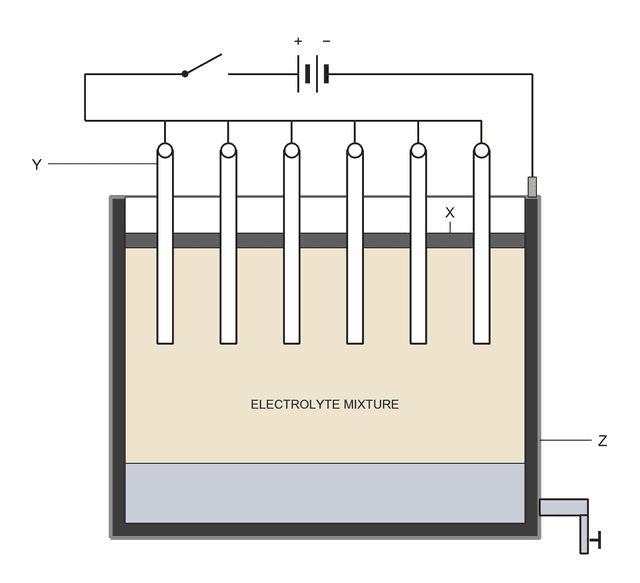
The following sketch illustrates the process of conversion of Alumina to Aluminium:
Study the diagram and answer the following:
(a) Name the constituent of the electrolyte mixture which has a divalent metal in it.
(b) Name the powdered substance 'X' sprinkled on the surface of the electrolyte mixture.
(c) What is the name of the process?
(d) Write the reactions taking place at the electrodes 'Y' (anode) and 'Z' (cathode) respectively.
Solve with AIWritten solution
Solution:
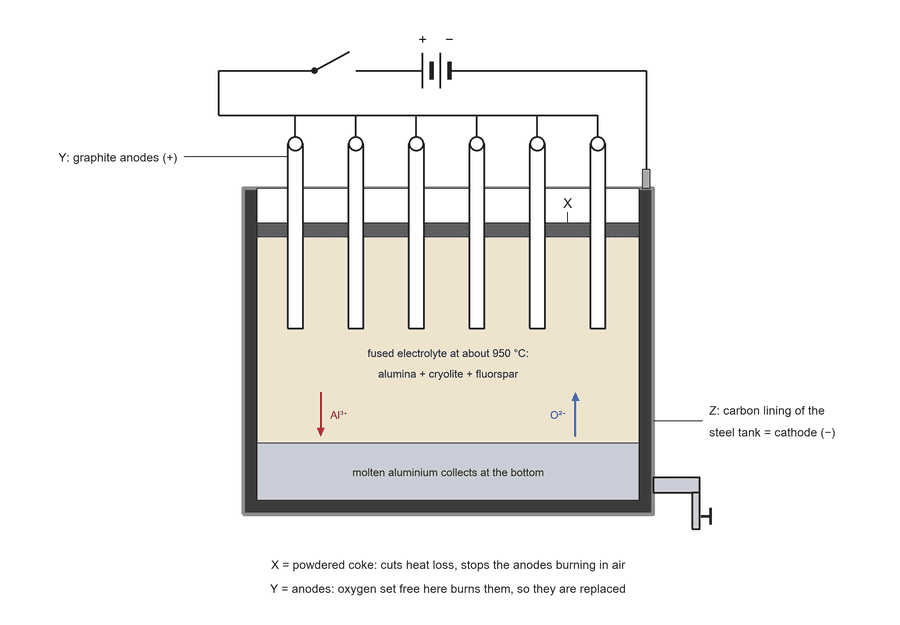
Concept: In the Hall–Héroult cell the electrolyte is a fused mixture of alumina (about 20%), cryolite, Na₃AlF₆ (about 60%) and fluorspar, CaF₂ (about 20%), kept at about 950 °C. Thick graphite rods dipping into it are the anodes (+), and the carbon lining of the steel tank is the cathode (−). The sketch shows this cell: Y are the graphite anodes joined to the + terminal, Z is the carbon lining joined to the − terminal, and X is the powdered layer on the surface of the electrolyte.
(a) Constituent with a divalent metal
Step 1 — Check the valency of each metal.
The electrolyte is alumina (Al³⁺, trivalent), cryolite Na₃AlF₆ (Na⁺, monovalent, and Al³⁺) and fluorspar CaF₂. Calcium forms Ca²⁺ ions, so it is divalent.
So the constituent with a divalent metal is fluorspar, CaF₂.
(b) The powdered substance X
Step 2 — Name X.
The layer sprinkled on the surface of the electrolyte is powdered coke. It reduces the loss of heat by radiation and stops the anodes burning in air.
(c) Name of the process
Step 3 — Name the process.
The electrolytic reduction of fused alumina to aluminium is the Hall–Héroult process.
(d) Reactions at the electrodes
Step 4 — Write the ions present.
In the molten electrolyte, alumina is split into aluminium ions and oxide ions.
Step 5 — Reaction at Y (anode).
The negative oxide ions move to the anode, lose electrons and form oxygen atoms, which join to form oxygen gas.
This oxygen attacks the hot graphite anodes (forming CO₂ and some CO), so they are replaced from time to time.
Step 6 — Reaction at Z (cathode).
The positive aluminium ions move to the cathode and gain electrons, forming molten aluminium, which collects at the bottom.
Watch out: The anode reaction is a LOSS of electrons (oxidation) and the cathode reaction a GAIN of electrons (reduction).
Therefore, (a) fluorspar, CaF₂; (b) X is powdered coke; (c) the Hall–Héroult process; (d) at Y: 6O²⁻ − 12e⁻ → 6[O], then 6[O] → 3O₂; at Z: 4Al³⁺ + 12e⁻ → 4Al.
- 332 marks
Question 33
Identify the alloy in each case from the given composition:
(a) aluminium, magnesium, manganese, copper
(b) iron, nickel, chromium, carbon
Solve with AIWritten solution
Solution:
Concept: An alloy is a homogeneous mixture of two or more metals, or of a metal with a non-metal, made to get useful properties such as greater hardness, lightness, a lower melting point or resistance to corrosion. An alloy is recognised from its main metal and the elements added to it.
(a)
Step 1 — Aluminium with magnesium, manganese and copper.
An alloy that is mainly aluminium with small amounts of copper (about 4%), magnesium and manganese (about 0.5% each) is duralumin.
(b)
Step 2 — Iron with nickel, chromium and carbon.
An alloy of iron with chromium (about 18%), nickel (about 8%) and a very little carbon is stainless steel.
Alloy Main metal and other constituents One use Duralumin aluminium about 95%, copper 4%, magnesium 0.5%, manganese 0.5% bodies of aircraft Magnalium aluminium with about 5–10% magnesium aircraft parts, light tools, balance beams Stainless steel iron about 73%, chromium 18%, nickel 8%, a very little carbon surgical instruments, cutlery Brass copper 60–70%, zinc 40–30% decorative articles, screws, hardware Bronze copper about 80%, tin 18%, zinc 2% medals, statues, coins Solder (fuse metal) lead 50%, tin 50% joining wires, electric fuses Watch out: Magnalium is aluminium with magnesium ONLY; the copper and manganese in (a) point to duralumin.
Therefore, (a) duralumin; (b) stainless steel.
- 342 marks
Question 34
Write one use of the following alloys:
(a) Bronze
(b) Fuse metal
Solve with AIWritten solution
Solution:
Concept: The use of an alloy follows from its properties: bronze is hard, can be cast and takes a polish; fuse metal (lead–tin) melts at a low temperature.
(a) Bronze
Step 1 — Give a use of bronze.
Bronze (copper about 80%, tin 18%, zinc 2%) is used for making medals and statues (also coins and utensils).
(b) Fuse metal
Step 2 — Give a use of fuse metal.
Fuse metal, the lead–tin alloy (lead 50%, tin 50%, also called solder), starts to melt at about 183 °C. It is used for making electric fuse wire: when too much current flows, the wire melts and breaks the circuit.
Watch out: Fuse metal and solder are the same lead–tin alloy, named after two of its uses.
Therefore, (a) bronze is used for medals and statues; (b) fuse metal is used for electric fuse wire.
- 351 mark
Question 35
Copper, Zinc and Tin are the metals alloyed to form:
Solve with AIAnswer
(A) Duralumin
(B) Brass
- Correct
(C) Bronze
(D) Solder
Answer: (C) Bronze
Concept: An alloy is a homogeneous mixture of two or more metals, or of a metal with a non-metal, made to get useful properties such as greater hardness, lightness, a lower melting point or resistance to corrosion. Bronze is copper about 80%, tin 18% and zinc 2%.
Step 1 — List the metals named.
The stem names three metals: copper, zinc and tin.
Step 2 — Match to an alloy.
Of the four alloys, only bronze contains all three: copper (main metal), tin and a little zinc.
Watch out: Brass has copper and zinc but NO tin; the tin points to bronze.
Why the other options are wrong:
- (A) Duralumin: duralumin is mainly aluminium with copper, magnesium and manganese; it has no zinc or tin.
- (B) Brass: brass is copper and zinc only; it has no tin.
- (D) Solder: solder is lead and tin; it has no copper or zinc.
Therefore, copper, zinc and tin are alloyed to form bronze, option (C).
- 361 mark
Question 36
The compound that is not a constituent of the electrolytic mixture used in the Hall-Heroult's process is:
Solve with AIAnswer
(A)
- Correct
(B)
(C)
(D)
Answer: (B)
Concept: In the Hall–Héroult cell the electrolyte is a fused mixture of alumina (about 20%), cryolite, Na₃AlF₆ (about 60%) and fluorspar, CaF₂ (about 20%), kept at about 950 °C. Thick graphite rods dipping into it are the anodes (+), and the carbon lining of the steel tank is the cathode (−).
Step 1 — List the electrolyte.
The electrolytic mixture is Al₂O₃, Na₃AlF₆ and CaF₂, so options (A), (C) and (D) are all constituents.
Step 2 — Place sodium aluminate.
Sodium (meta) aluminate, NaAlO₂, is formed earlier, in Bayer's process, when bauxite dissolves in caustic soda. It is then turned into aluminium hydroxide and alumina, so it is never put into the electrolytic cell.
Watch out: NaAlO₂ and Na₃AlF₆ both contain sodium and aluminium; only cryolite (Na₃AlF₆) is in the cell.
Why the other options are wrong:
- (A) : Al₂O₃ (alumina) is the compound being electrolysed, so it is a constituent.
- (C) : Na₃AlF₆ (cryolite) dissolves the alumina and lowers the fusion temperature, so it is a constituent.
- (D) : CaF₂ (fluorspar) is added as a solvent that improves conductivity, so it is a constituent.
Therefore, the compound that is not a constituent of the electrolytic mixture is NaAlO₂, option (B).
- 371 mark
Question 37
A mineral from which the metal can be extracted economically and conveniently is known as:
Solve with AIAnswer
(A) Matrix
- Correct
(B) Ore
(C) Flux
(D) Alloy
Answer: (B) Ore
Concept: Metals occur as compounds called minerals. A mineral is called an ore when the metal can be extracted from it conveniently and economically.
Step 1 — Match the description.
A mineral from which the metal is extracted economically and conveniently is, by definition, an ore.
Step 2 — Give an example.
Bauxite is the ore of aluminium: aluminium is extracted from it profitably.
Watch out: All ores are minerals, but all minerals are not ores.
Why the other options are wrong:
- (A) Matrix: matrix (gangue) is the earthy impurity, such as soil, sand and rocks, mixed with the ore.
- (C) Flux: a flux is a substance added during extraction to combine with the gangue and form a fusible slag.
- (D) Alloy: an alloy is a homogeneous mixture of metals (or of a metal with a non-metal), not a mineral.
Therefore, such a mineral is known as an ore, option (B).
- 381 mark
Question 38
Complete the following sentences by choosing the correct answer from the brackets:
(b) The metallic oxide which can be reduced by using common reducing agents is ............... . [ / ]
Solve with AIWritten solution
Solution:
Concept: The method used to get a metal from its oxide depends on its place in the activity series: K, Na, Ca, Mg, Al, Zn, Fe, Pb, [H], Cu, Hg, Ag, Au (most reactive first). Oxides of K to Al are too stable for chemical reducing agents, so these metals are obtained by electrolysis of their fused compounds; oxides of Zn to Cu are reduced by carbon, carbon monoxide or hydrogen (zinc oxide by carbon only).
Step 1 — Place the two metals.
Iron is in the middle of the activity series, while aluminium is near the top.
Step 2 — Reduce iron(III) oxide.
Iron(III) oxide is reduced by common reducing agents such as carbon monoxide.
Each side has 2 Fe, 3 C and 6 O atoms.
Step 3 — Rule out aluminium oxide.
Aluminium oxide is too stable to be reduced by carbon, carbon monoxide or hydrogen; aluminium is obtained by electrolysis instead.
Watch out: The more reactive the metal, the harder it is to remove oxygen from its oxide.
Therefore, the oxide reduced by common reducing agents is Fe₂O₃.
- 391 mark
Question 39
Complete the following sentences by choosing the correct answer from the brackets:
(e) The process of heating the concentrated ore in a limited supply or absence of air is ............... . [roasting / calcination]
Solve with AIWritten solution
Solution:
Concept: Before reduction, ores are changed to oxides by heating below their melting points: calcination (absence or limited supply of air) for carbonate and hydrated ores, and roasting (excess air) for sulphide ores.
Step 1 — Match the description.
Heating the concentrated ore in a limited supply or absence of air is calcination.
Step 2 — Show what it does.
Moisture, carbon dioxide and volatile impurities are driven off and the ore becomes porous; for example, calamine gives zinc oxide.
Watch out: Roasting needs EXCESS air, so it cannot be the answer here.
Therefore, the process is calcination.
- 402 marks
Question 40
Name the main metal used in making of the alloys given below:
(a) Duralumin
(b) Stainless steel
Solve with AIWritten solution
Solution:
Concept: An alloy is a homogeneous mixture of two or more metals, or of a metal with a non-metal, made to get useful properties such as greater hardness, lightness, a lower melting point or resistance to corrosion. The main metal of an alloy is the one present in the largest proportion.
(a) Duralumin
Step 1 — Find the main metal.
Duralumin is about 95% aluminium (with copper, magnesium and manganese), so its main metal is aluminium.
(b) Stainless steel
Step 2 — Find the main metal.
Stainless steel is about 73% iron (with chromium 18%, nickel 8% and a very little carbon), so its main metal is iron.
Watch out: Chromium and nickel make steel stainless, but iron is still the main metal.
Therefore, (a) aluminium; (b) iron.
- 411 mark
Question 41
Choose the correct answer from the list given below:
(a) The ore which can be concentrated by magnetic separation.
Solve with AIWritten solution
Solution:
Concept: Magnetic separation is used when the ore and the gangue differ in magnetic properties. The crushed ore falls on a belt running over a magnetic roller: the particles attracted by the magnet cling to the belt and drop close to the roller, while the non-magnetic gangue is thrown farther away.
Step 1 — Sort the list.
Zinc blende (ZnS) and calamine (ZnCO₃) are ores of zinc; C₂H₂ and the printed 'CH' are compounds of carbon and hydrogen, not ores. Haematite (Fe₂O₃) is the only ore of iron in the list.
Step 2 — Pick the magnetic ore.
Iron ores are attracted by a strong magnet, while their earthy gangue is not, so haematite can be concentrated by magnetic separation. (Haematite is only weakly magnetic, so a strong magnet is used; magnetite, Fe₃O₄, is strongly magnetic.)
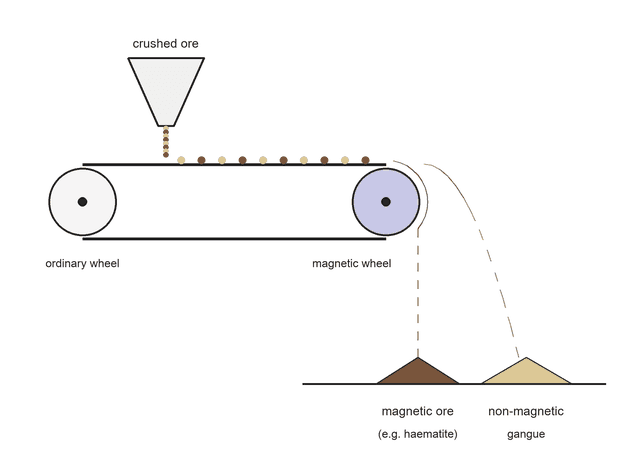
Watch out: Zinc blende is concentrated by froth floatation, not by a magnet.
Therefore, the ore concentrated by magnetic separation is haematite.
- 421 mark
Question 42
The metal whose oxide can be reduced by common reducing agents:
Solve with AIAnswer
- Correct
(A) Copper
(B) Sodium
(C) Aluminium
(D) Potassium
Answer: (A) Copper
Concept: The method used to get a metal from its oxide depends on its place in the activity series: K, Na, Ca, Mg, Al, Zn, Fe, Pb, [H], Cu, Hg, Ag, Au (most reactive first). Oxides of K to Al are too stable for chemical reducing agents, so these metals are obtained by electrolysis of their fused compounds; oxides of Zn to Cu are reduced by carbon, carbon monoxide or hydrogen (zinc oxide by carbon only).
Step 1 — Place each metal.
Potassium, sodium and aluminium are at the top of the activity series; copper is below hydrogen.
Step 2 — Reduce the oxide.
Copper(II) oxide gives up its oxygen easily, so hydrogen (or carbon, or carbon monoxide) reduces it on heating.
Watch out: A LOW place in the activity series means the oxide is EASY to reduce.
Why the other options are wrong:
- (B) Sodium: sodium is very reactive; its oxide is not reduced by common reducing agents, and the metal is obtained by electrolysis of its fused chloride.
- (C) Aluminium: aluminium has a great affinity for oxygen; alumina is reduced by electrolysis, not by carbon or hydrogen.
- (D) Potassium: potassium is the most reactive of these; it too is obtained by electrolysis of a fused compound.
Therefore, the metal whose oxide is reduced by common reducing agents is copper, option (A).
- 431 mark
Question 43
The ore that can be concentrated by using magnetic separation:
Solve with AIAnswer
(A) Corundum
- Correct
(B) Haematite
(C) Calamine
(D) Bauxite
Answer: (B) Haematite
Concept: Magnetic separation is used when the ore and the gangue differ in magnetic properties. The crushed ore falls on a belt running over a magnetic roller: the particles attracted by the magnet cling to the belt and drop close to the roller, while the non-magnetic gangue is thrown farther away.
Step 1 — Find the iron ore.
Corundum (Al₂O₃) and bauxite (Al₂O₃·2H₂O) are ores of aluminium, and calamine (ZnCO₃) is an ore of zinc. Haematite (Fe₂O₃) is the only ore of iron among the options.
Step 2 — Apply magnetic separation.
Iron ores are attracted by a strong magnet while the gangue is not, so haematite drops close to the magnetic roller and the gangue is thrown farther away. (Haematite is weakly magnetic, so a strong magnet is used; magnetite, Fe₃O₄, is strongly magnetic.)
Watch out: Magnetic separation needs an ore that a magnet attracts; aluminium and zinc ores are not attracted.
Why the other options are wrong:
- (A) Corundum: corundum (Al₂O₃) is an aluminium ore and is not attracted by a magnet.
- (C) Calamine: calamine (ZnCO₃) is a zinc ore and is not attracted by a magnet.
- (D) Bauxite: bauxite is not magnetic; it is concentrated by a chemical method (Bayer's process with caustic soda).
Therefore, the ore concentrated by magnetic separation is haematite, option (B).
- 441 mark
Question 44
Complete the following sentences by choosing the correct word(s) from the brackets:
Zinc blende is converted to zinc oxide by ................ [Calcination / Roasting]
Solve with AIWritten solution
Solution:
Concept: Before reduction, ores are changed to oxides by heating below their melting points: calcination (absence or limited supply of air) for carbonate and hydrated ores, and roasting (excess air) for sulphide ores.
Step 1 — Identify the ore type.
Zinc blende is zinc sulphide, ZnS, a sulphide ore, so it is roasted in excess air.
Step 2 — Write the reaction.
The sulphur is burnt off as sulphur dioxide gas and zinc oxide is left.
Each side has 2 Zn, 2 S and 6 O atoms.
Watch out: Calcination (no air) is for carbonates such as calamine, not for sulphides.
Therefore, zinc blende is converted to zinc oxide by roasting.
- 452 marks
Question 45
Answer the following questions with reference to the concentration of bauxite ore.
(a) Name the process used to concentrate the ore.
(b) Give a balanced chemical equation for the conversion of aluminium hydroxide to pure alumina.
Solve with AIWritten solution
Solution:
Concept: Aluminium is extracted in two stages. First, bauxite is purified to alumina (Al₂O₃) by Bayer's process, using concentrated sodium hydroxide. Then the alumina, dissolved in molten cryolite with fluorspar, is reduced to aluminium by electrolysis (Hall–Héroult process).
(a) Process used to concentrate bauxite
Step 1 — Name the process.
Bauxite is concentrated by a chemical method (leaching): Bayer's process, in which the alumina is dissolved in hot concentrated sodium hydroxide and the impurities are filtered off.
(b) Aluminium hydroxide to pure alumina
Step 2 — Write the equation.
The aluminium hydroxide is heated strongly, at about 1000 °C; it loses water and leaves pure alumina.
Each side has 2 Al, 6 O and 6 H atoms.
Watch out: The product of heating is alumina (Al₂O₃), not aluminium.
Therefore, (a) Bayer's process; (b) 2Al(OH)₃ → Al₂O₃ + 3H₂O on heating.
- 461 mark
Question 46
Read the statements given below:
I — Copper is a component in the alloy that is used to make medals. II — Aluminium is used in making the alloy stainless steel. III — Copper is a common component of both duralumin and brass.
Which of the statements are correct?
Solve with AIAnswer
(A) I & II
- Correct
(B) I & III
(C) II & III
(D) I, II & III
Answer: (B) I & III
Concept: An alloy is a homogeneous mixture of two or more metals, or of a metal with a non-metal, made to get useful properties such as greater hardness, lightness, a lower melting point or resistance to corrosion. Check each statement against the compositions: bronze (copper, tin, zinc) is used for medals; stainless steel is iron, chromium, nickel and a little carbon; duralumin is aluminium with copper, magnesium and manganese; brass is copper and zinc.
Step 1 — Test statement I.
Medals are made of bronze, which is about 80% copper. So statement I is true.
Step 2 — Test statement II.
Stainless steel contains iron, chromium, nickel and a little carbon, but no aluminium. So statement II is false.
Step 3 — Test statement III.
Duralumin contains about 4% copper, and brass is 60–70% copper, so copper is common to both. Statement III is true.
Step 4 — Pick the option.
Only statements I and III are correct.
Watch out: Duralumin's copper is only about 4%, but it is still a component.
Why the other options are wrong:
- (A) I & II: statement II is false, since stainless steel has no aluminium.
- (C) II & III: statement II is false, since stainless steel has no aluminium.
- (D) I, II & III: statement II is false, so all three cannot be correct.
Therefore, statements I and III are correct, option (B).
- 471 mark
Question 47
Assertion (A): Hydraulic washing is a method to separate impurities from the ore.
Reason (R): In Hydraulic washing, denser particles float and lighter particles settle down.
Solve with AIAnswer
(A) Both (A) and (R) are true and (R) is the correct explanation of (A).
(B) Both (A) and (R) are true and (R) is not the correct explanation of (A).
- Correct
(C) (A) is true but (R) is false.
(D) (A) is false but (R) is true.
Answer: (C) (A) is true but (R) is false.
Concept: Hydraulic washing (gravity separation) uses the difference in density between ore and gangue: in a stream of water on a sloping, corrugated table the denser ore particles settle in the grooves and the lighter gangue is washed away. In an assertion–reason item, judge A and R separately, then see whether R explains A.
Step 1 — Test the Assertion.
Hydraulic washing does separate the earthy impurities from a heavy ore (it is used for oxide ores such as haematite and tin stone). So the Assertion is true.
Step 2 — Test the Reason.
The Reason says the denser particles float and the lighter ones settle, which is the reverse of what happens: the denser ore settles and the lighter gangue is carried away. So the Reason is false.

Watch out: Read which particles SETTLE: in hydraulic washing it is the heavier ore.
Why the other options are wrong:
- (A) Both (A) and (R) are true and (R) is the correct explanation of (A): This needs both statements true and R to explain A, but the Reason is false.
- (B) Both (A) and (R) are true and (R) is not the correct explanation of (A): This needs both statements true with R not explaining A, but the Reason is false.
- (D) (A) is false but (R) is true: This needs A false and R true, but the Assertion is true.
Therefore, the Assertion is true but the Reason is false, option (C).
- 481 mark
Question 48
Justify the following statements:
Aluminium oxide cannot be reduced by carbon monoxide.
Solve with AIWritten solution
Solution:
Concept: A reducing agent can take oxygen away from a metal oxide only if it holds oxygen more strongly than the metal does.
Step 1 — Place aluminium.
Aluminium is high in the activity series and has a very great affinity for oxygen, so aluminium oxide is a very stable compound.
Step 2 — Compare with carbon monoxide.
Carbon monoxide holds oxygen less strongly than aluminium does, so it cannot remove the oxygen from Al₂O₃.
Step 3 — State how aluminium is obtained.
Aluminium is therefore obtained by the electrolytic reduction of fused alumina, in which the cathode supplies the electrons directly.
Watch out: Carbon monoxide reduces iron oxide but not aluminium oxide: the more reactive the metal, the more stable its oxide.
Therefore, aluminium oxide cannot be reduced by carbon monoxide because aluminium has a greater affinity for oxygen than carbon monoxide does.
- 493 marks
Question 49
Match the uses of alloys in List 1 with the appropriate answer from List 2.
List 1 List 2 (a) Used in making decorative articles. 1. Stainless steel (b) An alloy used in making aircraft and light tools. 2. Brass (c) Used in making surgical Instruments. 3. Duralumin Solve with AIWritten solution
Solution:
Concept: An alloy is a homogeneous mixture of two or more metals, or of a metal with a non-metal, made to get useful properties such as greater hardness, lightness, a lower melting point or resistance to corrosion. Each use matches a property of the alloy.
Step 1 — (a) Decorative articles.
Brass is bright yellow, easily cast and resists corrosion, so (a) matches 2. Brass.
Step 2 — (b) Aircraft and light tools.
Duralumin is light, strong and resists corrosion, so (b) matches 3. Duralumin.
Step 3 — (c) Surgical instruments.
Stainless steel does not rust, resists acids and alkalis and stays hard and bright, so (c) matches 1. Stainless steel.
Alloy Main metal and other constituents One use Duralumin aluminium about 95%, copper 4%, magnesium 0.5%, manganese 0.5% bodies of aircraft Magnalium aluminium with about 5–10% magnesium aircraft parts, light tools, balance beams Stainless steel iron about 73%, chromium 18%, nickel 8%, a very little carbon surgical instruments, cutlery Brass copper 60–70%, zinc 40–30% decorative articles, screws, hardware Bronze copper about 80%, tin 18%, zinc 2% medals, statues, coins Solder (fuse metal) lead 50%, tin 50% joining wires, electric fuses Watch out: Surgical instruments need an alloy that never rusts, which is stainless steel, not brass.
Therefore, (a) – 2 (brass); (b) – 3 (duralumin); (c) – 1 (stainless steel).
- 502 marks
Question 50
Answer the following questions related to the electrolytic reduction of pure Alumina by Hall Heroult’s process.
(a) The reaction occurring at the anode.
(b) The reaction occurring at the cathode.
Solve with AIWritten solution
Solution:
Concept: Fused alumina gives aluminium ions and oxide ions. Oxide ions are oxidised (lose electrons) at the graphite anode; aluminium ions are reduced (gain electrons) at the cathode, the carbon lining.
Step 1 — Write the ions present.
In the molten electrolyte the alumina is split into ions.
(a) Reaction at the anode
Step 2 — Oxidation of oxide ions.
The oxide ions move to the anode and lose electrons, forming oxygen atoms, which join to form oxygen gas.
The oxygen then burns the hot graphite anode, which is why the anodes are replaced from time to time.
(b) Reaction at the cathode
Step 3 — Reduction of aluminium ions.
The aluminium ions move to the cathode and each gains three electrons.
Watch out: The electrons lost at the anode (12) equal the electrons gained at the cathode (12).
Therefore, (a) at the anode: 6O²⁻ − 12e⁻ → 6[O], then 6[O] → 3O₂; (b) at the cathode: 4Al³⁺ + 12e⁻ → 4Al.
- 512 marks
Question 51
Give the chemical formula of the following ores:
(a) Cryolite
(b) Haematite
Solve with AIWritten solution
Solution:
Concept: Cryolite is sodium aluminium fluoride, an ore of aluminium; haematite is iron(III) oxide (anhydrous ferric oxide), an ore of iron.
Step 1 — Cryolite.
Three Na⁺ and one Al³⁺ (total +6) are balanced by six F⁻ (total −6), so cryolite is .
Step 2 — Haematite.
Two Fe³⁺ (total +6) are balanced by three O²⁻ (total −6), so haematite is .
Watch out: Do not confuse haematite (Fe₂O₃) with magnetite (Fe₃O₄).
Therefore, (a) cryolite is Na₃AlF₆; (b) haematite is Fe₂O₃.
- 521 mark
Question 52
In the electrolysis of molten aluminium oxide for extraction of aluminium, the following reactions take place:
The reaction that takes place at the negative electrode is:
Solve with AIAnswer
- Correct
(A) 1
(B) 2
(C) 3
(D) 4
Answer: (A) 1
Concept: The negative electrode is the cathode. Positive ions move to it and gain electrons there (reduction).
Step 1 — Find the positive ions.
In molten aluminium oxide the positive ions are Al³⁺, so they go to the negative electrode.
Step 2 — Pick the reaction.
At the cathode each Al³⁺ ion gains three electrons, which is reaction 1.
Watch out: Electrons appear on the LEFT (gained) at the cathode and on the right (lost) at the anode.
Why the other options are wrong:
- (B) 2: reaction 2 is a loss of electrons by oxide ions, which happens at the anode (positive electrode).
- (C) 3: reaction 3 is the burning of the graphite anode by the oxygen set free there, again at the anode.
- (D) 4: reaction 4 is the splitting of alumina into ions in the melt; it is not an electrode reaction.
Therefore, the reaction at the negative electrode is reaction 1, option (A).
-
- 532 marks
Question 53
Bauxite is the principal ore used in the commercial extraction of aluminium. The Bayer's process is used to refine bauxite into pure alumina, with caustic soda playing a crucial role in the initial stage of the process.
Based on this, answer the following questions:
(a) Explain the reason behind the addition of caustic soda during the Bayer's process.
(b) Write a balanced chemical equation representing the reaction between bauxite and caustic soda during the Bayer's process.
Solve with AIWritten solution
Solution:
Concept: Alumina is amphoteric, so it dissolves in caustic soda; the impurities in bauxite (iron(III) oxide, sand) do not.
(a) Why caustic soda is added
Step 1 — Explain the reason.
Caustic soda (sodium hydroxide) dissolves the aluminium oxide of bauxite, because aluminium oxide is amphoteric, and forms soluble sodium meta aluminate. The impurities, iron(III) oxide and sand, do not dissolve; they are left as red mud and removed by filtration. In this way the alumina is separated from the gangue.
(b) Reaction between bauxite and caustic soda
Step 2 — Write the equation.
Powdered bauxite is heated with concentrated sodium hydroxide at 140–150 °C under pressure.
Each side has 2 Na, 2 Al, 7 O and 6 H atoms.
Watch out: The alkali dissolves the ALUMINA; the impurities are what is left behind.
Therefore, (a) caustic soda dissolves the amphoteric alumina as sodium meta aluminate, leaving the impurities behind; (b) Al₂O₃·2H₂O + 2NaOH → 2NaAlO₂ + 3H₂O.
- 541 mark
Question 54
The process of dressing (purification) of the ore which involves separation of ore from gangue due to preferential wetting is:
Solve with AIAnswer
(A) Magnetic Separation
(B) Hydrolytic method
- Correct
(C) Froth flotation method
(D) Chemical method
Answer: (C) Froth flotation method
Concept: Froth floatation concentrates sulphide ores. It works on preferential wetting: the ore particles are wetted by oil (pine oil) and the gangue particles are wetted by water.
Step 1 — Read the clue.
The question describes separation by preferential wetting, which is exactly the principle of froth floatation.
Step 2 — See how it works.
The ore particles, wetted by pine oil, stick to air bubbles and rise into the froth; the gangue, wetted by water, sinks. Sulphide ores such as zinc blende and galena are concentrated this way.
Watch out: Froth floatation works on wetting, not on density.
Why the other options are wrong:
- (A) Magnetic Separation: magnetic separation works on the magnetic properties of the ore, not on wetting.
- (B) Hydrolytic method: no concentration method of this name is used; the water-based method, hydraulic washing, works on the difference in density, not on wetting.
- (D) Chemical method: the chemical method (leaching) dissolves the ore in a suitable reagent, as in Bayer's process.
Therefore, the process based on preferential wetting is the froth flotation method, option (C).
- 551 mark
Question 55
Choose the answer from the list of compounds given below:
sodium bisulphite, ferric oxide, iron (II) chloride, sodium sulphate, aluminium oxide
A compound which is a major constituent of bauxite.
Solve with AIWritten solution
Solution:
Concept: Bauxite is hydrated aluminium oxide, Al₂O₃·2H₂O, so its major constituent is aluminium oxide.
Step 1 — Find the share of aluminium oxide.
In the formula Al₂O₃·2H₂O, the aluminium oxide part has a mass of 102 (2 × 27 + 3 × 16) and the water 36 (2 × 18), so aluminium oxide is the larger part.
Step 2 — Rule out the others.
Ferric oxide is present in bauxite only as an impurity (it ends up in the red mud); the other compounds in the list are not in bauxite.
Watch out: Iron(III) oxide is IN bauxite, but only as an impurity, not its major constituent.
Therefore, the major constituent of bauxite is aluminium oxide.
- 563 marks
Question 56
State true or false for the following statements:
(a) Brass is an alloy which contains a non-metal as one of its constituents.
(b) Duralumin contains copper.
(c) Vapour density of gas is twice its molecular mass.
Solve with AIWritten solution
Solution:
Concept: Brass and duralumin are judged from their compositions; vapour density is related to molecular mass by molecular mass = 2 × vapour density.
(a)
Step 1 — Check brass.
Brass is copper (60–70%) and zinc (40–30%). Both are metals, so brass has no non-metal in it. The statement is false. (Steel is an alloy that does contain a non-metal, carbon.)
(b)
Step 2 — Check duralumin.
Duralumin is aluminium about 95% with copper about 4%, magnesium and manganese. It does contain copper, so the statement is true.
(c)
Step 3 — Check the vapour-density relation.
Vapour density is the mass of a volume of the gas divided by the mass of the same volume of hydrogen, so it is HALF the molecular mass, not twice it.
For example, carbon dioxide (molecular mass 44) has a vapour density of 22. The statement is false.
Watch out: In (c) the relation is the other way round: the MOLECULAR MASS is twice the vapour density.
Therefore, (a) false; (b) true; (c) false.
- 574 marks
Question 57
The following sketch illustrates the process of conversion of Alumina to Aluminum. Study the diagram and answer the following:

(a) Name the constituent of the electrolyte mixture which has a divalent metal in it.
(b) Write the reactions taking place at the electrodes:
(1) Y (anode) and
(2) Z (cathode) respectively.
(c) Give one use of sprinkling coke on the electrolyte.
Solve with AIWritten solution
Solution:
Concept: In the Hall–Héroult cell the electrolyte is a fused mixture of alumina (about 20%), cryolite, Na₃AlF₆ (about 60%) and fluorspar, CaF₂ (about 20%), kept at about 950 °C. Thick graphite rods dipping into it are the anodes (+), and the carbon lining of the steel tank is the cathode (−). The sketch shows this cell: Y are the graphite anodes joined to the + terminal, Z is the carbon lining joined to the − terminal, and coke is sprinkled on the surface of the electrolyte.
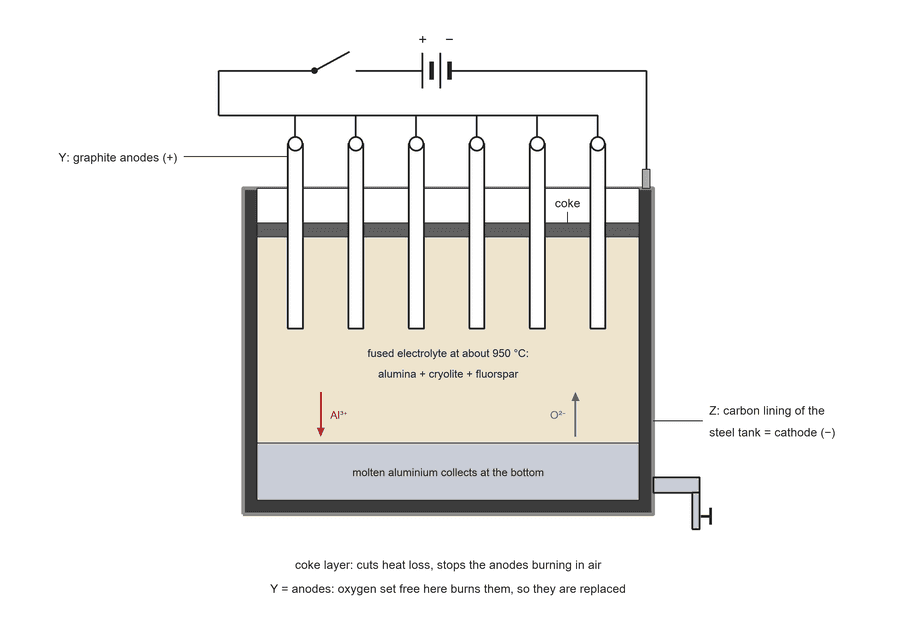
(a) Constituent with a divalent metal
Step 1 — Check the valency of each metal.
Alumina contains Al³⁺ (trivalent) and cryolite Na₃AlF₆ contains Na⁺ (monovalent) and Al³⁺. Fluorspar, CaF₂, contains Ca²⁺, which is divalent.
So the constituent is fluorspar, CaF₂.
(b) Reactions at the electrodes
Step 2 — Write the ions present.
In the molten electrolyte the alumina is split into ions.
Step 3 — (1) At Y, the anode.
The oxide ions lose electrons at the anode, forming oxygen atoms and then oxygen gas.
Step 4 — (2) At Z, the cathode.
The aluminium ions gain electrons at the cathode, forming molten aluminium.
(c) Use of sprinkling coke
Step 5 — Give a use.
The layer of powdered coke reduces the loss of heat by radiation from the surface of the electrolyte. It also prevents the hot graphite anodes from burning in the air.
Watch out: Y is joined to the + terminal, so it is the anode where oxide ions LOSE electrons.
Therefore, (a) fluorspar, CaF₂; (b) at Y: 6O²⁻ − 12e⁻ → 6[O], then 6[O] → 3O₂; at Z: 4Al³⁺ + 12e⁻ → 4Al; (c) the coke layer reduces heat loss by radiation (and stops the anodes burning in air).