Solution:
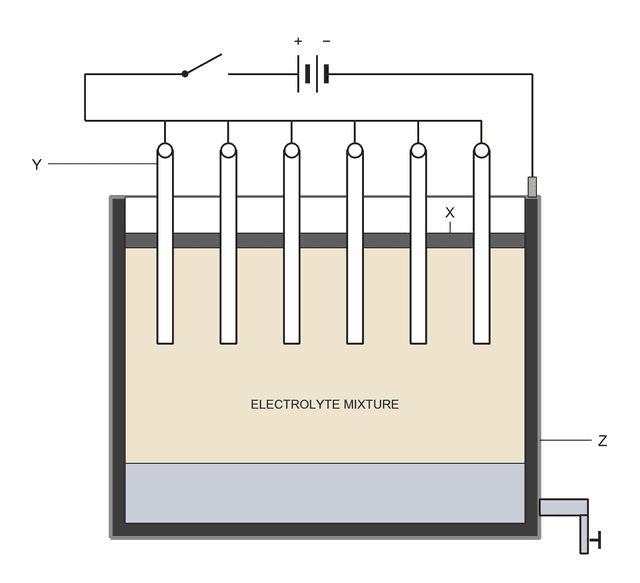
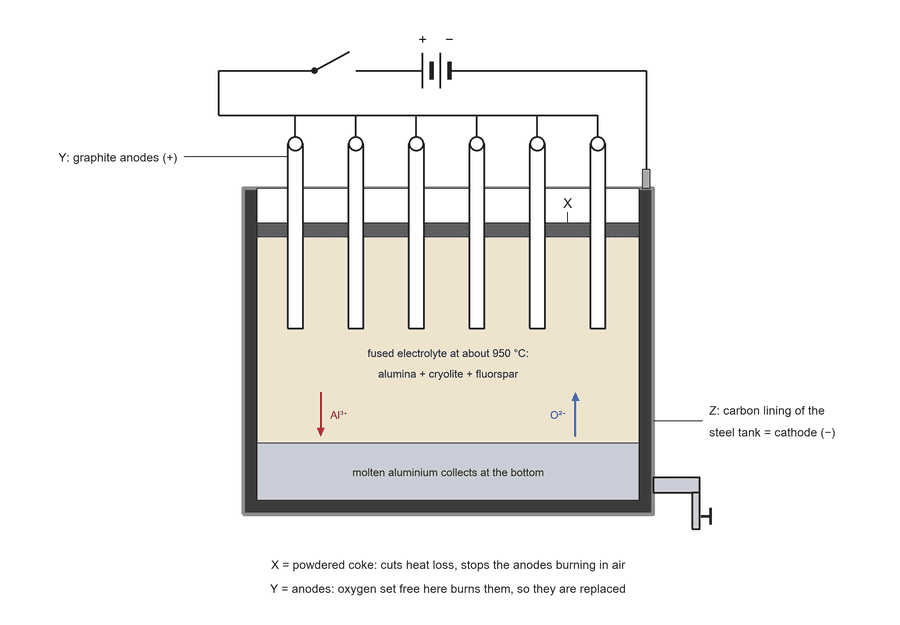
Concept: In the Hall–Héroult cell the electrolyte is a fused mixture of alumina (about 20%), cryolite, Na₃AlF₆ (about 60%) and fluorspar, CaF₂ (about 20%), kept at about 950 °C. Thick graphite rods dipping into it are the anodes (+), and the carbon lining of the steel tank is the cathode (−). The sketch shows this cell: Y are the graphite anodes joined to the + terminal, Z is the carbon lining joined to the − terminal, and X is the powdered layer on the surface of the electrolyte.
(a) Constituent with a divalent metal
Step 1 — Check the valency of each metal.
The electrolyte is alumina (Al³⁺, trivalent), cryolite Na₃AlF₆ (Na⁺, monovalent, and Al³⁺) and fluorspar CaF₂. Calcium forms Ca²⁺ ions, so it is divalent.
CaF2⇌Ca2++2F−
So the constituent with a divalent metal is fluorspar, CaF₂.
(b) The powdered substance X
Step 2 — Name X.
The layer sprinkled on the surface of the electrolyte is powdered coke. It reduces the loss of heat by radiation and stops the anodes burning in air.
(c) Name of the process
Step 3 — Name the process.
The electrolytic reduction of fused alumina to aluminium is the Hall–Héroult process.
(d) Reactions at the electrodes
Step 4 — Write the ions present.
In the molten electrolyte, alumina is split into aluminium ions and oxide ions.
Al2O3⇌2Al3++3O2−
Step 5 — Reaction at Y (anode).
The negative oxide ions move to the anode, lose electrons and form oxygen atoms, which join to form oxygen gas.
6O2−−12e−→6[O]
6[O]→3O2↑
This oxygen attacks the hot graphite anodes (forming CO₂ and some CO), so they are replaced from time to time.
Step 6 — Reaction at Z (cathode).
The positive aluminium ions move to the cathode and gain electrons, forming molten aluminium, which collects at the bottom.
4Al3++12e−→4Al
Watch out: The anode reaction is a LOSS of electrons (oxidation) and the cathode reaction a GAIN of electrons (reduction).
Therefore, (a) fluorspar, CaF₂; (b) X is powdered coke; (c) the Hall–Héroult process; (d) at Y: 6O²⁻ − 12e⁻ → 6[O], then 6[O] → 3O₂; at Z: 4Al³⁺ + 12e⁻ → 4Al.